

Longi Solar vs JA Solar 550W panel comparison
Neither brand is automatically better: panels from mainstream manufacturers with the same wattage produce within 2-3% of each other under real-world conditions. A Longi Solar vs JA Solar 550W panel comparison therefore comes down to the exact model, its warranty, technology and performance in your system.
Focusing on wattage makes sense, but that figure alone won’t tell you how a panel responds to heat or what its warranty covers. Cell technology, the exact model and your roof conditions matter too.
This comparison looks at LONGi and JA Solar warranties, PERC and N-type cells, HPBC technology, temperature coefficients, and back-contact versus TOPCon designs. Use these practical criteria to compare specifications, rather than choosing by brand name alone.
The sections ahead compare technologies and performance factors relevant to South African conditions, then offer a guide to matching a panel to your roof and system requirements.
Key Takeaways
- Compare the exact panel models, not just the brands or wattage; same-wattage panels can perform similarly in real-world conditions.
- Separate product warranty from performance warranty, then compare the terms for the specific module you’re considering.
- Learn how PERC, N-type TOPCon and LONGi’s HPDC technology differ, and what back-contact design means for panel selection.
- Use temperature coefficients to assess how panel output responds to heat, a relevant factor for South African installations.
- Match the panel technology and specifications to your roof and system requirements rather than looking for a universal brand winner.
JA Solar vs Longi Panels: Which Is Better in 2026?
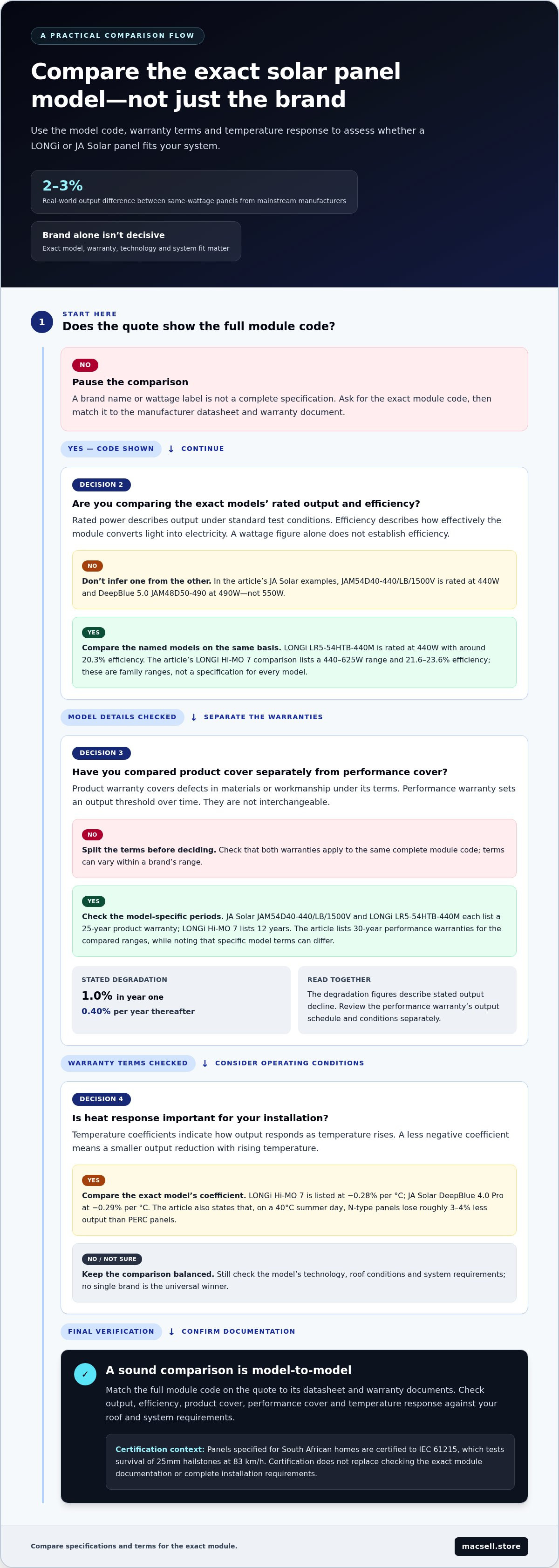
Neither brand leads on every specification. Compare rated power and module efficiency separately, then consider temperature response and the exact model.
JA Solar Efficiency and Power Output
JA Solar panel efficiency varies by model, so check the specifications for the exact module. That figure describes how effectively a module converts light into electricity; rated power describes output under standard test conditions. A 550W rating alone cannot establish a panel’s efficiency, because panel area and the exact model also matter.
For the JA Solar JAM54D40-440/LB/1500V, the listed rated output is 440W, not 550W. JA Solar DeepBlue 4.0 Pro has a temperature coefficient of −0.29% per °C. A lower light-level result cannot be inferred from efficiency alone, so assess it separately for the specific module.
LONGi Efficiency and Power Output
Specifications can vary across LONGi Hi-MO 7 models and markets, so check the exact module before comparing. In the South African comparison, LONGi Hi-MO panels range from 580W to 610W, with efficiencies of 22.0-22.6%. These are product-family ranges, not a specification for every LONGi model.
The LONGi LR5-54HTB-440M is rated at 440W and has an efficiency of around 20.3%. Hi-MO 7’s temperature coefficient is −0.28% per °C, slightly less negative than DeepBlue 4.0 Pro’s −0.29% per °C. These figures describe named models, not every panel from either brand.
Independent Tests and Customer Reviews
Kiwa PVEL’s 2026 Module Reliability Scorecard found that 87% of manufacturers had at least one test failure. That result is industry-wide, not a LONGi-versus-JA Solar ranking. Customer reviews also need context: feedback about one model or installation cannot establish the performance of every module in a brand’s range.
For a Longi Solar vs JA Solar 550W panel comparison, value depends on the exact model, efficiency, temperature performance and system fit. A current South African price cannot be compared reliably from brand names alone; assess the same wattage and specification on the same basis.
Available JA Solar 550W Models
The JA Solar model examples in this comparison are the JAM54D40-440/LB/1500V and DeepBlue 5.0 JAM48D50-490. Their model codes identify rated outputs of 440W and 490W, respectively, rather than 550W. A model code matters because specifications differ across product families and power classes.
Use the exact module code on a South African quote to find the matching manufacturer datasheet. That way, you won’t mistake a product-family name or wattage label for the full model specification.
| Brand option | Power range or example | Efficiency | Temperature coefficient |
|---|---|---|---|
| LONGi Hi-MO 7 | 440-625W | 21.6-23.6% | −0.28% per °C |
| JA Solar panels in comparison | 440W and 490W examples | 21.0-21.8% | DeepBlue 4.0 Pro: −0.29% per °C |
Choose by matching the exact module’s efficiency, temperature response and rated output to your installation, rather than selecting by brand alone.
Product and performance warranties
Warranty terms vary by model, even within LONGi and JA Solar ranges. Compare product cover, performance cover and degradation figures separately.
Product Warranty Terms
A product warranty covers defects in materials or workmanship under its stated terms. The JA Solar JAM54D40-440/LB/1500V and LONGi LR5-54HTB-440M each have a 25-year product warranty. By comparison, LONGi Hi-MO 7 has a listed product warranty of 12 years. These examples show why brand alone isn’t enough: the exact model can change the warranty period.
Dimensions also vary by module. The JA Solar JAM54D40-440/LB/1500V measures 1762 x 1134 x 30 mm, while the LONGi LR5-54HTB-440M measures 1722 x 1134 x 30 mm. Module weight depends on its construction, including frame and glass design. JA Solar DeepBlue 4.0 Pro uses N-type TOPCon cells, while LONGi Hi-MO 7 uses HPDC technology.
Performance Warranties and Degradation
A performance warranty sets an output threshold over time; it differs from cover for manufacturing defects. LONGi Hi-MO 7 has a listed performance warranty of 30 years. The listed JA Solar and LONGi ranges carry 30-year performance warranties and 12-year product warranties, although specific models can have different product terms.
Both compared panels have a first-year degradation rate of 1.0%, followed by annual degradation of 0.40% per year. Those figures describe the stated output decline, not product defects. Read the performance warranty’s output schedule alongside its conditions, because the warranty and degradation rate serve different purposes.
Heat matters in South Africa. On a 40°C summer day, N-type panels are stated to lose roughly 3-4% less output than PERC panels. LONGi Hi-MO 7’s temperature coefficient is −0.28% per °C; JA Solar DeepBlue 4.0 Pro’s is −0.29% per °C. A less negative coefficient indicates a smaller output reduction as temperature rises.
Certification and Warranty Verification
Panels specified for South African homes are certified to IEC 61215, which tests survival of 25mm hailstones at 83 km/h. Certification is a test standard, not a substitute for checking the exact module documentation and the requirements for the complete installation.
For model and warranty verification, match the complete module code on the quote against that model’s manufacturer datasheet and warranty document. Check that the quoted product warranty and performance warranty correspond to the same code. For example, don’t apply Hi-MO 7’s 12-year product warranty to the LR5-54HTB-440M, which has a 25-year product warranty.
Compare relevant solar panels by model and warranty terms, rather than treating a brand name as a complete specification.
Panel technology, including PERC, N-Type, and HPBC
Cell architecture affects efficiency, degradation and heat response, but each brand’s range can include different designs. Compare the technology listed for the exact module, not just the manufacturer.
Mono PERC adds a passivation layer to the rear of a cell, helping reflect some light back through the silicon. It remains a familiar design in solar modules, including older product ranges. The technology comparison lists annual degradation of about 0.55% for Mono PERC, compared with about 0.4% per year for N-type TOPCon. Those are technology-level figures, not a substitute for an individual model’s warranty terms.
N-type TOPCon uses a passivated contact structure and is used by JA Solar DeepBlue 4.0 Pro. In the South African market, N-type TOPCon panels account for over 75% of new panel shipments. That broad adoption makes TOPCon common in current residential and commercial comparisons, but it doesn’t make every TOPCon module identical in output or construction.
LONGi’s Hi-MO range includes several module designs, so the family name alone doesn’t identify its cell architecture. Hi-MO 7 uses HPDC technology. This distinction matters: HPDC and HPBC are different technology labels, and they shouldn’t be treated as interchangeable when reading a datasheet or quotation.
HPBC describes a back-contact cell approach associated with LONGi. Back-contact cells move electrical contacts to the rear, leaving the front surface less obstructed by metal lines. LONGi’s back-contact panels accounted for 66% of its shipments in early 2026. That shipment figure describes the manufacturer’s portfolio, not the share of every Hi-MO model or the performance of an individual installation.
If roof space is limited, module efficiency is a useful comparison because it relates power output to panel area. A higher-efficiency module can provide more rated power for a given area, depending on its dimensions and layout. Before comparing models for a home, measure usable roof space around edges, obstructions and shaded areas. Commercial layouts may allow more flexibility in row spacing and orientation.
Use this practical sequence to distinguish the technologies:
- Match the full model code to the manufacturer’s datasheet.
- Identify whether the module uses PERC, N-type TOPCon, HPDC or a back-contact design.
- Compare efficiency, degradation and dimensions for those exact models.
For a South African installation, the right choice depends on roof area, system design and the exact module specifications, not technology terminology alone.
Temperature coefficient
Temperature coefficients show how a module’s electrical performance changes as cell temperature rises. For South African installations, compare the coefficient for the exact model, since LONGi and JA Solar ranges include different panels.
Panel Temperature Coefficients
LONGi Hi-MO 7 has a temperature coefficient of −0.28% per °C, compared with −0.29% per °C for JA Solar DeepBlue 4.0 Pro. The less negative LONGi figure indicates a slightly smaller power reduction for each degree of temperature rise. The difference is modest, so assess it alongside rated power, efficiency and the system design.
Check which coefficient the datasheet gives. For example, the JA Solar JAM54D40-440/LB/1500V lists a short-circuit current coefficient of +0.046%/°C and an open-circuit voltage coefficient of −0.26%/°C. LONGi LR5-54HTB-440M lists +0.05%/℃ for short-circuit current. These current and voltage values are not the same as a power temperature coefficient.
Temperature Coefficient in Summer Heat
On a 40°C summer day in South Africa, N-type panels are stated to lose roughly 3-4% less output than PERC panels. This compares cell technologies, rather than guaranteeing that every N-type model will outperform every PERC model. For a specific choice, use the named panel’s coefficient and technology together.
Ambient temperature alone doesn’t determine panel temperature. Sun exposure, airflow beneath the modules, mounting and roof conditions all affect cell temperature. A coefficient describes the change in performance with temperature; it doesn’t predict daily output or account for shading and orientation.
Apply the coefficient to your installation with these steps:
- Match the full module code to its datasheet, such as Hi-MO 7 or DeepBlue 4.0 Pro.
- Compare the same type of coefficient for both panels, especially power coefficients.
- Consider roof exposure and mounting, as well as the local summer climate.
- Assess module electrical characteristics alongside inverter input limits and system design.
A higher-efficiency module may use roof space effectively, but efficiency and temperature coefficient measure different things. The first relates power to panel area; the second describes temperature-related change. For example, LONGi Hi-MO 7’s −0.28% per °C and JA Solar DeepBlue 4.0 Pro’s −0.29% per °C help compare heat response, but neither figure alone identifies the best panel for every roof.
For a South African home or commercial installation, compare the exact model datasheets with the inverter’s compatible operating range. Treat a small difference in temperature coefficient as one factor, alongside roof layout, rated output and system operating conditions.
Choosing between back-contact and TOPCon
Back-contact and TOPCon refer to different cell designs, not a simple ranking of panel quality. Compare the exact module’s cell technology, datasheet specifications and system fit before choosing between LONGi and JA Solar.
What back-contact design changes
Back-contact cells place electrical contacts on the rear, leaving the front surface less obstructed by metal conductors. This can make efficient use of the cell’s front area, but the complete module design determines its rated power and efficiency.
LONGi’s technology names need careful reading. Hi-MO 7 uses HPDC cell technology, while HPBC is a distinct back-contact technology label. Don’t assume that every Hi-MO panel uses HPBC, or that a panel described as back-contact has the same specifications as Hi-MO 7.
Back-contact panels accounted for 66% of LONGi’s shipments in early 2026. That figure describes LONGi’s shipment mix, not the performance of every LONGi model. For roof-space decisions, compare each module’s dimensions and efficiency with the usable roof area and layout.
What TOPCon offers
JA Solar DeepBlue 4.0 Pro uses N-type TOPCon cell technology. TOPCon uses a passivated contact structure, and the technology-level annual degradation figure is about 0.4%. The stated guaranteed output floor for TOPCon panels is about 89.4% of original output at year 25. Model-specific warranty terms remain important alongside these technology figures.
N-type TOPCon panels account for over 75% of new panel shipments to South Africa. This makes TOPCon a common option in current local comparisons, but adoption alone doesn’t establish which module suits a particular home or commercial system.
Use the manufacturer’s datasheet to compare the modules you’re considering. Focus on these points:
- Confirm the exact model code and stated cell technology.
- Compare rated power, efficiency, dimensions and temperature coefficient.
- Match electrical specifications with the inverter and planned system design.
- Review the model’s warranty terms separately from technology-level degradation figures.
A back-contact design may be worth comparing when roof space is limited and module efficiency matters. TOPCon may suit buyers prioritising an established N-type technology and its stated degradation profile. Neither label determines the maximum output of every panel; rated power and efficiency depend on the individual model.
For a practical shortlist, compare solar panel options by model code, datasheet and system requirements, rather than choosing by technology name alone.
MacSell Solar Outlet: Sunsynk 8KVA & 2X Hubble AM2 5.5 KWh Combo Kit
MacSell Solar Outlet is a practical next step once you’ve compared panel technologies and narrowed down your system requirements. Its Solar Panels offering supports readers choosing modules, while Hybrid Inverters and Lithium Batteries help build out the wider solar power system.
For a packaged hardware option, the Sunsynk 8KVA & 2X Hubble AM2 5.5 KWh Combo Kit brings together a hybrid inverter and battery storage. Consider panel selection alongside the system components and their specifications, rather than treating wattage or cell technology as the only decision.
Explore the hardware range and visit macsell.store to contact MacSell Solar Outlet.
Turn your panel shortlist into a system decision
Turn your shortlist into a system decision. A panel must suit your roof and fit the wider design, so assess it alongside the inverter and how you’ll use the system. This keeps your choice grounded in practical requirements rather than a single headline specification.
Use a Longi Solar vs JA Solar 550W panel comparison to narrow the options, then make the final selection against your own project priorities. Decide which trade-offs matter most, such as roof-space use, heat response or warranty structure. If your requirements change, revisit the shortlist rather than assuming one brand is always the better fit.
MacSell Solar Outlet can help you take the next step with solar hardware for your system requirements. Contact MacSell Solar Outlet today to discuss your solar hardware needs and move forward with a clear shortlist.
Frequently Asked Questions
Performance Metrics: Which Panel Outperforms?
Neither brand is a universal winner; the exact model and system design determine the better fit. For example, LONGi Hi-MO 7 has a −0.28% per °C temperature coefficient, compared with −0.29% per °C for JA Solar DeepBlue 4.0 Pro. Compare panels at the same rated wattage, then consider usable roof area, orientation, shading and inverter compatibility before judging expected output.
Should I pay more for a premium panel?
Paying more makes sense only when a specific panel’s advantages address a real project constraint. On a roof with limited usable area, higher module efficiency may help fit more rated power into the available space. If space is ample, compare the system design, warranty terms and heat response instead. A premium label alone doesn’t establish better value for your home or business.
What are the datasheet specifications of comparable LONGi and JA Solar 550W panels?
The model examples detailed here are rated at 440W, so they aren’t a matched 550W pair. JA Solar JAM54D40-440/LB/1500V measures 1762 x 1134 x 30 mm, with 38.9V open-circuit voltage, 32.47V maximum power voltage and 13.55A maximum power current. LONGi LR5-54HTB-440M measures 1722 x 1134 x 30 mm; its corresponding values are 39.83V, 33.56V and 13.12A.
How do LONGi and JA Solar 550W panels perform in South Africa’s climate and high temperatures?
Both brands offer models with temperature characteristics relevant to South African conditions, but compare the exact panel datasheets. LONGi Hi-MO 7’s temperature coefficient is −0.28% per °C; JA Solar DeepBlue 4.0 Pro’s is −0.29% per °C. N-type panels are stated to lose roughly 3-4% less output than PERC panels on a 40°C summer day. Roof exposure and airflow also affect operating temperature.
What are the dimensions, weight, cell technology, and warranty terms of each panel?
The JA Solar JAM54D40-440/LB/1500V measures 1762 x 1134 x 30 mm and has a 25-year product warranty; JA Solar DeepBlue 4.0 Pro uses N-type TOPCon cells. The LONGi LR5-54HTB-440M measures 1722 x 1134 x 30 mm and has a 25-year product warranty; LONGi Hi-MO 7 uses HPDC technology. The article gives no weight figures.