

Premium vs budget hybrid inverters in South Africa: 2026
A budget inverter can be the better buy, even when a premium model has a longer feature list. The premium hybrid inverter vs budget inverter South Africa decision depends on what your household needs from the system, not just the headline kVA rating or brand reputation. Useful performance depends on the inverter’s operating limits and how well it works with the battery and solar panels.
It’s sensible to ask whether extra features justify a higher investment, especially if your household won’t use them. The reverse is also true: choosing on purchase price alone could leave a system short of the capacity, monitoring or compatibility it needs. Matching the inverter and lithium battery specifications is essential to a well-planned system.
This comparison explains how to assess output, system requirements, battery compatibility and compliance considerations in South Africa. It looks at where premium features can add value, when a budget option may be sufficient, and how to compare brands such as Sunsynk, LuxPower and Deye without treating a brand label as a performance guarantee. The aim is to help you choose for your household’s loads and plans, rather than paying for unused features or relying on headline claims.
Key Takeaways
- Compare inverter specifications with the loads you need to run, not just headline ratings or “premium” and “budget” labels.
- Assess the premium hybrid inverter vs budget inverter South Africa choice by the features your household will actually use.
- Match battery voltage, communication protocols and operating limits to the inverter for a compatible system.
- Use a practical checklist covering current and future loads, battery choice, solar inputs and expansion plans.
- Compare Sunsynk, LuxPower and Deye by their documented model specifications and system fit, rather than assuming a brand determines its tier.
Premium hybrid inverter vs budget inverter in South Africa: what actually differs?
A hybrid inverter manages electricity from solar panels, a battery and the grid, directing power to household loads according to the system configuration. This allows one unit to support solar use, battery charging and backup operation. For a concise primer on inverter fundamentals, see Understanding Solar Inverters.
“Premium” and “budget” are market labels, not technical standards. A higher price or brand position doesn’t automatically mean greater efficiency, better reliability or a better fit. Compare specific models using their current manufacturer datasheets. In South Africa, grid-interactive equipment also needs to meet applicable requirements, including NRS 097-2-1:2024 for small-scale embedded generation connections.
| Compare | What to record for each model |
|---|---|
| AC output | Continuous output rating and surge capacity, with stated operating conditions |
| Phase configuration | Single-phase or three-phase output and supported system arrangement |
| Solar input | Maximum PV input, MPPT details and operating voltage range |
| Battery | Supported voltage, charging capability and documented communication options |
| Controls and modes | Monitoring, settings, backup behaviour and grid-interaction functions |
Which inverter specifications matter beyond the headline kW rating?
Continuous output is the power the inverter can supply on an ongoing basis within its stated conditions. Surge capacity is a temporary higher output that can help start equipment with a brief power demand, such as a motor. Phase configuration describes how AC power is supplied and must suit the household’s electrical setup and loads.
These specifications differ from PV input, which describes the solar array the inverter can accept, and battery charging capability, which describes how it charges the battery. Compare equivalent values, units and operating conditions rather than relying on a single kW or kVA figure.
What can a premium inverter offer that a budget model may not?
Differences may include monitoring detail, interface design, configurable settings and documented operating modes. Expansion options, such as supported parallel operation, also vary by model. Count these only when the model documentation states they are supported. Such features matter when they answer a real need, for example, setting backup priorities, seeing system data more clearly or planning a capacity change.
Weigh those functions against your grid connection and backup priorities. A household focused on essential circuits may value different capabilities from one planning broader backup. The premium hybrid inverter vs budget inverter South Africa decision is a model-and-system comparison, not a shortcut based on tier labels.
How inverter and system compatibility shape performance in South Africa
An inverter’s capabilities translate into useful household power only when they match the loads, battery and solar array. Start by listing what must stay on during an outage, then consider which appliances might run at the same time. A system intended to supply lights, a router and selected plugs has different demands from one expected to support high-demand appliances as well.
Eskom supply conditions and possible load-shedding are planning considerations, not a promise of uninterrupted power. Backup depends on the complete system and how it’s used. A load profile, including appliance power and typical operating times, helps separate the inverter output needed from the battery capacity needed for energy storage. It can guide sizing, but it cannot establish a guaranteed backup duration.
Will a premium inverter work with every lithium battery?
No. Compatibility depends on more than matching voltage. Confirm that the battery voltage falls within the inverter’s supported range, then check both manufacturers’ documentation for supported battery configurations and communication protocols. A cable connection may allow power to flow, but that alone doesn’t show that the inverter and battery can exchange status data or coordinate charging and protection controls.
Check the current documentation for both components, including operating limits and stated communication requirements. The lithium battery and inverter compatibility guide provides further context for evaluating the pairing.
How should South African buyers assess loads and backup priorities?
Separate essential circuits from high-demand appliances. Note which devices need backup, their power requirements and whether they’re likely to run together. A kettle, pump or other high-demand appliance can significantly change the combined load, even if it runs only briefly. Compare simultaneous demand with the inverter’s continuous output and documented surge capacity.
Battery choice matters too. Its voltage, communication capability and power limits must suit the inverter and intended loads. Review the home inverter and battery combo guide for broader system-planning context.
For the premium hybrid inverter vs budget inverter South Africa comparison, compatibility and load fit are stronger decision criteria than tier labels. A premium feature has practical value only if it addresses a defined need. MacSell Solar Outlet’s hybrid inverter range includes Sunsynk, LuxPower and Deye options to compare alongside lithium batteries and solar panels.
Premium vs budget hybrid inverter: compare value, not just purchase price
Purchase price is only one part of the comparison. Assess it alongside documented features, compatibility with the battery and solar inputs, and any expansion capability you genuinely plan to use. This keeps the decision grounded in system requirements rather than brand positioning or a long list of features.
A simple comparison can show what the extra investment is intended to deliver:
- Purchase price: Compare the specific inverter models under consideration.
- Documented features: Identify the controls, monitoring and operating modes relevant to your system.
- Compatibility: Check the inverter’s stated requirements against the selected battery and solar array.
- Expansion: Count future flexibility only if the manufacturer documents the required configuration and it fits your plans.
Don’t treat these factors as interchangeable. A lower purchase price doesn’t show that a unit suits your system, and a feature-rich inverter isn’t automatically better value if you won’t use those features. For more selection criteria, read the hybrid inverter buying guide for South Africa.
When can a budget hybrid inverter be the practical choice?
A budget model may suit a straightforward system with clearly defined loads and no specific need for advanced controls or additional operating modes. Its documented battery support, solar inputs and output limits still need to match the planned setup. This is a choice based on requirements, not price alone: the model must meet the needs you’ve set for your household.
If the specifications align and the simpler feature set covers the intended use, paying for options that won’t affect daily operation may add little practical value. Compare each model’s details in its current manufacturer documentation.
When might premium features justify the higher investment?
Additional features can make sense when they solve a defined problem. More configurable controls may help if the household needs particular operating priorities. Documented expansion capability may matter if it supports a planned system change. Monitoring features are useful when someone will use the information to understand or manage system behaviour.
Frame the decision practically: what requirement does the feature address, who will use it, and what trade-off does it involve? That gives household decision-makers a clearer basis for comparing options than a premium label or an assumed payback. The premium hybrid inverter vs budget inverter South Africa question is ultimately about paying for capabilities that fit the system. Explore hybrid inverter options alongside the battery and solar components in your plan.
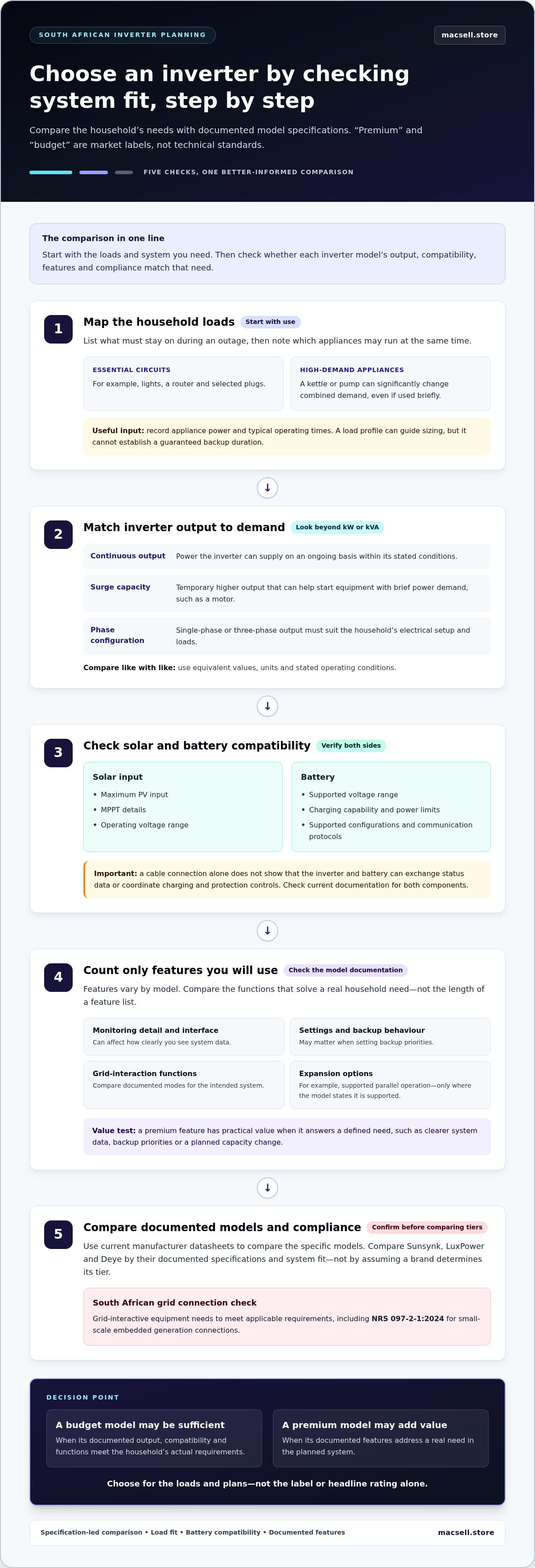
A South African buyer’s checklist for choosing the right inverter tier
Use the same requirements to assess each model. This keeps the comparison focused on your household rather than tier labels or isolated ratings.
- Set backup priorities. List the appliances that must keep running and separate them from those that can switch off during an outage.
- Record current and simultaneous loads. Note each appliance’s power requirements and which items may operate at the same time. Include high-demand appliances in the combined load assessment.
- Describe the battery plan. Record the proposed battery’s voltage, capacity, power limits and communication requirements. Compare these with the inverter’s documented battery support.
- Document the solar array. Note the proposed panel configuration and compare it with the inverter’s stated PV input limits and operating range.
- Separate future plans from current needs. List likely additions, such as extra loads or system expansion, separately. Include them in the decision only when they are realistic and the inverter documentation supports the intended configuration.
- Compare exact models. Use current manufacturer datasheets, matching units and operating conditions. Assess whether each model meets the requirements you recorded.
This process helps avoid two common mismatches: choosing a unit that falls short of current requirements, or paying for capacity and features with no defined use. Include your household’s electrical supply characteristics alongside the load and component information, so the comparison reflects the intended system.
How can buyers compare datasheets without overvaluing marketing claims?
Build a side-by-side table with rows for continuous output, surge capacity, phase configuration, PV input, battery voltage and charging limits, communication support, monitoring, protection and documented operating modes. Compare like with like. Ratings stated under different conditions may not be directly comparable, so keep each datasheet’s stated conditions beside the figure.
For every feature, ask whether it meets a recorded requirement. If a protection detail, monitoring function or expansion option is unclear or absent from the documentation, mark it for verification rather than treating it as an advantage. Marketing language is not a substitute for a stated specification.
The solar hardware cost breakdown for South Africa adds wider system-budget context. Keep inverter purchase price separate from battery and panel decisions when comparing options, and avoid relying on assumed payback or lifetime-cost figures.
For the premium hybrid inverter vs budget inverter South Africa decision, prioritise documented fit, compatibility and features your household will use. Compare hybrid inverter options against your checklist before settling on a tier.
Choosing inverter hardware from MacSell Solar Outlet
Your shortlist should connect four things: household loads, battery requirements, solar inputs and the inverter features you’ll use. Compare exact models against your system plan, not a general impression of a brand or whether a product is labelled premium or budget.
MacSell Solar Outlet’s hybrid inverter range includes Sunsynk, LuxPower and Deye. These are brand options, not automatic indicators of tier or suitability. Model specifications and supported configurations determine whether a particular inverter fits your requirements.
How to turn the comparison into a hardware shortlist
Start by removing any model that misses an essential requirement. Check that its output suits the loads you intend to run, its battery support matches your chosen battery, and its PV inputs fit the planned solar array. A high rating in one area won’t make up for a mismatch in another.
Then rank the remaining options by relevant features. For example, prioritise monitoring if you’ll use system data, or documented expansion capability if it fits a defined future plan. Verify model-specific ratings, operating limits, features and compatibility against current product documentation before purchase. Treat unclear details as unresolved, not as assumed benefits.
What to consider when selecting an inverter and battery combination
Assess the complete hardware combination rather than inverter capacity alone. Confirm that the battery configuration is supported and review the communication requirements for the specific inverter and battery models. Also compare their operating limits and charging capabilities with the planned solar inputs and household use.
This joined-up check can prevent a shortlist from looking suitable on paper while overlooking a component mismatch. It also gives you a clear basis for explaining the choice to other household decision-makers: which loads the system is intended to support, how the battery and solar inputs fit, and which inverter features serve a practical purpose.
The premium hybrid inverter vs budget inverter South Africa decision comes down to documented system fit and useful capability. Browse hybrid inverters and solar hardware to compare inverter, battery and solar options for your shortlist.
Choose the inverter that fits your system
The premium hybrid inverter vs budget inverter South Africa decision comes down to system fit, not the tier label. Match inverter output to the loads you need to run, confirm battery and solar compatibility in current manufacturer documentation, and weigh extra features against whether your household will use them. A simpler model may suit clearly defined requirements; premium capabilities are worthwhile when they solve a specific need.
MacSell Solar Outlet’s hybrid inverter range includes Sunsynk, LuxPower and Deye, alongside lithium batteries and solar panels. Compare the components as a system, rather than judging an inverter by its headline rating alone.
Ready to narrow down your options? Browse hybrid inverters and solar hardware and use your household requirements to guide your next step. A clear checklist and verified specifications make for a more informed choice.
Frequently Asked Questions
Is a premium hybrid inverter always better than a budget inverter?
No. A premium model is only better if its documented capabilities meet a requirement your household has. The premium hybrid inverter vs budget inverter South Africa comparison should account for output, battery and solar compatibility, controls and intended backup loads. If both models meet the system requirements, extra features may add little practical value if you won’t use them. Compare specific models rather than relying on tier labels.
Can a budget hybrid inverter run a household during load shedding?
Yes, a budget hybrid inverter may support household backup during load-shedding if the system is configured for that use. The inverter must support the loads you intend to run, and the battery must be compatible and have suitable capacity and power limits. List essential appliances and consider which may operate simultaneously. Backup performance depends on the complete system and actual usage, not the inverter’s price category alone.
How do I compare hybrid inverter specifications accurately?
Compare current manufacturer datasheets for the exact models, using equivalent units and operating conditions. Review continuous output, surge capacity, phase configuration, solar PV input limits, battery voltage and charging capability. Also check documented communication support, operating modes and protection features. A headline kW or kVA rating describes only part of the system fit. Treat unclear or missing specifications as unresolved rather than assuming they represent an advantage.
Will every hybrid inverter work with a lithium battery?
No. Battery compatibility depends on the inverter’s supported voltage range, battery configuration, operating limits and communication requirements. A physical connection alone doesn’t establish that the inverter and battery can exchange data or coordinate their controls. Compare the current documentation for both components, including any stated supported combinations and communication protocols. Select a lithium battery as part of the system, not simply because its connector appears to fit.
What happens if my inverter is undersized for my household loads?
If household demand exceeds the inverter’s documented output limits, it may limit power or stop supplying loads, depending on its design and operating conditions. High-demand appliances running together can push the combined load beyond capacity, even if each appliance works on its own. List essential loads, note their power requirements and consider simultaneous use. Compare the total with the inverter’s continuous output and surge specifications.
Does a more expensive inverter produce more solar power?
Not necessarily. Inverter price alone doesn’t determine how much solar energy a system can produce. Generation depends on factors including the solar array, sunlight conditions and the inverter’s documented PV input limits and operating range. A higher-priced inverter may offer different controls or other features, but those don’t automatically mean greater solar output. Compare the inverter and panel specifications as a system, using the planned array configuration.
Can I add more solar panels or batteries to a hybrid inverter later?
Possibly, but future additions depend on the inverter’s documented limits and supported configurations. Check its PV input capacity and operating range before adding panels. For batteries, verify compatible voltage, configuration, communication requirements and operating limits. Also consider whether the existing system can accommodate the intended change as a whole. Don’t assume spare capacity or a matching connector guarantees support; assess the documentation for the exact inverter, battery and panels first.