

Solar Systems as Status Symbols in South Africa
A rooftop system can make a household’s energy choices visible. In South Africa, a solar system as a status symbol can signal investment in energy independence and resilience, as well as practical planning for power supply. National solar capacity reached 8.97 GW in 2024, reflecting the technology’s growing place in the country’s energy mix.
Solar panels may catch the eye, but a system’s real value depends on what it can power and how it performs after sunset. That is why solar-plus-storage setups carry a different kind of status: they pair visible rooftop equipment with energy stored for later use.
This article explains how rooftop solar adoption has changed, why a complete solar-and-battery system can represent more than a visual statement, and what practical considerations matter when assessing that symbolism. The focus is on South African homes and the difference between prominent equipment and a system designed around household energy needs.
Key Takeaways
- Assess rooftop solar by its practical role in household energy use, not just its visibility from the street.
- Consider how battery storage changes a system’s usefulness after sunset and during supply interruptions.
- Understand why a solar installation may influence resale appeal, while recognising that buyers value the system’s fit and functionality.
- Explore how solar panels, hybrid inverters and lithium batteries can form part of a home energy setup, including the Sunsynk and Hubble combo kit.
Rooftop solar adoption
Rooftop panels have shifted from a niche feature to a visible sign of household energy planning in South Africa. Their status reflects both the equipment on a roof and the supply options it provides.
Home value and resale appeal
A solar system may support resale appeal by giving buyers an existing way to generate electricity at home. Its practical value depends on whether the equipment suits the property and household use, not simply on whether panels are visible. The components, condition and ability to meet everyday energy needs all shape how buyers may assess the system alongside the home.
The change has been substantial. In 2010, domestic rooftop solar was limited to a few isolated panels and had not contributed to Eskom’s national grid. By 2024, private-sector solar installations had added 6.1 GW of capacity. A further 961 MW of private-sector solar had been installed by October 2024. These figures show how household and business generation became a more prominent part of the country’s energy picture.
Cost comparisons depend on what each option provides. Solar panels can reduce grid electricity use when household demand aligns with generation; generators require fuel, while battery-only backup stores electricity rather than generating it. Total costs depend on equipment, usage and operating needs, so these options are not direct substitutes.
There is no universal residential rebate amount that applies to every system. Tax treatment depends on household eligibility and current rules, so don’t base a purchase decision on an assumed rebate.
Residential solar also involves risks to consider, including theft, fire safety and poor installation. Equipment suitability and workmanship affect system operation, while secure placement and correct installation help protect the household and its investment.
Drivers of rooftop solar adoption
Load-shedding, electricity tariffs and municipal billing all influence whether households invest in rooftop generation. When interruptions affect daily routines, solar can provide an alternative source during sunlight hours; rising grid costs can also make reduced grid use more attractive. Municipal billing arrangements matter because they shape how the grid connection and electricity charges interact with self-generation.
These pressures help explain why a solar system can function as a status symbol in South Africa. Visible panels suggest investment, but the stronger signal is a home equipped to manage its energy supply more deliberately. For households considering solar, the key question is how well generation matches daytime demand and local supply conditions.
Solar-plus-storage systems
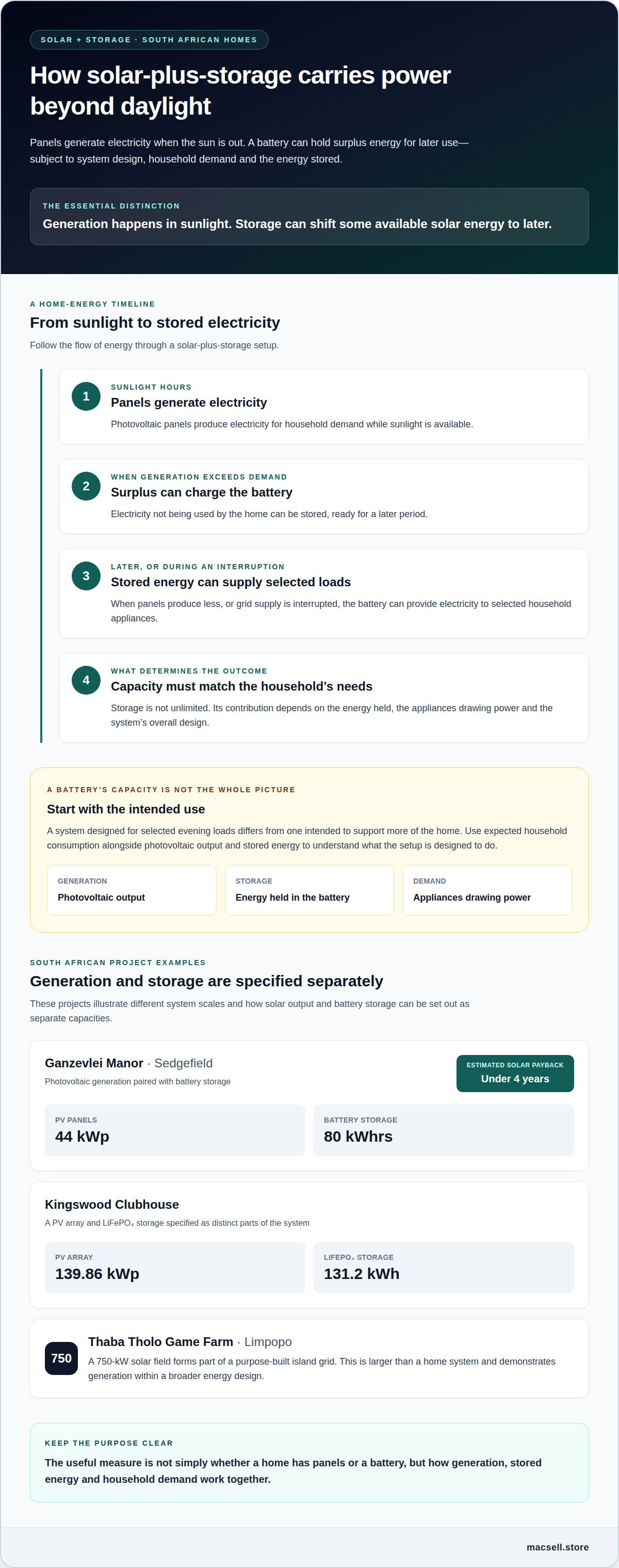
A solar-plus-storage system combines photovoltaic generation with a battery that stores electricity for later use. For a South African home, this pairing can make solar power useful beyond daylight hours.
During sunlight hours, panels generate electricity for household demand, while surplus generation can charge the battery. Later, stored energy can supply selected loads when panels produce less or the grid supply is interrupted. The outcome depends on system design, household consumption and battery capacity. Storage is not unlimited: how much it can contribute depends on the energy it holds and the appliances drawing power.
This combination can signal more than rooftop investment. A visible photovoltaic array shows generation equipment; a battery adds a functional layer. The system can shift some available solar energy into evening use, making the home’s energy setup more capable than panels alone. Its practical value comes from that added function, not simply from the presence of a battery cabinet.
South African projects illustrate different system scales. Ganzevlei Manor in Sedgefield has 44 kWp of photovoltaic panels and 80 kWhrs of battery storage, with an estimated solar payback period of under 4 years. Kingswood Clubhouse has a 139.86 kWp PV array and 131.2 kWh of LiFePO₄ storage. These examples show how generation and storage capacity can be specified separately to suit a site’s demand.
At Thaba Tholo Game Farm in Limpopo, a 750-kW solar field forms part of a purpose-built island grid. That example is larger than a home system, but demonstrates how storage and generation can be considered within a broader energy design. For residential planning, the key distinction is between daytime production and the stored electricity available afterwards.
Battery capacity alone doesn’t describe how well a system will serve a household. The balance between photovoltaic output, stored energy and appliance demand determines its usefulness. A design focused on essential evening loads differs from one intended to support more of the home. Considering that balance helps distinguish a visible status feature from a system with a clear operating purpose. Explore solar-plus-storage system components as part of that planning.
This figure puts a full-night storage scenario in cost terms alongside questions of capacity and household demand. It does not replace the need to consider what the system is expected to supply: a design for selected evening loads differs from one intended to cover a full night. When assessing a proposed system, keep its intended use clear and compare it with the household’s energy needs during that period. This makes the estimate easier to interpret alongside the system’s generation, storage and purpose, rather than treating a battery’s presence or capacity as a complete measure of value. The estimate is specific to solar-panel electricity with batteries for full-night coverage in South Africa.
How do solar systems affect South African home values and resale appeal?
A solar system can influence resale appeal by adding an installed energy feature buyers can assess alongside the property. In South Africa, its contribution depends on practical details: what it powers, how its components work together and whether it suits the home. Panels alone do not explain those factors. Buyers need a clear picture of the complete setup.
For sellers, a useful first step is to prepare a concise system record. List the panels, inverter, battery and household loads the system supports. Include available operating documents and records of completed work. This helps prospective buyers understand what comes with the property instead of treating rooftop equipment as an unexplained fixture.
For buyers, assess the system as part of the home’s energy setup. A photovoltaic array without storage serves a different purpose from one that also stores electricity. For example, a household focused on daytime use may value a different configuration from one seeking evening backup. The property and typical household routines also shape the system’s relevance.
Resale appeal and a higher sale price are not the same thing. A system may attract buyers who want on-site generation, but its effect on an offer depends on the property and the buyer’s priorities. A prominent installation may matter less than a well-documented setup that suits the home’s use. Equipment alone is not proof of added value.
South African buyers may also consider how the home interacts with Eskom supply. A grid-connected setup and an independently operating arrangement serve different needs, so describe the system accurately. Explain which household circuits it supports, how storage fits into its operation, and what energy use still depends on grid electricity. Clear explanations help buyers compare properties on useful terms.
Presentation matters. Show where the equipment is located and explain its role, from roof-mounted panels to the inverter and any battery. If buyers ask about running costs or expected savings, base the discussion on the property’s actual records rather than a general claim. This ties the solar feature to documented use, not assumed financial returns.
For homeowners planning a future sale, choose a system around household requirements first. A setup that meets current needs is easier to explain than equipment selected mainly for appearance. Review solar equipment options when considering the components that could suit a home’s energy requirements.
Beyond individual homes, four villages outside Thaba Tholo Game Farm are home to employees and their families. SAPVIA represents almost 700 members across South Africa's photovoltaic value chain, reflecting the breadth of the sector behind equipment buyers may encounter.
MacSell Solar Outlet
MacSell Solar Outlet supplies solar hardware for households considering how rooftop generation and storage fit their energy needs. Its range includes solar panels, hybrid inverters and lithium batteries, as well as the Sunsynk 8KVA & 2X Hubble AM2 5.5 KWh Combo Kit. These components give homeowners options to consider when planning a system for household use, rather than choosing equipment for appearance alone.
MacSell Solar Outlet supplies hardware for solar setups, including panels, storage and hybrid inverters. Choose components according to the system’s intended role and the household’s energy requirements.
Contact MacSell Solar Outlet to discuss solar hardware for your home.
Make your next solar decision practical
A solar system as a status symbol in South Africa carries more weight when it serves the household, rather than simply attracting attention. Before choosing equipment, define what you want the system to do: support daytime use, store energy for later, or combine both in a way that suits your home. That purpose gives you a clearer basis for assessing components and explaining their value to future buyers.
MacSell Solar Outlet offers lithium batteries, hybrid inverters and the Sunsynk 8KVA & 2X Hubble AM2 5.5 KWh Combo Kit. These hardware options can help you consider how generation and storage fit into a home energy setup. A solar installation doesn’t guarantee a higher resale price, so focus on useful system design and clear information about the equipment.
Contact MacSell Solar Outlet to discuss hardware for your solar plans, and take the next step with a clear purpose.
Frequently Asked Questions
How common are residential solar systems among South African households by income level?
Residential solar ownership varies with household resources, property suitability and access to suitable equipment. National capacity figures do not show household adoption by income group, so they cannot establish how common systems are within each bracket. In practice, a homeowner’s ability to invest, suitable roof space and household energy needs all shape whether rooftop solar is viable.
Why is rooftop solar seen as a status symbol in South Africa?
A solar system can act as a status symbol in South Africa because rooftop panels make a household’s investment in energy generation visible. It may also signal that the owner can make longer-term choices about electricity supply and household energy use. Its practical value depends on how well the equipment serves the home, not on appearance alone.