

450W Solar Panel: 2026 Hardware Specifications and Procurement Guide
The 450w solar panel has officially claimed the title of the most efficient residential hardware choice for South African homeowners in 2026. Whilst larger utility-scale modules exist, they often create unnecessary complications regarding roof space and inverter compatibility. You're likely looking for a solution that balances high power output with a manageable physical footprint, especially with the 30 September 2026 SSEG registration deadline approaching. It's a common concern that choosing the wrong specifications will leave you with an underperforming system or hardware that's difficult to mount.
This procurement guide confirms why the 450w solar panel is the current industry sweet spot for energy independence. You'll discover how these N-Type monocrystalline units, featuring efficiency ratings of up to 23%, integrate seamlessly with premium hardware like Sunsynk 8KVA or LuxPower inverters. We'll provide a technical breakdown of the 1.7-metre by 1.1-metre physical dimensions and the electrical parameters you need to verify before purchasing. This is a direct look at the hardware specifications required to build a reliable, future-proof solar array without the fluff of professional installation sales pitches.
Key Takeaways
- Identify why the 450w solar panel has become the 2026 industry standard for residential efficiency and roof-space optimisation.
- Analyse critical hardware parameters including Open Circuit Voltage (Voc) and Short Circuit Current (Isc) to ensure system stability.
- Evaluate compatibility requirements for pairing high-output modules with hybrid inverters like the Sunsynk 8KVA or LuxPower SNA5000.
- Master the calculation steps for solar array sizing using daily kWh consumption and South African peak sun hour data.
- Recognise Tier 1 procurement standards and the importance of linear power output guarantees for long-term hardware reliability.
Understanding the 450W Solar Panel Standard in 2026
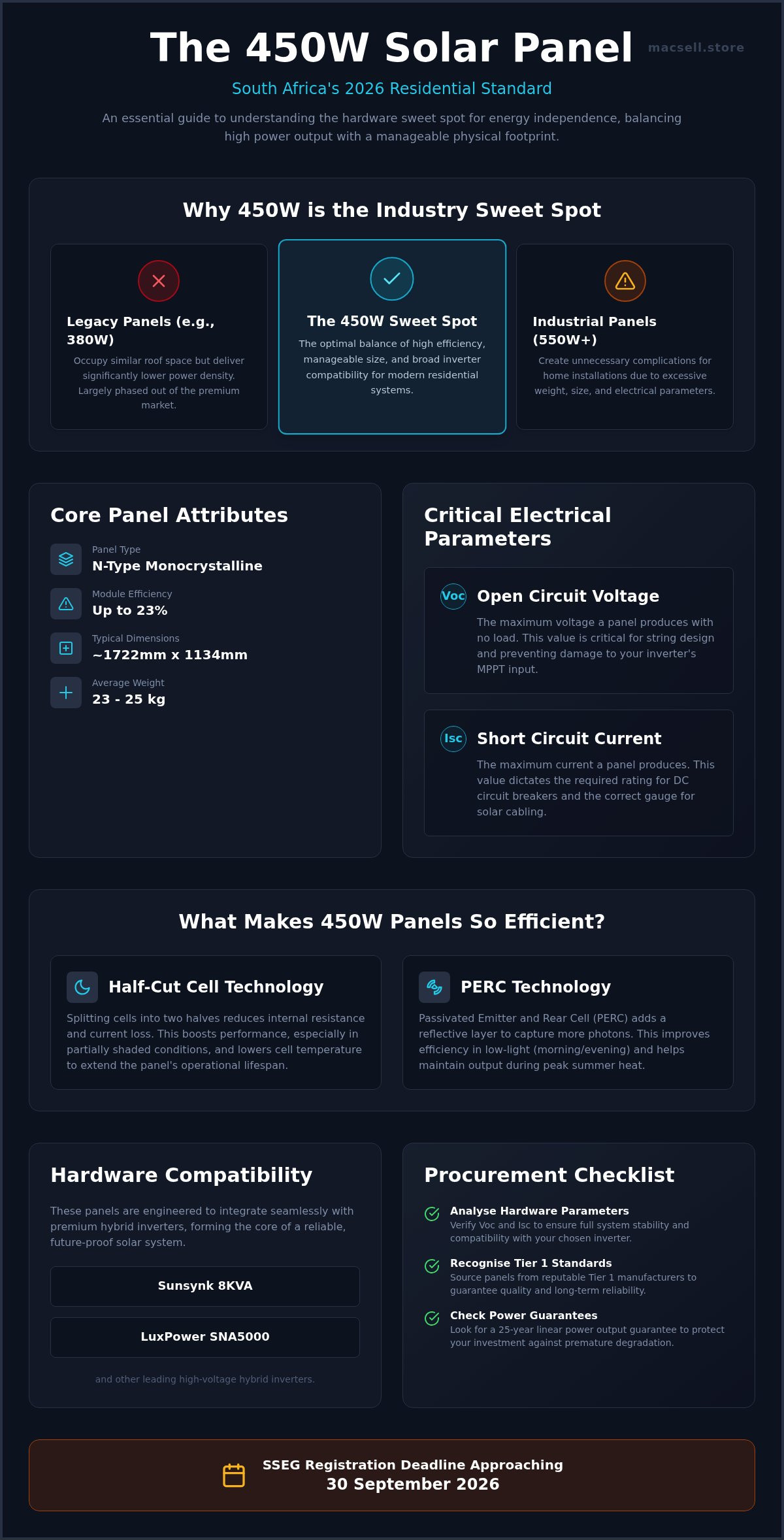
The 450w solar panel represents the primary hardware specification for South African residential systems in 2026. This module is a high-efficiency monocrystalline unit engineered to optimise energy harvest within limited roof footprints. While industrial projects often utilise 550W+ panels, the 450W class remains the practical standard for homes due to its physical dimensions and electrical compatibility. It offers a reliable balance between total power output and the physical constraints of domestic architecture.
Advancements in solar panel technology have phased out older 330W and 380W modules. These legacy units occupied similar physical space but delivered significantly lower energy density. The transition to 450W is largely driven by Half-Cut Cell technology. This design splits solar cells into two smaller sections, reducing internal resistance and improving performance in shaded conditions. By splitting the current, the hardware generates less heat, which extends the lifespan of the silicon cells. It's the essential building block for modern hybrid inverter price South Africa systems, as panel output directly dictates the required inverter capacity.
The Shift to High-Wattage Residential Modules
Residential hardware procurement now focuses on maximising yield per square metre. A 450w solar panel offers superior energy density compared to hardware from just three years ago. This allows homeowners to achieve their desired kWh targets with fewer total units. Reducing the number of panels simplifies the mounting process and lowers the total weight load on the roof structure. Standardising on 450W hardware ensures long-term availability for system expansions or individual panel replacements.
Modern 450W modules typically weigh around 24kg, maintaining a balance between high power output and safe manual handling. The 2026 trend favours higher efficiency in smaller footprints, ensuring that even homes with complex roof layouts can reach energy independence. These modules are designed to be manageable for two-person teams, avoiding the logistical strain associated with larger, heavier industrial panels.
Monocrystalline vs Polycrystalline in 2026
Polycrystalline modules have largely vanished from the premium residential market. By 2026, 450W panels are almost exclusively monocrystalline. These cells are cut from a single crystal of high-purity silicon, allowing for better electron flow and higher efficiency ratings, often reaching 21% to 23%. This purity is essential for maintaining performance over a 25-year lifespan.
The inclusion of PERC (Passivated Emitter and Rear Cell) technology is a critical factor for the South African climate. PERC technology is a method to reflect light back into the cell for increased efficiency. This extra layer allows the panel to capture more energy in low-light conditions, such as early morning or late afternoon. It also helps manage thermal coefficients, ensuring the hardware maintains performance during peak summer temperatures when standard cells might lose efficiency due to heat.
Technical Specifications: Efficiency, Dimensions, and Output
The technical profile of a 450w solar panel is defined by its physical footprint and electrical output capability. In 2026, standard module efficiency for this class ranges between 20% and 21%. These figures represent a significant optimisation of silicon surface area. A typical panel measures approximately 2100mm by 1050mm. This size remains the standard for residential roof-top installations. The hardware weight typically falls between 23kg and 25kg. This weight factor is a primary consideration for structural load assessments on older South African residential roofs.
Electrical Parameters for System Design
System designers must prioritise two critical electrical parameters: Open Circuit Voltage (Voc) and Short Circuit Current (Isc). Voc represents the maximum voltage the panel produces under no load. It is the decisive factor when stringing panels together for high-voltage hybrid inverters. Exceeding the inverter’s maximum input voltage will cause hardware failure. Isc determines the maximum current flow. This value dictates the required rating for DC circuit breakers and the gauge of the solar cabling. According to global solar market trends, higher current outputs are becoming standard. This requires precise hardware matching to avoid clipping.
The temperature coefficient is equally vital. South African summer temperatures can exceed 40°C. Panels lose efficiency as they heat up. High-quality 450W modules include low temperature coefficients to mitigate this performance drop. Integrated bypass diodes within the junction box further protect the hardware from hot-spot damage during partial shading. Understanding these specs ensures your system remains stable during peak solar radiation periods.
Physical Footprint and Mounting Requirements
A standard 10-panel array using 450W modules requires roughly 22 square metres of unobstructed roof space. This calculation must account for spacing between rows to prevent self-shading. Mounting hardware must be compatible with the specific roof type, whether corrugated iron, IBR, or concrete tile. Secure attachment points are essential for wind load resistance. For long-term durability, panels must feature anodised aluminium frames. This material provides necessary corrosion resistance against coastal salt spray and high inland humidity levels.
The frames also include pre-drilled mounting holes and earthing points to facilitate a grounded, safe installation. Correct mounting prevents mechanical stress on the silicon cells, reducing the risk of micro-cracks over time. If you are planning a system build, you can browse 450W solar panel options in our current inventory to find hardware that matches your specific roof layout.
Hardware Compatibility: Pairing 450W Panels with Hybrid Inverters
Pairing a 450w solar panel with a hybrid inverter requires careful analysis of electrical input limits. For instance, the Sunsynk Hubble combo kit is specifically designed to handle high-current inputs from modern modules. These inverters use Maximum Power Point Tracking (MPPT) to constantly adjust the electrical load, ensuring the array operates at peak efficiency despite variations in sunlight. Most modern hybrid inverters feature an MPPT voltage range between 125V and 425V. You must ensure your total string voltage falls within this window to maintain system stability and prevent hardware errors.
Matching Wattage to Inverter Input
A standard 5kW Sunsynk or LuxPower SNA5000 inverter typically supports a maximum DC input of around 6500W. This allows for approximately 14 units of the 450w solar panel. However, you must verify the Max DC Input Current, often rated at 13A or 22A per MPPT. If your panels produce more current than the inverter can process, "clipping" occurs, where excess energy is discarded. While clipping prevents hardware damage, it limits your total daily yield. Refer to this list of questions to ask when buying solar panels to ensure your chosen hardware matches your inverter’s technical datasheet perfectly.
Optimising String Configurations
String configuration directly dictates the efficiency of the MPPT tracker. When wiring 450W modules in series, the voltage adds up while the current remains constant. This is ideal for reaching the "strike voltage" required to start the inverter early in the morning. Parallel wiring increases current, which is useful when you have multiple roof orientations. Accurate stringing ensures that the voltage remains high enough to keep the MPPT active even during high-heat periods when panel voltage naturally drops.
Efficient energy storage relies on the array’s ability to charge a lithium ion solar battery during limited daylight hours. To achieve this, many designers "over-size" or over-clock the DC array. By installing more wattage than the inverter's AC output rating, the system reaches its peak production earlier and maintains it longer. This is particularly effective in a backup power kit South Africa where battery replenishment is the priority during frequent load shedding cycles. Consider these configuration factors:
- Series Strings: Maximises voltage for earlier inverter startup.
- Parallel Strings: Accommodates different roof aspects without losing total current.
- MPPT Balance: Distributes load across dual trackers to prevent thermal stress on the inverter.
Designing Your Solar Array: How Many 450W Panels Do You Need?
Determining the exact number of 450w solar panel units for your system is a mathematical process based on specific energy consumption and regional solar radiation. Guesswork leads to underperforming batteries or wasted capital on excess hardware. Follow this structured five-step calculation to define your hardware requirements accurately.
- Step 1: Locate your average monthly kWh usage on your electricity bill. Divide this total by 30 to determine your average daily consumption.
- Step 2: Factor in the average peak sun hours for your location. Most regions in South Africa receive between 4.5 and 6.5 peak sun hours daily.
- Step 3: Calculate the total array wattage required. You must cover daytime loads and battery charging while accounting for a 20% system loss factor. If your daily target is 20kWh and you have 5 sun hours, you need a 4.8kW array.
- Step 4: Divide your total required wattage by 450. In the 4.8kW example, you would require 11 physical modules.
- Step 5: Review the current solar panel for home price index to align these technical requirements with your available budget.
Sizing for Load Shedding vs Off-Grid
Hardware requirements differ significantly based on your energy goals. A basic load shedding backup system focuses on battery replenishment. To recharge a single 5.5kWh Hubble AM2 battery within a five-hour window, you need a minimum of four 450w solar panel units. This assumes no heavy loads are running during the charge cycle.
Expanding for full energy independence requires a larger footprint. Off-grid systems must generate enough power for 24/7 operation, including surplus for cloudy days. The 450W module is often superior to higher wattage alternatives in tight roof spaces. Its smaller dimensions allow for flexible placement around obstacles like chimneys or vents. This modularity ensures you can maximise every square metre of available roof area without the logistical challenges of oversized industrial panels.
Future-Proofing Your Hardware Procurement
Standardising on 450W modules ensures easier replacement or expansion in the future. Mixing different wattages or brands within a single MPPT string causes electrical mismatches and reduces overall efficiency. Organising your hardware purchase in batches allows for modular growth. You might start with six panels for load shedding and add another six later for full off-grid capacity. You can order solar hardware online to secure consistent stock for your system expansion. Always ensure that any added panels match the Voc and Isc parameters of your existing string to maintain peak performance.
Procuring 450W Solar Panels: Sourcing Reliable Hardware in South Africa
Procuring the correct hardware is the final step in securing residential energy independence. In the 2026 market, identifying Tier 1 manufacturers is essential. These companies control the entire production chain, ensuring the silicon purity and frame integrity of each 450w solar panel meet international standards. Choosing Tier 1 hardware isn't just about brand recognition. It's about securing a 25-year linear power output guarantee. This guarantee ensures your modules won't suffer from aggressive degradation, maintaining at least 80% to 85% of their rated capacity after two decades of operation.
MacSell Solar Outlet focuses exclusively on high-performance hardware that withstands the South African climate. While generic retailers might offer various wattages, we prioritise the 450W standard for its proven reliability and ease of integration. Before confirming any order, you must verify the product warranty, which typically covers 10 to 12 years for manufacturing defects. This hardware-centric approach allows us to provide technical precision without the distractions of installation services or financing packages.
What to Look for in a 450W Panel Supplier
A reliable supplier must provide immediate access to technical data sheets and compliance certificates. You need these documents to ensure your system meets the 30 September 2026 SSEG registration requirements. Transparency regarding stock levels and procurement lead times is equally vital. If you're building a complete system, you'll need all components to arrive simultaneously to avoid project delays. You can cross-reference your panel choice with our Deye inverter price South Africa guide to ensure your total hardware budget remains on track.
The MacSell Solar Outlet Advantage
We operate as a specialised warehouse for the South African solar industry. Our model is fundamentally transactional and direct. We don't offer professional installation or technical support; instead, we focus on providing the exact components you need at a competitive price point. This no-nonsense procurement style appeals to DIY enthusiasts and independent contractors who value efficiency over sales pitches. Our national supply chain ensures that premium brands like Sunsynk, Deye, and LuxPower are available for rapid dispatch.
Before you finalise your hardware-only purchase, use this final checklist to confirm your specifications:
- Cell Technology: Verify the use of N-Type or PERC monocrystalline cells for high-heat performance.
- Electrical Matching: Ensure the panel's Isc does not exceed your inverter's maximum MPPT input current.
- Frame Durability: Confirm the presence of anodised aluminium frames for long-term corrosion resistance.
- Documentation: Secure the manufacturer's linear power output guarantee for your records.
- System Balance: Check that your total panel count provides enough voltage to reach the inverter's strike voltage.
Optimising Your 2026 Residential Solar Strategy
The transition to energy independence relies on selecting hardware that matches both your roof capacity and inverter limits. By standardising on the 450w solar panel, you're choosing a module that balances high-efficiency monocrystalline technology with manageable physical dimensions. Technical parameters like Open Circuit Voltage and Short Circuit Current remain the primary metrics for a stable system. Prioritising Tier 1 manufacturers ensures you benefit from linear power output guarantees and long-term hardware reliability, which are essential for maintaining your return on investment over a 25-year lifespan.
MacSell Solar Outlet operates as a specialist retailer of Sunsynk, Deye, and LuxPower hardware, offering a curated selection of high-performance components. We focus on direct transactional efficiency to support DIY enthusiasts and independent contractors nationwide with premium energy storage solutions. View our current range of 450W solar panels and hybrid hardware at MacSell Solar Outlet to secure your system components today. Building a future-proof energy array starts with precise hardware procurement.
Frequently Asked Questions
How much power does a 450W solar panel actually produce in South Africa?
A 450w solar panel typically produces between 2.0kWh and 2.9kWh per day in the South African climate. This calculation depends on the average peak sun hours in your region, which generally ranges from 4.5 to 6.5 hours daily. Factors such as panel orientation, tilt angle, and seasonal variations will influence the final yield. It's essential to account for system losses of roughly 20% when calculating your total daily energy harvest.
What are the physical dimensions of a standard 450W solar panel?
Standard dimensions for a 450W module are approximately 2100mm in length by 1050mm in width. These panels usually feature a frame thickness of 35mm to 40mm and weigh between 23kg and 25kg. These measurements are specifically designed for residential roof-top mounting, allowing for efficient space utilisation. You should allow for a small gap between panels for mounting clamps and thermal expansion when planning your total roof footprint.
Can I mix 450W panels with my existing 330W solar panels?
Mixing different wattages on a single MPPT string is not recommended as it causes significant efficiency losses. The inverter will often limit the entire string to the current of the lowest-performing panel, effectively under-utilising your new hardware. If your inverter has multiple MPPT trackers, you can keep the 330W and 450W modules on separate strings. This ensures each array operates at its own maximum power point without electrical mismatch issues.
How many 450W solar panels do I need for a 5kW hybrid inverter?
A 5kW hybrid inverter, such as the LuxPower SNA5000, typically supports a DC array of up to 6500W. This allows for the installation of approximately 11 to 14 units of the 450w solar panel. The exact number depends on the inverter's maximum DC input voltage and current limits per MPPT. Over-sizing the DC array is a common strategy to ensure the system reaches its peak output earlier in the day.
Is a 450W panel better than a 550W panel for a residential roof?
The 450W module is often considered the optimal choice for residential applications due to its manageable physical size and weight. While 550W panels offer higher individual output, their larger dimensions can make them difficult to fit on complex residential roof layouts with chimneys or gables. Furthermore, 450W panels are typically easier for two-person teams to handle manually during the mounting process, reducing the risk of mechanical stress or micro-cracks.
Do 450W solar panels come with a warranty for the South African climate?
High-quality 450W modules from Tier 1 manufacturers include comprehensive warranties designed for harsh environments. You can expect a 10 to 12-year manufacturing warranty covering defects and a 25-year linear power output guarantee. This guarantee ensures the hardware maintains a specific performance level, typically at least 80% of its original rating, after two decades. These panels feature anodised aluminium frames and tempered glass to resist corrosion and high inland temperatures.
What is the efficiency rating of a typical 450W monocrystalline panel in 2026?
In 2026, a typical 450W monocrystalline panel features an efficiency rating between 20% and 23%. This high performance is achieved through N-Type or PERC cell technologies, which improve light absorption and reduce electron recombination. These efficiency levels allow homeowners to generate more power from a smaller surface area compared to older polycrystalline technology. High efficiency is particularly beneficial in South Africa for maintaining output during high-heat periods when standard cells often lose productivity.
Can I install 450W panels myself if I buy the hardware from MacSell?
MacSell Solar Outlet is a specialised hardware retailer and does not provide installation services or technical support. Whilst you can purchase the panels directly, you are responsible for ensuring the system complies with South African electrical safety standards. All grid-tied systems must be registered under Small-Scale Embedded Generation (SSEG) regulations by 30 September 2026. We recommend consulting a qualified professional to ensure your hardware is mounted and wired correctly.