

Deye vs GoodWe Hybrid Inverter Comparison: 2026 Hardware Evaluation
The inverter delivering the highest peak efficiency on paper might actually prove the wrong choice for your property's daily backup demands. If you find yourself stuck choosing between two market leaders during frequent grid interruptions, you aren't alone; the sheer divergence in battery bus voltages, surge capacity, and switchover speeds causes genuine confusion. A rigorous Deye vs GoodWe hybrid inverter comparison cuts straight through the spec sheets to reveal how these machines handle real electrical loads under pressure.
In this technical hardware evaluation, we examine the fundamental divide between Deye's flexible 48V low-voltage architecture and GoodWe's streamlined high-voltage platform. You'll gain a direct assessment of switching performance, battery bus implications on total hardware expenditure, and auxiliary generator controls so you can procure standalone hardware matched to your property's electrical demand. Up next, we dissect the core inverter architectures, starting with DC voltage design and sustained power delivery.
Key Takeaways
- Explore the architectural distinctions in this Deye vs GoodWe hybrid inverter comparison, pitting versatile 48V low-voltage battery topologies against streamlined high-voltage configurations.
- Analyse how battery bus voltage specifications fundamentally dictate total system expenditure, balancing open-protocol LiFePO4 modularity against high-voltage DC efficiency.
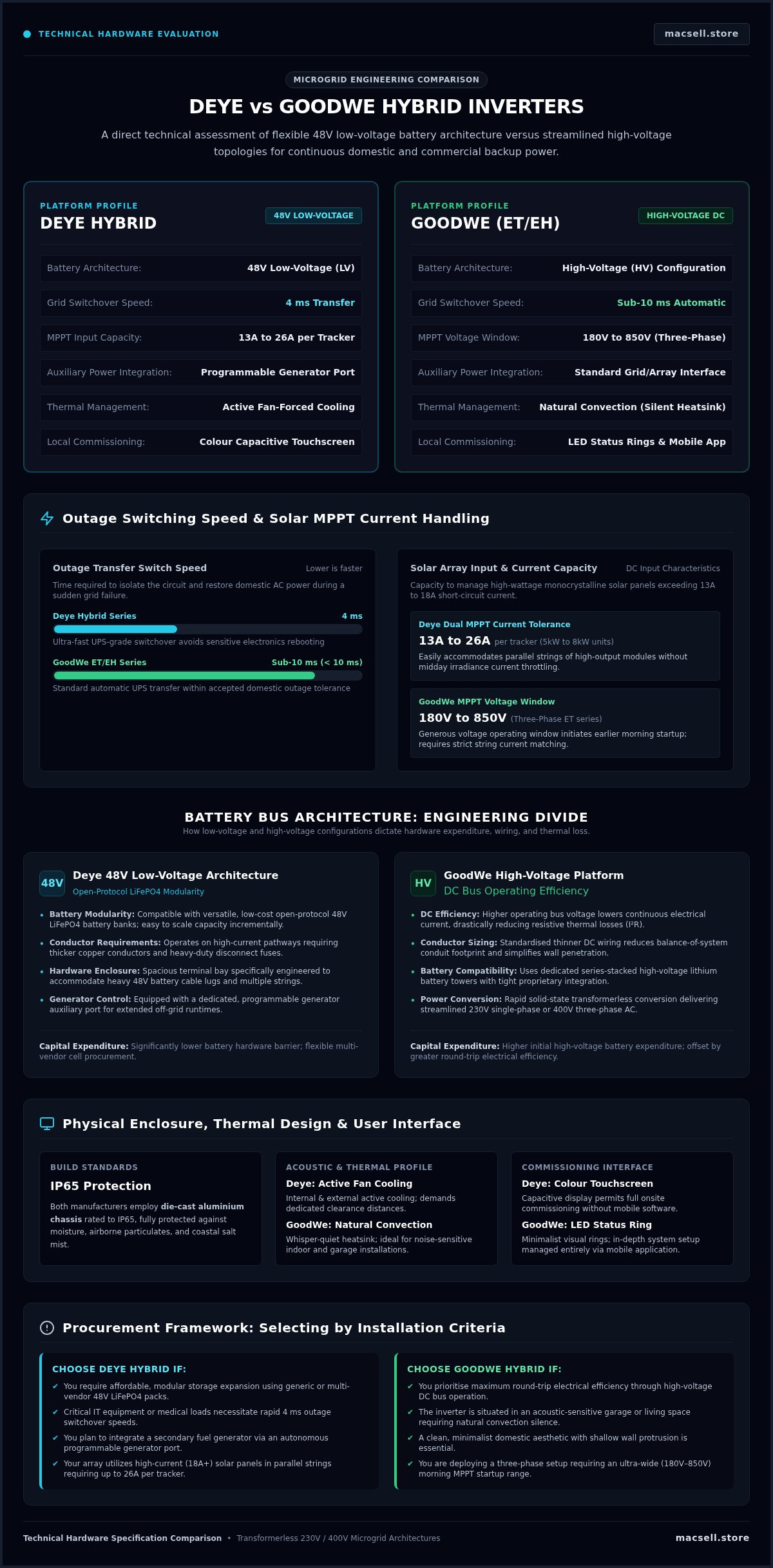
- Examine backup reliability and switchover performance during grid interruptions, contrasting Deye's 4 ms transfer speed and programmable generator port with GoodWe's sub-10 ms automatic switchover.
- Weigh physical deployment factors, including active fan cooling versus whisper-quiet natural convection, alongside direct touchscreen commissioning versus app-exclusive interfaces.
- Select standalone hardware precisely matched to your property's phase allocation, continuous electrical demand, and long-term storage expansion requirements.
System Architecture and Engineering: Deye vs GoodWe Hybrid Inverters
Hybrid inverters serve as the operational core of modern domestic and light-commercial microgrids. Both Deye and GoodWe engineer hardware capable of managing solar generation, battery storage, and utility grid interaction simultaneously. However, their internal power topologies diverge significantly. While GoodWe prioritises high-voltage DC bus efficiency in its mainstream residential lines, Deye focuses heavily on low-voltage, high-current circuits. Understanding this structural divide forms the bedrock of an accurate Deye vs GoodWe hybrid inverter comparison.
At an engineering level, both brands utilise transformerless power conversion topologies to maximise throughput and minimise idle self-consumption. Modern solar inverter technology relies on rapid solid-state switching to convert high-voltage DC array power into stable 230V or 400V AC power. The primary design divergence lies in the internal DC-DC converter stages that interface with storage systems, directly influencing continuous current handling, balance-of-system hardware, and thermal profiles.
MPPT Tracking and Solar Array Design Flexibility
Modern high-output solar panels frequently produce operational short-circuit currents exceeding 13A to 18A per string. Matching these modules requires robust Maximum Power Point Tracking (MPPT) inputs. Standard Deye single-phase units (5kW to 8kW) typically feature dual MPPT trackers with generous input current capacities (often 13A to 26A per tracker), accommodating parallel strings of modern high-wattage monocrystalline modules without clipping. GoodWe residential hybrid platforms, such as the ET and EH series, offer wide operational MPPT voltage windows (typically 180V to 850V on three-phase units), enabling earlier morning startup. However, their lower DC input current thresholds mean string calculations must be strictly matched to avoid current throttling during peak midday irradiance.
Build Quality, Form Factor, and Ingress Protection
Both manufacturers construct their enclosures to meet rigorous industrial protection standards, utilising IP65-rated die-cast aluminium chassis designed to resist moisture, airborne particulates, and coastal salt mist. The architectural differences emerge in form factor and thermal engineering:
- Deye Hybrid Series: Features a robust, utilitarian chassis with a front-facing capacitive colour touchscreen. The internal layout separates power electronics from the connection terminal bay, simplifying cable routing for heavy 48V battery lugs. Active internal and external cooling paths require specific side clearances.
- GoodWe ET/EH Series: Employs a compact, minimalist industrial aesthetic relying solely on LED status rings. The unit uses a rear-mounted heatsink design that reduces front depth, making it ideal for clean garage installations where physical protrusion must be minimised.
For independent solar installers and procurement managers, this Deye vs GoodWe hybrid inverter comparison highlights clear physical boundaries. GoodWe provides a streamlined, space-saving profile for tidy domestic walls. Conversely, Deye prioritises internal terminal space and rugged mechanical serviceability, catering directly to complex multi-string hardware installations.
Battery Bus Architecture: Low-Voltage (48V) vs High-Voltage Compatibility
Battery bus voltage forms the single most decisive engineering divide in any Deye vs GoodWe hybrid inverter comparison. This parameter dictates battery chemistry choices, DC disconnect switch sizing, cable cross-sections, and total hardware capital expenditure. While both architectures interface cleanly with solar arrays, their internal direct current operating ranges alter how storage capacity scales over time.
Understanding these voltage dynamics requires looking at basic electrical principles. Operating at higher voltages lowers current, which reduces resistive thermal losses across the circuit. Lower-voltage topologies require significantly thicker copper conductors and heavy-duty fuses to handle high current loads safely. In the context of broader grid integration and inverter functionality, how your inverter manages battery voltage directly influences round-trip conversion efficiency and off-grid surge response.
The Deye 48V Ecosystem and Modular Expansion
Deye positions its residential low-voltage (LV) platform around a nominal 48V battery bus, supporting an operating DC voltage range of 40V to 60V. Standard single-phase residential units handle enormous continuous current, reaching up to 190A to 380A on larger models, while standard three-phase LV units handle up to 240A. This high current capacity enables installers to integrate cost-effective, open-protocol 48V lithium iron phosphate (LiFePO4) server-rack batteries from diverse third-party manufacturers.
- Modular parallel scaling: Adding a single 5.12kWh battery module years after initial commissioning is simple, provided the communication protocols match.
- Heavy-gauge balance of system: High amperage demands substantial 35mm² to 70mm² DC cables, paired with 250A to 400A DC breakers or NH-rated fuse disconnectors.
GoodWe High-Voltage Battery Topology
GoodWe engineers its mainstream residential hybrid ranges, such as the ET series, predominantly around High-Voltage (HV) battery architecture. These inverters operate within a high DC window of 180V to 600V (and up to 800V on larger light-commercial models). Standard charge and discharge current ratings are restricted to 25A to 40A. This high-voltage approach delivers distinct operational traits:
- Reduced thermal dissipation: Lower current creates negligible resistive losses, allowing the use of slimmer 6mm² or 10mm² DC wiring and smaller fuse enclosures.
- Closed-loop stack requirements: System designers must use dedicated high-voltage battery stacks (such as GoodWe Lynx Home F+ or approved BYD modules) connected in series with a central Battery Management System (BMS) control base.
- Higher barrier to entry: You cannot deploy a single, low-capacity modular block. A functional minimum series voltage must be reached, raising initial equipment entry costs.
Consult our technical guide on lithium ion solar battery technology to understand cell longevity and internal degradation mechanics. If your installation demands phased, unbundled storage scaling without proprietary battery locks, explore standalone hardware solutions available directly from MacSell Solar Outlet.
Backup Power, Switching Speeds, and Grid Independence During Outages
Unstable distribution networks make automatic transfer capability a core procurement benchmark. When utility feeds drop abruptly, hybrid hardware must island immediately to avoid back-feeding lines while sustaining downstream consumer electronics without reboot cycles. In any direct Deye vs GoodWe hybrid inverter comparison, examining rated switchover speed, surge capacity, and auxiliary contact control determines whether a site achieves genuine microgrid independence.
Switchover speed dictates whether sensitive IT gear, networked storage, and desktop computers stay alive during unexpected disconnects. Deye hybrid units feature an ultra-fast automatic transfer switchover time rated at 4 ms. GoodWe residential units (such as the ET series) provide a certified transfer rating of under 10 ms. Because the standard threshold for uninterruptible power supply (UPS) compliance sits at 20 ms, both brands prevent relay chatter and dropped equipment loads under typical domestic operating conditions.
Surge Capacity and Inductive Load Management
Starting inductive equipment like borehole pumps, pool pumps, and refrigeration compressors demands massive inrush currents, often three to five times their nominal run ratings. Deye single-phase and three-phase units handle high peak surge currents (typically up to two times rated continuous output for ten seconds). This surge headroom allows installations to run substantial motor loads straight from battery storage. GoodWe hybrid inverters also deliver robust peak surge limits, but strict sizing of the critical backup distribution board remains mandatory. Isolating non-essential heavy circuits from dedicated backup terminals ensures inductive surges do not trigger safety trips when islanded from utility power.
Generator Integration and Auxiliary Port Functionality
Secondary off-grid resilience reveals substantial differences in balance-of-system design between the two brands:
- Deye Dedicated AUX/Smart Port: Features an onboard, bidirectional auxiliary port that software configures as a generator input, AC-coupling microinverter port, or smart dump load. The integrated dry contacts signal auto-start diesel or petrol generators directly, managing automatic synchronization without third-party transfer switches. Installers can also direct surplus midday PV generation to run hot water geysers automatically before battery reserve drops.
- GoodWe External Architecture: Relies on a standard dedicated backup output. Integrating an auxiliary fuel generator typically demands external changeover contactors, specialized digital input modules, or a separate static transfer switch cabinet, increasing external distribution board wiring complexity.
Review our comprehensive hybrid inverter price South Africa guide for wider hardware availability and equipment tiers across the country. Understanding balance-of-system demands alongside global hybrid inverter procurement and monitoring security trends ensures your electrical design remains resilient throughout extended outages.
Thermal Management, Acoustic Noise, and Monitoring Platforms
Sustained thermal dissipation directly governs internal component longevity, especially the lifespan of sensitive DC electrolytic capacitors. When hardware operates under continuous heavy loads in warm ambient climates, heat management determines whether a system maintains rated output or initiates protective thermal derating. Comparing thermal management and digital interfaces reveals another distinct divide in this Deye vs GoodWe hybrid inverter comparison.
Cooling Strategies: Active Forced Air vs Natural Convection
GoodWe engineers its residential ET series (5kW to 10kW) with passive natural convection cooling. Lacking mechanical fans, these units run virtually silent at under 25 to 30 dB(A), making them exceptionally suited for residential installations in garages or utility rooms near living spaces. However, passive heatsinks require generous wall clearances and ambient operating temperatures below 40°C to avoid output derating.
Deye hybrid units (5kW to 12kW+) deploy intelligent forced-air active cooling fans to manage heat from high-amperage low-voltage DC conversion. Operational noise measures between 35 and 45 dB(A), climbing to 50 to 55 dB(A) under maximum continuous battery charging. Active airflow prevents derating in hot plant rooms, but fans introduce mechanical wear points that require periodic dust inspection. Mounting a Deye unit on shared bedroom or study walls isn't recommended.
Software Interfaces: Solarman vs GoodWe SEMS Portal
Monitoring ecosystems dictate your visibility over daily production curves, self-consumption ratios, and battery states of charge:
- Deye (Solarman / Deye Cloud): Features an onboard capacitive colour touchscreen LCD directly on the inverter casing. Installers can configure complete grid parameters, battery charge profiles, and six-slot time-of-use schedules on-site without requiring a smartphone or active internet connection. Open Modbus-RTU and TCP protocols allow direct integration into home automation platforms like Home Assistant for local energy management during wider network outages.
- GoodWe (SEMS Portal / SolarGo): Employs a minimalist physical exterior featuring LED indicator lights only. System commissioning, diagnostic parameter configuration, and firmware updates rely strictly on local Bluetooth or Wi-Fi communication via the PV Master or SolarGo mobile applications. The cloud-based SEMS Portal provides polished desktop telemetry and automated reporting, though real-time local polling without cloud dependencies requires dedicated communication accessories.
Selecting the right hardware platform requires balancing acoustic comfort against hands-on, display-based operational autonomy. Order tier-one hybrid inverters from MacSell Solar Outlet to secure unbundled hardware matched directly to your property's installation footprint.
Procurement Framework: Selecting the Right Inverter for Your Installation
Sourcing standalone solar equipment requires aligning property load characteristics, battery chemistry preferences, and physical site parameters. Rather than relying on rigid finance bundles with locked-in installer margins, procuring bare hardware lets you match components directly to site demands. Translating this Deye vs GoodWe hybrid inverter comparison into an actionable specification framework centres on three core variables: battery bus voltage, noise tolerance, and auxiliary generator requirements.
When to Specify Deye Hybrid Hardware
Specify Deye when the electrical installation prioritises scalable energy storage, auxiliary generator synchronization, and high current headroom. Key criteria include:
- Modular 48V battery expansion: Integrates with open-protocol LiFePO4 rack batteries, keeping initial storage procurement costs manageable while allowing capacity additions over time.
- Multi-source microgrid management: Automated generator triggering or dedicated diversion of surplus solar power to high-draw heating elements via the smart AUX port.
- Heavy duty cycles: Aggressive active fan cooling keeps power conversion components stable in warm environments during prolonged outages. Mount the unit in a dedicated garage, outbuilding, or sheltered exterior wall where fan noise won't disturb living areas.
Explore standalone hardware specifications via our national Deye inverter price South Africa catalogue overview to assess individual unit ratings.
When to Specify GoodWe Hybrid Hardware
Specify GoodWe when spatial constraints and acoustic parameters dictate a clean, whisper-quiet footprint. Choose GoodWe for:
- Living area placement: Indoor domestic installations where fanless, natural convection cooling eliminates operational hum near bedrooms or home offices.
- Streamlined DC infrastructure: High-voltage battery architecture enables thinner DC cable runs, smaller conduit sizing, and compact, vertically stacked storage blocks.
- Grid-optimised consumption: High-efficiency DC conversion paired with polished cloud-based dynamic export limiting and peak shaving controls.
Both platforms deliver tier-one reliability across the national supply chain. For turnkey domestic installations, consider an engineered backup power kit South Africa package combining storage and inverter hardware to eliminate balance-of-system guesswork. Anchoring your selection to electrical architecture rather than brand loyalty guarantees dependable, long-term power autonomy.
Securing the Right Hybrid Inverter for Long-Term Resilience
Deciding between these two platforms hinges on matching internal hardware topology to your actual site constraints. As detailed throughout this Deye vs GoodWe hybrid inverter comparison, Deye excels when your installation demands modular 48V battery expansion, heavy inductive motor surge headroom, and automated auxiliary generator controls. In contrast, GoodWe delivers a streamlined, fanless configuration where whisper-quiet indoor operation and high-voltage DC efficiency take precedence.
Taking control of your energy infrastructure starts with transparent, unbundled equipment sourcing. You can order Deye hybrid inverters and solar hardware directly from MacSell Solar Outlet with verified standalone availability and reliable nationwide distribution across South Africa. Bypassing third-party installer markups puts high-performance tier-one inverters and open-protocol lithium storage directly into your hands. Select the platform engineered for your property's electrical load profile, and build a resilient power backup system designed to outlast grid instability.
Frequently Asked Questions
Can I use a 48V lithium battery with a GoodWe hybrid inverter?
No, not with their mainstream residential hybrid models like the ET or EH series, which mandate high-voltage battery stacks operating between 180V and 600V. GoodWe does manufacture limited low-voltage units, but their core hybrid catalogue relies on high-voltage architecture. In any direct Deye vs GoodWe hybrid inverter comparison, Deye remains the primary choice for native 48V open-protocol lithium battery compatibility.
Does the Deye hybrid inverter support seamless automatic switching during load shedding?
Yes, Deye hybrid inverters execute automatic transfer switching within 4 ms of a grid drop. This ultra-fast switchover comfortably beats the standard 20 ms benchmark for uninterruptible power supplies. Sensitive household electronics, desktop computers, Wi-Fi routers, and network-attached storage stay operational without resetting or experiencing power dips during sudden load shedding stages or unplanned grid outages.
Which inverter runs quieter in residential installations: Deye or GoodWe?
GoodWe runs noticeably quieter due to its fanless natural convection cooling design on residential ET series units, generating operational noise below 25 to 30 dB(A). Deye inverters employ active, temperature-controlled cooling fans to manage heat from high-current 48V conversion, producing sound levels between 35 and 50 dB(A) under heavy loads. If mounting inside living quarters or near bedrooms, GoodWe offers distinct acoustic advantages.
Can I connect a backup generator directly to both Deye and GoodWe inverters?
Deye supports direct generator connectivity via a dedicated, programmable AUX port with integrated dry contacts for automated generator start and stop signalling. GoodWe hybrid inverters don't feature an equivalent dedicated auxiliary input port. Adding a secondary generator to a GoodWe installation typically requires an external static transfer switch box, external contactors, or separate distribution board changeover arrangements to prevent grid back-feeding.
Is a high-voltage battery system more efficient than a 48V low-voltage battery system?
Yes, high-voltage battery systems deliver slightly higher round-trip conversion efficiency, reaching up to 98.2% peak efficiency compared to roughly 97.6% on 48V systems. Operating at higher voltages reduces current, minimising resistive heat loss across internal conductors and battery cabling. However, this technical efficiency advantage comes with higher upfront equipment costs and stricter pairing limitations than open-protocol 48V battery topologies.
Can Deye and GoodWe hybrid inverters operate completely off-grid without utility power?
Both inverters operate effectively in pure off-grid configurations, generating stable AC microgrids from solar panels and connected battery banks. Deye offers specific operational advantages in permanent off-grid environments due to its integrated generator management and high surge handling capacity for inductive loads. In this Deye vs GoodWe hybrid inverter comparison, both units deliver 100% unbalanced three-phase output support when islanded from the grid.
How do the warranties compare between Deye and GoodWe hybrid inverters?
Both manufacturers standardise on a 5-year standard hardware warranty across their hybrid portfolios, often extendable to 10 years depending on the distributor channel and approved battery pairing. Warranty processing across South Africa relies on local authorised repair centres and distribution partners. When procuring standalone hardware, ensure your equipment is sourced through verified national channels to guarantee full local warranty registration and access to replacement components.