

5.5 kWh Lithium Battery South Africa: 2026 Hardware and Sizing Guide
Selecting a 5.12 kWh battery for a high-demand 8kW inverter often leaves zero margin for error during prolonged load shedding stages. The 5.5 kWh lithium battery South Africa market has shifted, establishing this capacity as the technical sweet spot for reliable residential backup. You likely understand the frustration of grid instability and the confusion surrounding battery-to-inverter communication protocols. Worrying about how Depth of Discharge (DOD) affects your 10-year ROI shouldn't be part of your daily routine.
This guide provides a professional breakdown of hardware procurement, sizing logic, and system integration for 2026. You'll gain the technical clarity needed to pair high-performance units, such as the Hubble AM2, with Sunsynk or Deye hybrid inverters. We examine discharge parameters, voltage compatibility, and modular scalability to ensure your system delivers genuine energy independence. This is a direct resource for those who value hardware precision and long-term reliability over vague marketing promises.
Key Takeaways
- Learn why the 5.5 kWh lithium battery South Africa market has evolved to treat this capacity as the essential baseline for modern hybrid systems.
- Evaluate the performance benefits of 1C discharge rates and 6,000+ cycle life ratings to ensure a hardware lifespan exceeding 10 years.
- Verify communication compatibility between Hubble AM2 units and leading hybrid inverters like Sunsynk and Deye using CAN-bus and RS485 protocols.
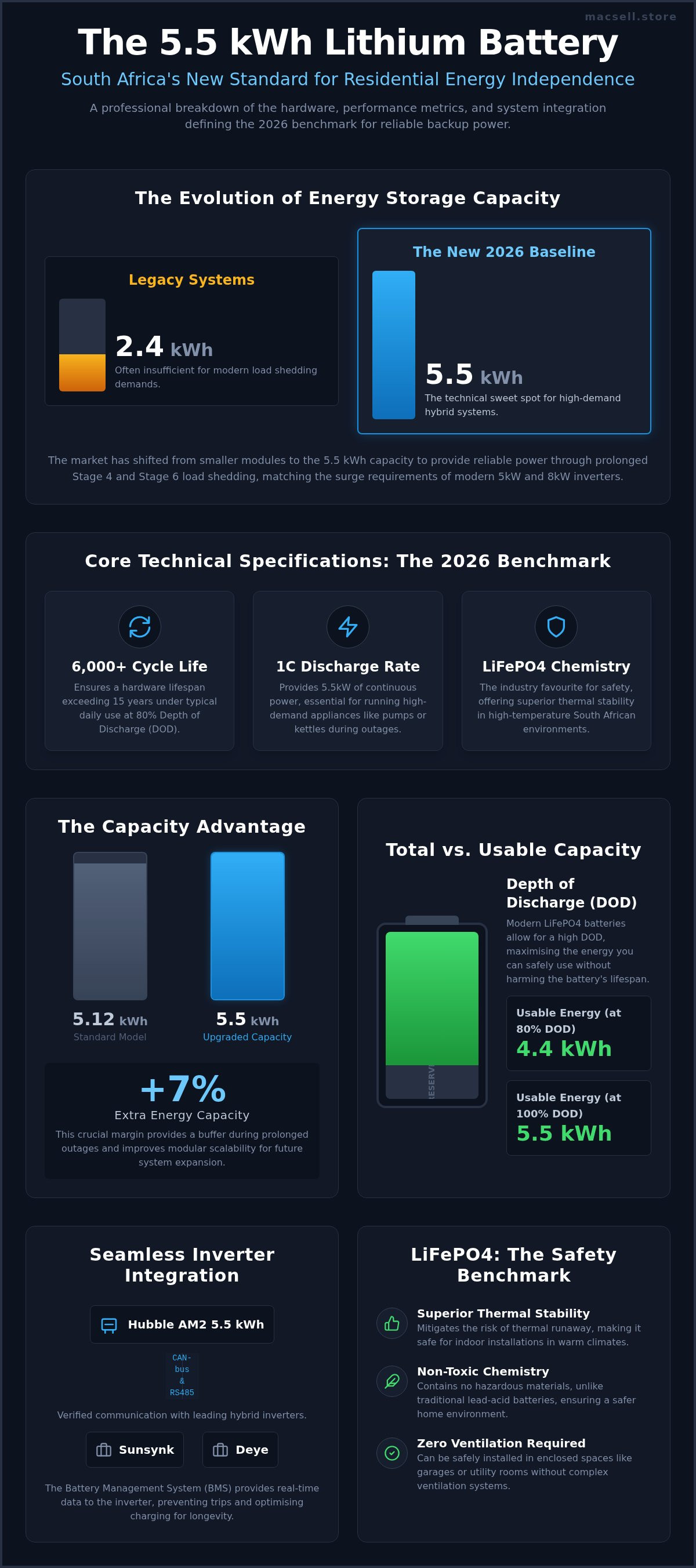
- Analyse the 7% capacity advantage of 5.5 kWh units over standard 5.12 kWh models and how this margin improves modular scalability.
- Streamline procurement by sourcing high-end solar hardware directly to maintain control over your system components and project budget.
Understanding the 5.5 kWh Lithium Battery Standard in South Africa
A 5.5 kWh lithium battery South Africa standard represents a high-density energy storage solution designed for modern hybrid power systems. It typically features a nominal voltage of 48V or 51.2V and a capacity of 110Ah. This specific capacity has emerged as the baseline for residential backup in response to increasing grid instability. Whilst earlier systems relied on 2.4 kWh modules, the current demand for longer discharge windows during Stage 4 and Stage 6 load shedding has rendered smaller units insufficient for most households.
Understanding the distinction between total capacity and usable capacity is vital for system sizing. A 5.5 kWh unit provides a specific amount of stored energy, but the amount you can safely extract depends on the Depth of Discharge (DOD) settings. Most modern Lithium-ion (Li-ion) battery systems, particularly those using LiFePO4 chemistry, allow for a DOD of 80% to 100%. This means a 5.5 kWh battery offers approximately 4.4 kWh to 5.5 kWh of actual energy to support your critical loads. This margin is essential for maintaining hardware health over a decade of operation.
The Evolution of Energy Storage Capacity
The transition from traditional lead-acid technology to lithium has redefined efficiency. Lead-acid batteries occupied significant floor space and suffered from rapid degradation if discharged below 50%. In contrast, 5.5 kWh lithium modules offer a compact footprint with significantly higher energy density. This module size has become the preferred choice amongst South African homeowners because it aligns perfectly with the surge requirements of 5kW and 8kW hybrid inverters. It provides enough headroom to run essential appliances like refrigerators, lights, and routers for 4-hour load shedding blocks without reaching critical voltage levels. Comparing energy density amongst leading hardware brands shows a clear trend toward these larger, more efficient modules.
LiFePO4 Chemistry: The South African Safety Benchmark
Lithium Iron Phosphate (LiFePO4) has become the industry favourite due to its inherent thermal stability. In high-temperature South African environments, the risk of thermal runaway is a genuine concern for indoor hardware installations. LiFePO4 chemistry mitigates this risk by maintaining structural integrity at higher temperatures compared to other lithium variants. These batteries are non-toxic and don't require the ventilation systems associated with lead-acid alternatives. Choosing LiFePO4 ensures that your hardware remains safe for installation within garages or utility rooms. It's the standard for risk mitigation in residential environments, providing peace of mind alongside technical performance.
Technical Specifications: Discharge Rates and Cycle Life
Selecting a high-performance 5.5 kWh lithium battery South Africa requires a close analysis of discharge parameters and longevity metrics. The 2026 industry standard for LiFePO4 hardware has solidified at 6,000+ cycles at an 80% Depth of Discharge. This benchmark ensures that your investment remains operational for over 15 years under typical daily cycling conditions. According to a recent battery storage market assessment, the transition toward high-cycle LFP (Lithium Iron Phosphate) chemistry is the primary driver for residential energy security in the local market.
The Battery Management System (BMS) serves as the critical interface between your stored energy and the inverter. A professional-grade BMS manages cell balancing, over-voltage protection, and thermal regulation. In grid-tied systems, the BMS must provide real-time data to the inverter via CAN-bus or RS485 ports to prevent "tripping" during high-demand intervals. Without accurate BMS communication, the inverter cannot optimise the charging profile, which leads to premature cell degradation and reduced efficiency.
Optimising Discharge Rates for Longevity
C-ratings define how quickly energy can be drawn from the cells. A 0.5C rating means the battery discharges its full capacity over two hours, whilst a 1C rating allows for a full discharge in just one hour. For a 5.5 kWh unit, a 1C rating provides 5.5kW of continuous power. This is essential when running high-demand appliances like borehole pumps or kettles during load shedding. High-quality units, such as those found in our Hubble AM2 5.5 kWh battery range, are engineered to handle these peak loads without excessive heat build-up, ensuring the internal chemistry remains stable during rapid discharge cycles.
Managing Depth of Discharge (DOD)
Modern LiFePO4 batteries are often marketed as having 100% usable capacity. Whilst technically possible, configuring your inverter to a 20% reserve (80% DOD) significantly enhances the hardware's lifespan. Operating at the extreme ends of the voltage curve increases internal resistance and heat. Depth of Discharge (DOD) defines the percentage of the total battery capacity that has been utilised, and limiting this value directly increases the total number of operational cycles the hardware can achieve. Setting conservative discharge limits protects your cells during consecutive Stage 6 power outages where recharge windows are limited.
Comparing 5.5 kWh Battery Performance Against Standard Capacities
The 5.5 kWh lithium battery South Africa market often pits standard 5.12 kWh units against higher-density 5.5 kWh alternatives. While 0.38 kWh appears negligible on a spec sheet, it represents a 7.4% increase in energy reserves. In a Stage 6 load shedding scenario where power outages last four hours, this extra capacity provides approximately 45 minutes of additional runtime for a standard home office setup. This margin prevents the hybrid inverter from reaching the low-voltage cutoff point prematurely, which protects the internal cells and ensures critical appliances remain online during extended blackouts.
Form factor plays a significant role in hardware deployment. High-capacity 5.5 kWh units are available in both wall-mount and rack-mount configurations. Wall-mounted units save floor space but are heavier, often exceeding 45kg, which requires reinforced mounting surfaces. Rack-mount modules offer better airflow and easier maintenance for multi-battery banks. When evaluating cost-per-kWh, the 5.5 kWh unit typically offers a lower price point per unit of energy stored because the fixed costs of the Battery Management System (BMS) and casing are spread over a larger cell array.
Capacity vs. Usable Energy
Calculating real-world run-times requires looking at continuous draw versus surge capacity. Modern hybrid inverters pull high currents when motors or heating elements engage. A 5.5 kWh module handles these surge currents more effectively than smaller 2.4 kWh or 3.5 kWh units by distributing the load across a larger internal cell bank. For a comprehensive look at the underlying cell architecture, refer to our guide on lithium ion solar battery technology. This increased capacity ensures that a single 5.5 kWh unit can comfortably support a refrigerator and entertainment system without the voltage sag common in lower-capacity hardware.
Scalability and Future-Proofing
Energy requirements rarely remain static. Modular scalability allows users to parallel multiple units, creating banks of 11 kWh or 16.5 kWh as household needs grow. Most 5.5 kWh modules use CAN-bus or RS485 communication to synchronise their states of charge. This ensures the master battery manages the slave units effectively. It prevents one module from discharging faster than the others. Using identical 5.5 kWh modules in a parallel configuration is the most efficient way to future-proof a system. It simplifies the wiring and ensures the charging parameters remain consistent across the entire hardware stack.
Inverter Compatibility: Integrating 5.5 kWh Units with Sunsynk and Deye
Successful integration of a 5.5 kWh lithium battery South Africa depends on the communication protocol established between the Battery Management System (BMS) and the hybrid inverter. Most high-end hardware uses CAN-bus or RS485 ports to synchronise data. This connection allows the inverter to read the battery's state of charge, voltage, and temperature in real-time. Without this data exchange, the system operates on "voltage-only" mode, which is less accurate and can lead to inefficient charging cycles or sudden power cut-offs during high-load periods.
Voltage range alignment is another critical factor. A standard 48V or 51.2V lithium module must operate within the inverter's DC input window, typically between 40V and 60V. Ensuring these parameters match prevents hardware damage and maximises the usable energy from the cells. For a secure installation, use high-quality 35mm² or 50mm² DC cables and appropriately rated DC circuit breakers to protect the hardware from overcurrent events. Proper cabling reduces voltage drop and minimises heat generation during peak discharge cycles.
Sunsynk and Hubble: The Premium Pairing
The Sunsynk Hubble combo kit has become a benchmark for residential systems due to its seamless "plug-and-play" compatibility. Sunsynk 8KVA inverters feature advanced load management, allowing users to prioritise essential circuits whilst managing non-essential loads like geysers or pool pumps. Setting up the BMS communication requires selecting the correct protocol on the Sunsynk touch interface, which then automates the charging profile. This ensures the Hubble AM2 5.5 kWh unit receives the precise current required for optimal cell health and longevity.
Deye and LuxPower Integration
Hardware from Deye offers similar technical depth, often sharing internal components with Sunsynk. When researching the Deye inverter price South Africa, compatibility with 5.5 kWh modules is a primary value driver. LuxPower SNA5000 units also support these modules, though they may require manual dip-switch configuration on the battery to identify the master and slave units in a parallel bank. Troubleshooting communication errors usually involves checking the pin-outs on the RJ45 cables, as different brands occasionally use varying pin configurations for CAN-bus signals. Ensuring the master battery is correctly identified allows the inverter to manage the entire bank as a single logical unit.
Procure your high-performance 5.5 kWh lithium battery and hybrid inverter hardware today to ensure total system compatibility and reliability.
Procuring 5.5 kWh Lithium Batteries: The Hardware-Only Advantage
Procuring high-end energy storage requires a shift from retail-focused bundles to direct hardware procurement. By sourcing a 5.5 kWh lithium battery South Africa directly from a specialised outlet, you eliminate the hidden markups typically found in turnkey installation quotes. This direct model provides transparency in hardware costs. It ensures your budget is spent on superior components like the Hubble AM2 rather than administrative overheads. MacSell Solar Outlet serves as a professional-grade procurement partner, focusing exclusively on the supply of high-performance solar hardware.
Verifying serial numbers and warranty documentation upon delivery is a non-negotiable step in the procurement process. All hardware must be registered with the manufacturer to ensure the 10-year lifespan is fully protected. When you buy hardware-only, you receive the original manufacturer’s packaging and factory seals, which guarantees the unit hasn't been refurbished or previously installed. This level of technical integrity is essential for systems that must withstand the daily cycling demands of the South African grid.
Streamlining Your Solar Project
Many professional installers prefer working with hardware provided by the client. It simplifies their scope of work to technical labour and compliance. Sourcing your own backup power kit South Africa allows you to lock in hardware availability before scheduling an electrician. This strategy prevents project delays caused by stock shortages in an installer's private supply chain. You should ensure your chosen professional is PV GreenCard certified or holds a valid Wireman’s License to sign off on the Certificate of Compliance required for legal grid-tied operation.
National Delivery and Support
Safe handling during transit is a priority for high-capacity lithium units. These batteries are classified as Class 9 Dangerous Goods and require specialised logistics to meet South African safety regulations. MacSell Solar Outlet manages the complexities of national delivery, ensuring hardware arrives in optimal condition. A technical hardware catalog should provide clear specifications on dimensions and weight to help you organise your storage space before the delivery vehicle arrives. This methodical approach to procurement ensures you have the right tools to achieve long-term energy independence.
Explore our 5.5 kWh lithium battery range at MacSell Solar Outlet to secure professional-grade hardware for your next energy project.
Securing Your Energy Independence with 5.5 kWh Technology
The 5.5 kWh lithium battery South Africa market has evolved to prioritise hardware that offers genuine discharge margins and high-cycle longevity. Selecting a module with a 6,000+ cycle rating and established BMS compatibility ensures your backup system remains operational for over a decade. By focusing on direct hardware procurement, you eliminate unnecessary retail markups whilst maintaining full control over your system's technical specifications and installation timeline. This approach guarantees that your investment is spent on high-performance cells rather than administrative overheads.
MacSell Solar Outlet serves as a professional-grade partner for your solar project. As an authorised Sunsynk and Hubble retailer, we provide a specialised technical hardware catalog designed for both individual consumers and industry professionals. Our national delivery service ensures that high-performance components reach your site safely and efficiently. Integrating a 5.5 kWh unit like the Hubble AM2 into your hybrid system provides the necessary headroom to navigate the most demanding power outages with confidence. You now have the technical roadmap to build a reliable, future-proof energy storage solution.
View 5.5 kWh Lithium Battery Pricing and Hardware at MacSell Solar Outlet to secure your energy future today.
Frequently Asked Questions
Is a 5.5 kWh lithium battery enough to run a house during load shedding?
A single 5.5 kWh lithium battery South Africa module typically powers essential loads for a standard four-hour load shedding block. Essentials include LED lighting, refrigeration, Wi-Fi routers, and home entertainment systems. It isn't designed to support high-draw appliances like electric stoves, geysers, or air conditioners for extended periods. Users should calculate their average hourly kilowatt draw to ensure the battery capacity aligns with their specific backup requirements during power outages.
How long does a 5.5 kWh lithium battery take to charge?
Charging duration depends on the inverter's charge current settings and the battery's maximum charge rate. At a standard 0.5C rate, which translates to roughly 2.75kW of input power, a 5.5 kWh battery reaches full capacity from a 20% state of charge in approximately two hours. Using a higher 1C charge rate can reduce this time, provided the hybrid inverter and battery management system support the increased current without overheating the cells.
Can I use a 5.5 kWh lithium battery with a 5kW hybrid inverter?
Yes, pairing a 5.5 kWh lithium battery with a 5kW hybrid inverter is a standard configuration in South Africa. You must ensure the battery voltage matches the inverter's DC input range, which is typically 48V or 51.2V. This setup allows the inverter to pull its full rated power whilst maintaining a healthy discharge margin. Systems using LuxPower SNA5000 or Deye 5kW units frequently utilise this specific battery capacity for residential backup.
What is the lifespan of a Hubble AM2 5.5 kWh battery in 2026?
The Hubble AM2 5.5 kWh battery features a 2026 industry-standard rating of 6,000 cycles at an 80% Depth of Discharge. Under typical daily cycling conditions, this hardware provides a service life of approximately 15 years. Longevity depends heavily on maintaining stable operating temperatures and avoiding repeated discharges to 0%. High-quality lithium iron phosphate (LiFePO4) chemistry ensures the cells retain significant capacity even after a decade of consistent use in local climates.
Do I need to buy a specific brand of battery for my Sunsynk inverter?
You don't have to use a specific brand, but the battery must support the Sunsynk inverter's communication protocols. Sunsynk inverters utilise CAN-bus and RS485 ports to talk to the battery management system. Whilst many brands are compatible, the Hubble AM2 is a preferred choice due to its proven integration and reliable data exchange. Always verify that the battery's firmware is compatible with your inverter model to ensure automated charging and accurate state-of-charge reporting.
What happens if my 5.5 kWh battery reaches 0% charge?
If a battery reaches a 0% state of charge, the internal Battery Management System (BMS) triggers a protective shutdown to prevent permanent cell damage. The unit will remain offline until it receives a wake-up charge from an external power source like the grid or solar panels. Repeatedly discharging the hardware to this extreme level increases internal resistance and shortens the overall cycle life. Setting a conservative 20% discharge limit on your inverter prevents this scenario.
Can I parallel a 5.5 kWh battery with a 5.12 kWh unit?
Paralleling batteries with different capacities, such as a 5.5 kWh unit and a 5.12 kWh unit, is not recommended. Discrepancies in internal resistance and capacity cause unbalanced charging and discharging cycles. One battery will work harder than the other, leading to premature failure of the smaller unit and potential BMS communication errors. For optimal performance and warranty protection, always use identical modules of the same brand, capacity, and firmware version within a parallel bank.
Is it safe to install a 5.5 kWh lithium battery inside my home?
Installing a 5.5 kWh lithium battery inside a residential building is safe when using Lithium Iron Phosphate (LiFePO4) technology. Unlike older lead-acid batteries, LiFePO4 units don't emit toxic gases during charging and possess high thermal stability. This chemistry significantly reduces the risk of thermal runaway. You should still ensure the installation area is dry, well-ventilated, and kept away from direct heat sources to maintain the hardware's efficiency and safety standards.