

Best Solar Hardware for a Home Office: Panels and Inverter
More panels don’t automatically make a better home-office backup system. South African households typically need six to fourteen solar panels rated at 460W or 575W, but the right number for your workspace depends on the equipment you run and its daily energy use.
It’s easy to focus on panel wattage and overlook the inverter, battery capacity and the loads running at the same time. Choosing the best solar hardware for a home office setup means matching all three to your actual demand, rather than choosing a bundle by panel count alone.
This guide explains how to estimate panel needs, size inverter capacity around peak demand and assess solar generator bundles with suitable panel sizes. You’ll also see why a household-wide estimate is only a starting point: a laptop-led workspace has different requirements from one running multiple screens, networking equipment and other essential loads. The result is a clearer basis for selecting components that fit your home-office setup.
Key Takeaways
- Size the inverter for the appliances running together at peak demand, not just the office equipment’s individual ratings.
- Estimate panel requirements from energy use and available sunlight, then consider how batteries support power when generation is low.
- Assess solar generator bundles by matching their inverter and battery capacity with compatible panel input.
- Separate home-office needs from household-wide loads to choose a system that suits your actual usage.
Sizing inverter capacity to peak demand
Size the inverter around the highest combined demand from equipment running simultaneously. Add the rated input of the laptop, monitors, router, lighting and other essential devices you expect to use together.
Include household loads if the inverter will support more than the office. A kettle or refrigerator operating alongside office equipment can raise total demand. The inverter needs to handle that combined load, not just the desk equipment’s separate ratings.
Allow for equipment that draws extra power when starting. Motors in refrigerators and pumps can have a higher start-up demand than their normal running demand. Check the equipment specifications and account for this surge when selecting inverter capacity.
A 3.6kW-5kW inverter is described as sufficient where essential loads rarely exceed a few kilowatts. A 5kW inverter is a suitable balance for most houses. Larger Sunsynk inverter versions are rated at 8.8kW and 12kW, but higher capacity only helps when the connected loads need it.
What permits, municipal approvals and electrical certificates are required for home solar in South Africa? Requirements depend on whether the system connects to the grid and on the relevant municipality’s rules. Establish the applicable approval and certification requirements before connecting a grid-tied hybrid inverter.
Which solar hardware brands and warranties are available in South Africa? Sunsynk, LuxPower and Deye are brand options, with the LuxPower 5kW SNA5000 a hybrid inverter choice. Compare the warranty terms for the exact model and its components, rather than assuming one brand-wide period applies.
A grid-tied hybrid inverter works with solar panels, batteries and the grid, drawing on different power sources. Match its output capacity to peak demand, then assess battery capacity separately for backup duration. This keeps inverter sizing focused on simultaneous load, not stored energy.
How Many Solar Panels Do I Need?
Estimate panel quantity by setting a target array capacity and dividing it by the rated output of one panel. Round up to a whole panel. This is a starting count, not a daily energy forecast: actual generation depends on the site and system design.
Compare each panel’s electrical specifications with the inverter’s solar-input limits. Array wiring affects voltage and current, so the combined values must fit the inverter’s operating range. If panels differ in model or rating, mismatched electrical characteristics can constrain the array.
Available roof area can set a practical limit. Map usable roof sections, noting orientation, obstructions and space needed for mounting access. One roof plane may not fit the full array, while separate planes can receive different amounts of sunlight. Account for these conditions before settling on a panel count.
Panel placement also affects how the array connects. Group panels with similar exposure where possible, and plan wiring routes from the array to the inverter. A coherent layout supports a clear system design and makes the installation easier to inspect.
For a home office, distinguish energy generated during working hours from energy intended for later use. A daytime-focused system can prioritise panels serving active equipment. Storing surplus also requires an inverter and battery that can handle the energy flow.
Compare panel specifications beyond headline wattage. Review rated output, electrical values and physical dimensions together to see whether a panel suits the available space and intended array configuration.
Before settling on a panel count, align the array plan with roof layout, inverter input limits and how you intend to use the generated power. These factors can change the practical requirement even when two home offices have similar equipment.
Use these considerations to narrow down solar panel options for your home-office system.
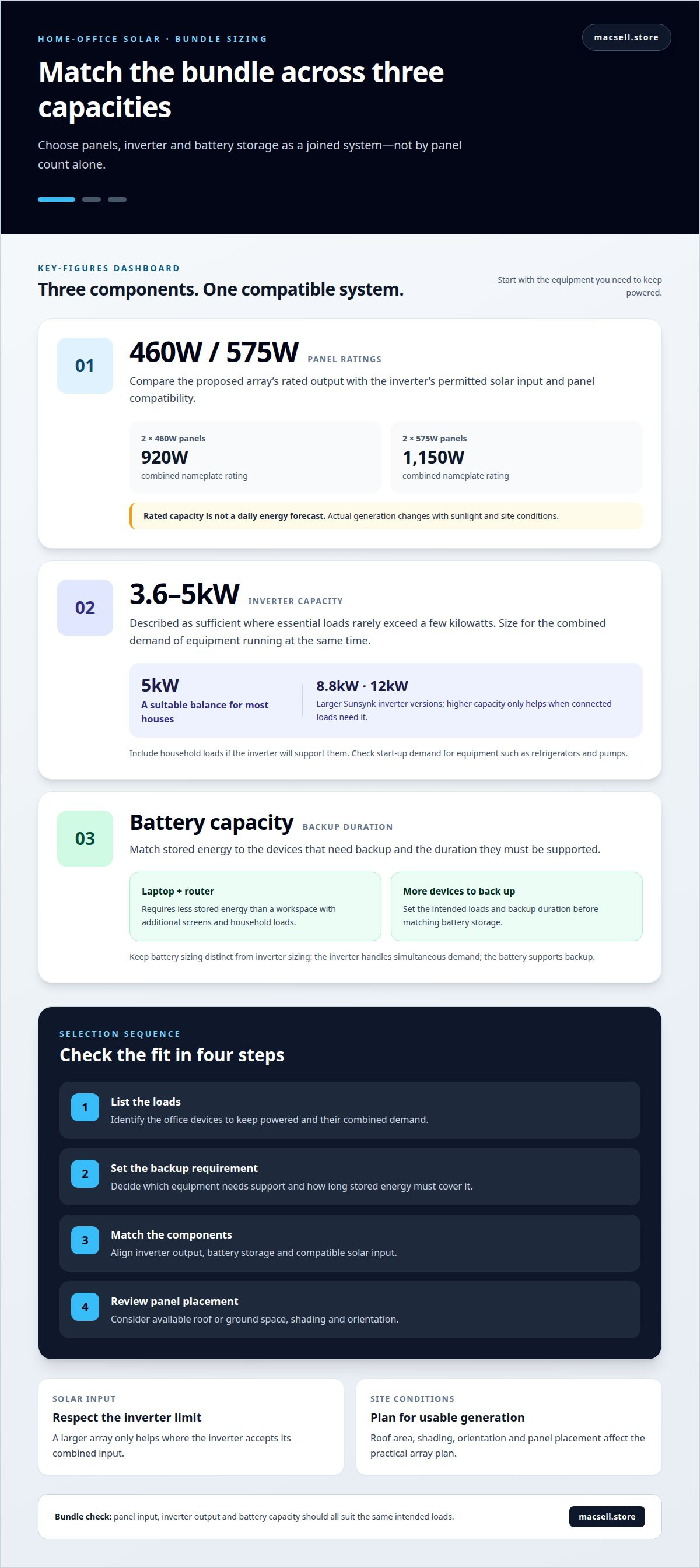
Solar generator bundles and recommended panel sizes
Solar bundles can combine an inverter, battery storage and panels, but configurations differ. Match each component to the office load and intended backup use. A bundle’s headline capacity alone does not show whether its panels can recharge storage effectively.
Start with the panel input specifications of the inverter or generator. Check the permitted solar input and panel compatibility, then compare these with the proposed array’s rated output. For example, two 460W panels have a combined nameplate rating of 920W; two 575W panels total 1,150W. These sums describe rated capacity, not guaranteed daily energy production.
Next, match battery capacity to the equipment that needs backup. A laptop and router require less stored energy than a workspace with additional screens and household loads. Keep the intended loads consistent across the bundle: a larger panel array cannot make up for an inverter unable to supply the required simultaneous demand.
Use this selection sequence:
- List the loads. Identify which home-office devices must remain powered and their combined demand.
- Set the backup requirement. Choose the equipment to support and the duration the stored energy must cover.
- Match the components. Align inverter output, battery storage and compatible solar input.
- Review panel placement. Consider roof or ground space, shading and orientation, which affect usable generation.
Panel count should follow the bundle’s solar-input limits and the energy the system needs to restore. A panel’s 460W or 575W rating helps compare options, but actual generation changes with sunlight and site conditions. Fewer higher-rated panels may suit limited mounting space; a larger array only helps where the inverter accepts its combined input.
Review panel input, inverter output and battery capacity together when selecting a bundle. This helps distinguish a configuration suited to office equipment from one intended to support broader household loads.
What solar power system size is best for a home office in South Africa?
There’s no single system size for every South African home office. Consider three ratings: panel capacity in watts, inverter output in kilowatts and battery storage in kilowatt-hours. Each serves a different purpose: panels generate energy, the inverter supplies loads, and batteries store energy for later.
Start with the equipment the system must support. A laptop, monitor and router create a different demand from a workspace that also runs household appliances. Decide whether solar should back up the office alone or selected household circuits. That boundary sets the required inverter output and prevents unrelated loads from inflating the design.
Then assess energy use across the working day. An office used mainly during daylight can draw on solar generation as it occurs; evening work relies more on stored energy or grid supply. Panel capacity should reflect daily use and site conditions, including roof orientation and shading. Rated panel output is not the same as energy delivered throughout the day.
Use this sequence to define the system:
- Define the backup loads. List office devices and any household circuits included.
- Calculate peak demand. Add the equipment expected to operate simultaneously, including start-up needs for motorised appliances.
- Estimate daily energy. Consider operating hours, not just the equipment’s maximum power rating.
- Set the backup objective. Decide which devices need stored power and when they must run.
- Match the hardware. Align panel input, inverter output and battery capacity with those requirements.
A larger array won’t fix an inverter that cannot supply the simultaneous load. Likewise, a high-output inverter doesn’t create stored energy during an outage. In South Africa, grid availability, local sunlight conditions and office working hours all affect the balance between panels, battery storage and grid supply.
Use your load profile to compare solar panel options against the system’s intended use, rather than choosing by panel count alone.
MacSell Solar Outlet
MacSell Solar Outlet sells solar panels, hybrid inverters and lithium batteries, including pre-configured solar power kits. These products let you compare the main system components together when matching hardware to your home-office requirements.
For a packaged option, the Sunsynk 8KVA & 2X Hubble AM2 5.5 KWh Combo Kit brings specified inverter and battery hardware together. Compare any package’s specifications with your planned loads, panel requirements and backup needs before choosing. Individual components may suit a setup where you’re selecting panels, storage or inverter hardware separately.
Use your system requirements to guide the hardware selection. Contact MacSell Solar Outlet to discuss your solar hardware options.
Turn your equipment list into a system plan
The best solar hardware for a home office setup is the combination that fits your working pattern, backup priorities and available space. Decide which devices must stay powered and whether the system should support household circuits too. Those choices give you a practical basis for selecting compatible hardware rather than choosing components in isolation.
MacSell Solar Outlet offers options across hybrid inverters, lithium batteries and solar equipment, including the Sunsynk 8KVA & 2X Hubble AM2 5.5 KWh Combo Kit. Use your load requirements to guide the conversation and focus on how the components fit your intended system.
Contact MacSell Solar Outlet to discuss hardware for your home-office setup. A clear set of priorities is a useful starting point for your next decision.
Frequently Asked Questions
How many watts do common home office devices use, including computers, monitors, routers and printers?
There isn’t one wattage for each device category; the exact figure depends on its model and operating mode. Read the power rating on the device label or power adapter, then add the wattages for equipment used simultaneously. A printer’s demand can change between standby and printing, so record both operating conditions before estimating the office’s peak load.
What solar panels, inverter and battery capacity are suitable for a South African home office?
Choose components around the office’s actual use, not a standard bundle size. A household estimate commonly spans six to fourteen panels rated at 460W or 575W, while essential loads may suit a 3.6kW-5kW inverter. Battery capacities such as 5.32kWh and 10.65kWh provide comparison points. Confirm that panel input, inverter and battery specifications are compatible.
How long can different battery sizes power a home office during load-shedding?
Runtime depends on usable battery energy and the office’s average load. As a rough calculation, divide usable battery capacity in kWh by average demand in kW; the result estimates hours before accounting for conversion losses. A 10.65kWh battery stores more energy than a 5.32kWh battery, but devices left running determine how quickly either capacity is used.
Is a grid-tied, hybrid or off-grid solar system best for a home office?
A hybrid system suits an office that needs to use grid electricity, solar generation and battery backup. A grid-tied system prioritises connection to the electricity network, while an off-grid system is designed to operate without relying on that connection. Base your choice on whether backup is required, how the office uses power and whether the wider home should be included.
What safety risks, maintenance needs and battery lifespan should home-office solar buyers consider?
Before connecting a grid-tied hybrid inverter, establish the applicable approval and electrical certification requirements. Check equipment specifications and ensure the array fits the inverter’s operating range.