

Buy Solar Inverter South Africa: 2026 Hardware Procurement Guide
In 2026, the value of a solar inverter is no longer measured by peak output alone. It is defined by its firmware's ability to manage high-discharge lithium batteries whilst maintaining grid-tie flexibility. You've likely felt the frustration of navigating confusing technical jargon like KVA versus kW. Perhaps you're worried whether your chosen hardware will actually communicate with your lithium bank. With the introduction of the SANS 10142-1:2026 standards, equipment compliance is now a technical necessity rather than a suggestion.
As the market shifts from emergency loadshedding fixes to long-term infrastructure investment, selecting the right hardware is critical for system longevity. This guide provides a technical roadmap to help you buy solar inverter South Africa hardware that meets these rigorous requirements. We examine the performance profiles of Tier-1 hybrid units from Sunsynk, Deye, and LuxPower. Our focus remains on seamless integration with Hubble storage and the efficiency of pre-configured combo kits for nationwide delivery. This analysis ensures you procure a system designed for the specific demands of the South African energy landscape.
Key Takeaways
- Understand why hybrid inverters have become the 2026 benchmark for grid-tie flexibility and advanced battery management in the South African context.
- Identify critical technical specifications such as MPPT efficiency windows and sub-10ms switchover speeds to safeguard sensitive hardware.
- Compare the specific performance profiles of Sunsynk, Deye, and LuxPower to ensure your equipment matches your load requirements.
- Master the procurement process to buy solar inverter South Africa stock with confidence by verifying VAT inclusion and nationwide dispatch timelines.
- Ensure seamless system integration by utilising pre-configured combo kits that guarantee BMS communication between inverters and lithium storage.
Understanding the 2026 Solar Inverter Landscape in South Africa
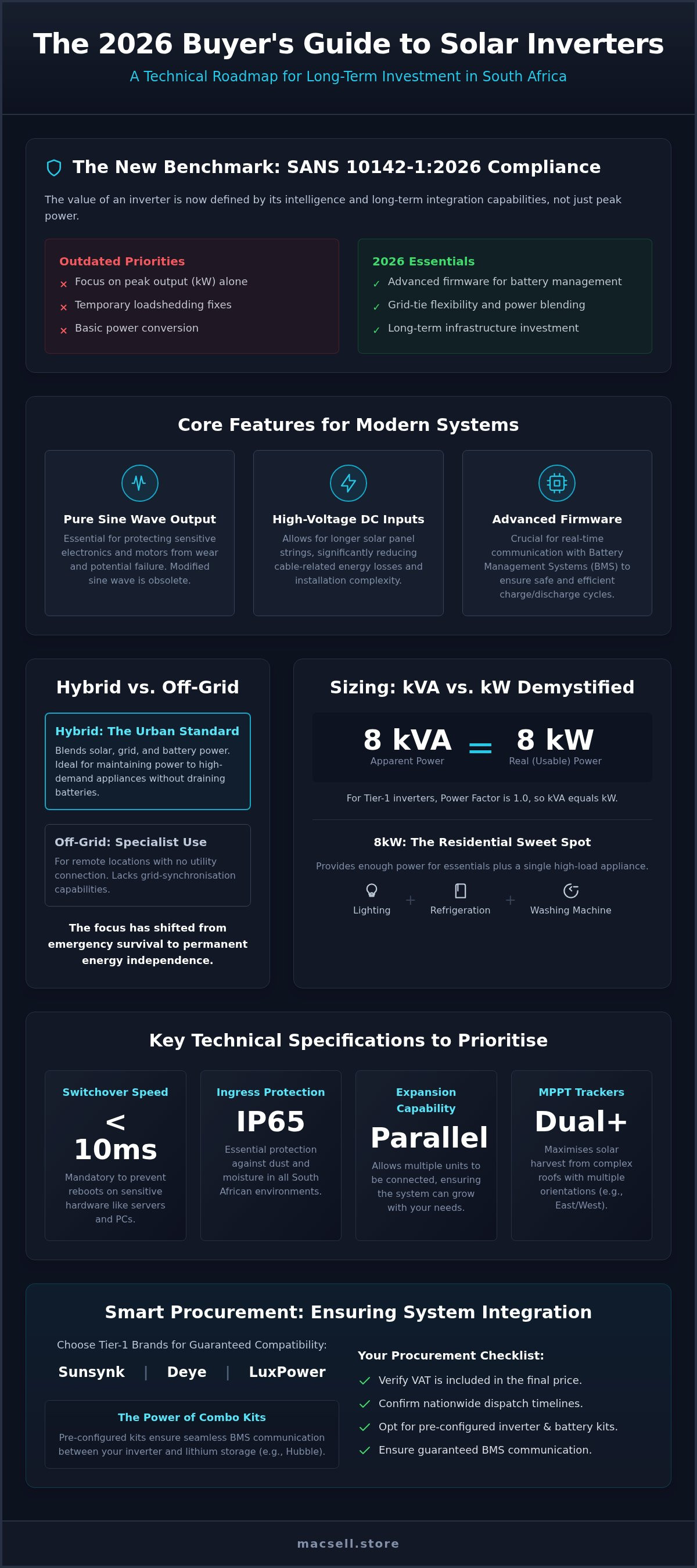
The solar inverter is the central intelligence of any modern power system. It manages the complex energy flow between PV panels, lithium storage, and the national grid. Understanding what a solar inverter is involves recognising its role as a power balancer rather than just a simple converter. In 2026, South African hardware must prioritise several key technical standards to ensure system longevity:
- Pure Sine Wave Output: This is essential for preventing equipment wear in sensitive electronics and household motors. Modified sine wave units are obsolete as they cause overheating and potential component failure.
- High-Voltage DC Inputs: Modern hardware now supports higher voltage ranges, which facilitates longer panel strings and significantly reduces cable-related energy losses.
- Advanced Firmware: 2026 models require sophisticated software to manage real-time communication with lithium battery management systems (BMS), ensuring safe discharge cycles.
When you prepare to buy solar inverter South Africa equipment, understanding these technical distinctions prevents costly procurement errors. The shift towards high-performance hardware reflects a maturing market that prioritises efficiency over temporary backup solutions.
Hybrid vs Off-Grid: Which Should You Buy?
Hybrid inverters are now the default choice for urban South Africans. These units offer blending capabilities, allowing the system to combine solar energy with grid power to meet high-demand loads simultaneously. This prevents the system from switching entirely to battery power when a high-draw appliance is activated. Off-grid inverters remain a specialist choice for remote sites where no utility connection exists. They lack the ability to synchronise with the grid, making them less versatile for the average homeowner looking to buy solar inverter South Africa hardware for long-term reliability. With the country having passed 365 consecutive days without loadshedding as of May 2026, the focus has moved from emergency survival to permanent energy independence.
Sizing Your Inverter: KVA vs kW Explained
Technical jargon regarding KVA versus kW remains a common pain point for buyers. Real power (kW) is what performs the work, whilst apparent power (KVA) includes the reactive power in the system. Most Tier-1 hybrid inverters now operate with a power factor of 1.0, meaning the kW and KVA ratings are identical. For example, a Sunsynk 8KVA unit provides a full 8kW of usable power.
An 8kW inverter has become the national sweet spot for residential use. It provides sufficient headroom to run essential lighting, refrigeration, and a single high-load appliance like a washing machine or microwave. To avoid inverter tripping, you must calculate your peak load by summing the wattage of all devices likely to run at once. Overloading the unit triggers protective shutdowns, which can lead to unnecessary hardware stress and reduced lifespan for the internal capacitors.
Key Technical Specifications to Prioritise
Technical specifications dictate how your system handles real-world environmental stressors. When you decide to buy solar inverter South Africa hardware, prioritise the internal components that ensure grid stability and hardware longevity. A primary metric is the switchover speed. For sensitive electronics like servers and desktop computers, a switchover time of 10ms or less is mandatory to prevent reboots during power transitions. High-performance hybrid units also feature IP65 ratings, providing essential protection against dust and moisture in both coastal and high-veld environments.
Expansion capability is another critical factor for long-term procurement. Most Tier-1 hybrid inverters allow for paralleling multiple units. This ensures that a 5kW or 8kW installation can grow with your energy needs without requiring a complete system replacement. Modern hardware also supports high-discharge rates, which are necessary to leverage the full power of lithium battery banks during peak demand periods.
MPPT Trackers and Solar Input
MPPT is the optimiser of solar harvest efficiency. Multiple MPPT trackers are essential for South African homes with complex roof orientations. If your PV array is split between East and West roof faces, dual trackers allow each string to operate at its peak voltage independently. This prevents the lower-performing string from dragging down the efficiency of the entire array. For an 8KVA Sunsynk model, the maximum PV input often reaches 10,400W. This headroom allows for "over-clocking" the solar array, ensuring the inverter reaches its full output even during the weaker solar radiation of winter months.
Hardware Protection and Durability
Compliance with the National Energy Regulator of South Africa (NERSA) guidelines and SANS 10142-1:2026 standards requires specific built-in safety features. Modern hybrid inverters must include integrated DC disconnect switches and Type II surge protection. These components protect the inverter's sensitive power electronics from atmospheric surges and simplify the isolation process for maintenance.
Thermal management is equally vital for hardware durability. High-capacity 8kW units typically utilise fan-assisted cooling to maintain optimal operating temperatures during peak South African summer heat. Whilst passive cooling is quieter, fan-assisted systems are superior for maintaining high loads over extended periods. You can view technical specifications for Deye and LuxPower models to compare these cooling strategies. Finally, consider the casing material; robust steel enclosures offer better protection during national delivery and provide superior heat dissipation compared to plastic alternatives.
Comparing Leading Hybrid Inverter Brands: Sunsynk, Deye, and LuxPower
Selecting hardware from established manufacturers ensures compliance with safety standards promoted by the South African Photovoltaic Industry Association (SAPVIA). Sunsynk and Deye dominate the local market, collectively accounting for approximately 75% of hybrid installations. Whilst they share a technical origin, their firmware and interface options cater to different user profiles. For those looking to buy solar inverter South Africa hardware, reviewing current hybrid inverter price South Africa data is the first step in budgeting for a Tier-1 system.
The Sunsynk 8KVA Standard
The Sunsynk 8KVA hybrid inverter is a benchmark in the South African residential sector. Its popularity stems from a highly intuitive touch-screen interface and extensive local support. A primary procurement option is the Sunsynk Hubble combo kit, which pairs the 8kW inverter with two Hubble AM2 5.5kWh batteries. This specific combination is pre-configured to ensure immediate BMS communication. Users can monitor system health via the Sunsynk Logger, which provides real-time data on PV harvest and battery state-of-charge. The 8kW model is particularly effective for households requiring high surge capacity for appliances like boreholes or large refrigeration units.
LuxPower and Deye: Technical Alternatives
Deye inverters offer high-performance hardware that mirrors Sunsynk's internal specifications, as Deye acts as the original equipment manufacturer (OEM) for much of the Sunsynk range. They provide a competitive edge in high-wattage residential applications, offering robust 8kW and 12kW Three Phase Hybrid models. These units are favoured by industry professionals who prioritise raw performance and modularity. You can review the latest Deye inverter price South Africa data to compare these high-capacity units against other Tier-1 brands.
For budget-conscious procurement, the LuxPower 5kW Inverter – SNA5000 Hybrid Inverter remains a reliable workhorse. It supports solar-to-load blending, making it ideal for smaller households or townhouses. Unlike entry-level units, the SNA5000 supports lithium communication and can be paralleled for future capacity growth. It represents a functional choice for those who need to buy solar inverter South Africa equipment that balances technical reliability with a lower entry cost. The SNA5000 is often paired with a single Hubble AM2 unit for a compact, high-efficiency backup solution.
Optimising Performance: Pairing Inverters with Lithium Battery Storage
The synergy between an inverter and its storage bank determines the overall efficiency of a renewable energy system. When you buy solar inverter South Africa hardware, the choice of battery chemistry is non-negotiable. Lithium Iron Phosphate (LiFePO4) has become the 2026 industry standard due to its superior thermal stability and cycle life. Unlike lead-acid predecessors, LiFePO4 units handle the frequent, deep discharge cycles required to manage South African energy instability without rapid degradation. These units typically offer over 6,000 cycles at 80% Depth of Discharge, providing a decade of reliable service.
Effective Battery Management System (BMS) communication is the most critical technical factor in this pairing. Many buyers assume "Plug and Play" compatibility, but true integration isn't always guaranteed without specific protocol matching. Integration requires the inverter to read real-time data from the battery via CAN or RS485 ports. This communication allows the inverter to adjust charge and discharge parameters based on the battery's internal temperature and cell voltage. For a deeper technical breakdown of these systems, consult our lithium ion solar battery guide.
The Hubble AM2 Integration
The Hubble AM2 5.5KWh lithium unit is specifically engineered for high-performance integration with Tier-1 inverters. It features a high-capacity busbar and a sophisticated BMS that supports seamless communication with Sunsynk and Deye hardware. This specific pairing is the preferred industry combo because it eliminates the guesswork involved in manual voltage settings. The integration is further enhanced by the Hubble Cloudlink, which provides advanced hardware health monitoring and remote firmware updates. This proactive management ensures that both the inverter and battery operate within safe thermal and electrical limits at all times.
Discharge Rates and Depth of Discharge (DoD)
Sizing your battery bank to match your inverter's discharge capacity is essential to prevent hardware stress. An 8kW inverter can pull significant current; if the battery bank's C-rate is too low, the system will throttle performance or trigger a protective shutdown. We recommend a 0.5C or 1C discharge rate for heavy residential loads. Maintaining a Depth of Discharge (DoD) between 80% and 90% is the optimal balance between usable capacity and hardware longevity. Even during persistent grid instability, keeping a 10% reserve prevents the lithium cells from entering a deep-discharge state that requires manual recovery. You can browse our pre-configured lithium and inverter combos to ensure your hardware is perfectly matched for maximum efficiency.
Procurement Strategy: How to Buy Your Solar Inverter Online
Strategic hardware procurement in 2026 requires more than just price comparison. To successfully buy solar inverter South Africa stock, you must verify the technical readiness of the supplier. High-demand units like the Sunsynk 8KVA or LuxPower SNA5000 often face stock volatility. Always confirm immediate national dispatch availability before completing a transaction. Transparency regarding VAT inclusion and delivery surcharges is also essential to avoid hidden costs that can inflate your project budget significantly. For a comprehensive list of necessary components, refer to our backup power kit South Africa checklist.
The Hardware-Only Buyer's Checklist
Purchasing hardware independently requires a meticulous approach to ancillary components. An inverter alone is insufficient for a safe installation. You must procure correctly rated DC circuit breakers, surge protection devices, and high-specification battery cables. Using undersized cabling is a common cause of system inefficiency and thermal failure. Additionally, verify the manufacturer's warranty terms for hardware-only purchases. Most Tier-1 brands require a Certificate of Compliance (CoC) from a registered electrician to honour warranty claims. You should plan your installation timeline by securing a qualified contractor whilst your hardware is in transit.
- DC Protection: Ensure breakers match the string voltage of your PV array.
- Cable Gauge: Use 35mm or 50mm copper cabling for high-discharge lithium banks.
- Firmware: Confirm the unit has the 2026 firmware update for Hubble compatibility.
Why Source from MacSell Solar Outlet?
MacSell Solar Outlet operates as a specialised hardware warehouse rather than a general retailer. This focus ensures that every buy solar inverter South Africa transaction is backed by technical expertise in high-end brands like Sunsynk, Deye, and LuxPower. By removing the overheads associated with installation services and financing, we provide direct-to-customer national delivery at competitive rates.
Our inventory includes curated inverter and battery combo for home use kits. These pre-configured sets eliminate compatibility guesswork between the inverter's BMS and the lithium storage cells. This direct procurement model allows savvy buyers to secure premium hardware whilst maintaining control over their own installation logistics. We specialise in Sunsynk 8KVA and Hubble AM2 combinations, ensuring you receive a system designed for the specific demands of the South African energy landscape.
Securing Your 2026 Energy Infrastructure
The transition from emergency power backup to long-term energy infrastructure requires a hardware-first approach. Prioritising Tier-1 hybrid inverters with sub-10ms switchover speeds and high-voltage DC inputs ensures your system remains compliant with the SANS 10142-1:2026 standards. As firmware compatibility between inverters and lithium storage becomes more complex, it's clear that selecting pre-configured kits is the most efficient way to reduce integration risks.
When you are ready to buy solar inverter South Africa hardware, sourcing from a specialised distributor ensures you receive the latest 2026 stock with verified technical specifications. We focus on providing high-performance Sunsynk, Deye, and LuxPower units that are engineered for the specific demands of the local grid. Our pre-configured Sunsynk 8KVA and Hubble AM2 kits offer guaranteed BMS communication and are ready for immediate dispatch.
Browse our range of Sunsynk and LuxPower inverters at MacSell Solar Outlet for national delivery across South Africa. Professional hardware procurement is the foundation of a reliable and efficient solar power system.
Frequently Asked Questions
What is the best solar inverter brand for South African conditions in 2026?
Sunsynk and Deye currently lead the market, representing a significant share of residential hybrid installations. Sunsynk is often preferred for its user-friendly touch-screen interface and extensive local support network. Deye offers robust hardware performance and is frequently selected for high-wattage applications. Both brands comply with the latest SANS 10142-1:2026 standards, making them reliable choices for those looking to buy solar inverter South Africa hardware for long-term use.
Can I buy a solar inverter and install it myself?
You can purchase the hardware independently, but a professional installation is required to ensure safety and legal compliance. South African regulations demand that a Department of Employment and Labour registered person signs off the system with a Certificate of Compliance (CoC). Attempting a DIY installation usually voids the manufacturer's warranty. MacSell Solar Outlet focuses strictly on the retail of premium components and does not provide installation services or technical support.
What is the difference between a hybrid and an off-grid inverter?
Hybrid inverters are designed to work with the national grid, solar panels, and battery storage simultaneously. They can blend power from multiple sources to meet high loads. Off-grid inverters are intended for remote locations where no grid connection exists. In an urban South African context, hybrid models are the standard choice because they allow for grid-tie functionality whilst providing essential backup power during outages or grid instability.
How do I choose between a 5kW and an 8KVA inverter?
The choice depends on your peak load requirements. A 5kW unit, such as the LuxPower SNA5000, is suitable for smaller households or townhouses with essential loads. An 8KVA unit is the residential "sweet spot" for standard homes, providing enough headroom to run multiple high-draw appliances like washing machines or pumps. Always calculate your total simultaneous wattage to ensure the inverter capacity matches your household's peak energy consumption patterns.
Are Sunsynk and Deye inverters the same hardware?
Deye is the original equipment manufacturer (OEM) for much of the Sunsynk range, meaning they share many internal power electronics and chassis designs. However, they are not identical. Sunsynk utilises proprietary firmware and a unique touch-screen interface designed for the South African market. Deye units often appeal to technical professionals who prioritise raw hardware performance and modularity. Both brands offer high efficiency and reliable communication with Tier-1 lithium batteries.
Does MacSell Solar Outlet provide installation services or financing?
No, MacSell Solar Outlet is a specialised hardware-only retailer. We do not provide professional installation services, solar financing plans, or 24/7 emergency technical support. Our business model focuses on supplying premium components like the Sunsynk 8KVA & 2X Hubble AM2 5.5 KWh Combo Kit at competitive retail prices. This allows savvy buyers to procure high-end hardware directly and manage their own installation logistics through independent contractors.
How much does a high-end hybrid inverter cost in South Africa?
Pricing for hybrid inverters is determined by the unit's capacity, brand tier, and current stock availability. High-end 8kW models are positioned as long-term infrastructure investments rather than emergency fixes. When you buy solar inverter South Africa stock, you should account for the cost of the inverter alongside essential DC protection and cabling. Investing in a Tier-1 brand ensures better firmware stability and hardware longevity compared to entry-level budget alternatives.
Is the Hubble AM2 battery compatible with all hybrid inverters?
The Hubble AM2 5.5KWh lithium unit is engineered for high compatibility with leading hybrid brands like Sunsynk, Deye, and LuxPower. It utilises a sophisticated Battery Management System (BMS) that communicates via CAN or RS485 ports. Whilst it works with many units, pairing it with a pre-configured Sunsynk or Deye inverter ensures seamless integration. This prevents communication errors and allows the inverter to manage the battery's charge cycles with technical precision.