

Deye Low Voltage vs High Voltage Battery Compatibility: 2026 Hardware Guide
Can you connect a standard 48V lithium battery to any Deye hybrid inverter, or does your backup setup demand a dedicated high-voltage stack? Assuming that any lithium unit will pair seamlessly with your hardware is an expensive mistake. Understanding Deye low voltage vs high voltage battery compatibility is essential before commissioning your power system; operating voltage architecture directly dictates electrical efficiency, expansion limits, and physical cabling constraints long before the first switch is thrown.
It's easy to see why confusion persists around CAN bus handshake protocols, BMS integration, and thermal limits during sustained load shedding. In this hardware guide, you will master the technical compatibility differences between Deye low-voltage and high-voltage energy storage systems to configure an optimal solar installation without risking component damage. We examine dedicated inverter series, communication wiring standards, and electrical isolation rules so you can select the correct battery architecture for your operational goals.
Key Takeaways
- Deye hybrid inverters feature dedicated hardware architectures, meaning low-voltage 48V units and high-voltage series stacks cannot be interchanged.
- Understanding Deye low voltage vs high voltage battery compatibility ensures seamless BMS handshake protocols and eliminates communication faults across CAN bus or RS485 connections.
- High-voltage energy storage reduces internal thermal stress and line losses by transferring power at higher DC potentials rather than massive currents.
- Low-voltage storage remains the practical standard for typical residential backup requirements, offering simpler modular expansion and accessible safety isolation.
- Hardware procurement requires rigorous verification of DC input voltage ranges and manufacturer firmware compatibility before matching inverters with lithium batteries.
Understanding Deye Low Voltage vs High Voltage Battery Architecture
Operating voltage defines the physical and electrical topology of an energy storage system. In solar backup applications, solar power inverters must physically interface with the battery bank at matching DC bus voltages. Deye manufactures distinct hardware lines with dedicated internal conversion stages: low-voltage (LV) inverters engineered for nominal 48V to 51.2V DC packs, and high-voltage (HV) units operating across a broad 160V to 800V DC window. System designers cannot mix these topologies. Evaluating Deye low voltage vs high voltage battery compatibility starts by recognising how cell grouping dictates current flow, circuit breaker specifications, and thermal dissipation under continuous load shedding cycles.
Low Voltage (48V/51.2V) Battery Architecture
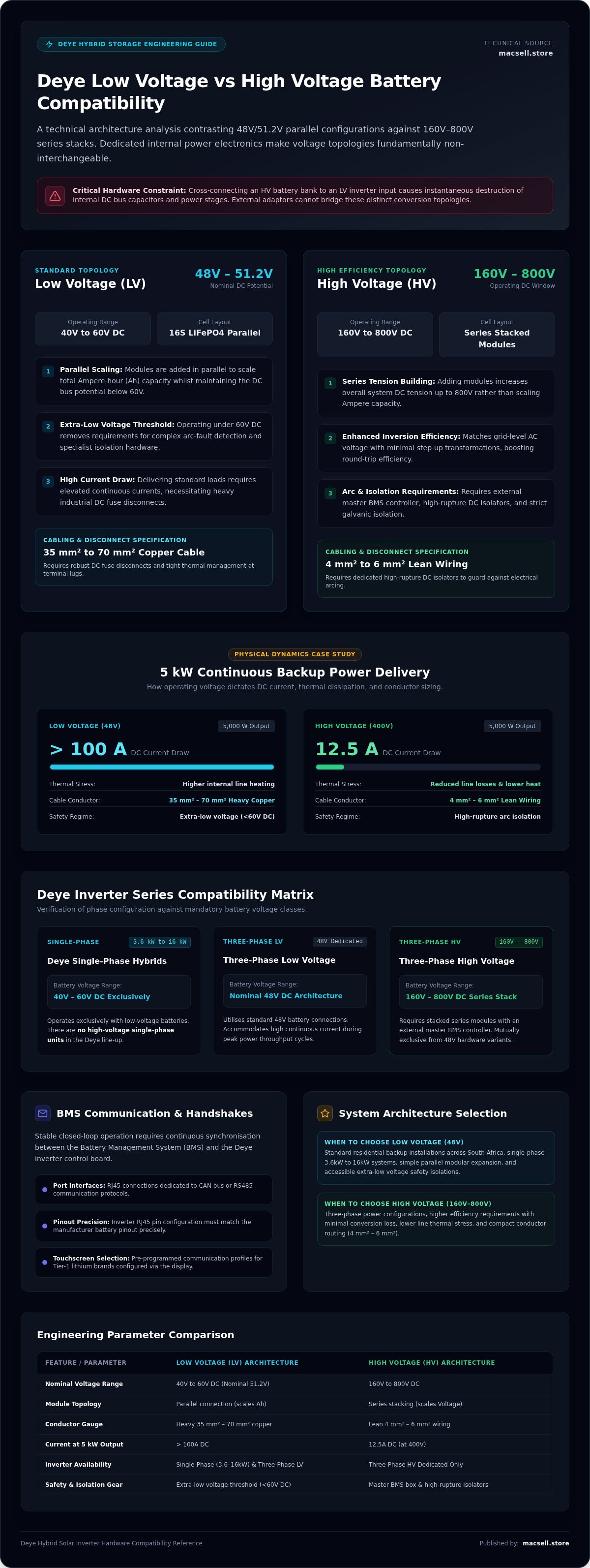
Low-voltage configurations connect multiple lithium cells or modular battery units in parallel. This arrangement scales total ampere-hour (Ah) capacity while keeping bus potential fixed at a nominal 51.2V (16S LiFePO4). Working below the 60V DC extra-low voltage threshold eliminates the need for complex arc-fault detection systems and specialised isolation gear. The physical trade-off is current. Delivering 5 kW of continuous backup power at 48V draws over 100A of DC current. This demands heavy copper conductors (typically 35 mm² to 70 mm² cable), industrial DC fuse disconnects, and tight thermal management at terminal lugs. Despite cabling bulk, LV remains the standard choice for domestic installations across South Africa due to simple modular expansion.
High Voltage (160V-800V) Battery Architecture
High-voltage setups take the opposite engineering route by stacking lithium modules in series. Adding batteries increases total DC bus potential rather than amp capacity, building system tension from 160V up to 800V DC. Operating at high tension allows the inverter to match grid-level AC voltages with minimal step-up transformations, boosting round-trip efficiency. Drawing 5 kW at 400V requires merely 12.5A. Consequently, system cabling drops to lean 4 mm² or 6 mm² wiring. However, high-voltage battery architecture requires an external master BMS control box to balance series cell strings. It also mandates dedicated high-rupture DC isolators and strict galvanic isolation protocols to protect against severe electrical arcing during component disconnection.
Technical Compatibility: Matching Deye Inverters with LV and HV Batteries
Hybrid hardware design dictates strict electrical boundary conditions. A hybrid inverter converts direct current (DC) electricity from photovoltaic arrays and storage banks into stable alternating current. Attempting to bridge low-voltage and high-voltage terminals using external adaptors is impossible; the internal power electronics are fundamentally fixed. Evaluating Deye low voltage vs high voltage battery compatibility requires checking the input voltage window on the unit nameplate prior to matching storage units. For detailed model comparisons, examine our Deye inverter specification guide.
Single-Phase vs Three-Phase Deye Inverter Voltage Classes
Deye single-phase hybrid inverters (spanning 3.6kW up to 16kW) operate exclusively within a 40V to 60V DC battery range. There are no high-voltage single-phase units in the line-up. For three-phase installations, Deye provides two mutually exclusive hardware architectures. Three-phase low-voltage inverters utilise 48V battery connections, which pulls high current during peak throughput. Three-phase high-voltage models require connected battery stacks operating between 160V and 800V DC. Cross-connecting an HV battery bank to an LV inverter input causes instantaneous destruction of the internal DC bus capacitors and power stages.
BMS Communication Protocols and CAN/RS485 Handshakes
Stable system performance relies on uninterrupted closed-loop communication between the battery management system (BMS) and the inverter control board. Deye inverters feature pre-programmed communication profiles for Tier-1 lithium manufacturers selectable directly via the touchscreen interface. Pinouts on the RJ45 CAN bus and RS485 communication ports must match the battery's pin assignment precisely. Check our lithium ion solar battery guide for architecture details. While Deye units offer open-loop voltage-sensing mode, this is purely an emergency failsafe and should not be used as a permanent operational strategy.
Parallel Expansion Capabilities and Hardware Limits
System scaling mechanics differ radically across both classes. Low-voltage storage banks expand by connecting uniform 48V modules in parallel on common busbars, multiplying available amp-hour capacity without altering system voltage. High-voltage systems require adding series modules to build voltage inside a dedicated tower or control rack. Ensure the total series voltage remains comfortably inside the inverter MPPT battery input range. To guarantee reliable Deye low voltage vs high voltage battery compatibility without configuration errors, source verified hardware combinations through MacSell Solar Outlet for guaranteed factory-level alignment.
Performance and Efficiency Comparison: Low Voltage vs High Voltage
DC-to-DC conversion physics dictate real-world backup performance. In a hybrid setup, the inverter internal DC bus runs between 350V and 450V to produce a clean 230V single-phase or 400V three-phase AC sine wave. Low-voltage batteries require an aggressive step-up transformation stage to elevate 48V to that internal bus tension. High-voltage battery systems bypass this conversion bottleneck entirely by delivering DC electricity at direct bus levels. When assessing Deye low voltage vs high voltage battery compatibility, these internal electrical mechanics determine overall round-trip efficiency, heat output, and system longevity. Review our hybrid inverter buying guide to evaluate system-level conversion efficiencies across various deployment sizes.
Round-Trip Efficiency and Internal Thermal Dissipation
Eliminating voltage step-up hardware directly lowers switching losses across the inverter power transistors. High-voltage battery banks frequently deliver round-trip storage efficiency gains of 3% to 5% over equivalent 48V setups. Operating at lower currents also reduces thermal stress on battery internal cell tabs and inverter circuit components. Lithium modules manufactured to international safety standards for energy storage experience less thermal degradation over repeated daily cycling when current density stays low. Cooler running temperatures translate directly into reliable continuous duty during sustained power outages.
Cable Sizing, Amperage Draw, and Conductor Heat Loss
Ohm's law governs physical conductor sizing. Delivering a sustained 10kW load illustrates the dramatic physical contrast between architectures:
- Low Voltage (48V): 10,000W / 48V = 208.3A continuous draw. Demands heavy 50 mm² to 70 mm² copper cables, industrial mega-fuses, and rigorous torque checking on terminal lugs.
- High Voltage (500V): 10,000W / 500V = 20A continuous draw. Requires straightforward 4 mm² to 6 mm² standard solar DC cabling.
High current creates significant resistive cable heat (calculated as I²R losses). Under back-to-back load shedding stages, continuous 200A draws generate heat that degrades standard terminations if cable runs exceed two metres. High-voltage installations eliminate these transmission losses, streamlining trunking and cable management. Factoring these thermal dynamics into your Deye low voltage vs high voltage battery compatibility evaluation prevents premature tripping and voltage-drop lockouts under heavy residential or light commercial loads.
Selection Criteria for Residential and Commercial Solar Setups
Matching operational demand to voltage topology prevents premature hardware obsolescence. Evaluating Deye low voltage vs high voltage battery compatibility requires analysing baseline electrical loads, available installation space, and future capacity scaling rather than simply comparing battery kilowatt-hour ratings. System designers must map these criteria directly against inverter continuous discharge thresholds.
Residential Backup Sizing and Load Demand Factors
Domestic properties with inverter capacities up to 12kW predominantly rely on low-voltage storage. A standard 48V configuration provides sufficient surge capacity for household essentials like borehole pumps, refrigeration, and lighting circuits. Modular 48V architecture allows incremental expansion; property owners can bolt on an additional 5kWh lithium battery as budget allows without altering system voltage or replacing switchgear. Consult our backup power kit guide for balanced residential hardware pairings.
Commercial Scaling and High-Surge Operational Demands
Industrial workshops, retail centres, and large estates running heavy three-phase HVAC compressors or machinery require the high continuous throughput of HV systems. High-voltage battery arrays sustain massive inductive motor surges without encountering the thermal throttling common to high-amperage 48V connections. Stacking series modules satisfies commercial energy storage targets while keeping line current well within manageable thermal boundaries. However, commercial battery rooms require strictly ventilated enclosures, dedicated fire suppression clearances, and lockable DC disconnect enclosures.
Installation Footprint and Battery Management Safety
Physical plant room constraints often settle the architectural choice quickly:
- Low Voltage Footprint: 48V rack-mount or wall-hung lithium batteries utilise vertical wall space, keeping floor areas clear in narrow domestic garages and utility rooms.
- High Voltage Footprint: HV systems assemble into vertical floor-standing towers or dedicated server-style racks, demanding level concrete plinths and clear side access for inter-module series linking.
- Isolation Safety: Low-voltage DC permits standard maintenance isolation switches. High-voltage strings create dangerous DC potentials up to 800V, requiring specialised rated isolators and arc-containment cabinets.
Selecting the right topology ensures proper balance between safety, footprint, and expansion limits. For certified, factory-matched storage stacks and hybrid units, browse inverter and battery stock at MacSell Solar Outlet to secure verified hardware delivered directly to site.
Procuring Compatible Deye Inverter and Battery Hardware
Specifying solar equipment demands thorough verification before components arrive on site. Confirming Deye low voltage vs high voltage battery compatibility requires cross-referencing model identifiers, DC input terminal ratings, and battery management system (BMS) communication integration. Inverter labels show strict operating parameters; verify whether the DC battery input specifies a 40V-60V operational window or a 160V-800V series array before finalising any purchase order.
Verifying Inverter Firmware and Protocol Mapping
Successful closed-loop integration depends on firmware alignment between the inverter microprocessor and the battery BMS. Verify that your battery distributor provides explicit RJ45 pinout diagrams matching Deye CAN bus ports (typically pin 4 for CAN-H and pin 5 for CAN-L) or RS485 terminals. Inverter control boards store pre-loaded protocol IDs; select the correct manufacturer index on the digital interface to initiate the handshake. A verified protocol handshake guarantees real-time data telemetry, allowing the battery to command dynamic charge current limits, report precise state of charge, and trigger immediate isolation if abnormal cell voltages occur.
Sourcing Verified Inverter and Battery Hardware Packages
Protecting capital equipment requires sourcing genuine Tier-1 hardware engineered to work together under demanding daily cycling. Mismatched balance-of-system accessories cause preventable field failures. When configuring hardware packages, specify the appropriate protection components for your chosen voltage class:
- Low-Voltage Protection: Heavy-duty NH00 or NH1 DC disconnect fuse switches rated for 160A to 250A, alongside high-flex copper cabling capable of handling heavy continuous current.
- High-Voltage Protection: Dedicated rotary DC isolators rated up to 1000V DC and specialised high-rupture fuses designed to extinguish severe direct-current arcs instantly.
Matching balance-of-system hardware directly preserves manufacturer warranties and ensures uninterrupted performance through sustained load shedding cycles. To source verified hybrid inverters, matched lithium batteries, and pre-configured hardware packages, visit MacSell Solar Outlet for nationwide dispatch across South Africa.
Deploying the Right Deye Storage Architecture
Operating voltage architecture dictates system efficiency, installation safety, and overall hardware longevity. Successfully navigating Deye low voltage vs high voltage battery compatibility comes down to matching your load profile with dedicated inverter engineering. Low-voltage 48V banks provide modular flexibility and straightforward handling for typical residential backup demands. Conversely, high-voltage series stacks deliver superior round-trip efficiency, minimal thermal stress, and compact conductor sizing for high-demand three-phase installations. Establishing verified closed-loop CAN bus communication between the BMS and the inverter remains essential across both topologies to ensure continuous cell protection.
Selecting the correct hardware combination upfront eliminates costly installation rework and protects your capital investment against premature component failure. With strict hardware-focused distribution, authentic manufacturer equipment, and nationwide dispatch across South Africa, sourcing verified storage setups has never been more straightforward. Explore high-performance Deye inverters and compatible lithium batteries at MacSell Solar Outlet to secure a dependable, expertly matched solar backup system today.
Frequently Asked Questions
Can I connect a 48V low voltage battery to a Deye three-phase high voltage inverter?
No, you cannot connect a 48V battery to a Deye high-voltage inverter. Deye three-phase high-voltage inverters require a minimum DC operating potential, typically between 160V and 800V DC. Connecting a 48V nominal battery causes an immediate undervoltage fault, preventing the internal DC stage from initiating. Internal circuit architectures are fundamentally separate, making Deye low voltage vs high voltage battery compatibility strictly non-interchangeable.
What happens if a Deye inverter loses BMS communication with a lithium battery?
If CAN bus or RS485 communication drops, the Deye inverter logs a BMS comms alarm and engages safety protocols. Depending on your configuration, the unit either stops charging and discharging immediately or defaults to conservative voltage thresholds for a limited period. Without active digital telemetry, the system cannot monitor individual cell voltages or internal temperatures, making prompt cable inspection vital to avoid system shutdown.
Are high voltage battery systems more efficient than low voltage battery systems?
Yes, high-voltage battery systems deliver higher round-trip electrical efficiency than low-voltage setups. HV stacks transfer power between 160V and 800V DC, keeping line current low and drastically reducing resistive heat losses across cables and connectors. In addition, the inverter bypasses the aggressive DC-to-DC voltage step-up stage needed for 48V inputs, eliminating conversion losses and improving total round-trip efficiency by up to 5%.
Can I add more battery modules to my Deye high voltage system later?
You can expand an HV battery stack later, provided you follow the manufacturer series matching rules. Expansion involves adding identical series modules to increase storage capacity and operating voltage within the inverter window. However, mixing fresh lithium modules with heavily degraded packs can lead to capacity throttling, as the lowest-capacity unit dictates string discharge limits. Always verify firmware and string parameters before adding modules.
How do I know if my Deye hybrid inverter is low voltage or high voltage?
Check the technical rating plate located on the side of your inverter casing. Low-voltage units explicitly specify a battery voltage range of 40V to 60V DC alongside high maximum charge currents exceeding 100A. High-voltage models show an operating DC battery range spanning 160V to 800V DC with much lower continuous current ratings. Confirming this label guarantees Deye low voltage vs high voltage battery compatibility before purchasing storage units.
Does Deye support open-loop lead-acid charging parameters for lithium batteries?
Yes, Deye inverters allow open-loop voltage-regulated charging by selecting lead-acid mode or manual voltage targets. This profile charges and discharges using bulk, absorption, and float voltages rather than digital BMS signals. While functional as a temporary backup during initial installation, running lithium packs open-loop permanently isn't recommended; it eliminates dynamic cell-level protection, disables thermal cut-offs, and frequently invalidates the lithium battery warranty.
Is high voltage battery cabling safer than low voltage battery cabling during operation?
High-voltage cabling produces significantly less operational heat, though it presents higher electrical shock risks. Operating at 10A to 25A prevents high thermal build-up and eliminates terminal lug melting common to sustained 200A low-voltage draws during back-to-back load shedding. However, DC voltages above 160V can maintain sustained electrical arcs if disconnected under load, requiring specialised high-rupture DC isolators and sealed conduit enclosures.