

Hubble Lithium Battery Warranty Terms and Cycle Life Claim: 2026 Guide
What if the ten-year coverage on your energy storage drops to five years simply because your remote monitoring link went offline? Evaluating the official Hubble lithium battery warranty terms and cycle life claim requires looking past headline marketing figures. Battery longevity depends entirely on strict, inverter-driven parameter compliance and operating temperatures, not broad showroom promises.
It is easy to feel frustrated by dense fine-print exclusions, particularly when balancing advertised cycle counts against daily real-world cell degradation and inverter compatibility limits. You shouldn't have to second-guess whether your hybrid inverter charge settings or operating environment might void your manufacturer protection. This guide analyses official Hubble warranty clauses, cycling metrics, and operational mandates so you can safeguard your hardware investment without unnecessary risk. We break down specific Cloudlink monitoring rules, usable cycles across varying Depths of Discharge, and critical inverter matching protocols for long-term system reliability.
Key Takeaways
- Master the dual-layer structure of factory protection, separating long-term cell retention thresholds from shorter battery management system coverage periods.
- Decipher the Hubble lithium battery warranty terms and cycle life claim across varying Depths of Discharge to benchmark real-world degradation against laboratory ratings.
- Identify mandatory operating protocols, including active Cloudlink monitoring connections and thermal thresholds, required to maintain full warranty coverage.
- Avoid claim-invalidating integration errors, from unapproved firmware modifications to missing DC circuit protection.
- Ensure system compliance by correctly matching battery hardware with approved hybrid inverters via closed-loop communications.
Hubble Lithium Battery Warranty: Core Terms and Coverage Structure
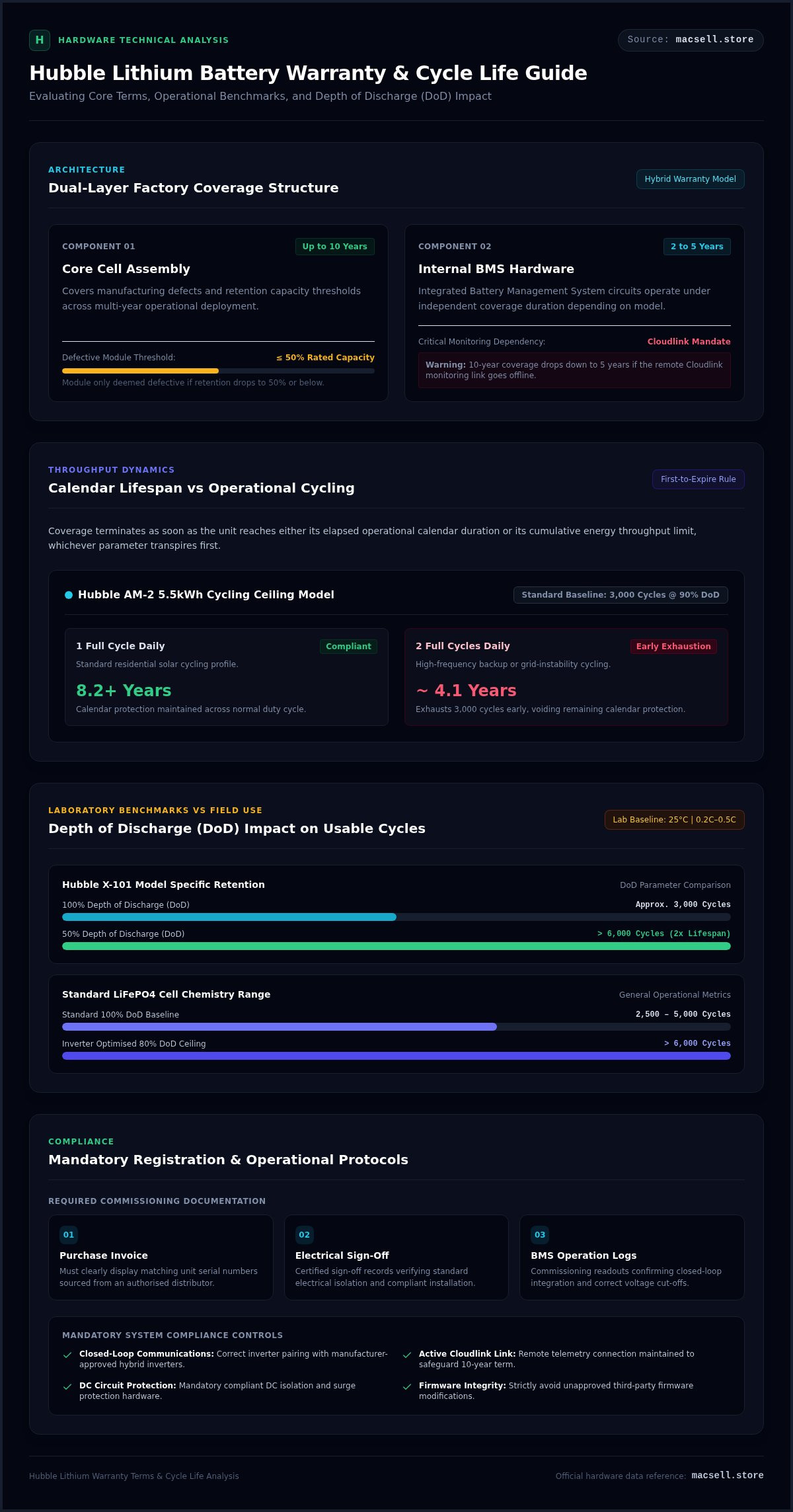
Energy storage procurement requires understanding the split between factory marketing and legal warranty protection. A proper evaluation of the Hubble lithium battery warranty terms and cycle life claim reveals a dual-layer warranty model: "a hybrid warranty covering manufacturing defects and benchmarked retention capacity." Protection does not apply indefinitely. Coverage terminates as soon as the unit reaches either its elapsed operational duration or its cumulative energy throughput limit, whichever parameter transpires first.
Manufacturer terms distinguish between core cell assemblies and internal control hardware. While lithium cells often carry a ten-year operational benchmark, integrated Battery Management Systems (BMS) carry independent periods ranging from two to five years depending on the model. For units like the Hubble AM-2 5.5kWh, capacity retention clauses specify that a module is only deemed defective if it delivers 50% or less of its original rated capacity during the claimed period. Basic understanding of underlying lithium-ion battery technology helps installers establish realistic expectations regarding chemical retention over standard multi-year deployments.
Calendar Lifespan Versus Energy Throughput Guarantees
Fixed calendar duration does not guarantee unrestricted discharge activity. High-frequency cycling draws down total megawatt-hour throughput rapidly. For example, the AM-2 standard warranty sets an upper ceiling of 3,000 cycles at 90% Depth of Discharge (DoD) across ten years. Running two full cycles daily exhausts that 3,000-cycle threshold in just over four years, voiding the remaining calendar protection ahead of schedule. Balancing daily load schedules prevents early throughput exhaustion.
Mandatory Registration and Commissioning Documentation
Validating warranty coverage demands strict administrative compliance immediately after installation. Hardware owners must record hardware serial numbers and register units via the manufacturer portal. Standard claim processing requires specific verification documentation:
- Original Purchase Invoice: Must clearly display matching unit serial numbers from an authorised distributor.
- Electrical Sign-Off: Certified sign-off records verifying standard electrical isolation and compliant installation procedures.
- BMS Operational Logs: Commissioning readouts confirming closed-loop integration and correct voltage cut-offs.
Omitting portal registration compromises downstream claim eligibility. Reviewing all operational parameters before commissioning protects your energy storage investment from early administrative rejection.
Analysing the Cycle Life Claim: Laboratory Benchmarks Versus Operation
Datasheet cycle metrics stem from strictly managed laboratory environments. Manufacturers validate longevity under stable 25°C ambient temperatures, uniform charging regimes, and moderate discharge rates (typically 0.2C to 0.5C). Real-world applications rarely mirror these baseline conditions. Frequent grid failures force energy storage banks into erratic, multi-cycle daily routines that compound mechanical and chemical wear. Understanding how these operational stresses challenge the Hubble lithium battery warranty terms and cycle life claim is critical, as detailed in CNET's consumer guide to solar battery warranties regarding stated throughput versus usable capacity.
Depth of Discharge Impact on Usable Cell Cycles
Depth of Discharge (DoD) dictates cell degradation rates. Standard lithium iron phosphate (LiFePO4) cells deliver between 2,500 and 5,000 cycles under 100% DoD conditions. Adjusting inverter cut-off parameters to an 80% DoD ceiling can extend cycle life beyond 6,000 cycles. For instance, the Hubble X-101 achieves approximately 3,000 cycles at 100% DoD, but delivers over 6,000 cycles when limited to 50% DoD. Integrated Battery Management Systems retain safety buffers to prevent destructive deep-discharge states. For detailed cell chemistry operational comparisons, consult our lithium ion solar battery guide.
Charge Rates and Thermal Degradation Factors
High charging currents elevate internal cell resistance and generate excess core heat. Exceeding recommended continuous C-rates accelerates irreversible lithium plating on internal anodes. Temperature control remains equally critical for preserving factory protection:
- Thermal Penalties: On units like the Hubble AM-2, the effective warranty period is reduced by 50% for every continuous 10°C increase in ambient operating temperature above 25°C.
- Optimal Current Thresholds: Setting charge parameters between 0.3C and 0.5C via solar arrays or grid supplies prevents thermal runaway and preserves internal chemistry.
- Buffer Configuration: Programming hybrid inverters with conservative float and absorption cut-offs shields modules during rapid, repeated recharge cycles.
Sourcing matched components through MacSell Solar Outlet ensures hardware configurations align with manufacturer charge profiles, preventing thermal degradation and keeping factory warranty clauses intact.
Operating Requirements for Maintaining Valid Warranty Protection
Manufacturer coverage is conditional rather than absolute. Protecting the Hubble lithium battery warranty terms and cycle life claim requires strict adherence to system integration mandates. Unlike off-grid lead-acid banks, lithium units function as software-managed hardware. Failing to maintain prescribed communication protocols and telemetry links gives manufacturers valid technical grounds to deny repair claims.
Operating data validates retention claims. As highlighted in a Nature Energy real-world battery degradation study, most residential storage packs meet their stated warranty claims only when operational settings match laboratory control limits. Integrating energy storage into certified electrical ecosystems protects long-term cell performance.
Approved Inverter Integration and Communication Protocols
Closed-loop communication between the battery management system and the hybrid inverter is non-negotiable. Connecting through dedicated RJ45 cables via CAN-bus or RS485 ports ensures the BMS directly dictates real-time charge rates, absorption limits, and low-voltage cut-offs based on instantaneous cell temperatures. Open-loop voltage-based operation exposes cells to overcharging. Leading hybrid platforms, including Sunsynk, Deye, and LuxPower units, feature native protocol integration with Hubble hardware to keep operation within factory safety limits.
Cloudlink Telemetry and Remote Data Logging
Remote telemetry represents an active warranty condition for specific Hubble models rather than a casual convenience. The manufacturer uses cloud logging to audit system parameters during warranty evaluations:
- Uptime Mandates: For models like the Hubble AM-5 and Blade, units must remain connected to the internet via the Cloudlink gateway. Prolonged offline status slashes the warranty coverage from ten years down to five years.
- Diagnostic Event Logging: Cloud records log cell voltage imbalances, discharge spikes, and thermal excursions. Resellers access these telemetry archives to adjudicate fault origins.
- Firmware Integrity: Active connections confirm the unit runs approved operational code without unverified third-party BMS modifications.
Operating Environment and Ambient Temperature Thresholds
Physical operating conditions dictate chemical stability. Most Hubble storage modules, including the AM-2, AM-5, and Blade, are strictly rated for indoor operation in clean, dry environments. Enclosures lack high-level ingress protection against windblown dust and moisture. Installers must avoid uninsulated corrugated iron outbuildings or unventilated ceiling spaces subject to high ambient heat. Sustained operating environments above 25°C trigger rapid chemical degradation, invalidating long-term retention coverage.
Common Pitfalls and Warranty Exclusion Clauses to Avoid
Manufacturer fine print protects suppliers against external electrical abuse and flawed installation practices. When technical service centres evaluate returns, claims fail most frequently due to avoidable site-level oversights rather than internal cell manufacturing defects. Preserving the Hubble lithium battery warranty terms and cycle life claim requires understanding these exclusionary clauses before energising the system.
Standard exclusionary clauses universally reject claims originating from lightning strikes, grid-induced voltage spikes, water ingress, or external mechanical shocks. Service technicians routinely inspect internal circuitry for telltale scorch marks and melted trace lines that signal high-voltage surges. If environmental or line-side electrical surges destroy internal management modules, standard manufacturer warranties do not cover replacement expenses.
DC Protection: Fusing, Isolators, and Surge Mitigation
Operating a battery bank without dedicated overcurrent and isolation hardware invalidates factory guarantees immediately. Official warranty clauses mandate specific circuit protection hardware between the storage unit and the power conversion equipment:
- Fast-Acting DC Fuses: Installations require appropriately rated high-rupture capacity (HRC) fuses or specialised DC-rated circuit breakers sized precisely to cable current limits.
- Rotary DC Isolators: Accessible, bi-directional disconnect switches must be installed to facilitate safe, arc-free physical isolation under heavy load.
- Cable Gauges and Terminations: Undersized DC cables induce high resistance, creating localised overheating. Using hydraulic crimping tools on high-strand pure copper cabling prevents hot spots that trigger inspection rejections.
- Surge Protection Devices (SPDs): Type 2 surge arrestors installed on primary AC distribution boards and incoming solar PV strings shield hardware against secondary lightning induced surges.
Battery Bank Undersizing and Heavy Inverter Demands
Pairing inadequate storage capacity with oversized power conversion units stresses lithium cells beyond their continuous discharge envelopes. A single 5.5kWh battery paired with an 8kVA inverter experiences severe over-current events during sudden residential peak loads. Inverter demand spikes yank discharge current past rated continuous limits, driving internal temperatures upward and tripping the BMS into emergency cut-off.
Repeated thermal trips write critical fault events into local diagnostic memories. Manufacturers review these event counters during claim assessments to repudiate coverage for over-stressed banks. Standard system balancing guidelines require a minimum of two 5.5kWh units when matching with an 8kVA inverter, or a single dedicated 5.5kWh module paired with conservative 5kW hardware. Review our home inverter and battery combo guide to evaluate complete configurations, or browse verified hardware components at MacSell to safeguard your battery investment with properly rated hardware.
Procuring Authentic Hardware: Sizing and Sourcing Strategy
Securing genuine equipment from established supply channels is the first step in protecting your energy investment. The validity of any Hubble lithium battery warranty terms and cycle life claim hinges on authentic product origins with documented serial traceability. Sourcing hardware directly through dedicated component distributors eliminates grey-import risks, uncertified refurbishments, and inflated installation package markups.
Matching Hubble AM2 Units with Sunsynk Inverters
Pre-engineered hardware combinations eliminate the guesswork of system sizing. Pairing an 8kVA inverter with storage requires adequate capacity to prevent current overloading. Deploying our Sunsynk 8KVA and Hubble AM2 combo kit balances continuous electrical draws by distributing power across two parallel 5.5kWh units. This configuration halves the operational C-rate per battery, maintaining nominal operating temperatures and safeguarding throughput thresholds.
Sunsynk hybrid inverters feature native CAN-bus integration engineered specifically for Hubble BMS protocols. Once connected via standard communication cables, the inverter automatically adjusts charge voltages, float levels, and cut-off points based on real-time cell parameters. This automated closed-loop communication prevents voltage imbalances while keeping factory guarantees intact.
Procurement Checklist for South African Hardware Buyers
Before taking delivery and scheduling your qualified electrical contractor, verify critical hardware details across your consignment:
- Serial Verification: Confirm that factory serial labels on the outer casing match your official supplier invoice for seamless portal registration.
- Terminal Accessories: Ensure your battery ships with factory busbars, communication leads, and correct terminal hardware to avoid substandard third-party substitutions.
- Integration Documentation: Supply your certified wireman with manufacturer pinout schematics for RJ45 CAN-bus sockets to prevent miswiring during inverter commissioning.
- Dedicated Hardware Supply: Procure directly from specialist retail stockists providing genuine Sunsynk, Deye, LuxPower, and Hubble inventory across South Africa.
Transparent hardware sourcing puts you in complete control of equipment specifications. By matching pre-tested components and adhering strictly to manufacturer operating parameters, you preserve your usable cycle life and guarantee full factory warranty protection from day one.
Safeguard Your Storage Investment with Certified Hardware
Securing reliable backup power requires navigating technical operational conditions well before commissioning your installation. Safeguarding your Hubble lithium battery warranty terms and cycle life claim comes down to disciplined system design: maintaining conservative discharge depths, enforcing closed-loop inverter communications, and ensuring continuous telemetry uptime. When you eliminate undersized battery banks and install compliant DC protection, your storage hardware reliably delivers the long-term energy throughput promised on the factory datasheet.
Hardware reliability begins with verified equipment procurement. MacSell provides a curated selection of premier Sunsynk and Hubble hardware, supplying strictly authentic equipment backed by original manufacturer guarantees. Sourcing pre-matched units eliminates communication friction and preserves your usable cycle life from day one. With nationwide direct-to-door delivery across South Africa, getting certified equipment to your door is seamless. Explore certified Hubble lithium batteries and inverter kits at MacSell to configure a balanced, warranty-compliant energy system built for long-term endurance.
Frequently Asked Questions
What is the standard warranty duration for a Hubble lithium battery?
Standard factory coverage varies by model, offering up to ten years on cells alongside two to five years on the BMS. For units like the AM-2, coverage terminates at ten years or 3,000 cycles at 90% Depth of Discharge. Evaluating the Hubble lithium battery warranty terms and cycle life claim means checking both cell duration and management electronics, as integrated control circuitry carries shorter protection periods than the raw lithium cells.
Does the Hubble cycle life claim mean the battery will last over 15 years?
No, a 15-year design life reflects internal cell capability under nominal conditions rather than a guaranteed operating period. If a bank cycles twice daily, it depletes rated cycle allowances in four to five years. Calendar degradation also reduces usable storage over time regardless of cycle volume. Daily operating temperatures above 25°C accelerate this loss, halving the AM-2 warranty duration for every sustained 10°C rise.
Is the Cloudlink device mandatory to maintain the Hubble battery warranty?
Yes, continuous Cloudlink connection is mandatory for specific models like the AM-5 and Blade to preserve the full ten-year coverage. If the unit remains disconnected from remote telemetry for extended periods, the factory warranty drops down to five years. The telemetry platform logs cell voltages, temperatures, and error codes, providing the verified operational history required by technical teams to process manufacturer claims.
Can using an unapproved inverter void my Hubble battery warranty?
Yes, operating with unapproved or non-communicating inverters puts warranty coverage at risk. Hubble units require active closed-loop CAN-bus or RS485 communication with compatible hybrid inverters like Sunsynk, Deye, or LuxPower platforms. Operating in open-loop voltage mode prevents dynamic charge regulation based on real-time cell temperatures. If voltage irregularities damage internal components during unmonitored charging, the manufacturer repudiates the claim.
What Depth of Discharge should I set to maximise Hubble cycle life?
Setting your hybrid inverter cut-off to 80% Depth of Discharge delivers the best balance of capacity and longevity. While models like the AM-2 support 90% DoD and the X-101 handles 100% DoD, conservative discharge ceilings dramatically extend usable service. LiFePO4 chemistry easily exceeds 6,000 cycles at reduced discharge depths, ensuring your system outlives its baseline throughput thresholds without triggering low-voltage BMS shutdowns.
What electrical protection hardware is mandatory when installing a Hubble battery?
Installations mandate fast-acting DC-rated fuses or specialised breakers sized to cable current limits, alongside a rotary DC isolator for physical disconnection. High-strand copper cables must use hydraulic crimps to avoid resistance hot spots. Installations also require Type 2 surge protection devices on AC distribution boards and incoming solar arrays. Neglecting these external safeguards immediately invalidates the Hubble lithium battery warranty terms and cycle life claim.