

Energy Storage Kit South Africa: The 2026 Hardware Procurement Guide
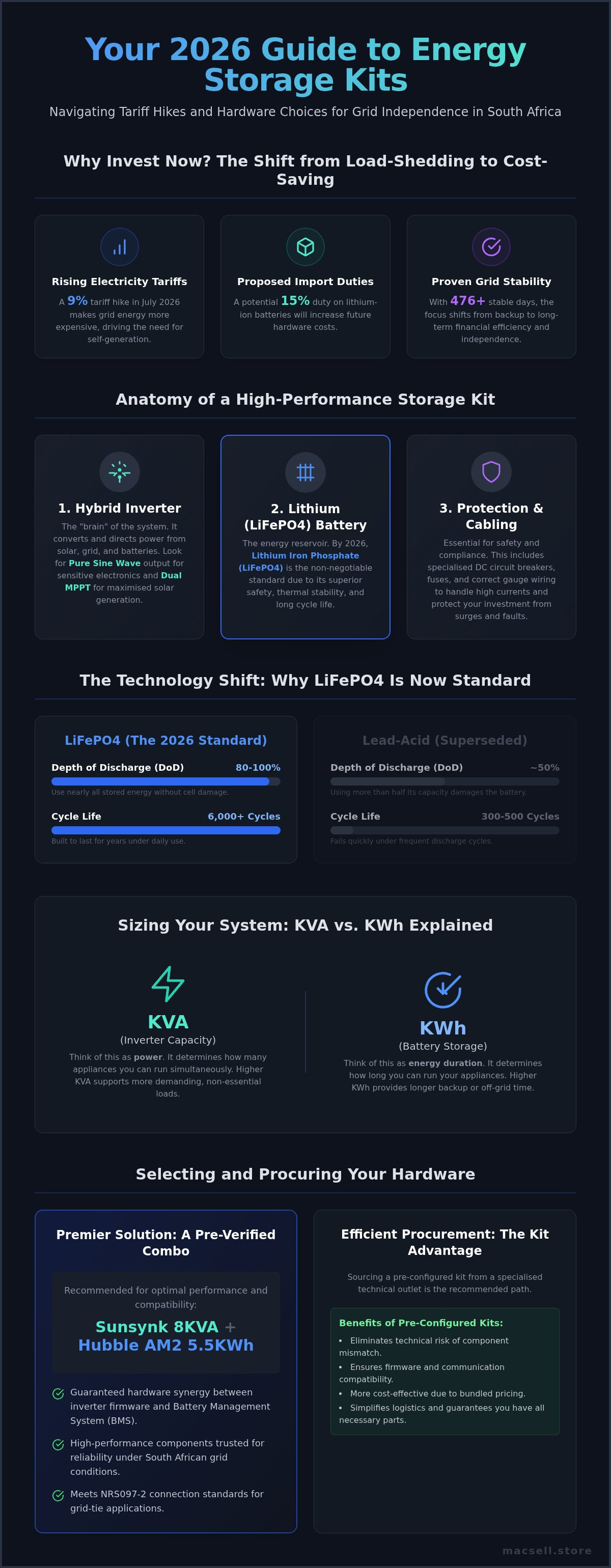
Why are South African households and businesses still investing heavily in backup power when the national grid has remained stable for 476 consecutive days? The answer lies in the 9% electricity tariff hike implemented in July 2026 and the proposed 15% import duty on lithium-ion batteries. Securing a high-performance energy storage kit South Africa is no longer just about surviving load-shedding. It's about financial independence and long-term grid-tie efficiency against rising utility costs.
You likely recognise that mismatched components lead to premature hardware failure and wasted capital. This technical guide eliminates that confusion. You'll master the precise specifications and hardware requirements for high-performance kits tailored for the local grid. We'll examine the critical synergy between Sunsynk hybrid inverters and Hubble AM2 lithium storage, providing a clear procurement roadmap for the 2026 landscape. From NRS097-2 connection standards to the performance metrics of the Sunsynk 8KVA and Hubble combo, this overview ensures your hardware investment delivers sustained reliability and technical compatibility.
Key Takeaways
- Define the modular components of a high-performance energy storage kit South Africa to effectively navigate grid instability and rising utility costs.
- Distinguish between KVA inverter capacity and KWh battery storage to accurately size hardware for essential and non-essential loads.
- Compare the technical merits of Sunsynk, Deye, and LuxPower hybrid inverters to select the most reliable control unit for your specific power requirements.
- Identify why the Sunsynk 8KVA and Hubble AM2 5.5 KWh combo kit represents a premier solution for hardware compatibility and sustained performance.
- Streamline the procurement process by sourcing pre-configured hardware kits directly from specialised technical outlets to ensure total component synergy.
Understanding Energy Storage Kits in the South African Context
An energy storage kit South Africa is a modular power solution designed to manage the interface between the national grid and local consumption. Each kit comprises three primary pillars: a hybrid inverter for power conversion, a high-density battery for energy retention, and specialised protection hardware to ensure system safety. Understanding the broader context of Energy in South Africa reveals why these systems have transitioned from luxury additions to essential infrastructure. By 2026, lead-acid technology has been entirely superseded by lithium-ion phosphate (LiFePO4) as the industry standard. This shift is driven by the need for depth of discharge (DoD) capabilities that lead-acid simply cannot sustain. MacSell Solar Outlet provides these high-performance hardware components directly to consumers and professionals, whilst clarifying that final integration must be performed by a qualified electrician to ensure regulatory compliance and safety.
The Role of Load Shedding in Hardware Selection
The historical frequency of load shedding in South Africa has fundamentally altered hardware requirements. Frequent discharge cycles demand high-cycle lithium batteries capable of 6,000 cycles or more at 80% to 100% depth of discharge. Standard batteries fail prematurely under these stresses, leading to hardware failure within months rather than years. Modern kits prioritise rapid recharge rates, often referred to as high C-ratings, allowing the reservoir to replenish quickly between power interruptions. This technical capability facilitates the transition from a backup-only strategy to a model of full energy independence. Users no longer just wait for the lights to stay on; they actively manage their own generation and storage to bypass rising municipal tariffs and grid instability.
Why Pre-Configured Kits Are the Efficient Choice
Procuring an energy storage kit South Africa as a pre-configured package is the most efficient path to a functional system. These kits eliminate the technical risk of communication errors between the battery management system (BMS) and the inverter's firmware. When you purchase a Sunsynk and Hubble combo, the hardware synergy is pre-verified, ensuring the inverter can accurately read the battery's state of charge. Logistically, sourcing a single package from a specialist outlet like MacSell simplifies the procurement process. It's often more cost-effective than buying individual components. Bundled pricing typically reflects a lower total capital outlay for the consumer while ensuring all necessary circuit breakers and fuses are included. You receive a synchronised hardware stack ready for professional installation without the headache of component hunting.
Core Components of a High-Performance Storage Kit
A reliable energy storage kit South Africa relies on the technical synergy between four critical pillars. It isn't merely a collection of parts; it's a synchronised system where the inverter, battery, management software, and protection hardware work in unison. Selecting high-tier components prevents the common "bottleneck" effect where a weak link limits the performance of the entire installation. Each piece of hardware must meet specific 2026 standards to ensure longevity under local conditions.
The Hybrid Inverter: Beyond Simple Conversion
The hybrid inverter acts as the system's brain. Unlike traditional off-grid models, hybrid hardware manages power from the grid, solar panels, and batteries simultaneously. It's essential to select an inverter that provides a pure sine wave output. This ensures that sensitive electronics, such as modern compressors or high-end computers, operate without interference or damage. Modern units from Sunsynk and Deye feature dual MPPT (Maximum Power Point Tracking) trackers. These allow you to maximise solar input from two different roof orientations, such as East and West, effectively extending your generation window throughout the day. The inverter dictates how quickly you can charge your batteries and how much load you can run during an outage.
Lithium Battery Storage: Hubble and LiFePO4 Standards
The lithium battery serves as the essential reservoir for stored energy. By 2026, Lithium Iron Phosphate (LiFePO4) has become the non-negotiable chemistry for residential safety. It offers superior thermal stability compared to older lithium-ion variants. Hardware like the Hubble AM2 5.5 KWh has set the benchmark for South African households due to its high Depth of Discharge (DoD). This allows users to utilise nearly 100% of the stored capacity without degrading the cells. These standards align with the evolving South African Renewable Energy Policy, which prioritises efficient, safe, and decentralised power solutions. High-performance batteries include an integrated Battery Management System (BMS) that monitors cell temperature and voltage, preventing overcharging and extending the hardware's lifespan.
Protection hardware is the final, often overlooked, component. A dedicated DC DB box with high-quality surge protection and fuses is mandatory to shield your investment from grid-side surges and lightning strikes. These protection layers ensure that a fault in one area doesn't lead to total hardware failure. If you're ready to secure your system, you can browse pre-configured hardware combos that include all these essential protection elements as standard. This methodical approach to component selection ensures your energy storage kit South Africa remains operational for its full intended service life.
Sizing Your Energy Storage Kit: Capacity vs Load
Monthly electricity spend is a misleading metric for system sizing. It doesn't account for peak demand or specific hardware limitations. To procure the right energy storage kit South Africa, you must distinguish between KVA (the inverter's instantaneous power capacity) and KWh (the battery's total energy volume). If your peak load exceeds your inverter's KVA rating, the system will trip. If your total consumption exceeds your KWh capacity, the lights go out. Accuracy in these calculations prevents the common error of buying an undersized system that fails under load.
Calculating Household Energy Demand
You must categorise your loads into essential and non-essential groups. Essential loads typically include lighting, security systems, and refrigeration. Non-essential loads usually comprise geysers, ovens, and air conditioning units. Consider these common appliance wattages when estimating your peak load:
- LED Lighting: 5W - 10W per bulb
- Refrigeration: 150W - 300W
- Laptops/Routers: 50W - 100W
- Kettles/Microwaves: 2,000W - 3,000W
Surge current is a critical factor. Inductive loads like pool pumps or borehole motors require three to five times their running wattage to start. An 8KVA inverter handles these spikes more effectively than a 5kW unit. For a comprehensive inventory of necessary hardware, refer to this solar power hardware checklist. This ensures every circuit breaker and fuse matches your calculated demand.
Battery Sizing for Extended Load Shedding
A single 5.5 KWh battery provides roughly five hours of backup for a home drawing a constant 1,000W load. If your demand is higher, modular expansion is necessary. Most modern lithium units allow for parallel connection to increase KWh without requiring an inverter upgrade. It's a scalable way to future-proof your installation against grid instability.
Pay close attention to the C-rating of your battery. A 0.5C battery can only discharge half its rated capacity in one hour. A 1C battery, such as the Hubble AM2, can discharge its full capacity in sixty minutes. You must match this discharge rate to your inverter’s DC input limit. If the inverter pulls more current than the battery can safely provide, the BMS will trigger a shutdown. Large family homes with multiple refrigeration units or pumps require an 8KVA Sunsynk energy storage kit South Africa to ensure the hardware isn't constantly running at its thermal limit. A 5kW LuxPower system is generally sufficient for smaller households focused on basic essentials.
Selecting Premium Hardware: Sunsynk, Deye, and LuxPower
Selecting the core hardware for an energy storage kit South Africa requires a comparison of technical parameters rather than brand popularity. Sunsynk and LuxPower represent two different tiers of performance and price. Sunsynk provides advanced power management for complex loads, whilst LuxPower offers a robust entry point for standard residential backup. Both brands provide hybrid functionality, but their software capabilities and hardware limits differ significantly. Choosing between them depends on your specific solar array size and peak discharge requirements.
Sunsynk 8KVA: The Professional Choice
The Sunsynk 8KVA hybrid inverter is a high-end unit capable of managing up to 10,400W of solar input. Its touch-screen interface allows for granular control over battery discharge schedules and grid-tie settings. For households requiring future scalability, this hardware supports parallel configurations of up to 16 units. This model is frequently paired with high-cycle batteries to create a resilient energy storage kit South Africa. It's built to handle heavy inductive loads, such as borehole pumps or large refrigeration units, without thermal throttling. You can find a detailed breakdown of this setup in the Sunsynk 8KVA and Hubble AM2 combo guide.
LuxPower SNA5000 Performance Specs
The LuxPower SNA5000 is a reliable 5kW hybrid inverter that excels in smaller residential applications. It features a peak efficiency of 93% and supports seamless switching between grid and battery power. This model is particularly suited for dedicated backup circuits where the total load doesn't exceed 5,000W. Whilst it lacks the advanced parallel depth of the Sunsynk 8KVA, it remains a cost-effective solution for essential power. It's a "plug-and-play" option for users who don't require complex load-shifting logic. For current market valuations and hardware comparisons, consult the hybrid inverter price South Africa buying guide.
Modern hardware must include remote monitoring capabilities. Both Sunsynk and LuxPower provide Wi-Fi dongles and dedicated mobile applications. These tools allow you to track energy production, battery health, and load patterns in real-time. Firmware updates are equally critical. They ensure the inverter communicates correctly with the latest battery management systems (BMS) and patches any technical bugs. Remote access allows for troubleshooting without on-site visits, ensuring your hardware remains optimised for the South African grid environment.
Ready to secure your power? Purchase a high-performance inverter or combo kit today for national hardware distribution.
Procuring Your Energy Storage Kit from MacSell Solar Outlet
Procuring an energy storage kit South Africa requires a hardware partner that prioritises technical accuracy over generic retail strategies. General retailers often lack the inventory depth or technical knowledge needed for 2026 grid requirements. MacSell Solar Outlet operates as a specialised technical outlet, focusing on the direct distribution of premium brands like Sunsynk, Deye, and Hubble. This transactional efficiency ensures that individual consumers and industry professionals receive high-performance components without unnecessary delays. It's important to clarify that MacSell is a hardware specialist. We provide the technical tools and pre-configured kits, whilst you provide the qualified electrician to handle the professional installation and compliance certification.
The Sunsynk and Hubble Combo Advantage
The technical synergy between Sunsynk inverters and Hubble lithium batteries is the foundation of a reliable backup system. The Sunsynk 8KVA and 2X Hubble AM2 5.5 KWh combo kit is currently the premier solution for residential power independence. These brands have developed native communication protocols that facilitate a "plug-and-play" connection. Using the correct communication cables allows the inverter to monitor the battery's internal state of charge and cell temperature in real-time. The Hubble AM2 5.5 KWh battery is a high-cycle unit that maintains its performance even under the stress of frequent discharge. This combination eliminates the firmware conflicts common in mismatched systems, ensuring your hardware investment remains protected and efficient.
Hardware Availability and National Delivery
National hardware distribution is a core pillar of the MacSell service model. We maintain deep stock levels of hybrid inverters and lithium storage units to ensure immediate availability. This streamlined procurement process allows you to bypass the long lead times often associated with local contractors. By sourcing your energy storage kit South Africa directly from a specialised warehouse, you gain control over the hardware quality and project timeline. Every pre-configured kit is verified for component compatibility before dispatch. This logistical focus ensures that your chosen installer has every necessary part, from the inverter to the protection hardware, ready for immediate implementation. This methodical approach to inventory management makes MacSell the go-to technical partner for high-end solar procurement.
View the full range of energy storage kits at MacSell Solar Outlet
Secure Your Grid Independence with Technical Precision
Procurement in 2026 demands technical precision. Selecting a pre-configured energy storage kit South Africa ensures component synergy and prevents the communication failures common in mismatched systems. You've now mastered the distinction between KVA capacity and KWh volume, along with the performance metrics of industry leaders like Sunsynk and Hubble. MacSell Solar Outlet serves as an authorised Sunsynk and Hubble retailer, maintaining a specialised technical hardware inventory for national distribution across South Africa. We focus on transactional efficiency, providing the exact hardware your installer requires to build a resilient power system.
It's a methodical approach that guarantees hardware compatibility and long-term reliability against rising utility costs. Explore our range of Sunsynk and Hubble Energy Storage Kits to begin your transition to energy independence today. Your path to a stable, self-sufficient power supply is now technically clear. Secure your hardware and take control of your energy future today.
Frequently Asked Questions
What is included in a standard energy storage kit in South Africa?
A standard energy storage kit South Africa includes a hybrid inverter, one or more lithium batteries, and a DC protection box. It should also contain the necessary communication cables for the Battery Management System (BMS) and both AC and DC circuit breakers. These components work together to manage power flow from the grid or solar panels. MacSell focuses on providing these hardware essentials as pre-configured packages ready for professional installation by your own electrician.
Can I expand my energy storage kit by adding more batteries later?
You can expand your system by adding more lithium batteries in parallel. Most modern hardware, like the Hubble AM2, is designed for modular scalability. It's essential to ensure the new batteries match the voltage and chemistry of the existing units. You should also check if your hybrid inverter’s firmware supports the expanded capacity. Adding units allows you to increase your total energy reservoir as your consumption needs grow without replacing the entire inverter.
How long will a 5.5 KWh lithium battery last during load shedding?
A 5.5 KWh battery typically provides between four and six hours of backup for a standard household load of 1,000W. The exact duration depends on your discharge rate and the efficiency of your inverter. If you run heavy appliances like kettles or pumps, the stored energy will deplete much faster. Monitoring your real-time load via the inverter's mobile application helps you manage consumption during extended grid interruptions and ensures you don't exceed the battery's limits.
Is the Sunsynk 8KVA inverter compatible with all lithium batteries?
The Sunsynk 8KVA inverter is compatible with most leading lithium brands, but it requires a specific communication protocol to function optimally. It works best with batteries that share a verified BMS integration, such as the Hubble AM2 series. Whilst it can operate with many 48V lithium units, using a non-approved brand might limit your access to real-time data. Always verify hardware compatibility before procurement to ensure seamless system communication and full access to the inverter’s advanced settings.
Do I need a special certificate of compliance (CoC) for my energy storage kit?
A Certificate of Compliance (CoC) is a legal requirement for any fixed electrical installation in South Africa. This document must be issued by a registered electrician after the hardware has been integrated into your distribution board. It confirms the system meets national safety standards and is necessary for insurance purposes. Whilst MacSell provides the high-quality hardware, you must engage a qualified professional to perform the installation and issue the certificate to ensure your system is fully compliant.
What is the difference between a backup power kit and a full solar kit?
A backup power kit focuses on storing grid energy for use during outages, whilst a full solar kit includes photovoltaic panels for local generation. Both systems utilise a hybrid inverter and lithium battery, but the solar version allows you to reduce your reliance on the grid entirely. An energy storage kit South Africa can be upgraded to a full solar solution later by adding panels and MPPT-compatible hardware to the existing setup as your budget allows.
How do I choose between a 5kW and an 8KVA hybrid inverter?
Your choice depends on your peak instantaneous load and the number of essential circuits you wish to power. A 5kW LuxPower unit is suitable for smaller homes with basic essentials like lights, routers, and refrigeration. An 8KVA Sunsynk inverter is the professional choice for larger households with inductive loads like pool pumps or multiple air conditioners. If you plan to expand your solar array in the future, the 8KVA model offers significantly better scalability and power management.
Can an energy storage kit help me go completely off-grid?
An energy storage kit is the foundation of an off-grid system, but it requires a significant solar array and large battery bank to achieve total independence. Most residential setups are grid-tied, meaning they use the national grid as a secondary backup. Going fully off-grid in 2026 requires careful load management and enough storage to last through several days of poor weather. It's a hardware-intensive transition that demands precise capacity planning and a high-performance inverter to manage the load.