

Home Battery Backup South Africa: The 2026 Hardware Procurement Guide
A high-performance home battery backup South Africa system is no longer a luxury upgrade; it is essential residential infrastructure for 2026. Most homeowners realise that basic portable power stations cannot sustain a modern household during the current cycle of tariff increases and grid instability. You've likely experienced the frustration of hardware that trips under heavy load or the confusion of trying to match inverter discharge rates with lithium battery capacities. It is a technical challenge where small errors lead to expensive system failures.
This guide provides the technical specifications required to achieve permanent energy independence. You'll learn how to correctly size hardware for your specific demand and discover why certain solar combo kits outperform fragmented configurations. We focus on the precise compatibility between high-end hybrid inverters and lithium storage units to ensure your investment delivers reliable power regardless of external grid conditions.
We examine the critical hardware differences between 5kW and 8KVA systems. This includes an analysis of high-performance components like Sunsynk and LuxPower inverters paired with Hubble AM2 batteries. You will gain a clear roadmap for procuring hardware that meets the rigorous energy demands of the 2026 South African landscape.
Key Takeaways
- Define 2026 standards for fixed-wire energy storage, focusing on LiFePO4 chemistry and hybrid inverter roles.
- Master the technical distinction between kWh storage capacity and kW peak output to avoid system trips under load.
- Learn why high-speed CANbus communication and BMS integration are essential for a reliable home battery backup South Africa installation.
- Discover the procurement advantages of matching high-performance hardware like Sunsynk and Hubble in pre-configured combo kits.
- Navigate the national hardware market to identify authorised retailers and secure critical manufacturer-backed warranties.
Understanding Home Battery Backup in the South African Context
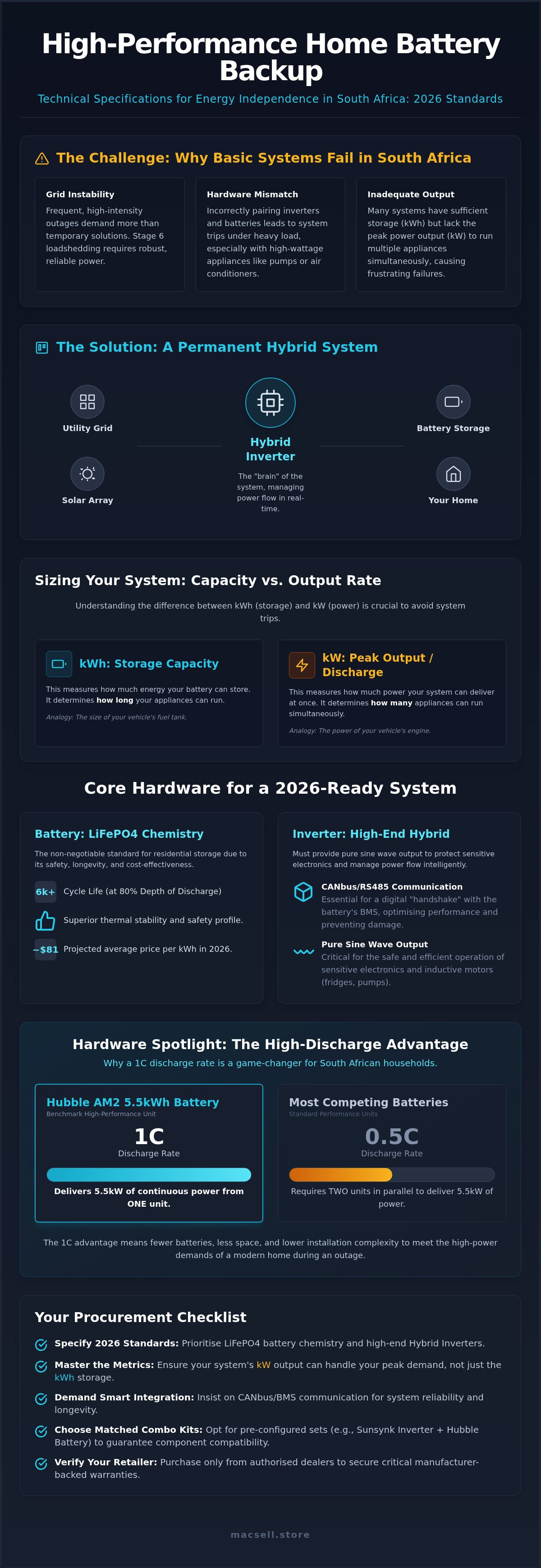
A permanent home battery backup South Africa system is defined as a fixed-wire Battery Energy Storage System (BESS) integrated directly into the property's distribution board. Unlike portable power stations, these installations provide a seamless transition during grid failures. The system functions as critical infrastructure rather than a temporary appliance. A centrally managed hybrid inverter acts as the system's brain; it regulates power flow between the utility grid, the solar array, and the battery bank simultaneously. It ensures that energy is prioritised for immediate use, storage, or grid feedback based on real-time demand.
Local requirements differ significantly from European or American standards. South African households face frequent, high-intensity outages that necessitate higher discharge rates to sustain normal living conditions. European systems often prioritise slow, steady energy release for self-consumption. In contrast, local hardware must handle rapid draws to keep essential services running during Stage 6 loadshedding. Moving from portable units to a permanent residential energy architecture is a shift toward total grid independence and long-term energy security.
Grid-Tied vs. Off-Grid vs. Hybrid Systems
Standard grid-tied systems provide no protection during outages. They are designed to shut down for safety when the grid fails, leaving the property in the dark. Hybrid systems represent the gold standard for energy security in South Africa. They combine the benefits of grid connectivity with the reliability of battery buffers. Off-grid kits are gaining popularity amongst high-usage households. These users choose to disconnect from the utility entirely to avoid rising fixed charges and unpredictable tariff hikes, effectively becoming their own power utility.
Load Profile Analysis for Energy Independence
Accurate hardware sizing requires a detailed understanding of base load versus peak demand. Base load is the constant power draw from refrigerators, security systems, and standby electronics. Peak demand occurs when high-wattage inductive loads, like borehole pumps or air conditioning units, start up. These devices require a massive initial surge of current, often three to five times their running wattage. Successful system design involves prioritising essential circuits within the distribution board. This ensures that critical appliances remain powered whilst non-essential heavy loads are shed to preserve battery life during extended outages.
Core Hardware Components: Lithium Batteries and Hybrid Inverters
LiFePO4 (Lithium Iron Phosphate) is the non-negotiable standard for 2026 home battery backup South Africa systems. It offers superior thermal stability and a cycle life often exceeding 6,000 cycles at 80% depth of discharge. Global data indicates LFP pack prices are projected to average around $81/kWh in 2026, making them the most cost-effective chemistry for residential use. This technology dominates the lithium ion solar battery technology curve. As noted in the International Energy Agency analysis, the transition to renewable infrastructure requires hardware that can withstand intensive daily cycling without rapid degradation.
Effective system management relies on high-speed CANbus or RS485 communication between the inverter and the battery management system (BMS). This digital handshake allows the inverter to adjust charging parameters in real-time based on internal cell temperatures and voltages. Relying on basic voltage-based sensing is insufficient for lithium chemistries and often leads to premature hardware failure. High-end hybrid inverters also ensure a pure sine wave output. This is critical for protecting sensitive electronics and ensuring the smooth operation of inductive motors in household appliances.
Premium Battery Selection: The Hubble AM2 Advantage
The Hubble AM2 5.5 KWh lithium battery is a benchmark for residential storage. It features a high-performance 1C discharge rate, which allows a single unit to provide up to 5.5kW of continuous power. Most competing batteries only offer 0.5C, meaning you would need two units to achieve the same instantaneous output. This high discharge capability is vital for South African households running heavy appliances during outages. The AM2 supports modular scalability; you can parallel multiple units to increase total storage capacity as your energy needs grow.
High-Performance Inverters: Sunsynk, Deye, and LuxPower
Selecting the right inverter depends on specific load requirements and your hardware budget. The LuxPower SNA5000 price and performance ratio makes it a preferred choice for 5kW off-grid and hybrid setups. For mid-range installations, the Deye inverter price South Africa remains highly competitive, offering robust dual MPPTs and parallel capability for future expansion. These brands provide advanced remote monitoring via dedicated apps to track energy production and consumption. You can review these high-performance units in our solar hardware inventory.
Sizing Your Backup System: Capacity vs. Discharge Rates
Accurate hardware sizing for a home battery backup South Africa installation requires a clear distinction between capacity and power output. Capacity, measured in kilowatt-hours (kWh), dictates the total energy volume available for use. Power output, measured in kilowatts (kW) or kilovolt-amperes (kVA), determines the maximum load the system can support at any given second. Undersizing the output leads to inverter trips during peak demand, whilst insufficient capacity results in total depletion before the grid returns. Consult the backup power kit South Africa guide for pre-sized configurations that balance these two variables.
Depth of discharge (DoD) is equally critical for hardware longevity. Whilst modern lithium batteries allow for 80% to 100% DoD, consistently draining cells to their absolute limit accelerates chemical degradation. Maintaining a conservative DoD of 80% ensures the hardware reaches its full rated cycle life, typically 6,000 cycles or more for LFP chemistry. This technical buffer protects the lithium cells from the stress of extreme voltage drops at low charge levels.
5KW Systems: Ideal for Small to Medium Households
A 5kW inverter is the standard entry point for households prioritising essential services. This hardware supports critical loads such as LED lighting, high-speed Wi-Fi routers, and energy-efficient refrigeration. When evaluating the hybrid inverter price South Africa market, a 5kW unit paired with a single 5.5kWh lithium battery is a common configuration. However, these systems have strict limitations. Attempting to run a kettle whilst a microwave and a fridge compressor are active can push the unit toward its 5,000W limit, risking an immediate shutdown. These systems are best suited for managed loads where heavy appliances are used sequentially rather than simultaneously.
8KVA and 10kW+ Systems: Whole-Home Energy Security
For larger residential projects, the Sunsynk 8KVA is the preferred industry choice. This hardware provides a significant buffer for surge loads and allows for more comprehensive household coverage. It effectively manages high-draw appliances like geysers and ovens through integrated smart load management features. These features allow the inverter to toggle heavy loads based on battery state-of-charge or solar availability. Oversizing the inverter capacity also improves hardware longevity. By running an 8KVA unit at a 4kW constant load, the internal components operate at lower temperatures compared to a 5kW unit running at near-maximum capacity. This thermal efficiency reduces stress on the capacitors and cooling fans, extending the overall service life of the system.
Hardware Matching and Combo Kits: Ensuring Component Compatibility
Hardware matching is the most overlooked aspect of a reliable home battery backup South Africa system. Many procurement errors stem from the assumption that any 48V lithium battery is compatible with any hybrid inverter. This is a technical fallacy. Without seamless Battery Management System (BMS) integration, the inverter cannot accurately monitor cell-level data. This leads to inefficient charging cycles and potential hardware shutdowns during heavy load. Pre-configured hardware combo kits eliminate these procurement risks by providing verified, interoperable components that have undergone extensive laboratory testing.
The Sunsynk Hubble combo kit is a prime example of successful hardware synchronisation. Beyond the core units, a complete solar equipment checklist South Africa must include compatible DC breakers and high-gauge copper cabling. Using undersized cables or generic AC breakers in a DC circuit creates significant fire risks and voltage drops. Correct hardware matching ensures that every component, from the smallest fuse to the primary inverter, operates within its specified thermal and electrical parameters.
The Sunsynk 8KVA and Hubble AM2 Synergy
The technical success of this pairing relies on high-speed CANbus communication protocols. The Sunsynk inverter reads the Hubble AM2 internal temperature and state-of-charge data 10 times per second. This allows the system to optimise charging parameters dynamically, which is essential for maximum Hubble battery lifespan. During Stage 6 loadshedding, where the grid may only be available for short windows, this synergy allows for rapid, safe recharging at high current levels without risking cell damage. The 8KVA Sunsynk unit provides the necessary headroom to handle the 1C discharge capabilities of the Hubble hardware, ensuring the system does not trip when heavy appliances start up simultaneously.
Modular Expansion: Future-Proofing Your Hardware
A well-designed system allows for modular expansion as energy requirements increase. You can add additional Hubble AM2 units to an existing Sunsynk installation by simply paralleling the batteries and updating the BMS settings. For households requiring even higher output, Sunsynk inverters support paralleling up to 16 units. This allows for 16KVA or even 50kW+ configurations for large residential estates. Integrating high-wattage solar panels further extends battery runtime during prolonged outages. By providing a constant DC charge during daylight hours, panels reduce the depth of discharge required from the battery bank, effectively preserving the hardware for night-time use. Browse our pre-configured solar combo kits to find a compatible hardware match for your property.
Procuring Your Backup System: A National Hardware Guide
Procuring a home battery backup South Africa system requires technical diligence to avoid the risks associated with grey-market imports. These unauthorised units often lack manufacturer-backed warranties and local technical support, leaving homeowners vulnerable if a component fails. Purchasing from a specialised hardware retailer ensures that every inverter and battery in your configuration is sourced through official channels. This guaranteed provenance is essential for securing the 5-to-10-year warranties standard for premium brands like Sunsynk and Hubble. Review our solar system hardware cost breakdown South Africa to establish accurate 2026 pricing benchmarks before committing to a purchase.
Technical accuracy in procurement prevents the common mistake of buying mismatched components. General electrical retailers often lack the specific knowledge required to verify high-speed communication compatibility between different hardware generations. A specialized distributor understands the nuances of the 2026 hardware landscape, ensuring that your chosen inverter firmware is compatible with the battery management system of your storage units. This expertise is critical when moving from a conceptual design to a physical hardware list.
Logistics and National Hardware Delivery
Large-format lithium batteries are classified as dangerous goods and require specialised transport protocols. Safe delivery involves shock-resistant packaging and couriers certified for hazardous materials to prevent internal cell damage during transit. Current global supply chain shifts can impact lead times for premium brands. It's advisable to confirm stock availability for high-demand units like the Sunsynk 8KVA or Hubble AM2 before finalising project timelines. Use the following checklist upon delivery:
- Verify that all hardware seals are intact and show no signs of tampering.
- Inspect inverter and battery casings for any visible impact damage or scratches.
- Confirm that serial numbers match the technical documentation provided for warranty registration.
- Check that all included accessories, such as communication cables and mounting brackets, are present.
Finalising Your Component List
The final step in procurement is verifying compatibility with your existing property infrastructure. Ensure your chosen hybrid inverter is compatible with the physical space and ventilation requirements of your distribution board area. Whilst the procurement of hardware is a standalone process, the eventual installation requires a professional electrical sign-off. This Certificate of Compliance (CoC) is a non-negotiable requirement for both insurance validation and the activation of manufacturer hardware warranties. Once your component list is finalised and delivered, you can transition from the procurement phase to a professional installation with technical certainty.
Securing Your Energy Independence with Verified Hardware
Achieving total grid independence in 2026 requires moving beyond basic portable power to a permanent home battery backup South Africa system. Success depends on the technical synergy between high-performance hybrid inverters and high-discharge lithium storage. By prioritising 1C-rated batteries like the Hubble AM2 and matching them with authorised Sunsynk or Deye hardware, you eliminate the risks of system trips and premature cell degradation during heavy loadshedding cycles.
Procuring your system through an authorised specialist ensures your hardware carries full manufacturer-backed warranties whilst meeting the rigorous demands of the current energy landscape. Pre-configured combo kits further simplify this process by providing technically verified compatibility for seamless BMS communication. This methodical approach to procurement ensures your investment remains operational for the full duration of its rated cycle life without the technical risks of mismatched components.
Ready to finalise your hardware list? As an authorised Sunsynk and Hubble retailer, we provide technically verified hardware kits with national delivery across South Africa. Browse Our Premium Home Battery Backup Hardware and Combo Kits to secure your residential energy future today. With the right hardware configuration, permanent energy security is an achievable standard for your household.
Frequently Asked Questions
What is the best lithium battery for home backup in South Africa?
High-performance LFP batteries like the Hubble AM2 are considered industry benchmarks. They offer a 1C discharge rate, which is superior to 0.5C alternatives. This allows for higher peak power draws. The AM2 provides 5.5kWh of storage and is compatible with major inverter brands. Lithium Iron Phosphate chemistry ensures safety and longevity, typically exceeding 6,000 cycles. It's a reliable choice for any home battery backup South Africa installation.
Can I run my whole house on an 8KVA Sunsynk inverter?
An 8KVA Sunsynk inverter can power a standard household provided you manage heavy inductive loads. It supports a continuous output of 8,000W, which covers lights, electronics, and several appliances. However, running multiple geysers, ovens, and air conditioners simultaneously may exceed this limit. Using the inverter's smart load features allows you to prioritise essential circuits whilst shedding non-essential heavy loads during outages to maintain system stability and hardware health.
How long will a 5.5kWh Hubble AM2 battery last during loadshedding?
Duration depends entirely on your specific power draw. If your base load is 500W for lights, fridge, and Wi-Fi, a single Hubble AM2 unit will last approximately 9 to 10 hours at an 80% depth of discharge. If the load increases to 2,000W for cooking or heating, the runtime drops to roughly 2.5 hours. Accurate sizing requires calculating your average hourly consumption against the battery's usable energy capacity to ensure coverage.
Is it better to buy a solar combo kit or individual components?
Purchasing a pre-configured solar combo kit is generally better for ensuring technical compatibility. These kits, such as the Sunsynk 8KVA and Hubble AM2 bundle, are verified to have seamless BMS communication. Buying individual components from different retailers increases the risk of firmware mismatches or communication failures. Kits streamline the procurement process and ensure that all DC breakers and cabling are correctly specced for the specific hardware configuration being installed.
What is the difference between a hybrid inverter and a standard inverter?
A hybrid inverter manages power from the grid, solar panels, and batteries simultaneously, whilst a standard inverter usually only handles one or two sources. Hybrids are essential for modern home battery backup South Africa systems because they can blend solar and grid power to charge batteries or feed the house. Standard off-grid inverters often lack the ability to feedback excess energy or intelligently manage grid interaction during varying municipal tariff periods.
Do I need solar panels for a home battery backup system to work?
No, you don't need solar panels for the system to function as a backup. A hybrid inverter can charge the batteries directly from the grid when power is available. This configuration protects your home during loadshedding. However, adding solar panels allows you to recharge the batteries during prolonged daytime outages and reduces your reliance on the utility provider, effectively lowering your monthly electricity costs and reducing the stress on your storage hardware.
Why is LiFePO4 technology preferred for residential energy storage?
Lithium Iron Phosphate (LiFePO4) is preferred due to its high thermal stability and long cycle life. Unlike older lead-acid or even some NMC lithium chemistries, LiFePO4 cells are non-combustible and can withstand high temperatures without thermal runaway. They typically offer 6,000 cycles or more, translating to over 10 years of daily use. This chemistry also supports deeper discharge rates, providing more usable energy for residential storage applications compared to traditional battery technologies.
How many batteries can I add to a Sunsynk 5kW inverter?
You can parallel multiple batteries to a Sunsynk 5kW inverter to increase your storage capacity. Whilst the inverter's output remains capped at 5,000W, adding more units like the Hubble AM2 extends the total runtime. Most Sunsynk 5kW models support up to 16 batteries in a single string. It's critical to ensure that the battery management system for all units is correctly addressed to maintain high-speed communication and accurate state-of-charge monitoring.