

Home Solar Equipment Checklist for South Africa: Get Ready Before Installation
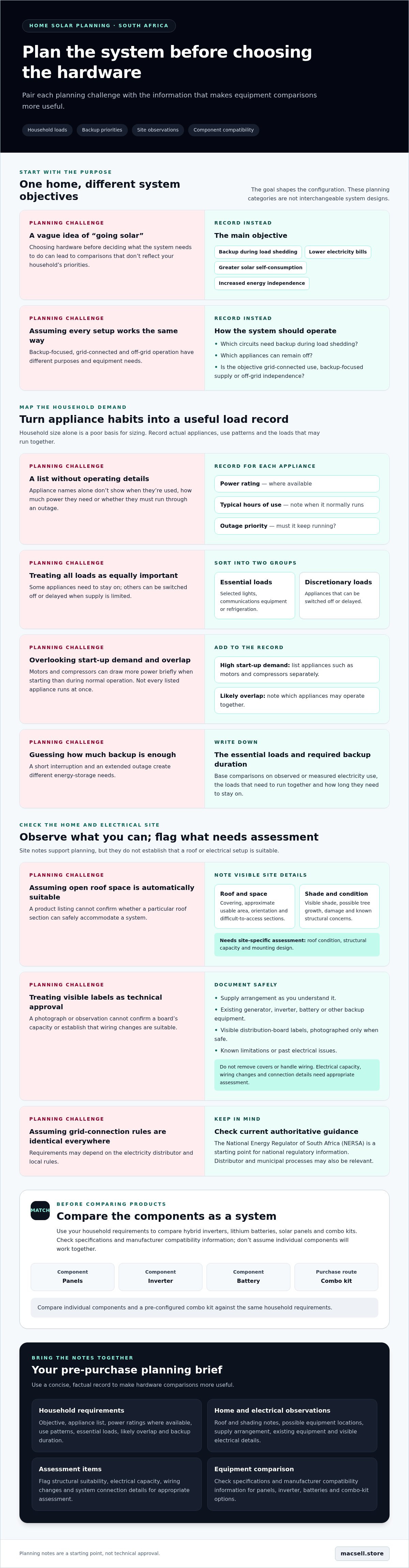
Before comparing panels, work out what your household needs to run and for how long. A home solar equipment checklist South Africa homeowners can use should start with appliance loads and backup priorities, then cover site conditions and compatibility between components. This helps you avoid choosing individual hardware before you know whether it suits your planned system.
It can be difficult to decide which loads to prioritise, how much backup you need and whether an inverter, battery and panels will work together. This checklist helps you organise those decisions before choosing equipment. Record your household requirements, then compare hybrid inverters, lithium batteries, solar panels and combo kits against them.
Use the steps below to review essential and high-demand loads, expected backup time, roof and site considerations, and component compatibility. You’ll also distinguish equipment planning from installation preparation, including the need to understand applicable grid-connection requirements for your electricity distributor. Bring your notes together in a pre-purchase brief to make hardware comparisons more useful.
Key Takeaways
- Use a home solar equipment checklist South Africa homeowners can follow to record essential appliances, operating patterns and backup priorities before comparing hardware.
- Note roof space, shading and possible equipment locations to give your system planning a practical starting point.
- Compare panels, inverter and batteries as a system, using specifications and manufacturer compatibility information to guide selection.
- Organise your load schedule, site observations and electrical details into a pre-purchase record before reviewing equipment options.
- Compare individual components and a pre-configured combo kit against the same household requirements to decide which purchasing route suits your plans.
Home solar equipment checklist South Africa: define what the system must do
Before comparing panels, batteries or inverters, define what your solar system needs to do. This home solar equipment checklist South Africa homeowners can use begins with household loads, site conditions and equipment compatibility. Set your priorities first, then use them to guide your hardware choices.
Choose the main objective: backup during load shedding, lower electricity bills, greater self-consumption of solar generation, or increased energy independence. Each goal can lead to a different system configuration. A backup-focused setup prioritises selected appliances during outages, while a grid-connected system may be planned around using solar energy alongside grid supply. Off-grid operation has a different purpose and should not be assumed to use the same equipment configuration.
A solar system’s purpose is the starting point for selecting its equipment. For broader context on the country’s solar sector and solar power types, see Solar power in South Africa.
How to record household loads and backup priorities
Make an appliance list. For each item, record its power rating where available, typical hours of use and whether it must run during an outage. Group items into essential loads, such as selected lights, communications equipment or refrigeration, and discretionary loads that can be switched off or delayed.
List appliances with high start-up demand separately. Motors and compressors can draw more power briefly when starting than they use during normal operation. Record when appliances are used, too. Rather than assuming every listed load runs at once, note which appliances are likely to operate together. That combination helps clarify the system’s requirements.
For backup planning, write down which essential appliances need to stay on and for how long. A short interruption and an extended outage create different energy-storage needs. This record is more useful than a general estimate based only on the number of people or rooms in the home.
Which South African supply conditions should shape the checklist?
Include how the system should behave during load shedding: which circuits or appliances need backup, and which can remain off. Record whether your objective is grid-connected operation, backup-focused supply or off-grid independence. These are planning categories, not interchangeable system designs. Each affects how the panels, inverter and batteries need to work together.
Household size alone is a poor basis for sizing. Two homes with the same number of occupants can have different appliances, schedules and backup priorities. Base equipment comparisons on observed or measured electricity use, the loads that need to run together and the required backup duration. Keep these details in your checklist so equipment choices reflect actual household needs.
Check the home and electrical site before selecting solar equipment
Household requirements describe what the system must do. Site information helps establish what the home may accommodate. Add roof, equipment-location and electrical observations to your home solar equipment checklist South Africa homeowners can use to prepare for hardware comparisons. These notes support planning, but they don’t establish that a roof or electrical setup is suitable.
What roof and panel-site details belong on the checklist?
Record the roof covering, approximate usable area and orientation. Note the direction each potential panel area faces, along with visible shade from trees, chimneys, neighbouring buildings or other structures. Consider whether nearby trees may grow enough to change shading over time. Also note roof sections that are difficult to access, visible damage and any known structural concerns.
An open roof area is not automatically suitable for panels. Roof condition, structural capacity and mounting design need site-specific assessment. A product listing can describe a panel, but it can’t establish whether a particular roof section can safely accommodate a system.
What information should you gather about the electrical setup?
Record the electricity supply arrangement as you understand it, along with any existing generator, inverter, battery or other backup equipment. Photograph distribution-board labels if they’re visible and safe to photograph. Don’t remove covers, handle wiring or assume a label confirms the board’s capacity. Include known limitations or past electrical issues in your planning notes.
Separate what you can observe from what needs a qualified technical assessment. You can document roof features, equipment locations, visible labels and existing hardware. Structural suitability, electrical capacity, wiring changes and system connection details require appropriate assessment. Don’t treat an observation as technical approval.
For grid-connected systems, requirements may depend on the electricity distributor and local rules. Check current authoritative guidance before settling on a configuration. The National Energy Regulator of South Africa (NERSA) is a useful starting point for national regulatory information. Distributor and municipal processes may also be relevant, so don’t assume the same requirements apply everywhere.
Keep the record concise and factual:
- Roof covering, usable areas, orientation and visible shading.
- Potential inverter and battery locations, with access, ventilation and exposure considerations.
- Supply arrangement, visible distribution-board labels and existing backup equipment.
- Known site constraints and items requiring technical assessment.
These observations make equipment comparisons more grounded, but they aren’t a substitute for a site assessment. Once your notes are organised, browse solar equipment options with your site requirements in mind.
Match solar panels, inverter and batteries before you buy
A panel, inverter and battery can each meet their individual specifications and still be unsuitable as a set. Use your home solar equipment checklist South Africa to compare each component’s role, required specifications and documented compatibility. Check current manufacturer documentation for the exact models and proposed configuration. A product category or brand name alone is not enough.
| Component | Role | What to compare | Compatibility evidence |
|---|---|---|---|
| Hybrid inverter | Converts and manages power between panels, battery, household loads and, where applicable, the grid. | Output and operating characteristics against essential loads; battery voltage range; solar input limits. | Inverter datasheet and manufacturer documentation for the intended system configuration. |
| Lithium battery | Stores energy for later use, including planned backup operation. | Voltage, nominal capacity, usable energy and communication requirements. | Battery and inverter compatibility information, including supported communication protocols. |
| Solar panels | Generate electricity from available sunlight. | Electrical specifications, proposed quantity and arrangement, and fit with available roof area. | Panel datasheet compared with inverter input limits and string-design requirements. |
How should the inverter and battery be checked as a pair?
Start with the inverter’s listed battery compatibility, voltage range and supported communication protocols. Then compare the battery’s usable energy with the planned loads and backup duration. Nominal capacity or a shared brand name doesn’t establish that two components will work together. Look for model-specific compatibility evidence in the manufacturers’ documentation. For a closer look at pairing, use the home inverter and battery combo guide.
How do panel specifications fit the rest of the system?
Compare panel electrical values with the inverter’s solar input limits and the proposed string design. Panel quantity and arrangement must suit both the available roof area and the system configuration, so don’t select panels by wattage alone. Solar resource information also informs expectations for a site, and the IEA-PVPS handbook outlines solar resource data best practices.
For panel procurement context, see the solar panel for home price guide. Keep the comparison table with your household load plan. It records what each component must do and which documentation supports the proposed match.
Use this South African pre-installation checklist before placing an order
Bring your household and site notes together in one project file before comparing equipment. This home solar equipment checklist South Africa buyers can use helps reveal missing information before it leads to a hardware mismatch. Record unknowns as questions instead of guessing at system capacity or specifications.
What should be complete before you compare equipment?
- Document household loads. List appliances, power ratings where available, operating patterns and which loads are essential.
- Set the backup objective. Record which essential loads need power and the backup duration you’re planning for.
- Collect site observations. Note roof covering, usable area, orientation, shading, access constraints and possible inverter and battery locations.
- Describe the existing supply. Record the supply arrangement, visible distribution-board labels, known limitations and any existing generator, inverter or backup equipment.
- Build a component comparison. List the exact panel, inverter and battery model references, quantities, relevant electrical specifications and supporting compatibility documentation.
- Identify unresolved checks. Separate observations from items requiring technical assessment, such as roof suitability, electrical capacity or system configuration.
- Review current requirements. Check the applicable local grid-connection, electrical compliance and approval processes for your supply arrangement. Requirements can vary by distributor and municipality, so verify current details rather than relying on assumptions or outdated information.
What should be checked on a hardware quote or product listing?
Check model references and quantities against your project file. Compare inverter output and operating characteristics with the intended loads, then review battery voltage, usable energy and communication requirements against the inverter documentation. For panels, compare electrical specifications with the inverter’s input limits and proposed system design. A familiar brand or product category alone isn’t evidence of compatibility.
Read the hardware scope carefully. Confirm that the listed components, quantities and specifications match the system you’re comparing. Keep the equipment purchase distinct from installation work, approvals and other project arrangements. These are separate parts of getting a system ready.
For a separate view of equipment-cost categories, read the South African solar hardware cost breakdown. Use your completed checklist to compare solar hardware options against documented household and site requirements.
Choose a practical South African solar equipment route and next steps
With your requirements recorded, compare two purchasing routes: selecting individual components or choosing a pre-configured combo kit. Use the same load plan, site notes and compatibility records for both. This keeps the decision focused on fit, rather than assuming a package or a collection of separate products is automatically suitable.
When might individual components or a combo kit suit the project?
Individual components let you select the inverter, lithium battery and panels against specific household needs and site conditions. This route can suit a project where component specifications need careful matching or the planned system has particular requirements.
A combo kit brings specified hardware together as a defined package, which can simplify comparison. It may suit a project when its stated contents align with your documented loads, backup objective and site requirements. A packaged kit won’t automatically suit every home, load profile or roof. Check its component models and compatibility evidence just as you would for separately selected equipment.
What are the next steps after completing the checklist?
Keep your load schedule, site observations and manufacturer compatibility records together. Use them to compare the contents and specifications of each option, and note unanswered technical questions rather than assuming an item will work in your intended configuration. MacSell’s range includes hybrid inverters, lithium batteries, solar panels and combo kits, giving you distinct hardware categories to consider once your requirements are defined.
For a category-by-category inventory, see the solar power hardware checklist. It can help you organise the equipment under consideration without replacing model-specific compatibility checks.
The completed home solar equipment checklist South Africa buyers have prepared is a useful comparison tool, not a substitute for technical assessment where needed. Keep equipment selection separate from installation planning and any applicable approval or compliance processes.
Once your requirements are clear, browse solar equipment and combo kits and compare the listed hardware against your project records.
Turn your checklist into a clear equipment plan
A useful home solar equipment checklist South Africa starts with household loads and backup priorities, then brings together site observations and component compatibility records. Use these details to compare equipment against your actual requirements, rather than choosing by household size or product category alone.
Keep each component’s role clear: hybrid inverters manage system power, lithium batteries store energy, and solar panels generate it. Check model-specific documentation before treating components as a compatible set. Individual hardware and combo kits can both suit a project when their stated equipment fits the planned system.
MacSell Solar Outlet sells solar hardware, including hybrid inverters, lithium batteries, solar panels and combo kits, with brands such as Sunsynk, Deye, LuxPower and Hubble. Use your checklist to compare the available equipment against your requirements and identify the hardware that fits your planned system.
Frequently Asked Questions
What equipment do I need for a home solar system in South Africa?
A home solar system typically uses solar panels, an inverter, mounting equipment, electrical cabling and protection components. Batteries are needed if energy storage or backup is part of the plan. The exact equipment depends on whether you want grid-connected generation, backup during load shedding or off-grid operation. Check the inverter, panels and battery as a compatible system, and have the site and electrical setup assessed for the intended configuration.
How do I calculate what size solar system my home needs?
Base system sizing on recorded electricity use, appliance loads and the backup duration you require, not household size alone. List each appliance, its power rating where available, how often it runs and whether it’s essential. Note high start-up demand and which loads may run simultaneously. These details help establish inverter output and battery energy needs, while roof conditions and available sunlight inform the panel design.
Can I add solar panels to an existing inverter and battery system?
Yes, provided the existing inverter can support the proposed panels and system arrangement. Compare panel electrical specifications and string design with the inverter’s solar input limits, and consider available roof area and shading. Check the exact inverter documentation rather than assuming spare capacity. If the system includes a battery, confirm that any changes remain compatible with its configuration and communication requirements.
Do I need batteries for a home solar system in South Africa?
No, batteries aren’t essential for every solar system. A grid-connected system may be designed to use solar generation without storing it. Battery storage is relevant if you want energy available when panels aren’t generating or need backup during outages. Define which appliances need backup and for how long before comparing battery options. The inverter must also support the intended battery configuration.
Can solar panels provide power during load shedding?
Not necessarily. Panels alone don’t guarantee power during load shedding: the system must be designed and configured to supply selected household loads when grid power is unavailable. This commonly involves a suitable hybrid inverter and, for stored energy after sunlight drops, a compatible battery. Confirm which circuits are intended for backup and how the system behaves during an outage before choosing equipment.
What should I check before buying a solar inverter and battery?
Check the inverter’s output and operating characteristics against your essential-load plan. Then compare its documented battery compatibility, voltage range and communication requirements with the battery’s specifications. Relate usable battery energy to the loads and backup duration you need. Don’t treat a shared brand name or nominal battery capacity as proof of compatibility. Use current manufacturer documentation for the exact models and proposed configuration.
Do I need approval for a home solar system in South Africa?
Grid-connected systems must be registered with the relevant electricity distributor, whether or not they export power. Systems under 100 kW register with their licensed distributor, such as Eskom or the municipality; systems over 100 kW register with NERSA. Off-grid systems are exempt from this grid-connection registration requirement. Local processes can differ, so verify current requirements with your distributor. Electrical work also requires the applicable safety compliance documentation.