

DIY solar for 4-bedroom house in South Africa: 2026 guide
What if the number of bedrooms tells you very little about the solar system your home needs? A search for “DIY solar kit for 4-bedroom house South Africa” is a starting point, not a system specification. Your requirements depend on the appliances you use, their power draw and how long you need them to run during load-shedding.
To compare kits, start with your household’s loads and backup priorities rather than guessing from floor space or household size. This guide shows you how to list appliances, estimate inverter and battery capacity, and assess panels and other components. It also explains the difference between buying hardware and carrying out electrical work, which may require a qualified professional and compliance with applicable requirements. Use it to compare pre-configured kits and individual components, including hybrid inverters, lithium batteries and panels, against your home’s actual needs.
Key Takeaways
- Bedroom count alone can’t size a system. Use appliance loads and backup priorities to assess a DIY solar kit for 4-bedroom house South Africa.
- Follow a practical sizing sequence: list appliances, estimate energy use, decide how many backup hours you need, then compare hardware.
- Compare inverter output, battery usable energy, solar input limits and expansion compatibility, not just headline capacity.
- Choose between grid-tied, hybrid and off-grid configurations based on how you plan to use solar and what you need powered during outages.
- Separate buying a kit from doing electrical work. A DIY purchase doesn’t by itself establish that installation is safe or compliant.
DIY solar kit for a 4-bedroom house in South Africa: what does the home actually need?
A four-bedroom label doesn’t tell you how much electricity a household uses or which appliances run at the same time. One home may use gas for cooking and water heating; another may have an electric geyser, pool pump and air conditioning. Those choices affect system requirements far more than bedroom count. For an overview of the local context, Solar power in South Africa describes the country’s solar landscape. To size a home system, start with your own appliance loads.
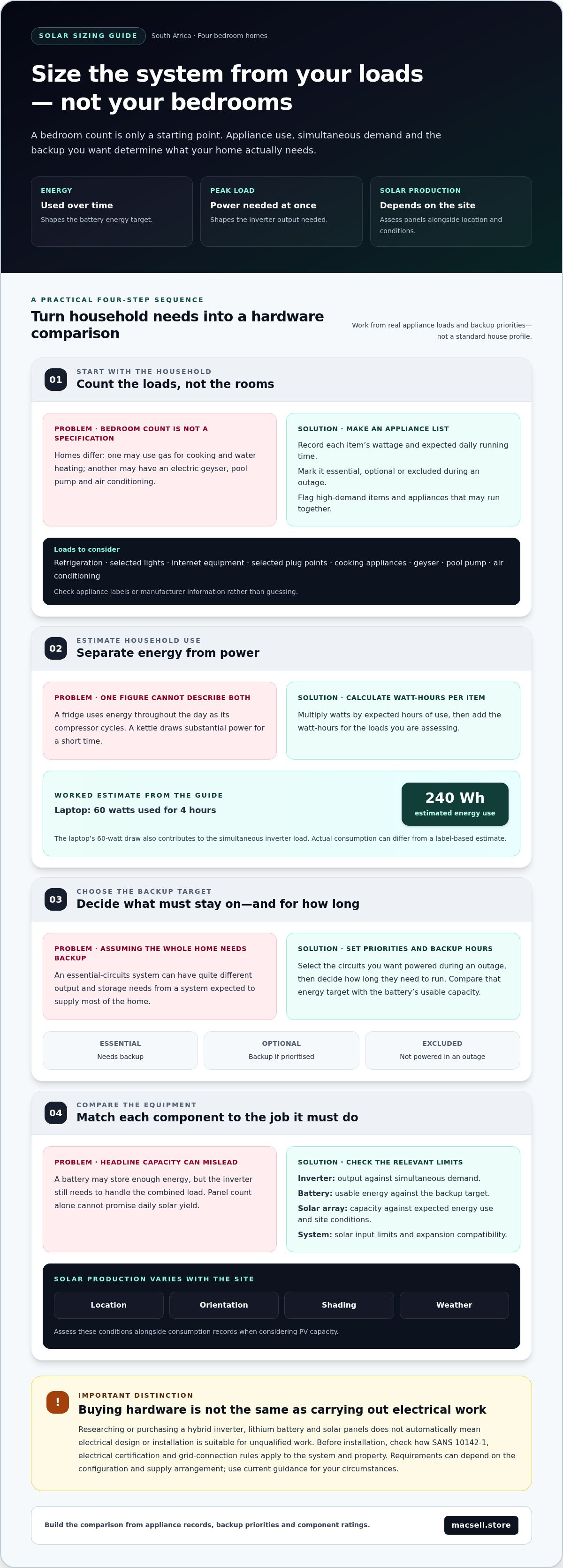
Measured appliance loads, not bedroom count, guide sizing. Daily energy use and peak demand are different things. A fridge uses energy throughout the day as its compressor cycles, while a kettle draws substantial power for a short time. The fridge’s energy use affects how much battery capacity you may need over a chosen period. The kettle’s draw contributes to the total power the inverter must handle if several appliances run together.
For load-shedding, decide which circuits need backup. You might prioritise refrigeration, selected lights, internet equipment and chosen plug points. That doesn’t mean an electric oven, geyser or pool pump must also run on backup. A system for essential circuits can have quite different output and storage needs from one expected to supply most of the home.
Which household loads should go on the assessment list?
For each appliance, record its wattage, estimated daily running time and backup priority. Check the appliance label or manufacturer information instead of guessing. Flag high-demand items, such as kettles or cooking appliances, and note which appliances might run at the same time.
- List refrigeration, lighting, internet equipment and selected plug points.
- Record wattage and expected daily running time for each item.
- Mark each load as essential, optional or excluded during an outage.
- Identify high-demand appliances and possible simultaneous use.
What does DIY mean when buying solar hardware?
DIY can mean researching and purchasing components such as a hybrid inverter, lithium battery and solar panels. It doesn’t automatically mean that electrical design or installation is suitable for unqualified work. Electrical safety and applicable South African requirements still matter.
Before installation, verify how SANS 10142-1, electrical certification and grid-connection rules apply to the system and property. Requirements can depend on the configuration and supply arrangement, so use current guidance that applies to your circumstances. Treat a DIY solar kit for 4-bedroom house South Africa as a set of hardware to assess for compatibility, not as permission to bypass safety or compliance checks.
How to size a South African four-bedroom solar kit from real household loads
Size the system using household data, not a standard house profile. Keep three questions separate: how much energy the household uses over time, how much power it may need at once, and how much solar the panels can produce under the site’s conditions. The CSIR energy research offers wider technical context, but your household’s own records are central to choosing equipment.
- Inventory the loads. List appliances and circuits, noting their rated power, expected use and whether they need to operate during an outage.
- Estimate daily energy. Multiply each appliance’s power in watts by its expected operating time in hours. Add the watt-hours for the loads you’re assessing.
- Set backup hours. Choose which loads need power during an outage and how long they should run. This sets your backup target without assuming the whole home must stay powered.
- Match the hardware. Compare inverter output with simultaneous demand, battery usable energy with the backup target, and solar-array capacity with expected energy use and site conditions.
Daily energy demand is the total electricity used over time; peak load is the power required by appliances running at the same moment. For example, a 60-watt laptop used for four hours consumes an estimated 240 watt-hours. That estimate contributes to daily energy use, while the laptop’s 60-watt draw contributes to the simultaneous load on the inverter. Actual consumption can differ from a label-based estimate.
How do you estimate daily electricity demand?
Use appliance labels or manufacturer information as a starting point, then compare your estimates with meter data or available consumption records. For each item, calculate watts × expected hours of use = watt-hours. Treat the result as an estimate: geysers, pumps and air conditioning can vary with season, settings and household behaviour. Mark intermittent loads separately so you don’t mistake a short operating period for continuous use.
How should backup time and solar production affect sizing?
Set the required outage duration for your selected circuits, then compare the energy target with the battery’s usable capacity, not just its headline rating. Check inverter limits too: a battery may store enough energy, but the inverter still needs to handle the combined load. Review component compatibility and manufacturer ratings when comparing a DIY solar kit for 4-bedroom house South Africa.
Panel production depends on location, orientation, shading and weather, so panel count alone can’t promise a daily yield. Consider those site conditions alongside your consumption records when assessing PV capacity. To compare the main hardware categories against your load schedule, explore solar inverters, batteries and panels.
Compare inverter, battery and panel specifications before choosing a DIY solar kit
A kit’s headline rating is only a starting point. Compare each component’s limits with your load schedule and backup plan, then confirm that the inverter, battery and solar array are designed to work together. This gives you a more useful basis for comparison than panel count or bedroom number alone.
| Component | Compare | Why it matters |
|---|---|---|
| Inverter | Continuous output, surge capacity, phase, battery voltage and PV input limits | Must support the loads that may run together and accept the planned array and battery. |
| Battery | Usable energy, discharge limits, voltage and charging limits | Determines how much energy can be delivered and whether charging suits the inverter. |
| Solar panels | Rated wattage, array configuration, voltage and current | Total panel wattage and electrical configuration must stay within inverter input limits. |
| Expansion | Supported battery or PV additions and compatibility requirements | Future additions need to match system limits and manufacturer guidance. |
Which inverter specifications matter for a household?
Rated continuous output is the power the inverter can supply during normal operation. Surge capacity covers a brief increase in demand, such as a motor starting, but it doesn’t replace adequate continuous output. Match both ratings to appliances likely to run at the same time. Check phase configuration and supported battery voltage in the manufacturer documentation.
kVA and kW are related, but they aren’t interchangeable: power factor affects how much usable real power a kVA rating represents. Compare the inverter’s stated kW output and power factor, as well as its PV input voltage and current limits, rather than relying on the kVA figure alone.
How should batteries and solar panels fit the system?
Compare battery usable energy with your backup-load plan, and check its discharge and charging limits. Confirm inverter-battery compatibility using current manufacturer documentation. For background on battery chemistry and operation, read this lithium-ion solar battery technology guide.
Panel wattage alone doesn’t establish compatibility. The number and electrical arrangement of panels must keep the array’s voltage and current within the inverter’s PV input range. A named combo is a configuration to assess, not a universal recommendation: compare the Sunsynk and Hubble combo kit specifications with your loads and current manufacturer data. Choose a DIY solar kit for 4-bedroom house South Africa by component fit, not bedroom count.
Grid connection is another system consideration. Review current, application-specific requirements using this article on solar installation regulations before settling on a configuration.
What to check before buying a DIY solar kit in South Africa
Compare the package with your load schedule, planned backup circuits and installation requirements. A kit description should identify the main components and their ratings, so you can assess the details instead of relying on a headline capacity. Use this checklist to organise your review of South African solar hardware.
- Load schedule: List the circuits and appliances the system is expected to supply, including which need backup.
- Equipment ratings: Compare inverter output and input limits, battery usable energy and charging limits, and panel array ratings.
- Protection hardware: Check the package documentation for the protection and isolation components required by the design. Don’t assume the word “kit” means every installation component is included.
- Compatibility and expansion: Review battery-inverter compatibility, supported PV configuration and manufacturer limits for future additions.
- Installation and connection: Identify which requirements apply to the system configuration and the relevant electricity distributor or municipality.
Configuration matters. A grid-tied system works with the electricity supply, but its operation during an outage depends on its design and equipment. A hybrid system combines solar and battery storage with a grid connection, while an off-grid system is designed to operate without one. These are different approaches, not automatic upgrades from small to large. Choose based on backup needs, connection arrangements and intended use.
Which South African compliance and connection details need checking?
Hardware selection doesn’t replace compliant system design or electrical work. Before purchase and installation, verify current requirements for the property and setup with the relevant authority. Check the applicability of SANS 10142-1, any required electrical Certificate of Compliance, and the distributor or municipal connection process. SABS and NRS references may also be relevant, but don’t assume a standard or process applies universally without checking current guidance.
How can a buyer compare kit completeness and future flexibility?
Use the package description to confirm what’s included: inverter, battery, panels and required protection hardware. Then compare expansion limits with possible future loads. Extra panels or storage must remain compatible with inverter input limits, battery voltage and manufacturer instructions. For component-level budgeting context, see the South African solar system hardware cost breakdown.
A DIY solar kit for 4-bedroom house South Africa is a hardware choice, not permission to carry out electrical work without the required competence and compliance. Explore solar hardware and pre-configured kits to compare components against your planned system.
Choose a four-bedroom solar kit by matching the configuration to your backup plan
Choose a system for how you expect to use it, not the number of bedrooms. These three profiles can help narrow your comparison. For each, consider what inverter output the loads need at the same time, how long the battery must support them, and what PV capacity the site can accommodate.
- Essential-load backup: If your priority is refrigeration, lighting, internet equipment and selected plug points, identify the circuits that must stay on and for how long. Size inverter output for the loads that may run together, and storage for the planned backup period.
- Broader household backup: If you want more circuits or higher-demand appliances available during outages, check their combined running demand and any start-up surge. Consider whether the battery can supply the required energy for the intended duration, and whether the PV array can support the household’s wider use.
- Solar self-consumption: If your main aim is to use solar energy during the day, compare expected daytime loads with available PV capacity. Decide whether storage is needed for evening use or outages, rather than assuming a large battery is essential.
These profiles are starting points, not fixed system sizes. Suitability depends on measured load data, equipment compatibility and design requirements. The Sunsynk 8KVA & 2X Hubble AM2 5.5 KWh Combo Kit is one product to use as a comparison example. Assess its current manufacturer specifications and package details against your plan rather than treating it as a universal four-bedroom recommendation.
When is an inverter-and-battery combo a useful starting point?
A combo can make component comparison more straightforward when its specifications and included hardware are clear. Check inverter-battery compatibility, ratings and package contents against current manufacturer documentation. For a structured comparison, see the home inverter and battery combo guide.
What information should be ready before selecting a kit?
Prepare appliance wattages, estimated operating times, outage priorities and details of any existing solar equipment. For panel planning, note roof orientation, shading and usable panel area. These details help you compare inverter output, storage duration and available PV capacity with your household’s actual requirements.
Use that information to assess each DIY solar kit for 4-bedroom house South Africa against your backup plan and system constraints. Compare solar hardware and kits to review the components for your configuration.
Build your solar plan around measured household demand
The right DIY solar kit for 4-bedroom house South Africa depends on appliance loads, backup priorities and site conditions, not bedroom count. Start with measured or estimated daily energy use, then check peak inverter demand, battery capacity for your chosen backup duration and PV input against the panel array. Compare component ratings and compatibility, and treat hardware selection separately from compliant electrical design and installation.
MacSell Solar Outlet sells hybrid inverters, lithium batteries and solar panels, along with pre-configured kits. The Sunsynk 8KVA & 2X Hubble AM2 5.5 KWh Combo Kit is one product to compare with your household requirements. Review its current product details rather than assuming it will suit every home.
With a clear load list and backup plan, you can compare system options against practical requirements. Compare MacSell Solar Outlet’s solar hardware and kits to find components for your planned configuration.
Frequently Asked Questions
Is a DIY solar kit suitable for a 4-bedroom house in South Africa?
Yes, a DIY solar kit can suit a four-bedroom home if its components match the household’s measured loads and backup priorities. Bedroom count alone doesn’t show how much power appliances use or how many run simultaneously. List essential circuits, daily energy use and high-demand appliances, then compare inverter, battery and panel ratings. Buying hardware as a DIY route doesn’t automatically make electrical design or installation suitable for unqualified work.
How do I size a solar kit for a four-bedroom house?
Start with appliance wattages and expected operating times. Multiply watts by hours to estimate watt-hours, then total the loads relevant to your plan. Separately identify appliances that may operate together to assess inverter demand. Choose which circuits need backup and for how long, then compare that energy requirement with battery usable capacity. Finally, match the panel array to inverter input limits and site conditions such as shading and roof orientation.
Can I install a solar kit myself in South Africa?
Buying components yourself doesn’t automatically mean you can safely or compliantly complete the electrical installation. Requirements depend on the system and whether it connects to the grid. Before work begins, verify current safety, electrical certification and connection requirements that apply to your property with the relevant authority. Electrical design and installation involve hazards, so use suitably qualified electrical expertise rather than assuming a pre-configured kit makes installation a do-it-yourself task.
What size inverter does a 4-bedroom house need?
There’s no inverter size determined by bedroom count. Base output on the appliances likely to run at the same time, including their starting demand where relevant. Check continuous output and surge capacity, then confirm phase configuration, battery voltage and solar input limits against manufacturer documentation. kVA and kW aren’t identical ratings, so compare the stated real-power output and power factor. The right choice depends on your load data and system design.
How much battery storage does a four-bedroom solar kit need?
Battery capacity depends on which circuits you want backed up, their estimated energy use and the outage duration you’re planning for. Add the watt-hours required by those loads over that period, then compare the result with the battery’s usable energy, not just its headline capacity. Check discharge and charging limits, as well as inverter compatibility. A plan covering refrigeration and lighting will differ from one intended to supply more household circuits.
What should a solar kit for a South African home include?
A system commonly needs a compatible inverter, a battery if storage is required, solar panels if PV generation is planned, and protection hardware specified for the design. Check package documentation to see exactly what is included and compare component ratings, wiring requirements and compatibility. Panel arrangement must stay within the inverter’s input limits. The required hardware varies by configuration, so don’t assume every package includes all equipment needed for a compliant installation.
Can a solar kit run the whole house during load-shedding?
It can only do so if the system is designed to support the home’s combined demand for the required duration. High-demand appliances, such as an electric geyser or oven, can affect inverter output and battery runtime, especially if several operate together. Many households instead prioritise selected circuits. Check the inverter’s continuous and surge ratings, available battery energy and system configuration before expecting whole-house backup during load-shedding.