

How to Explain Solar Costs and Monthly Bills to Your Partner
A solar system does not automatically eliminate an electricity bill. If you’re working out how to explain solar costs to a sceptical partner, distinguish the equipment purchase or finance payments from electricity still drawn from the grid and any ongoing charges. Then compare these costs with the bill savings the system is expected to deliver.
It’s reasonable to question the figures: upfront costs, monthly payments and estimated payback can vary depending on how the system is paid for and how much electricity the household uses. This article explains purchase and finance options, how grid use affects monthly bills, and which costs to include in a payback estimate. It also shows how to discuss the numbers clearly, without treating projected savings as money already in the bank.
Key Takeaways
- Compare cash purchase, financing and power purchase agreement structures by ownership, payment basis and contract terms.
- Size a system around household electricity use and when demand occurs, not just its potential output.
- Account for electricity drawn from the grid when solar production falls short, alongside any ongoing utility charges.
- Build a realistic payback estimate from expected generation, future electricity costs and the financing period.
Comparing solar purchase and financing options
Compare the upfront payment, monthly commitment and total repayment against the system’s expected use. The payment structure affects household cash flow and ownership, but not the need to match panels to demand.
Buying versus financing solar
Buying means paying for the system upfront; financing spreads payments over an agreed term. A cash purchase avoids finance repayments, while financing preserves more cash initially but adds a monthly commitment.
A residential solar system’s cost in South Africa in 2026 depends on its design, equipment and installation scope. For couples considering how to explain solar costs to a sceptical partner, compare complete proposals by separating equipment, installation and finance charges, not just the monthly payment. Six-year and eight-year finance plans should be compared by instalment, interest, fees and total repayment. A longer term may lower each instalment but extends the repayment period. Financing through a home loan is another option; include the borrowing in the home-loan repayment calculation and account for its term and interest.
Government incentives in financing
Incentives may reduce eligible costs, but they do not automatically lower finance repayments. Their value depends on eligibility, applicable rules and timing, so show any benefit separately from the lender’s figures.
South Africa offered a solar tax incentive to households and businesses in 2023. Don’t assume that incentive applies to a 2026 purchase. When discussing how to explain solar costs to a sceptical partner, distinguish a past incentive from savings available for the current decision.
Home solar also involves maintenance costs and risks. Cleaning, faults or repairs can add expenses, while poor sizing or lower-than-expected production can reduce savings.
Solar panels may last 25 to 30 years, depending on the equipment. Most panel performance warranties state that panels will produce 80% of their original output for 25 years. Solar equipment warranties can last 10 to 30 years, depending on equipment and manufacturer. Check inverter and battery warranty terms separately, since coverage varies.
Grid electricity use when solar production is insufficient
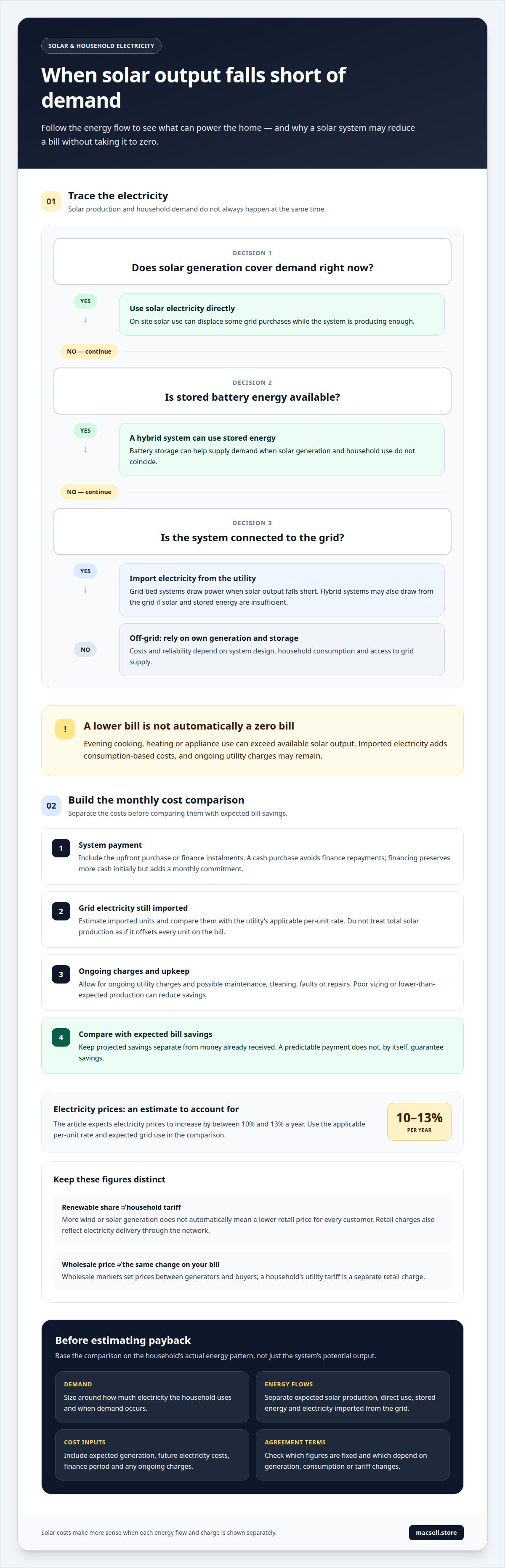
Grid-tied systems draw electricity from the utility when solar generation falls short of demand. Hybrid systems can also use stored battery energy, while off-grid systems rely on their own generation and storage. Costs and reliability depend on system design, household consumption and access to grid supply.
Solar panels generate electricity when conditions allow, but production and household demand do not always coincide. Evening cooking, heating or appliance use can exceed available solar output. A grid-connected home then imports electricity, so its monthly bill may fall without reaching zero. Include this grid use when discussing expected costs.
Keep the share of renewable energy separate from the tariff on a household bill. A higher share of wind or solar generation does not automatically mean a lower retail price for every customer. Retail charges reflect more than generation, including the cost of delivering electricity through the network.
Electricity prices are expected to increase by between 10% and 13% a year. Per-unit charges matter because each unit imported adds to consumption-based costs. Compare the utility’s applicable per-unit rate with expected grid use, rather than treating total solar production as electricity that offsets every unit on the bill.
Wholesale markets set prices between electricity generators and buyers. Generators offer energy at a price, and supply and demand help determine which generators run and the wholesale price. A household’s utility tariff is a separate retail charge, so wholesale price movements do not translate directly into the same change on a monthly bill.
Wind and solar can reduce reliance on higher-cost generation when their output is available, but their production varies. They don’t guarantee lower retail bills at every hour. To explain this clearly, distinguish expected solar production, electricity consumed directly, energy stored, and power imported from the grid. Solar system components are part of planning a system around those energy flows.
Grid-tied systems can import utility power when solar output is insufficient, hybrid systems can also draw on stored battery energy, and off-grid systems rely on their own generation and storage. Costs and reliability depend on system design, household consumption and access to grid supply.
Guaranteed savings and predictable monthly costs
A predictable payment does not automatically guarantee savings. Compare the solar agreement’s monthly charge with expected grid costs, then identify which figures are fixed and which depend on generation, consumption or tariff changes.
For a solar power purchase agreement, separate the electricity tariff from installation costs and ongoing service charges. Community-scheme proposals should state the tariff, escalation clauses, and whether service and maintenance are included in the monthly rate. A “No Take or Pay” arrangement charges for power used rather than a fixed amount for unused generation. That distinction affects the bill when demand changes.
Before treating savings as guaranteed, read the agreement’s precise guarantee terms. Identify the baseline bill, period covered, included charges and remedy if the stated saving is missed. A forecast based on expected solar generation is not the same as a contractual commitment. Lower consumption, system downtime or an escalation clause can change the comparison.
Businesses can assess solar power against operating demand and daytime generation. Electricity used directly on site can displace some grid purchases, linking potential cost reductions to the business’s load profile. A lower-emissions energy mix can also support a company’s sustainability messaging, but does not prove stronger sales or customer loyalty.
ERCOT wholesale-market savings estimates provide a separate market example, not a South African bill forecast. Reported estimates cover 2010 to August 2022, including the first eight months of 2022. In a simplified ERCOT scenario, forecast demand is 100 megawatts and a wind farm can produce 30 megawatts. Wholesale effects depend on market supply and demand; they don’t establish a household tariff or guaranteed saving in South Africa.
For a practical comparison, list initial installation or finance payments, monthly agreement charges, grid electricity and maintenance separately. Then compare the same period and expected demand across each option. This shows whether a steady payment offers predictability, a lower expected total, or both, without presenting estimated generation as a guaranteed result.
Planning for solar costs in payback and ROI estimates
In South Africa, homeowners can expect a solar system return on investment in 5 to 8 years, depending on energy savings and system performance. Payback estimates show when cumulative savings equal the initial investment.
Lifetime savings and payback estimates
Lifetime savings estimate the electricity costs avoided over a system’s operating life, minus its purchase and ongoing costs. This matters because a large projected saving can mislead if it excludes grid use, fixed charges or financing.
Build the estimate using annual electricity generation, expected changes in energy-bill costs and whether net metering is available. Compare expected solar yield with household consumption, then apply the same assumptions to each option. A system producing more energy than the household can use may not deliver savings at the assumed rate.
Solar panels may last 25 to 30 years, depending on the equipment installed. Set the estimate across that lifespan, but separate likely savings from finance repayments, maintenance and any utility charges that remain. Check the financing agreement’s duration against the years used for lifetime-savings claims.
Payback periods and return on investment
Payback is the time needed for accumulated savings to recover the initial investment; return on investment compares financial gains with that investment. Both measures help show whether solar could offer an advantage over continued grid purchases.
For a South African household, the 5 to 8-year expectation depends on energy savings and system performance. Actual payback changes with annual generation, consumption patterns and electricity-cost increases. A lower output or higher-than-expected grid use reduces the savings counted towards recovery.
Include the provider’s annual escalation rate in future-cost estimates. Compare the proposed tariff with expected solar yield and household consumption, and align lifetime-savings projections with the finance term. This prevents a long-term projection from obscuring payments due during the agreement.
To assess the generation assumptions behind your calculation, explore solar panels suited to a system’s expected use.
MacSell Solar Outlet
MacSell Solar Outlet offers households considering solar a way to assess equipment costs alongside their bill estimates. Its range includes solar panels, lithium batteries and hybrid inverters, which suit different system configurations and affect the costs a proposal needs to account for.
For a packaged option, the Sunsynk 8KVA & 2X Hubble AM2 5.5 KWh Combo Kit brings specified inverter and battery hardware together. Individual components may also suit a system plan built around household consumption. These products help make the equipment side of the discussion more concrete, while purchase or financing terms and installation costs remain separate parts of the overall calculation.
Contact MacSell Solar Outlet to discuss the solar hardware relevant to your household’s plans.
Agree on the next step together
Before deciding, agree on what would make solar worthwhile for your household. Each partner can note their priorities, concerns and the assumptions they want resolved. This keeps the discussion focused on a shared decision rather than a debate about who is right. If you’re considering how to explain solar costs to a sceptical partner, make room for both people to revise their views as the facts or household needs change.
Once you have a shared brief, use it to consider which hardware categories fit the plan and what questions remain about the system. MacSell Solar Outlet can be part of that next step, helping you explore relevant solar hardware for your household’s requirements. Contact MacSell Solar Outlet to discuss the equipment options. A clear, joint brief gives you both a practical basis for moving forward.
Frequently Asked Questions
How much can a South African household save on electricity with solar?
Savings vary with household electricity use, solar generation and the applicable tariff, so no single amount applies to every South African home. To estimate your household’s outcome, compare grid electricity units across equivalent billing periods, not just the rand total. Tariff changes can alter the bill even when grid consumption stays similar, so track units and charges separately.
How do Eskom tariffs, municipal electricity rates and fixed charges affect solar savings?
Eskom and municipal tariffs determine the cost of grid electricity that solar can displace, while fixed charges may remain even when fewer units are bought. The effect depends on the household’s tariff structure and the share of consumption supplied by solar. Separate usage-based charges from fixed items on the bill to see which costs can fall and which remain once solar generation begins.