

Load shedding inverter battery combos: power and capacity
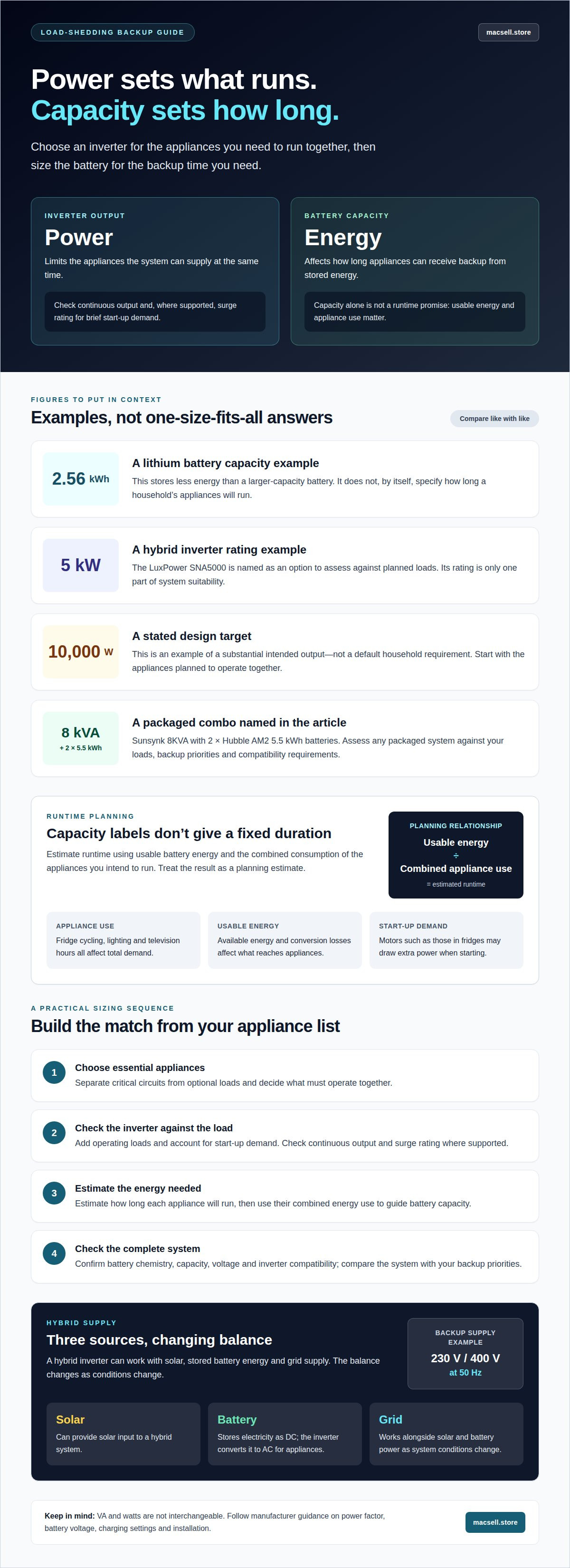
A larger inverter doesn’t automatically provide longer backup. The right load shedding inverter battery combo pairs enough inverter power to run the appliances you need at once with sufficient battery capacity to keep them running. Both ratings matter when choosing a system for your South African home.
It’s easy to focus on an inverter’s power rating and overlook how much energy the battery stores. Learn how to read inverter ratings, compare lithium battery capacities and understand what each specification tells you about backup performance.
A hybrid inverter can work with solar, battery and grid power, with the balance changing as conditions change. Understanding how these sources work together helps you assess a combo against your appliance loads and backup priorities, rather than choosing by one headline rating.
Key Takeaways
- Match inverter power to the appliances you need to run together; battery capacity determines how long they can receive backup.
- Compare lithium battery capacity options against your expected energy use, not just the inverter’s headline rating.
- Understand how a hybrid inverter shifts between solar, stored battery energy and grid supply to manage power.
- Use the Sunsynk and Hubble combo as a starting point for assessing a packaged system against your backup requirements.
Hybrid inverter and battery backup combos
A backup combo pairs an inverter with a battery, and a hybrid system can also take solar input. The battery stores electricity as direct current (DC), which the inverter converts into alternating current (AC) for household appliances. During load shedding, the inverter supplies selected circuits from stored energy to help keep essential devices running.
According to ETSI, an AC distribution system can provide backed-up 230 V/400 V at 50 Hz, with backup duration determined by the installed battery’s capacity. A larger battery can store more energy, while inverter power determines which appliances can operate together. A fridge, router and lights place different demands on the system than high-load appliances.
The right kit for your South African home depends on which appliances need backup, how long they must run and whether you want solar charging. Compare the inverter’s output rating, battery capacity, chemistry and compatibility as parts of a complete system. Match the kit to the circuits you intend to back up, rather than choosing the largest headline rating.
Lithium-ion and lead-acid batteries differ in chemistry, charging requirements and suitability for different uses. Choose a battery that is compatible with the inverter and its charging settings. Capacity, expected use and the manufacturer’s operating guidance all inform the choice; chemistry alone does not determine backup duration.
Installing a combo involves electrical connections and integration with household circuits. A qualified electrician is the practical choice for fixed wiring and system integration. South African electrical and municipal requirements depend on the installation and connection arrangement, so the applicable rules should guide the work and any required certification.
For maintenance, follow the inverter and battery manufacturers’ instructions and keep equipment and connections in suitable condition. Battery lifespan depends on factors such as chemistry, charging and discharge patterns, operating conditions and system settings. For safety, use the specified wiring and installation instructions, provide suitable ventilation and avoid improvised connections that could create electrical or fire hazards.
Inverter power ratings
Choose an inverter based on the appliances you need to run simultaneously. Add their operating loads, then account for equipment that draws extra power when starting. Essential appliances might include a fridge, lights, router and selected electronics. Their combined demand, not the number of rooms in your home, determines the inverter output you need.
For essential appliances during load shedding, choose an inverter that can support their combined running and start-up demand. Size the battery according to how long those appliances need to operate and how much energy they consume. The right combination depends on your appliance list and desired backup duration.
Power ratings describe different limits. An inverter’s continuous output indicates the load it can supply steadily, while its surge rating covers brief starting demands where supported. Check both against your appliances, especially motors such as those in fridges. A system may store ample energy but still struggle if its inverter cannot deliver the required power.
VA and watts are not interchangeable. Compare the inverter’s stated output with appliance requirements expressed in compatible units, and follow the manufacturer’s guidance on power factor. Review the battery voltage and inverter specifications together to avoid choosing a battery arrangement that cannot meet the inverter’s input requirements.
A 10,000 W target illustrates why the load list matters: it represents a substantial intended output, not a default household requirement. For a smaller essential-load setup, prioritise the appliances that must operate together. Separate critical circuits from optional loads, then size the inverter around that planned combination.
The LuxPower 5kW Inverter - SNA5000 Hybrid Inverter is one option to consider when assessing a hybrid inverter rating against planned loads. Its 5kW name gives a power reference, but the appliance mix and battery pairing still shape system suitability. Explore hybrid inverter options in the context of the loads you want to support.
A forum participant said they wanted to build an inverter system providing around 10,000 W. That figure is a stated design aim, not a default household requirement. Before selecting equipment, translate the intended setup into appliances operating at once, including their starting demand, and check that the inverter output and battery pairing suit that plan.
Lithium battery capacity options
Lithium battery capacity is measured in kilowatt-hours (kWh), indicating stored energy. Capacity affects how long a system can supply appliances, while inverter power limits their simultaneous load. A 2.56 kWh lithium battery, for example, stores less energy than a larger-capacity battery. The difference matters most when several appliances run together or backup must last longer.
Capacity labels help you compare options, but they don’t state runtime directly. The energy available to appliances depends on usable battery capacity and conversion losses. Estimate runtime by dividing usable energy by the appliances’ combined consumption. Treat the result as a planning estimate, not a fixed duration for every household.
A fridge, lights, Wi-Fi router and television can run for different lengths of time on the same battery. Their individual consumption, how often the fridge cycles and how many hours the television is used all affect total demand. Runtime depends on usable battery energy divided by the appliances’ combined consumption, so there is no single duration for every combo.
Compare battery options with your intended loads and backup period. List essential appliances and estimate how long each will operate. Add their energy use to calculate the total requirement, then choose a battery capacity that supports that plan and an inverter compatible with the battery.
- Smaller capacity: suits a shorter list of essential loads or a shorter backup period.
- More capacity: stores more energy for longer use or additional appliances.
- Two batteries: a system with two 5.5 kWh batteries has 11 kWh of stated combined capacity.
- System matching: confirm battery capacity and inverter specifications work together.
The two-battery example shows why capacity should be considered alongside daily use, not in isolation. A load shedding inverter battery combo should reflect your actual appliance mix and expected operating hours. Switching off non-essential devices preserves stored energy for priority loads.
There is no standard runtime. A higher-capacity combo can generally run appliances longer, but the actual duration depends on their combined energy use and the battery’s usable capacity.
Hybrid inverter operation with solar, battery and grid power
A load shedding inverter battery combo stores electricity and converts it into household AC power during an outage. As the World Health Organization explains, when AC power is disconnected, an inverter converts battery DC power into AC electricity. A hybrid inverter can also coordinate solar generation and grid supply with battery charging.
When grid power is available, the inverter can supply connected loads and charge the battery. Solar generation can serve active loads, while surplus energy can charge the battery. When solar output falls, the system can draw from the battery or grid, depending on its configuration. Grid charging and reserving battery energy for outages can help keep backup available.
During an outage, the grid connection is unavailable, so the hybrid inverter switches to stored battery energy and converts DC into AC for connected circuits. When sunlight is available, solar panels can contribute power to loads and battery charging. The balance depends on household demand, solar output and battery charge.
Solar compatibility and future expansion depend on system specifications, not the word “hybrid” alone. Match the inverter’s solar input limits and battery requirements to the panels and battery. For expansion, the inverter must support the additional panels or battery capacity you plan to add, and the new components must remain compatible with the existing system.
Operating modes also affect how power flows. In a reported example, a 5,000 W load in line or bypass mode was estimated to draw about 22 A AC through inverter relays, without involving the battery. This illustrates why a hybrid system’s bypass behaviour and charging settings matter alongside its backup mode.
- Grid available: supply loads and charge the battery.
- Solar available: serve loads and charge from surplus generation.
- Grid disconnected: use battery power, with solar contributing when available.
Plan the intended energy sources and expansion path together before selecting components. Explore solar and hybrid inverter options for a system built around those requirements.
Charging an inverter battery kit from the grid and using it only when grid supply is unavailable helps keep the battery available for outages and helps extend its lifespan. The forum discussion noted that utility charging could be set to a maximum of 2 A.
MacSell Solar Outlet: Sunsynk 8KVA & 2X Hubble AM2 5.5 KWh Combo Kit
MacSell Solar Outlet offers the Sunsynk 8KVA & 2X Hubble AM2 5.5 KWh Combo Kit for comparing inverter power with battery capacity. The package pairs an 8KVA Sunsynk inverter with two Hubble AM2 batteries rated at 5.5 kWh each.
A packaged inverter and lithium battery system can be a practical option to assess. Compare it with the appliances you intend to back up, how long they need power and whether solar is part of your setup. The inverter rating and battery capacity describe different aspects of the system, so match both to your needs rather than relying on one figure.
MacSell Solar Outlet also offers hybrid inverters, lithium batteries and the LuxPower 5kW Inverter - SNA5000 Hybrid Inverter for different system requirements. Contact MacSell Solar Outlet to discuss the combo and your backup needs.
Plan your next backup step
Turn your backup needs into a clear system brief before choosing components. Note which circuits matter most, which appliances may run at the same time and whether you want solar to contribute now or later. This gives you a practical basis for choosing a load shedding inverter battery combo without treating one rating as the whole answer.
MacSell Solar Outlet offers hybrid inverters and lithium batteries to support different system requirements. If you’re weighing those components against a packaged option, outline your priorities and discuss the Sunsynk and Hubble combo in that context. The next step is a focused conversation about the setup you have in mind.
Contact MacSell Solar Outlet today to discuss your backup requirements and available options. A well-defined brief makes it easier to move towards a system that fits the way you use power.
Frequently Asked Questions
How much do inverter and battery combo kits cost in South Africa?
In South Africa, the components included in a combo kit determine what you are comparing: a battery-only package differs from a hybrid kit that includes panels. MacSell Solar Outlet sells inverter and battery options, including kits with solar panels. Match the package to the appliances you need to run and the backup duration you want, rather than comparing inverter ratings alone.
Which inverter battery combo is compatible with solar panels and future expansion?
Solar compatibility and expansion depend on the inverter’s specifications. Check that it supports the panels or additional battery capacity you plan to use, and that all components are compatible.