

How to Run a Welder on a Hybrid Inverter
The inverter’s output rating matters more than its headline capacity. Running a welder off a hybrid inverter is practical when the inverter can match the welder’s input voltage and continuous power demand, with enough capacity for peak draw. A 24 V, 150 A welding machine with 0.85 efficiency is estimated to require approximately 4,235 W.
That makes the welder’s input specifications, not just its welding output, the starting point. Learn how to read the voltage and current requirements, estimate the power needed, and compare them with the inverter’s output before connecting the equipment.
Next, consider the wiring requirements for a compatible setup and how battery capacity, intermittent welding and solar charging affect runtime. This gives you a practical way to judge whether your system can handle the job and where its limits lie.
Key Takeaways
- Start with the welder’s input voltage and current, then estimate the power demand before selecting an inverter.
- Match the inverter’s continuous output to the welder’s requirements and allow for peak demand.
- Plan battery use around welding time, and use solar charging to help replenish energy during operation.
- Use the equipment specifications to assess compatibility, cable needs and whether a hybrid inverter and battery setup suits the work.
Battery drain and solar charging
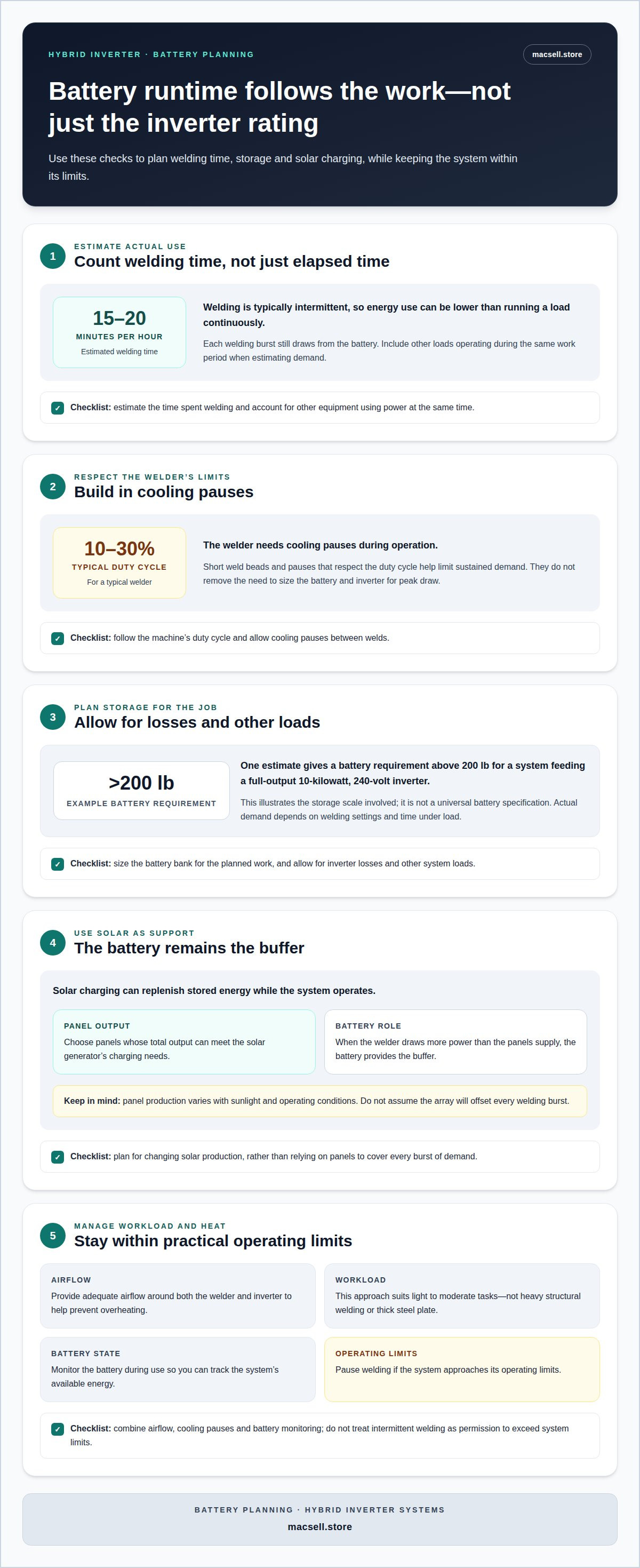
- Estimate battery demand from welding time, not just the inverter rating. Welding is typically intermittent, with an estimated 15-20 minutes of welding per hour. That reduces energy use compared with running a load continuously, but each welding burst still draws power from the battery. Include other loads that operate during the same work period.
- Plan for the welder’s duty cycle. A typical welder duty cycle is 10-30%, so it needs cooling pauses during operation. Short weld beads and pauses that respect the machine’s duty cycle help limit sustained demand. They don’t remove the need to size the battery and inverter for the welder’s peak draw.
- Size the battery bank for the work, then allow for inverter losses and other system loads. One estimate puts the battery requirement above 200 lb for a system feeding a full-output 10-kilowatt, 240-volt inverter. Treat this as an example of the storage scale involved, not a universal battery specification. Actual demand depends on welding settings and time under load.
- Solar charging can replenish stored energy while the system operates. Choose panels whose total output can meet the solar generator’s charging needs. Panel production varies with sunlight and operating conditions, so don’t assume the array will offset every welding burst. The battery remains the buffer when the welder draws more power than the panels supply.
- Manage heat and workload as well as charging. Provide adequate airflow around both the welder and inverter to help prevent overheating. Keep within the welder’s duty cycle and allow cooling pauses between welds. This approach suits light to moderate tasks, not heavy structural welding or thick steel plate. Monitor the battery state during use, and pause welding if the system approaches its operating limits.
How to Run a Welder on Solar Generator?
Yes, a hybrid inverter can run an arc welder if its continuous output and peak capacity meet the machine’s input demand. Calculate both before connecting the equipment.
-
Calculate Welder Power Requirements
Read the welder’s input voltage, current and efficiency from its rating plate or manual. Estimate required input power by multiplying voltage by current, then dividing by efficiency. For example, a 24 V, 150 A machine with 0.85 efficiency requires approximately 4,235 W. Use input figures, not welding output current, for this estimate. Check that the inverter’s continuous output meets or exceeds the resulting requirement.
-
Assess the Welder’s Peak Power Draw
Use the welder’s rated demand to assess continuous load, then account for peak draw separately. One described setup reached around 2400 watts at peak, showing why average consumption alone can understate inverter requirements. A solar generator’s continuous output should meet or exceed the welder’s rated power, whilst the system must also handle peak demand. Don’t treat a surge rating as continuous capacity. Compare both ratings against the welder’s specifications before use.
-
Check Arc Welder Compatibility
Match the welder’s input voltage and current with the inverter’s supported output. A 24V, 60A input requirement is one example a solar generator should support or exceed. A separate reported example used about 2 kw while welding 1/4-inch steel, but this doesn’t establish the demand for every arc welder. Electrode choice, material and welding settings affect actual load. Check the equipment specifications for a direct match. Explore hybrid inverter options when assessing a suitable system.
Welder input voltage and current compatibility
The welder’s input current and starting demand determine the inverter output required. Match the inverter’s voltage and continuous current to the welder, then check that its surge rating can handle brief starting demand.
- Read the welder’s input voltage and current on its rating plate or in its manual. Use these input figures to assess inverter compatibility, not the welding output current. The machine’s output rating describes welding performance, but doesn’t directly show how much power it draws from the inverter. Keep input and output values separate in your calculations.
- Match input voltage first. A standard 120 V MIG welder is a different match from a 240-volt machine. A reported small flux-core welder ran on a 3-kilowatt, 120-volt inverter. Treat that as an example, not a rule for every MIG welder. Check the specific welder’s voltage and the inverter’s output configuration.
- Compare input current with the inverter’s continuous capacity. One reported 240-volt stick welder needed 40 amps to reach maximum output. Another example, a late-1970s Lincoln TIG 300/300 IDEALARC, required 150 A of 240-volt input for full 375-amp AC TIG output. These examples show how input demand varies by machine and setting.
- Separate welding output amps from input amps on a 120 V MIG machine. A reported standard 120V MIG welder had an approximately 90-140A output range. That range describes the welding arc, not the current drawn from the supply. Use the input rating when matching the welder to an inverter.
- Allow for starting demand as well as steady operation. Starting current can briefly exceed normal running demand, so compare it with the inverter’s surge capability. A suitable continuous rating alone doesn’t establish that the inverter can start the welder. Check both ratings before connecting the equipment, and avoid assuming one 3-kilowatt example suits every welder.
Inverter and welder wiring
In South Africa, follow applicable electrical installation requirements and the inverter and welder manufacturers’ instructions. Cable size, breaker rating and earthing arrangement depend on the equipment and installation, so there is no single specification for every setup.
-
Connect the Inverter and Welder
Plan the connection from the inverter’s AC output to the welder’s input, matching voltage and plug configuration. Keep the welder on the inverter’s output circuit, not directly on the battery. A reported portable setup used a 24-volt, 200-amp-hour battery with a 3.2-kilowatt all-in-one inverter. That example illustrates system layout, not a universal wiring specification. Follow each unit’s connection instructions.
-
Determine Cable, Breaker and Earthing Requirements
Select the conductor size, circuit breaker and earthing arrangement according to the actual current, voltage, cable length, installation conditions and manufacturer requirements. These factors determine suitable protection and conductor selection, so one example cannot establish a general South African specification. Requirements vary between installations. Have the design assessed against applicable local requirements rather than choosing a breaker or cable based on inverter wattage alone.
- Separate the inverter’s battery-side DC wiring from its AC connection to the welder. A reported setup used short 2 AWG copper battery cables with securely crimped lugs. Treat that as a specific example, not a recommendation for every battery voltage, current or cable run. Use the inverter manufacturer’s cable and terminal requirements for the actual system, and keep all connections secure.
- Check the inverter’s continuous output and surge capability against the welder before finalising the circuit. One reported installation used a 3000 W pure sine wave inverter with 6000 W surge capability. Those ratings describe that setup only. For a compatible system, compare hybrid inverter options against your welder’s input requirements and the planned wiring.
MacSell Solar Outlet: Hybrid Inverters
MacSell Solar Outlet supplies hybrid inverters and lithium batteries for solar power systems. If your welder’s input demand is clear, use those specifications to narrow down the inverter and storage capacity your setup needs. The LuxPower 5kW Inverter - SNA5000 Hybrid Inverter and the Sunsynk 8KVA & 2X Hubble AM2 5.5 KWh Combo Kit are available options to consider. Compare their specifications with the welder’s input voltage, current and power demand before choosing equipment. A product’s headline capacity alone doesn’t establish compatibility with a particular welder.
If your system also uses solar charging, consider how the inverter, batteries and panels work together to support the intended workload. Contact MacSell Solar Outlet to discuss your hybrid inverter and battery requirements.
Plan the Next Step for Your Welding Setup
Before running a welder off a hybrid inverter, define the work the system needs to support. Note the welding process, materials, typical settings and how you’ll carry out the job. A clear use case helps distinguish a system for occasional repairs from one expected to handle regular workshop tasks.
Use this work profile to guide your equipment choices. Consider the welder’s input requirements alongside the planned battery and solar setup, rather than selecting components in isolation. This gives you a practical basis for discussing compatibility and system capacity without relying on the inverter’s headline rating alone.
MacSell Solar Outlet offers equipment for building solar power systems, including hybrid inverters and lithium batteries. Contact MacSell Solar Outlet for advice on selecting equipment for your requirements. A well-defined job profile is a useful starting point for shaping a setup around the work you actually need to do.
Frequently Asked Questions
What inverter continuous and surge power is needed for a welder?
Choose an inverter whose continuous AC output meets or exceeds the welder’s stated input demand and whose surge rating covers brief starting peaks. When running a welder off a hybrid inverter, include other appliances sharing the output, since their combined load counts too. Check the surge duration as well as the wattage: a brief surge rating cannot support a sustained welding load.
Can a hybrid inverter supply a welder's 230 V or 400 V power requirements?
Yes, if the inverter’s output voltage and phase arrangement match the welder’s input requirements. A welder designed for 230 V needs a compatible 230 V supply; a 400 V machine needs an inverter system configured for 400 V. Don’t assume a single-phase inverter can supply a three-phase load. Check both equipment nameplates and connection diagrams before selecting the system.
What battery capacity and discharge rate are needed to run a welder from an inverter?
Choose battery storage based on the usable energy needed for the planned welding period, and confirm its continuous discharge capability can meet the inverter’s DC demand. Nominal kilowatt-hours alone don’t show whether a battery can deliver power quickly enough. Check its discharge limit and battery management system against the inverter’s voltage and current requirements, including those of other connected loads.
How long can a typical welder run on a hybrid inverter battery?
There’s no single runtime for a typical welder. It depends on usable battery energy and the welder’s average input during the job. Frequent short welds and cooling pauses use less energy than sustained welding at higher settings. Inverter losses and other connected equipment also affect runtime. Estimate it using the actual workload and usable battery capacity, not the battery’s nominal figure alone.
Can a hybrid inverter run a welder while charging from solar panels or the grid?
Yes, if the inverter model and its settings support simultaneous charging and AC output. Solar charging can contribute power while welding, but panel output varies with sunlight and operating conditions. Grid charging also depends on the inverter’s configuration and available input. If the welder draws more power than the charging source supplies, the battery makes up the difference and its stored energy falls.
What are the risks of voltage drop, inverter overload, and welding interference?
Long or undersized cables and loose connections can cause voltage drop and heat. Excessive load may trigger inverter protection or interrupt welding, while electrical noise and abrupt load changes can affect sensitive connected equipment. In South Africa, installation must comply with SANS 10142 (and all its parts), be performed by a qualified electrical wireman or Master electrician registered with the Department of Labour, and receive a valid Electrical Certificate of Compliance (COC).