

JA Solar vs Canadian Solar Panels: 2026 South Africa Hardware Comparison
The choice between these two Tier 1 giants in 2026 isn't about brand loyalty. It's about matching specific hardware to the 75°C heat of a Highveld rooftop. The market has shifted entirely to N-type TOPCon technology, rendering older P-type modules obsolete for new installations. This JA Solar vs Canadian Solar panels South Africa comparison provides the technical clarity needed to navigate this transition. We understand the pressure to procure hardware that won't degrade under intense UV or trigger current clipping on your Sunsynk or Deye inverters.
You want maximum energy harvest per square metre without the risk of over-voltage shutdowns during a cold winter morning. This analysis delivers a no-nonsense breakdown of the JA Solar DeepBlue 4.0 Pro and the Canadian Solar TOPHiKu6 series. We'll compare their identical -0.29% / °C temperature coefficients, examine the impact of local Durban assembly versus imported modules, and provide the exact string calculations required for South African conditions. By the end, you'll have the data to choose a clear technical winner for your next bulk procurement project.
Key Takeaways
- Evaluate the technical shift to N-type TOPCon cells to mitigate boron-oxygen light-induced degradation in high-intensity sunlight.
- Discover why a temperature coefficient of -0.29% / °C is the benchmark for maintaining voltage stability on South African rooftops.
- Access a detailed JA Solar vs Canadian Solar panels South Africa comparison to identify which module current profiles prevent power clipping on Sunsynk and Deye inverters.
- Distinguish between the local content advantages of JA Solar's domestic assembly and the imported Tier 1 specifications of the Canadian Solar range.
- Learn to calculate string lengths accurately to prevent over-voltage safety shutdowns during cold Highveld winter mornings.
Comparing JA Solar and Canadian Solar in the South African Market
The rapid expansion of solar power in South Africa has established JA Solar and Canadian Solar as the dominant hardware choices for both residential rooftops and utility-scale projects. By 2026, the market has shifted entirely away from older P-type technology. This JA Solar vs Canadian Solar panels South Africa comparison is now defined by how each manufacturer implements N-type TOPCon cells to handle local environmental stressors. Both brands maintain a Tier 1 ranking, yet their market positioning differs significantly. JA Solar focuses heavily on high-efficiency cell architecture, whilst Canadian Solar leverages a massive, diverse module portfolio to suit varied commercial and industrial applications.
Procuring hardware in 2026 requires more than just brand recognition. You need to understand how these manufacturers have adapted to the specific demands of the national grid and climate. While both provide exceptional reliability, the technical nuances in their 2026 flagship modules determine long-term energy yield. JA Solar's Bycium+ cell technology competes directly with Canadian Solar's TOPHiKu series, making a hardware-level audit essential for any new procurement strategy.
Brand Reputation and Local Presence
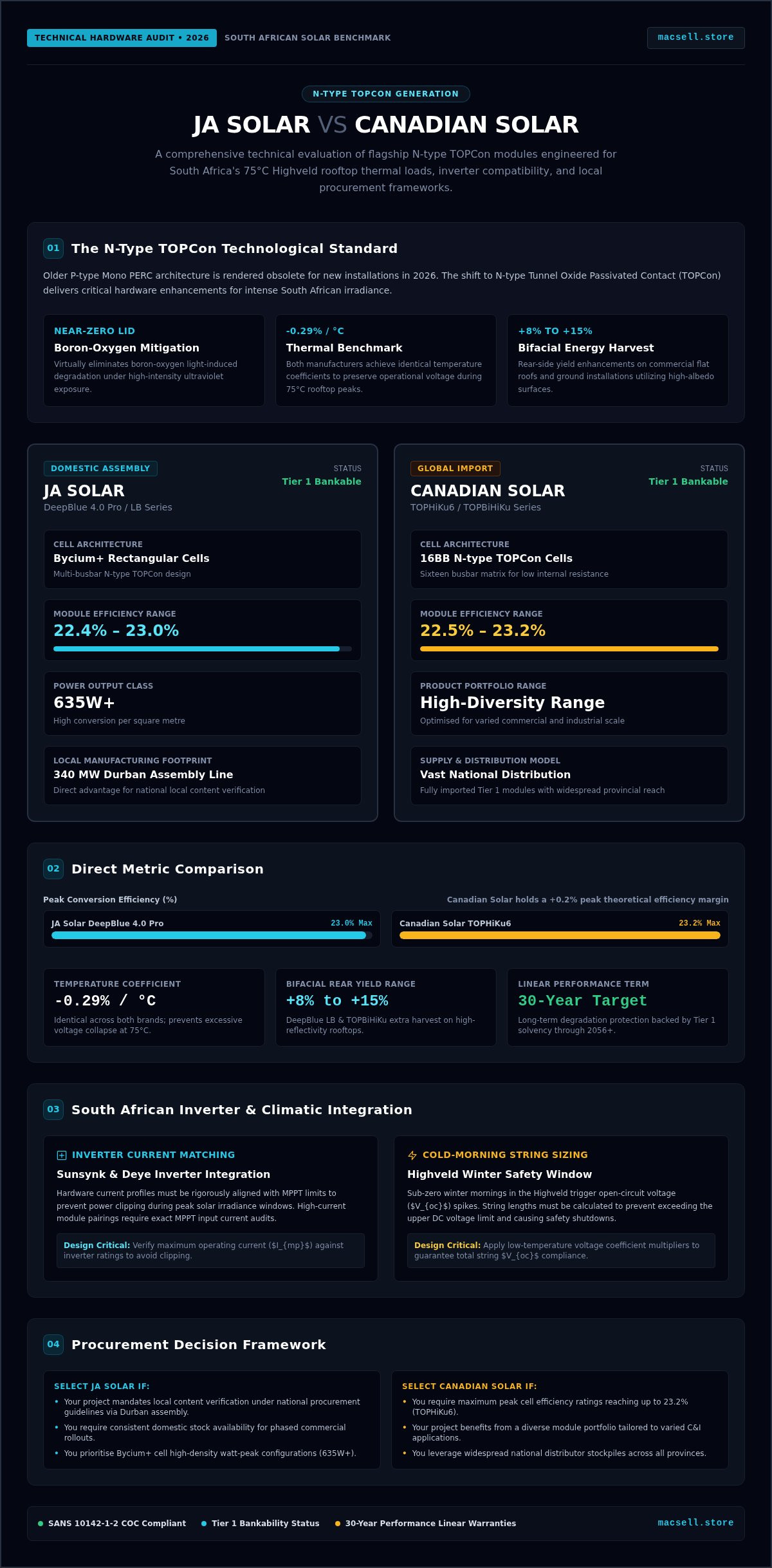
JA Solar maintains a strategic advantage through its domestic manufacturing partnership within the country. This 340 MW production line assembles N-type DeepBlue 4.0 Pro modules locally, which is a critical factor for projects requiring local content verification under national procurement guidelines. Canadian Solar takes a different route, supplying fully assembled Tier 1 modules through a vast national distribution network. Both brands have proven track records across all provinces, but JA Solar's domestic assembly footprint often provides better stock consistency for large-scale rollouts. Warranty support for both manufacturers is handled through these established national channels, ensuring technical backing is available without the delays associated with direct international claims.
Hardware Tier 1 Status Defined
Tier 1 status is often misunderstood as a simple quality seal. In reality, it is a metric of bankability and financial stability. For a South African buyer, this status is a prerequisite for securing insurance and ensuring that the installation meets the Certificate of Compliance (COC) requirements under SANS 10142-1-2 guidelines. Banks and insurers won't typically cover systems using non-Tier 1 hardware due to the lack of long-term performance guarantees. Both JA Solar and Canadian Solar maintain rigorous quality control whilst scaling production, ensuring that the modules you procure today will meet their 30-year linear degradation targets. This status guarantees that the manufacturer has the financial longevity to honour warranties through 2056 and beyond.
Technical Specifications: Efficiency, Wattage, and TOPCon Technology
The technical landscape of this JA Solar vs Canadian Solar panels South Africa comparison is defined by the industry-wide transition to N-type TOPCon (Tunnel Oxide Passivated Contact) architecture. By 2026, older P-type Mono PERC modules have been largely phased out due to their higher degradation rates. N-type cells offer near-zero boron-oxygen light-induced degradation (LID) and superior performance in low-light conditions. Understanding photovoltaic technology basics is vital when evaluating these modules; the shift to N-type allows for higher bifaciality and better conversion efficiency across the entire solar spectrum.
Cell Technology and Efficiency Gains
JA Solar utilizes its proprietary Bycium+ rectangular N-type TOPCon cells in the DeepBlue 4.0 Pro series. These modules deliver efficiency ratings between 22.4% and 23.0%, with power outputs reaching 635W and beyond. Canadian Solar counters with the TOPHiKu6 series, employing 16BB (sixteen busbar) N-type TOPCon cells. This hardware achieves slightly higher peak module efficiencies, ranging from 22.5% to 23.2%. Both brands use multi-busbar technology to reduce internal resistance and improve current collection, which is essential for maintaining output during South Africa's intense peak-sun hours.
Bifacial modules have become the standard for commercial flat roofs and ground-mount systems. JA Solar DeepBlue 4.0 Pro LB series and Canadian Solar TOPBiHiKu modules can provide an additional 8% to 15% rear-side yield. On high-albedo surfaces like white-painted roofs or light gravel, this extra harvest significantly improves the return on investment for large-scale procurement.
Wattage and Physical Dimensions
Module size has increased alongside wattage. A standard 580W to 610W panel now typically utilizes 182mm or 210mm wafers, resulting in a larger physical footprint than legacy modules. When evaluating a 450W solar panel for a residential installation, the dimensions are more manageable for standard pitched roofs. However, move to the 600W+ range, and the panels often exceed 2.3 metres in length and 30kg in weight. This requires careful consideration of the mounting system's structural integrity and the wind load capacity of the roof.
- JA Solar DeepBlue 4.0 Pro: Power outputs from 440W to 635W+; uses rectangular wafers to optimise space and density.
- Canadian Solar TOPHiKu6: Power outputs from 440W to 620W; known for consistent performance across diverse environmental conditions.
- Efficiency Benchmarks: Both brands now exceed the 22.5% threshold for their flagship N-type commercial lines.
Optimising your panel layout involves balancing total wattage with available roof area. High-density modules allow for maximum power per square metre, which is critical when roof space is limited by chimneys or vents. You can view our current solar panel inventory to compare the physical dimensions and wattage ratings of these Tier 1 brands before finalising your system design.
Durability Factors: Performance in High-Temperature South African Climates
Operating conditions on a local rooftop are brutal. Ambient temperatures exceeding 35°C routinely drive panel core temperatures above 65°C. This reality makes environmental durability a critical metric in this JA Solar vs Canadian Solar panels South Africa comparison. According to irradiation data from the Global Solar Atlas, the high solar exposure across the country accelerates thermal derating if the hardware lacks a competitive temperature coefficient. Selecting panels based on nameplate wattage alone ignores the actual field performance during peak summer conditions.
Temperature Coefficient Comparison
Both JA Solar DeepBlue 4.0 Pro and Canadian Solar TOPHiKu6 modules feature an identical temperature coefficient for maximum power (Pmax) of -0.29% / °C. This represents a significant technical upgrade over older P-type PERC panels, which typically degraded at -0.35% to -0.38% / °C. This improvement prevents up to 3.5% thermal output losses when rooftop temperatures peak. The open-circuit voltage coefficient (Voc) is also identical at -0.25% / °C, providing predictable voltage drops across both hardware lines during extreme heatwaves.
N-type TOPCon technology provides near-zero boron-oxygen light-induced degradation (LID). This ensures that the first-year power drop is limited to 1.0% or less for both manufacturers. Subsequent annual degradation is guaranteed at 0.40% or less over years 2 to 30. This linear degradation profile ensures that both brands retain at least 87.4% of their nominal output power at Year 30, protecting your long-term procurement investment against premature power loss.
Build Quality and Material Integrity
Mechanical resilience is vital in regions where severe summer hailstorms are common. Both manufacturers certify their modules for a front static load of 5,400 Pa and a rear wind load of 2,400 Pa. However, the glass configuration varies by model selection. Dual-glass bifacial modules utilise 2.0mm dual tempered glass, which provides superior resistance to micro-cracking caused by hail impacts compared to standard 3.2mm single-glass monofacial alternatives.
- Frame Construction: Anodised aluminium alloys provide corrosion resistance in both coastal and high-pollution industrial zones.
- Junction Box Sealing: IP68-rated enclosures protect the bypass diodes from dust ingress and torrential summer downpours.
- Connector Reliability: Standard MC4 or MC4-EVO2 compatible connectors ensure low contact resistance in high-amperage strings.
Hardware longevity depends heavily on these material standards. Dust accumulation in arid regions requires robust junction box seals to prevent moisture ingress during sudden downpours. Both brands deliver identical mechanical load ratings, meaning the choice between them often comes down to specific inventory availability and layout design rather than a difference in structural durability.
Compatibility Guide: Matching Panels with Sunsynk and Deye Inverters
Hardware compatibility is the most overlooked factor in this JA Solar vs Canadian Solar panels South Africa comparison. Modern 580W to 610W TOPCon modules operate at an optimum operating current (Imp) between 13.1A and 14.5A. Older 5kW hybrid inverters often featured MPPT inputs limited to 11A or 13A; this causes current clipping where excess solar generation is simply wasted during peak sun hours. To avoid this, you must pair these high-output panels with a modern Sunsynk inverter or equivalent Deye model. Current 8kW and 12kW units provide 22A to 26A per tracker, allowing for full power harvest without throttling.
Inverter-Panel Synergy
Voltage string calculations are critical for national winter conditions. When morning temperatures drop to 0°C, the open-circuit voltage (Voc) of these panels rises by approximately 6% to 7% due to their thermal coefficients. For a typical Deye inverter price South Africa profile, the MPPT operational range is 125V to 425V. Exceeding the 500V DC safety limit will trigger an immediate hardware shutdown. To stay within the 425V sweet spot during cold winter mornings, installers should restrict string lengths to a maximum of 8 to 9 panels in series. This ensures your hybrid inverter price South Africa investment delivers peak efficiency across all seasons.
Maximising Battery Storage
Efficient panel selection directly impacts how quickly you can charge a lithium ion solar battery. During load shedding intervals, the goal is to reach a full state of charge as rapidly as possible before the next power cut. High-amperage N-type modules from JA Solar and Canadian Solar provide the necessary current density to saturate the DC charging bus of your inverter. By optimising your backup power kit South Africa with correctly matched modules, you ensure consistent power delivery whilst maintaining a healthy battery lifespan through reduced depth-of-discharge cycles.
- Current Matching: Ensure MPPT capacity exceeds 15A for single strings to prevent clipping.
- Voltage Safety: Factor in a 7% Voc rise for cold-weather mornings to protect the DC bus.
- Clipping Prevention: Avoid legacy 11A MPPT inverters for panels rated over 550W.
Correct hardware synchronisation prevents mid-day power losses and inverter hardware strain. You can browse our compatible inverter and panel combinations to find a pre-verified hardware match for your specific project requirements.
Procurement Strategy: Selecting Hardware for Your 2026 Solar Project
Direct hardware procurement has become the standard for cash-conscious buyers in 2026. By sourcing components through a specialised outlet, you eliminate the significant markups typically applied by full-service firms. This JA Solar vs Canadian Solar panels South Africa comparison shows that both manufacturers offer Tier 1 bankability, yet your choice should align with specific site constraints and budget allocations. Understanding the current solar panel for home price metrics allows you to calculate a precise return on investment against rising national electricity tariffs.
Budget vs Performance
JA Solar often leads in efficiency for residential rooftops where space is a premium. Their DeepBlue 4.0 Pro series maximises wattage per square metre, allowing for a higher total system capacity on smaller roof sections. Canadian Solar remains the benchmark for large-scale commercial procurement. Their TOPHiKu series provides exceptional value when buying in pallet quantities, making them the preferred choice for industrial arrays where roof area is less restricted. ROI calculations for 2026 should factor in the 0.40% annual degradation rate; both brands ensure your hardware remains a high-performing asset for three decades.
Hardware Procurement Checklist
A secure procurement process requires verifying every component before it reaches the site. Use a comprehensive solar equipment checklist South Africa to ensure total system synergy. Managing the logistics of high-capacity lithium batteries and panels requires technical precision to avoid hardware damage.
- Serial Number Verification: Always register your modules on the manufacturer’s portal to activate the 12 to 25-year workmanship warranties.
- Compatibility Audit: Confirm that the panel short-circuit current ($I_{sc}$) does not exceed the MPPT thresholds of your Sunsynk or Deye inverter as discussed in the compatibility guide.
- Logistics and Storage: Ensure modules are stored vertically on a level surface to prevent micro-cracking during the pre-installation phase.
Final Verdict
The technical winner depends on your primary project driver. If you require the highest power density for a compact residential roof, JA Solar is the superior choice. If your project prioritises the lowest cost-per-watt for a high-capacity commercial system, Canadian Solar offers the most resilient procurement path. Both brands provide the N-type TOPCon reliability required for South Africa’s high-UV environment. By purchasing your hardware directly, you retain control over component quality and total project expenditure.
Optimising Your 2026 Solar Hardware Procurement
Selecting between these two Tier 1 giants requires a technical audit of your specific site conditions. This JA Solar vs Canadian Solar panels South Africa comparison highlights that whilst both brands offer superior -0.29% / °C temperature coefficients, your final choice rests on matching panel amperage to your hybrid inverter's MPPT capacity. JA Solar provides high power density for restricted spaces, whereas Canadian Solar remains the benchmark for commercial-scale value.
As a specialised retailer of Sunsynk, Deye, and LuxPower hardware, we provide the no-nonsense technical expertise needed to build a resilient energy system. Our specialised solar combo kits are engineered for maximum efficiency without the unnecessary markups of full-service installation firms. Browse our latest Tier 1 Solar Panel hardware and prices to secure your 2026 energy independence.
Building a high-performance solar array is a straightforward process when you lead with technical data and specialised hardware.
Frequently Asked Questions
Is JA Solar better than Canadian Solar for South African homes?
Neither brand is universally superior. JA Solar modules often suit residential rooftops where space is limited due to higher efficiency and power density. Canadian Solar is frequently selected for larger arrays where cost-per-watt is the primary driver for procurement. This JA Solar vs Canadian Solar panels South Africa comparison shows that both provide the N-type TOPCon technology required for local conditions. Your choice should reflect your specific roof dimensions and total wattage requirements.
What is the standard warranty for JA Solar and Canadian Solar panels in SA?
Both manufacturers offer a standard 12-year product and workmanship warranty for their commercial lines. The linear power output warranty is guaranteed for 30 years. By the end of this period, both brands ensure the modules will produce at least 87.4% of their initial nominal power. You must register the serial numbers on the manufacturer portals to ensure these protections remain valid throughout the hardware's operational lifespan. This provides long-term security for your energy investment.
Can I mix JA Solar and Canadian Solar panels in the same string?
You shouldn't mix different panel brands or models within the same string. Mismatched electrical characteristics, specifically the optimum operating current ($I_{mp}$) and open-circuit voltage ($V_{oc}$), will cause the string to perform at the level of the weakest panel. This leads to significant energy harvest losses and can cause hot spots that damage the cells. Always use identical hardware across a single MPPT tracker to maintain consistent performance and protect your inverter's DC bus.
How does the temperature coefficient affect panel performance in the Karoo or Northern Cape?
In high-heat regions like the Northern Cape, ambient temperatures often exceed 40°C. The -0.29% / °C temperature coefficient found in these 2026 N-type modules is critical. It ensures that power loss is minimised as the panel surface heats up. Legacy P-type panels lose significantly more efficiency in these arid climates. Selecting hardware with this superior thermal rating prevents massive mid-day production drops during extreme summer heatwaves, ensuring a more consistent daily energy yield.
Which panel brand is more resistant to hail damage in South Africa?
Both brands carry a front static load certification of 5,400 Pa, which is the industry standard for hail and snow resistance. For regions prone to severe storms, choosing dual-glass bifacial modules is recommended. These utilise 2.0mm tempered glass on both sides, offering better structural integrity against micro-cracking than 3.2mm single-glass alternatives. This build quality is essential for long-term durability in the Highveld and other provinces where summer hailstorms are a regular occurrence.
Are these panels compatible with my Sunsynk 8KVA hybrid inverter?
These modules are fully compatible with the Sunsynk 8KVA hybrid inverter. The inverter’s MPPT trackers are rated for 22A to 26A, which comfortably handles the 13A to 14.5A output of modern 550W+ TOPCon panels. You must ensure your total string voltage doesn't exceed the 500V DC limit, especially during cold mornings when voltage naturally rises. Correct string sizing ensures that you maximise battery charging rates without triggering inverter safety shutdowns or hardware clipping.
What is the expected lifespan of a Tier 1 solar panel in 2026?
A Tier 1 solar panel in 2026 has a warranted lifespan of 30 years. The transition to N-type TOPCon technology has virtually eliminated boron-oxygen light-induced degradation, which was a common failure point in older hardware. While the power output will naturally decrease by approximately 0.40% annually, the modules are designed to remain functional well beyond their three-decade warranty period. This longevity makes them a stable long-term asset for achieving residential or commercial energy independence.
Does MacSell Solar Outlet provide installation for these panels?
MacSell Solar Outlet does not provide installation services. We are a specialised national retailer focusing exclusively on the distribution of high-end solar hardware, including Sunsynk and Deye inverters, lithium batteries, and solar panels. Our business model prioritises providing technical expertise and variety at retail prices without the overhead of installation fees or financing plans. Customers are responsible for sourcing their own qualified installers to ensure compliance with SANS 10142-1-2 regulations and municipal requirements.