

Pre-configured Solar Kit South Africa: 2026 Hardware Procurement Guide
With Eskom tariffs rising by 8.76% in April 2026 and the SSEG registration deadline of 30 September approaching, generic hardware bundles are a liability. Selecting a high-performance pre-configured solar kit South Africa property owners can rely on requires a focus on component synergy; specifically how your inverter manages peak loads alongside battery discharge rates. You want a system that handles high-surge appliances without technical bottlenecks or communication errors between mismatched brands.
It's frustrating to face confusing jargon or the fear of purchasing an underpowered system that fails during heavy load periods. This guide provides a technical roadmap to mastering hardware procurement for 2026. You'll gain a clear understanding of component compatibility and access to elite hardware brands like Sunsynk, Hubble, and LuxPower. We'll break down the specific synergies of the Sunsynk 8KVA and Hubble AM2 combo to ensure your property achieves total energy independence through precise, expert-curated hardware selection.
Key Takeaways
- Identify why a pre-configured solar kit South Africa provides superior component synergy and technical reliability compared to piecemeal hardware procurement.
- Master the technical specifications of the Sunsynk 8KVA and Hubble AM2 combo to ensure your system handles high-surge household appliances.
- Learn to calculate daily kWh consumption and distinguish between essential and non-essential loads for accurate hardware sizing.
- Understand the logistics of national hardware procurement through a dedicated retail model focused on elite solar brands and technical accuracy.
Understanding Pre-configured Solar Kits in the 2026 South African Context
A pre-configured solar kit South Africa is a technically matched assembly of high-end hardware, including a hybrid inverter, compatible lithium storage, and tier-1 solar panels. This approach eliminates the technical risks associated with piecemeal procurement, where mismatched hardware often results in communication failures or inefficient power conversion. By selecting a kit where the components are already verified for synergy, you ensure that the system operates at peak efficiency from the moment of activation.
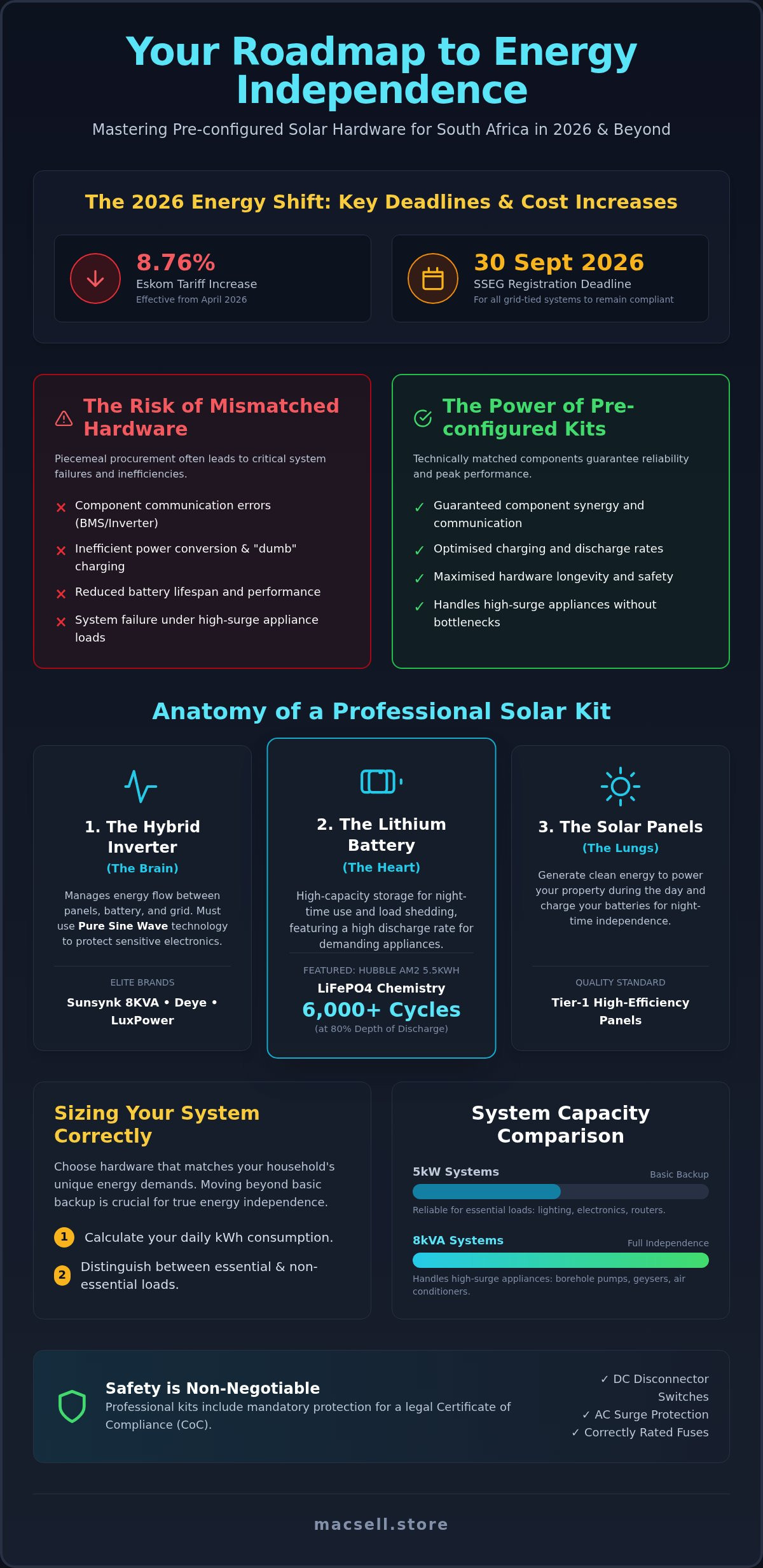
The landscape for Solar power in South Africa has shifted significantly in 2026. With NERSA-approved tariff increases of 8.76% effective from April 2026, and a further 8.83% approved for 2027, homeowners are moving beyond basic backup. The focus is now on total energy independence. All grid-tied systems must meet the 30 September 2026 SSEG registration deadline to remain compliant with Eskom and municipal regulations. Whilst these kits are pre-configured for optimal performance, a Certificate of Compliance (CoC) from a registered electrician remains a legal requirement for every installation.
The Evolution of Energy Independence
Load shedding patterns have evolved from temporary inconveniences to a permanent driver for high-capacity storage. Simple 5kW systems, whilst reliable for basic lighting and electronics, are often insufficient for modern South African households. High-surge appliances like borehole pumps, geysers, or multiple air conditioning units require the robust overhead provided by 8kVA hardware. The transition from simple backup to full hybrid energy production allows properties to run almost entirely off solar during the day whilst charging batteries for night-time use. This shift reflects the 6.2% decline in Eskom electricity sales as more users move toward embedded generation.
Component Synergy: Why Matching Matters
Hardware synergy is the foundation of system longevity. A pre-configured solar kit South Africa ensures that the inverter and the Battery Management System (BMS) communicate via the correct protocols, typically CAN or RS485. Mismatched components often lead to "dumb" charging, where the inverter cannot monitor the individual cell voltages of the battery. This lack of data reduces the lifespan of lithium units like the Hubble AM2. Using a matched bundle, such as a Sunsynk 8KVA paired with Hubble storage, ensures that discharge rates are optimised and safety parameters are strictly maintained by the hardware's internal logic.
Technical Anatomy of a Professional Solar Hardware Bundle
A professional pre-configured solar kit South Africa functions as a synchronised ecosystem. It consists of three core pillars: the inverter (the brain), the lithium battery (the heart), and the solar panels (the lungs). For technical reliability, the inverter must utilise Pure Sine Wave technology. This ensures the output voltage matches the quality of the grid, protecting sensitive household electronics and high-surge appliances from harmonic distortion or electrical noise.
Modern 2026 hardware kits prioritise comprehensive protection and safety. A professional bundle includes essential switchgear: DC disconnector switches, AC surge protection devices, and correctly rated fuses. These components are mandatory for a legal Certificate of Compliance (CoC) and prevent hardware failure during atmospheric surges or internal faults. You can view these technical specifications in our hardware inventory to ensure your procurement meets local safety standards.
Hybrid Inverters: Sunsynk, Deye, and LuxPower
The Sunsynk 8KVA hybrid inverter is a market leader due to its sophisticated software and robust power handling. It manages complex energy flows between the grid, panels, and batteries with precision. For users requiring modularity, the LuxPower 5kW Inverter, specifically the SNA5000 Hybrid Inverter, allows for straightforward system expansion. Deye units are favoured for their parallel capabilities, enabling multiple inverters to work in unison to satisfy larger residential or commercial loads.
Lithium Storage: The Hubble AM2 Advantage
The Hubble AM2 5.5 KWh lithium battery is the primary storage choice for high-end bundles. Its Lithium Iron Phosphate (LiFePO4) chemistry provides superior thermal stability and a longer operational lifespan than traditional storage technologies. These units offer over 6,000 cycles at 80% Depth of Discharge, ensuring long-term reliability for South African properties.
Understanding the discharge rate, or C-rating, is critical for accurate system sizing. The Hubble AM2 supports a high continuous discharge rate, which is vital for handling high-surge appliances like electric kettles or borehole pumps. Whilst entry-level batteries are often limited to 0.5C, premium lithium hardware in a pre-configured solar kit South Africa supports 1C discharge. This ensures the battery provides the full power required by the inverter during peak load periods without triggering thermal shutdowns or safety cut-outs.
The Sunsynk 8KVA and Hubble AM2 Synergy
The Sunsynk 8KVA and Hubble AM2 combination is the benchmark for high-performance residential systems. This pairing ensures seamless communication between the inverter's control logic and the battery's management system, preventing the "dumb" charging issues found in cheaper bundles. For a detailed breakdown of the performance metrics, read our Sunsynk 8KVA and Hubble AM2 Combo Kit: Technical Review.
One distinct technical advantage is the integrated Hubble Cloudlink. This hardware allows for remote monitoring and real-time firmware updates. It ensures the system remains optimised for the latest NERSA grid conditions and Eskom tariff structures without requiring a technician on-site. The ability to push updates remotely is a critical feature in the 2026 landscape, where regulatory compliance is increasingly automated and monitored by local municipalities.
LuxPower vs Deye: Choosing the Right Hybrid Path
The LuxPower SNA5000 is an effective solution for budget-conscious procurement that doesn't compromise on core reliability. When used in a dual-battery configuration, it provides a stable 5kW output with 11kWh of storage. This capacity is sufficient to navigate extended load shedding periods for essential loads like refrigeration, security, and home offices. It's particularly suited for modular residential expansion where users intend to add more storage capacity as their budget allows.
Deye inverters are the preferred choice for complex installations. Their parallel capabilities allow up to 16 units to synchronise, making them ideal for large-scale commercial applications. Both brands offer robust local firmware support and are fully compliant with South African safety standards. Choosing between them depends on whether your priority is modular residential growth or high-capacity industrial scaling. A pre-configured solar kit South Africa based on Deye hardware provides the necessary overhead for businesses aiming to claim the Section 12B tax incentive for systems up to 1 MW.
Sizing Your System: Matching Hardware to Household Demand
Selecting a pre-configured solar kit South Africa requires a precise audit of your property's energy profile. Total daily kWh consumption is determined by multiplying appliance wattage by hours of operation. For example, a 3kW geyser running for two hours consumes 6kWh. Accurate sizing ensures hardware handles peak instantaneous demand without tripping. You can browse our matched hardware bundles to find a system that fits your audited load.
Effective load management involves categorising circuits into "Essential" and "Non-Essential" paths. Essential loads, such as Wi-Fi, refrigeration, and security, remain active during outages. Non-Essential loads, like pool pumps or ovens, are typically disconnected during grid failure to preserve battery life. A high-end 8KVA system provides enough throughput to run a geyser and aircon simultaneously, provided the solar array or battery bank supports the continuous draw. This eliminates the need to manually switch off heavy appliances during the day.
The 5kW vs 8KVA Debate
A 5kW system is appropriate for smaller properties or basic backup needs focusing strictly on essential circuits. In contrast, the 8KVA inverter is the modern standard for South African family homes in 2026. It offers the necessary current for high-surge appliances and allows for more complex energy management. For a deeper technical comparison, consult our Home Inverter and Battery Combo: 2026 Hardware Guide.
Calculating Battery Capacity for Loadshedding
Determining the number of Hubble AM2 units depends on the duration of the expected outage. A single Hubble AM2 provides 5.5kWh of total capacity. With a recommended 80% Depth of Discharge (DoD), you have 4.4kWh of usable energy. For a 4-hour outage with a 2kW constant load, at least two units are required. Sizing the solar panel array is equally critical. The array must produce enough energy to power the home whilst simultaneously recharging the batteries to 100% within available peak sun hours. This modular hardware approach allows for future-proofing, enabling you to add storage as your energy requirements grow.
Procuring Elite Solar Kits for National Delivery in South Africa
Procuring a pre-configured solar kit South Africa via a hardware-only retail model provides a streamlined path to energy independence. This approach is designed for customers who have existing relationships with qualified installers and require direct access to elite components without the overhead of bundled services. By purchasing from an authorised South African hardware outlet, you ensure that every component in the bundle is genuine and carries a full manufacturer-backed warranty.
National delivery logistics are a primary consideration for solar procurement. Heavy lithium batteries, such as the Hubble AM2, and large-format solar panels require specialised freight handling to maintain hardware integrity during transit. A professional distributor manages these logistics nationally, ensuring that technical equipment arrives in factory condition. This hardware-first model eliminates the delays often associated with middlemen or installers who don't hold their own stock.
The MacSell Solar Outlet Procurement Process
Efficiency in procurement depends on high-stock availability and technical accuracy. We maintain a constant inventory of Sunsynk, Deye, LuxPower, and Hubble hardware to satisfy national demand. This direct access allows for immediate dispatch of complex systems like the Sunsynk 8KVA and Hubble AM2 combo. For comprehensive insights into hardware selection, consult our Backup Power Kit South Africa: 2026 Hardware Procurement Guide. Ensuring your hardware is warranty-backed is the final safeguard for your investment, providing a clear path for technical support if hardware faults occur.
Final Hardware Checklist Before Purchase
A successful procurement requires a final verification of all technical peripherals. Use this checklist to ensure your pre-configured solar kit South Africa is complete before the installer arrives on-site:
- Communication Cables: Confirm that the specific CAN or RS485 cables for inverter-to-battery communication are included in the kit.
- Panel Compatibility: Verify that the total wattage and voltage of the solar panel array stay within the MPPT parameters of your chosen inverter.
- Mounting Hardware: Ensure that mounting rails and clamps are compatible with your specific roof profile, such as Kliplok, IBR, or concrete tile.
- Protection Components: Check for the inclusion of DC and AC surge protection devices, which are mandatory for legal sign-off and safety.
The final step in the procurement process is a consultation with your preferred professional installer. This ensures that the hardware matches your property's specific electrical layout and that all components meet the 30 September 2026 SSEG registration requirements. Taking these steps guarantees a high-performance system that delivers long-term energy security.
Securing Energy Independence for 2026 and Beyond
Achieving total energy independence in the current South African landscape requires a shift from basic backup to high-performance hardware synergy. A professional pre-configured solar kit South Africa property owners select must balance inverter throughput with battery discharge rates to handle high-surge appliances effectively. By prioritising matched components like the Sunsynk 8KVA and Hubble AM2 combo, you ensure your system remains compliant with the 30 September 2026 SSEG registration deadline whilst protecting your hardware's long-term operational lifespan.
MacSell Solar Outlet provides direct access to these elite components through a hardware-only retail model. As an authorised Sunsynk retailer and specialists in premium Hubble lithium storage, we facilitate national delivery across South Africa to streamline your procurement process. This expert-curated inventory allows you to bypass technical incompatibility and focus on a system that satisfies your specific household demand. Take the final step toward reliable power by selecting hardware designed for the rigours of the modern grid. Browse our Pre-configured Sunsynk and Hubble Solar Kits today to secure your energy future.
Frequently Asked Questions
What is included in a pre-configured solar kit in South Africa?
A standard pre-configured solar kit South Africa includes a hybrid inverter, compatible lithium storage units, and tier-1 solar panels. It also contains essential protection components like DC and AC switchgear alongside surge protection devices. These kits are technically matched to ensure communication protocols between the inverter and battery management system are seamless. This hardware-only procurement model provides all high-end components required for a professional installer to complete a grid-compliant commissioning.
Can I install a Sunsynk 8KVA and Hubble AM2 kit myself?
No, you cannot legally install this hardware yourself. Whilst we provide the hardware, South African regulations require a Certificate of Compliance (CoC) issued by a registered electrical contractor. This document is mandatory for the 30 September 2026 SSEG registration deadline. Attempting a DIY installation voids manufacturer warranties and creates significant safety risks. You should procure your hardware and then engage a qualified professional to ensure the system meets SANS 10142-1 safety standards.
How long will a 5.5 KWh Hubble lithium battery last during loadshedding?
A Hubble AM2 5.5 KWh battery provides approximately 4.4kWh of usable energy when considering a recommended 80% Depth of Discharge. The actual duration depends on your constant load. For a typical household drawing 1kW for lights, Wi-Fi, and refrigeration, a single unit lasts roughly 4.4 hours. If your load increases to 2kW during a Stage 6 outage, the duration drops to 2.2 hours. Adding a second Hubble AM2 in parallel doubles this capacity.
What is the difference between a grid-tied and a hybrid solar kit?
A grid-tied kit is designed strictly to reduce electricity bills by feeding solar power into the home or grid, but it shuts down during load shedding. A hybrid pre-configured solar kit South Africa includes lithium storage, allowing it to function as a backup power source during outages. Hybrid systems manage power from the grid, solar panels, and batteries simultaneously. This ensures your essential circuits remain powered even when the utility supply is disconnected.
Do pre-configured kits come with solar panels included?
Yes, our pre-configured bundles typically include a specific number of high-wattage solar panels matched to the inverter's MPPT capacity. Each kit is designed to ensure the panel array generates enough energy to power the household whilst simultaneously recharging the lithium battery bank. It's important to verify the exact panel count and wattage in the technical specifications before purchase to ensure the array fits your available roof space and specific mounting requirements.
Can I add more batteries to my solar kit at a later date?
Yes, the Sunsynk and Hubble hardware we supply is designed for modular expansion. You can add more batteries in parallel to increase your storage capacity as your energy needs grow. It's best to add identical units, such as additional Hubble AM2 modules, to maintain balanced charging and discharging cycles. Your installer will need to update the inverter's battery settings and ensure the communication cables are correctly linked between the new and existing units.
Why is the Sunsynk 8KVA inverter preferred for South African homes?
The Sunsynk 8KVA is favoured because it provides the necessary overhead to run high-surge appliances like geysers and borehole pumps. Its robust software allows for complex load management, prioritising essential circuits during outages. It's also highly scalable, allowing for parallel configurations if your power requirements increase. In the 2026 landscape, its ability to integrate seamlessly with Hubble lithium storage makes it the benchmark for reliable, high-performance residential energy independence.
What warranty coverage applies to solar hardware bought online?
All hardware bought through our outlet carries official manufacturer-backed warranties. For Sunsynk inverters and Hubble batteries, these warranties are typically conditional on the system being installed by a qualified electrician and having a valid Certificate of Compliance. Registration of the serial numbers on the manufacturer's portal is often required within a specific timeframe. Buying from an authorised retailer ensures you receive genuine hardware that is fully supported by local technical service centres.