

Problems with grey import inverters in SA: warranty and support risks
A cheaper inverter can carry more risk than its price suggests. The main problems with grey import inverters in SA are uncertain local warranty cover, limited manufacturer support and specifications intended for another market. Parallel imports are legal in South Africa, but sellers must disclose when goods aren’t covered by the manufacturer’s warranty.
The appeal is clear: a branded inverter may look like the same product at a lower price. The difference can emerge after purchase, when a fault needs attention or the unit’s market-specific configuration doesn’t suit the system.
This article explains how parallel importing can affect warranty claims and support, what import-status checks can reveal, and why specifications matter. It also covers warning signs and ways to weigh the risks before choosing an inverter for a South African installation.
Key Takeaways
- Read warranty terms closely: parallel-imported equipment may have cover limited to its country of origin, with local repairs and support affected.
- Use the inverter’s serial number and import documentation to establish its distribution route and support eligibility with the manufacturer.
- Compare the unit’s market-specific settings and specifications with the requirements of the South African system it will serve.
- Assess compliance separately from brand or import status; safety standards and the system’s Certificate of Compliance matter for an installation.
Authorized equipment warranties and support
The problems with grey import inverters in SA often become practical when a unit needs repair. The import route, warranty terms and local support determine who handles the fault and where.
Warranty eligibility and limitations
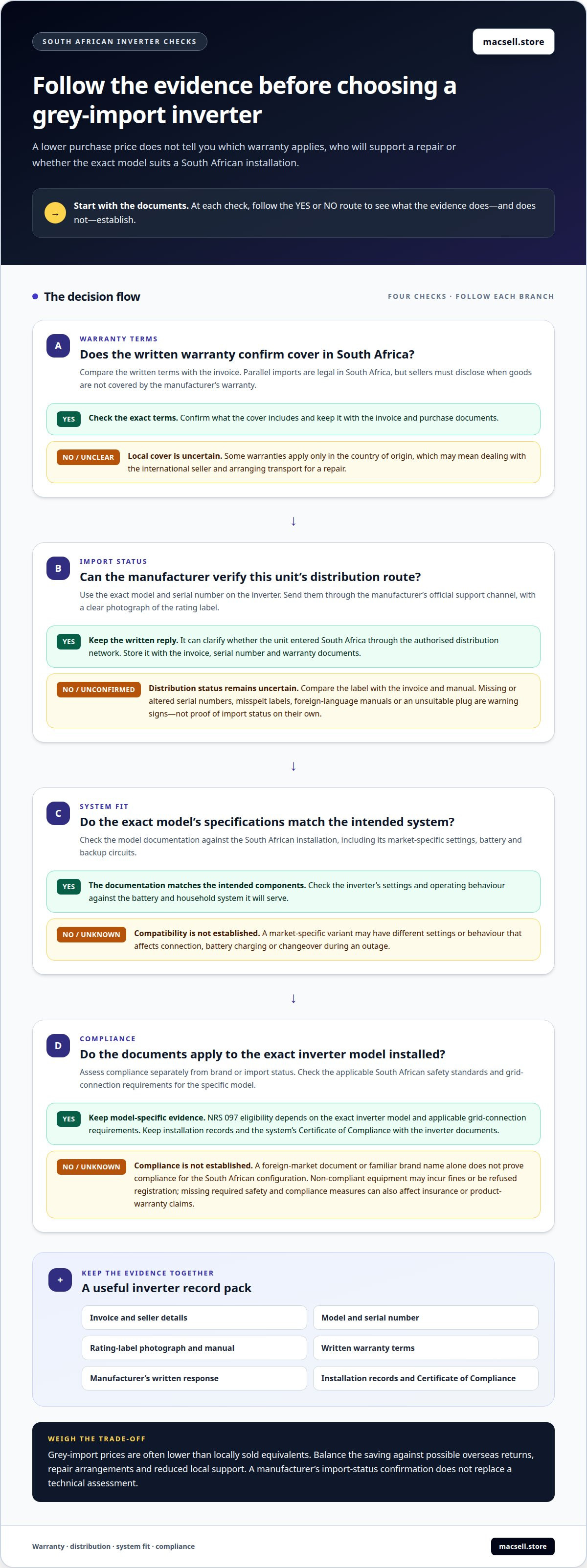
Warranty eligibility depends on the terms and the market for which the inverter was supplied. Some grey-import warranties apply only in the country of origin, so a South African owner may need to return the unit to the international seller. That can add transport and coordination to a repair. Parallel imports are legal in South Africa, but sellers must disclose when goods aren’t covered by the manufacturer’s warranty. Compare the written terms with the invoice before buying.
Technical support and repairs
Technical support includes fault diagnosis, product guidance and access to repairs. Grey imports may lack a local service agreement, leaving the owner to arrange maintenance or repairs. A technician may face delays if parts or manufacturer assistance aren’t available through local channels. Keep the invoice, serial number and warranty documents together. These records identify the unit and seller if a fault needs attention.
Grey-import inverter prices in South Africa are often lower than those of locally sold equivalents. Weigh the saving against possible overseas returns, repair arrangements and reduced local support. A lower purchase price alone doesn’t tell you which warranty applies. This is one of the problems with grey import inverters in SA that buyers can assess before committing.
Are warranties and repairs available for grey import inverters in South Africa? They may be, but cover depends on the warranty terms and the seller’s arrangements. If cover is restricted to the country of origin, the owner may need to deal with the international seller rather than local manufacturer support.
Insurance can also be affected by compliance. An inverter installed without required safety and compliance measures may leave the customer unable to claim insurance or product warranties. Keep installation records and the system’s Certificate of Compliance with the inverter documents.
Checking import status with manufacturers
A serial number and proof of purchase can help establish an inverter’s origin. Import status matters because the route into South Africa may affect manufacturer recognition and support.
Start with the exact model and serial number printed on the inverter. Send those details to the manufacturer through its official support channel and ask whether the unit entered South Africa through its authorised distribution network. Include a clear photograph of the rating label; a model name alone may not distinguish versions made for different markets.
Compare the manufacturer’s response with the seller’s invoice and product documents. An invoice or proof of ownership links the specific unit to its seller. Keep these records together with the serial number, manual and written warranty terms. Missing or altered serial numbers are warning signs, as are generic packages with misspelt labels.
Packaging and documentation can offer further clues. A foreign-language manual or a plug that doesn’t match South African use may indicate a product intended for another market. These signs don’t establish import status on their own, so use the model and serial details for a manufacturer check.
- Record: the model, serial number and seller details.
- Compare: the inverter label with the invoice and manual.
- Ask: the manufacturer whether the serial number identifies an official South African import.
- Keep: the manufacturer’s written response with the purchase documents.
Can grey import inverters be registered with municipal utilities or Eskom? Import status alone doesn’t establish eligibility for registration. The key questions are whether the inverter’s specifications and compliance documents meet the applicable connection requirements.
Manufacturer confirmation clarifies distribution status; it doesn’t replace technical assessment of the unit. A branded inverter bought online can still fail to integrate properly or meet safety needs. For a system decision, compare the inverter’s documentation and specifications with the installation requirements; hybrid inverter options provide a product category to consider.
Differences in product specifications for different markets
Import status alone doesn’t establish NRS 097 grid-connection approval; the exact inverter model must meet applicable local requirements. Load-shedding performance also depends on settings and compatibility with the battery and household system.
Local certifications and standards
South African inverter certification and SANS standards address local safety and operating requirements. Their relevance is model-specific: the documentation and inverter variant must match the unit installed. A foreign-market test document or familiar brand name alone doesn’t establish compliance for a South African configuration. Grey imports that fail South African safety and environmental standards may incur fines or be refused registration.
For NRS 097 approval, import status isn’t proof of eligibility. The evidence must relate to the exact inverter model and its applicable grid-connection requirements. A different model number or market variant can mean different documentation and operating characteristics.
Compatibility with local grids and load-shedding
Grid compatibility describes how an inverter responds to the supply and connects with other system components. A market-specific variant may have different settings or operating behaviour, affecting connection, battery charging or changeover during an outage. Check the model documentation against the intended system, including the battery and backup circuits.
Charging settings matter when power returns after load-shedding. A South African simulation recommended limiting battery-backup charging to 0.15 C. For a 5 kWh battery, that rate corresponds to 0.75 kW; inverter defaults can reach 1 C, or 5 kW for the same battery capacity. A setting designed for another market can therefore affect demand and battery operation locally.
Compare South African system requirements with the inverter’s specific documentation, rather than relying on its brand or broad product name. Focus on the exact model, grid-connection evidence and battery settings. For example, a label showing the correct brand but a different variant doesn’t establish that the specifications match the installation.
- Match the model number on the unit to its technical documents.
- Review grid-connection evidence for that exact model.
- Compare battery charging settings with the system design.
Which inverter certifications and SANS standards are required in South Africa?
Compliance evidence must relate to the inverter’s exact model and intended use. A brand name or overseas document alone doesn’t establish suitability for a South African installation.
SANS refers to South African National Standards. The relevant standard depends on the equipment and its application, so don’t assume one certificate covers every inverter. Read the product documentation for the model identifier, referenced standards and scope of any certification. A document for a similar model or another market may not describe the unit being installed.
Grid connection and installation compliance are related, but they answer different questions. NRS 097 concerns grid connection, while a Certificate of Compliance records compliance for an installed solar system. Keep the inverter’s model documentation with the installation records. The paperwork should correspond to the actual equipment, not simply the product family printed on its packaging.
Grey imports that fail South African safety and environmental standards may incur fines or be refused registration. This makes it important to distinguish import status from technical compliance. A genuine inverter can still be unsuitable if its model variant or supporting documents don’t match South African requirements.
- Match the model number on the inverter label to its certification documents.
- Read which standards the documents cite and what equipment they cover.
- Keep the inverter records with the system’s Certificate of Compliance.
- Separate evidence of import origin from evidence of safety and grid suitability.
For example, a certificate naming a different model variant doesn’t demonstrate that the installed unit meets the same requirements. A complete document set makes it easier to spot gaps between the inverter, its intended grid connection and the installed system.
Compare hybrid inverter options against the technical and compliance requirements of your South African system before choosing equipment.
The applicable SANS standards and certifications depend on the inverter model and its intended use, so check the exact model’s documentation. NRS 097 relates to grid connection, while the system’s Certificate of Compliance covers installation compliance.
MacSell Solar Outlet: Sunsynk 8KVA & 2X Hubble AM2 5.5 KWh Combo Kit
MacSell Solar Outlet offers the Sunsynk 8KVA & 2X Hubble AM2 5.5 KWh Combo Kit for buyers comparing inverter and battery equipment. Its named components make the package a concrete option to assess against your system requirements and product documentation.
When comparing equipment for a South African solar system, consider a kit alongside individual hybrid inverters, lithium batteries and solar panels. Match the inverter and battery specifications to the intended setup, and keep product records with your purchase documents. This helps you assess equipment choice, compatibility and documentation together.
For a different configuration, explore the available hardware categories and compare specifications with your system needs. Contact MacSell Solar Outlet or visit macsell.store to view the equipment options.
Make your next inverter choice with the full system in view
The problems with grey import inverters in SA are a reminder to assess the product, its paperwork and its intended role together. Before choosing an option, write down your system’s requirements, then compare them with the inverter and battery documentation. This gives you a clear basis for considering compatibility and equipment choices.
MacSell Solar Outlet offers hybrid inverters, lithium batteries and the Sunsynk 8KVA & 2X Hubble AM2 5.5 KWh Combo Kit. These are relevant options to consider when reviewing inverter and battery equipment for your setup. The right next step is a product discussion grounded in your intended system, rather than a decision based on import status or headline price alone.
Explore equipment with MacSell Solar Outlet and move forward with a clearer view of your options.
Frequently Asked Questions
Why is parallel importing a problem?
Parallel importing can create problems because branded inverters bypass a manufacturer’s official local distribution route. A unit may be intended for another market, and local warranty or manufacturer support may not apply. A lower purchase price can therefore come with gaps in repairs, parts access or technical assistance. In South Africa, sellers must disclose when parallel-imported goods aren’t covered by the manufacturer’s warranty.
Are grey import inverters legal to sell or install in South Africa?
Parallel imports are legal in South Africa, but warranty disclosure and product compliance are separate matters. Sellers must disclose when the manufacturer’s warranty doesn’t cover the goods. Legal sale alone doesn’t establish that an inverter meets local installation requirements. Grey imports that fail South African safety and environmental standards may incur fines or be refused registration, so assess the exact model’s documentation and intended grid connection.
What are the risks of buying a grey import inverter in South Africa?
Risks include support disputes, difficulty sourcing spare parts and lower resale value. An inverter may also fail to integrate properly with a battery or the wider system. If its serial details don’t match its paperwork, establishing the unit’s origin can be harder. An unusually low price is one warning sign, but assess the equipment, documents and likely repair route together rather than relying on price alone.
How can buyers check an inverter’s compliance, origin and local support before purchase?
Compare the model and serial number on the rating label with those on the invoice and technical manual; resolve any mismatch before buying. Ask the manufacturer in writing to identify the unit’s intended market and local support route. Match the exact model’s grid and safety documents to the installation requirements. After installation, keep the seller’s records with the system’s Certificate of Compliance so the equipment and installation documents remain traceable.