

Pylontech vs Hubble AM2: Compare Battery Life and Capacity Loss
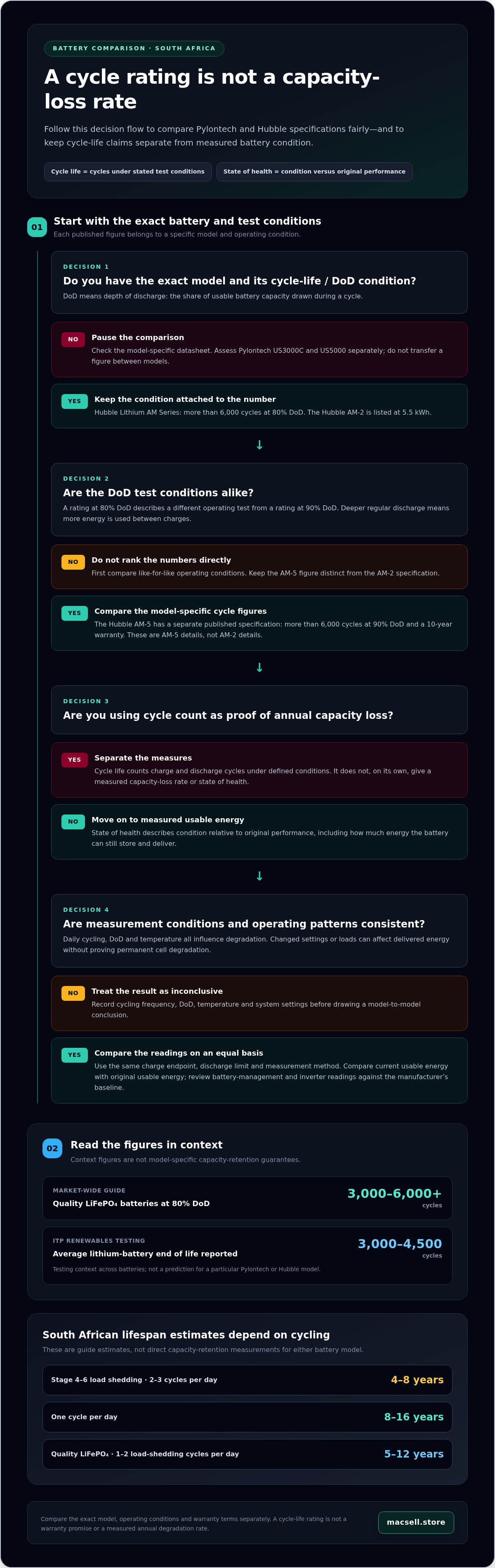
A higher cycle-life rating does not automatically mean a lower measured capacity-loss rate. For the Pylontech versus Hubble AM2 battery degradation rate in South Africa, the comparison starts with operating conditions: Hubble Lithium AM Series batteries are rated for more than 6,000 cycles at 80% depth of discharge. That is a cycle-life specification, not a percentage of capacity lost each year.
When comparing batteries, it’s easy to focus on the headline cycle-life figure. But depth of discharge, daily cycling and temperature all affect how that rating relates to capacity retention in a working system.
This comparison explains how depth of discharge shapes stated cycle life, then distinguishes those ratings from measured capacity degradation. You’ll see what the available figures say about Pylontech and Hubble AM2, which operating factors matter, and how to use those details when assessing a battery for a South African home.
Key Takeaways
- Read cycle-life ratings alongside their depth-of-discharge conditions; Hubble Lithium AM Series batteries are rated for more than 6,000 cycles at 80% depth of discharge.
- Separate a stated cycle-life rating from measured capacity loss and state of health; they describe different aspects of battery performance.
- Compare Pylontech and Hubble specifications carefully, including the operating conditions attached to each published rating.
- Daily cycling, depth of discharge and temperature all influence degradation, so operating patterns matter when assessing battery life.
- Use the warranty and capacity-retention terms as distinct parts of the comparison, rather than assuming a cycle rating defines either one.
Depth-of-discharge conditions for stated cycle life
Depth of discharge (DoD) is the share of a battery’s usable capacity drawn during a cycle. A cycle-life rating is meaningful only alongside its DoD condition: a rating at 80% DoD describes a different operating test from one at 90%. For a residential lithium battery, deeper regular discharge means more energy is used between charges, so compare like-for-like test conditions before judging longevity.
The Hubble Lithium AM Series is rated for more than 6,000 cycles at 80% DoD. The Hubble AM-2 is listed at 5.5 kWh, so its cycle count should not be read as a promise of a particular measured capacity after each year. The Hubble AM-5 also has a 5.5 kWh capacity per unit, but its separate published figure is more than 6,000 cycles at 90% DoD and a 10-year warranty. Keep the AM-5 rating distinct from the AM-2 rating.
For Pylontech US3000C and US5000, compare the exact model’s cycle-life rating with its stated DoD test condition. Don’t transfer a figure between models or assume a rating at one DoD applies at another. The available market-wide guide places most quality LiFePO4 batteries at 3,000-6,000+ charge/discharge cycles when used at 80% DoD. That range provides context, not a substitute for either manufacturer’s model-specific rating.
| Battery option | Capacity | Cycle-life and DoD comparison |
|---|---|---|
| Hubble AM-2 | 5.5 kWh | AM Series rating: 6,000+ cycles at 80% DoD |
| Hubble AM-5 | 5.5 kWh per unit | 6,000+ cycles at 90% DoD; separate AM-5 specification |
| Pylontech US3000C | Compare exact model datasheet | Match the model’s cycle-life figure to its DoD condition |
| Pylontech US5000 | Compare exact model datasheet | Assess separately from the US3000C rating |
Start by matching the usable energy you need to the depth-of-discharge conditions behind the rating, then compare the exact model specifications. Whether the setup is scalable or integrated, the battery and inverter must still be configured within compatible limits.
Warranty exclusions, claim processes and local support vary by model and warranty terms. Compare the exclusions, required evidence, claim process and South African support arrangements instead of treating cycle life as a warranty promise.
For safe installation, match the battery and inverter voltage, current limits, BMS communications and configuration. Follow the manufacturer’s installation instructions for system protection, cabling and placement.
A fair South African price comparison depends on the battery model, usable capacity and system configuration. Compare equivalent capacity and included equipment; a cycle-life rating alone does not indicate price.
Inverter support depends on compatibility with the exact Pylontech US3000C, US5000 or Hubble AM-2 model. The inverter’s battery profile, firmware and communications connection must match the battery manufacturer’s requirements.
Measured capacity degradation and state of health
A cycle-life rating and measured capacity degradation describe different things. Cycle life counts charge and discharge cycles under defined conditions. State of health (SoH) describes a battery’s condition relative to its original performance, including how much energy it can still store and deliver. A cycle count alone does not provide a measured capacity-loss rate for a Pylontech or Hubble AM-2 battery.
ITP Renewables’ battery testing found an average lithium-battery end of life of 3000 to 4500 cycles. That finding gives context for cycle-life claims across tested batteries. It does not establish that a specific Pylontech model or Hubble AM-2 will reach the same cycle count, or lose capacity at the same rate. Model, operating conditions and test method matter.
To assess a residential battery’s state of health (SoH), compare its current usable energy with its original usable energy. Keep test conditions consistent by using the same charge endpoint, discharge limit and measurement method. Record readings from the battery management system and inverter, then compare them with the manufacturer’s baseline. Changed settings or loads can affect delivered energy without proving permanent cell degradation.
South African cycling patterns also affect useful life. The guide estimates a LiFePO4 battery lifespan of 4-8 years during Stage 4-6 load shedding with 2-3 cycles per day. With one cycle per day, its estimate is 8-16 years. It also places quality LiFePO4 batteries at 5-12 years in South African conditions with 1-2 load-shedding cycles per day. These are lifespan estimates, not direct capacity-retention measurements for either battery model.
For a fair Pylontech-versus-Hubble comparison, keep the technical assessment consistent:
- Record the exact battery model and installation date.
- Compare logged energy delivered over equivalent charge and discharge conditions.
- Note cycling frequency, depth of discharge and system settings.
- Separate a temporary limit imposed by the management system from a lasting capacity change.
According to the University of California, Davis, state-of-charge range and cycling temperature are particularly important factors in lithium-battery degradation. That makes temperature records and charge behaviour useful evidence alongside capacity readings. A modular system’s logs can help reveal whether a change follows one battery, the inverters or the wider installation. Compare results using the same technical method before interpreting a difference as degradation.
The guide gives LiFePO4 battery usable capacity as 80-100%, while lead-acid battery usable capacity is 40-50%. These figures describe the share of nominal capacity treated as usable, not a measured capacity-retention result for a particular battery. They therefore should not be read as evidence that either battery has degraded by a particular amount. A useful comparison keeps usable capacity distinct from state of health and from energy actually delivered during a test.
When reviewing readings, check whether each value refers to nominal capacity, usable capacity or measured output, and compare like with like. The guide’s figures provide context for usable capacity by battery chemistry; they do not establish the capacity of a specific installation or show how it changes over time. Consistent measurements are needed to assess changes in battery condition.
What is the Hubble AM-2 battery warranty and capacity-retention guarantee in South Africa?
The key distinction is between a product warranty, a capacity-retention guarantee and a cycle-life rating. These terms describe different commitments. A cycle count does not, by itself, state the minimum capacity an AM-2 must retain after a particular period.
A general guide says most manufacturers offer a 10-year or 3,000-cycle warranty, whichever comes first. This is a broad market description, not a confirmed Hubble AM-2 warranty term. Warranty duration and cycle limits must be read against the exact battery model and the written conditions applying to it.
Keep Hubble’s AM-5 figures separate. Its 10-year warranty and rating of more than 6,000 cycles at 90% depth of discharge relate to the AM-5, not the AM-2. Applying those figures to an AM-2 would confuse two models, even though both are part of Hubble’s battery range.
A capacity-retention guarantee sets a minimum remaining capacity under defined conditions. To compare these terms, check the retention threshold, measurement method, operating limits, and time or cycle trigger. A cycle-life statement describes tested cycling performance; it does not automatically guarantee a particular level of capacity retention.
For an AM-2 warranty assessment in South Africa, organise the relevant evidence around the battery’s identity and operating history:
- Record the exact model, serial details and purchase documentation.
- Keep installation and commissioning records with the system configuration.
- Retain battery management system logs showing charge, discharge and fault events.
- Compare any capacity test with the warranty’s stated test conditions.
These records can help distinguish gradual capacity decline from a system setting, communication fault or other operating issue. For example, an inverter-imposed discharge limit can reduce the energy delivered to household loads without proving that cell capacity has fallen by the same amount.
The Hubble Lithium AM Series has a projected service life of 15 years, but projected service life is not the same as a guaranteed capacity floor. A warranty claim depends on the written warranty’s coverage, exclusions, evidence requirements and claim procedure. Those terms determine whether a reported fault or capacity change falls within the warranty.
When comparing the Pylontech and Hubble AM-2 battery degradation rate in South Africa, treat a warranty as a separate decision criterion. Compare model-specific warranty duration and cycle limits, then assess any explicit capacity-retention wording independently. This avoids treating the AM-5 warranty or an industry-wide warranty pattern as an AM-2 guarantee.
What published cycle life and depth-of-discharge specifications do Pylontech and Hubble AM-2 batteries have?
For Hubble, the published AM Series rating is more than 6,000 cycles at 80% depth of discharge (DoD). The Hubble AM-2 is listed at 5.5 kWh. Applying 80% to that nameplate capacity gives a simple energy comparison of 4.4 kWh per discharge. This is a calculation, not a separate usable-capacity guarantee.
For Pylontech, compare the US3000C and US5000 as separate models. A cycle-life figure only supports a fair comparison when its DoD condition and test basis are clear. Don’t transfer a rating from one Pylontech model to the other, or assume it matches Hubble’s 80% DoD condition. Use the model-specific manufacturer specification when evaluating those figures.
The DoD condition changes what a cycle rating means in daily use. A battery discharged to 80% uses more of its capacity in each cycle than one discharged less deeply. If two ratings use different DoD levels, their cycle totals are not directly equivalent. Compare the operating condition first, then examine the cycle count.
Use this comparison framework for the named models:
| Battery model | Capacity information | Cycle-life and DoD comparison |
|---|---|---|
| Hubble AM-2 | 5.5 kWh | AM Series rating: 6,000+ cycles at 80% DoD |
| Pylontech US3000C | Use the US3000C model specification | Match its stated cycle count to its DoD condition |
| Pylontech US5000 | Use the US5000 model specification | Assess independently from the US3000C rating |
The broad market guide places most quality LiFePO4 batteries at 3,000-6,000+ cycles when operated at 80% DoD. Treat that range as context, not as a substitute for model-specific Pylontech figures. Hubble’s 6,000+ AM Series rating sits above the guide’s lower bound, but the comparison still depends on equivalent testing and operating limits.
For a practical residential comparison, record the battery model, depth of discharge (DoD), cycle count and any stated test conditions. Then compare expected daily discharge with the DoD limit. A system that uses less capacity per cycle may perform differently from one routinely using the full stated depth, even if both batteries have cycle-life ratings.
Choose by matching the exact model’s cycle rating and DoD condition to your expected daily energy use. Compare Hubble AM-2 with each Pylontech model separately, rather than treating either manufacturer’s range as one specification.
Capacity planning also affects how deeply a battery is used in ordinary operation. In the example scenario, a 7.5 kWh battery can keep use within approximately ~65% depth of discharge. The page also advises using only 50% of a 10 kWh battery daily as a way to extend battery life. These examples illustrate that a system does not need to use the full rated capacity each day; expected demand and the chosen operating limit both matter when considering cycle life.
Discharge capability is another specification to check alongside cycle count and DoD: the Hubble Lithium AM Series is listed with a continuous discharge current of 100A, approximately 5 kW. Frequent cycling during periods of increased load shedding can contribute to battery wear. A residential comparison should therefore consider both the stated cycle conditions and how frequently the battery is expected to discharge.
How do temperature, charge rates, depth of discharge and cycling affect degradation of these batteries?
Battery degradation depends on operating conditions, not just the model name on a Pylontech or Hubble label. The University of California, Davis identifies state-of-charge range and cycling temperature as particularly important factors in lithium-battery degradation. These affect how cells respond to repeated charging and discharging over time.
Temperature matters because battery chemistry responds to its operating environment. A battery exposed to sustained heat may age differently from one kept in a stable, moderate environment. In a South African home, placement and ventilation can affect the temperature around an indoor battery. Record battery temperature alongside capacity readings to put changes in context.
Charge rate matters too. A high charging current places a different demand on cells than a slower charge, particularly when the battery is nearly full. The effect depends on the battery’s operating limits and how the inverter manages charging. Use the settings specified for the exact Pylontech or Hubble model; don’t change inverter limits independently.
Depth of discharge determines how much stored energy is used during each cycle. Drawing a large share of capacity repeatedly means deeper cycling than using only part of the available energy. The Hubble Lithium AM Series rating is more than 6,000 cycles at 80% depth of discharge. That condition gives a reference point, not a prediction of measured degradation for every household pattern.
Daily cycling can increase under load-shedding conditions. A system that charges and discharges repeatedly experiences more cycling activity than one used less often. The state-of-charge range between charging events also affects the conditions cells experience. Compare actual operating logs instead of assuming that two homes with the same battery model will see identical degradation.
Use these steps to manage and interpret operating data:
- Keep the battery within the manufacturer’s temperature and current limits.
- Set inverter charge and discharge parameters for the exact battery model.
- Log state of charge, temperature and daily cycling alongside delivered energy.
- Compare capacity readings under consistent charge and discharge conditions.
For Pylontech and Hubble AM-2, these records help distinguish operating stress from a simple difference in stated cycle ratings. Temperature, charge rate, depth of discharge and cycle frequency should be assessed together. A single capacity reading cannot show which factor drove a change.
Use battery options for your system as a starting point when matching lithium storage to your operating pattern.
MacSell Solar Outlet: Sunsynk 8KVA & 2X Hubble AM2 5.5 KWh Combo Kit
MacSell Solar Outlet offers the Sunsynk 8KVA & 2X Hubble AM2 5.5 KWh Combo Kit for readers considering a Hubble AM2 battery system. The package brings the named Sunsynk inverter and two Hubble AM2 batteries together; assess it against your household’s energy needs and the battery specifications discussed above.
If you’re comparing battery options rather than choosing this combo, MacSell Solar Outlet also sells lithium batteries, hybrid inverters and solar panels. These products can help you plan for storage, inverter and generation needs, without relying on cycle-life ratings alone to judge whether a system is suitable.
For details about the combo or related solar hardware, visit macsell.store.
Choose a battery setup around your daily loads
Your next step is to turn the comparison into a practical system requirement. List the essential appliances you need to run, when they operate and how often the battery will cycle. This usage profile helps you assess whether a battery’s usable storage, inverter configuration and operating limits suit your household.
Use the Pylontech versus Hubble AM2 battery degradation rate in South Africa as one part of that decision, not the only measure. Consider how the system will be used and which specifications matter most for your home. A battery choice should make sense alongside the inverter and your expected energy use.
MacSell Solar Outlet offers lithium batteries and hybrid inverters, including the Sunsynk 8KVA & 2X Hubble AM2 5.5 KWh Combo Kit. Explore the available options and contact MacSell Solar Outlet for battery advice as you plan your system. A clear picture of your household’s requirements gives you a practical starting point for the next decision.