

EV Charger Compatible Hybrid Inverters and How to Size Them
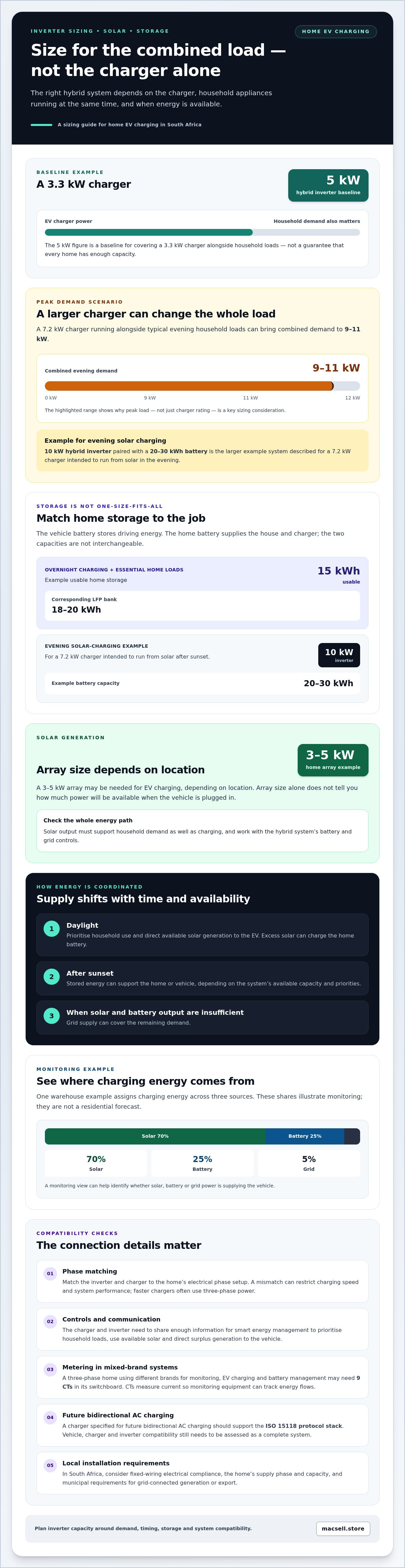
The charger rating alone doesn’t determine inverter size; the household load running alongside it matters too. For a home using a 3.3 kW EV charger, a 5 kW hybrid inverter is a baseline for covering charging and household demand. EV charger compatible hybrid inverters also need to suit the home’s electrical phase setup and work with the charger.
Choosing an inverter by its headline capacity alone can leave key compatibility questions unanswered. The right size depends on the EV charger’s power, when you charge and which household appliances are running at the same time.
This guide explains how to assess inverter capacity, solar generation and battery storage for home EV charging in South Africa. It also covers phase matching, load management and monitoring, so you can understand how the parts of a hybrid system work together.
Key Takeaways
- Size the system around the charger and the appliances likely to run at the same time, not the charger rating alone.
- A 7.2 kW charger alongside typical evening household loads can create total demand of 9-11 kW, making peak load a key sizing consideration.
- Coordinate solar generation, battery storage and grid power around when you charge; solar can supply daytime charging, while stored energy can support charging later.
- Match the inverter to the home’s electrical phase setup. Incorrect phase selection can restrict charging speed and system performance.
- Use monitoring and load-prioritisation features to see where energy is coming from and direct available solar power towards the vehicle.
What Inverter Size is Best for Homes With EV Chargers?
A 5 kW hybrid inverter is a baseline for a 3.3 kW charger alongside household loads. Larger chargers and simultaneous appliance use can require more inverter capacity, battery storage and solar generation.
Coordinating Solar, Batteries and EV Chargers
A hybrid system coordinates the solar inverter, battery, grid supply and EV charger so they can serve the home together. This matters because charging demand can coincide with household loads, especially in the evening. A 7.2 kW charger and typical evening demand can create a combined load of 9-11 kW. The inverter must manage that demand, rather than being sized only for the charger.
Balancing Solar, Battery and Grid Energy
Energy coordination determines whether solar, stored battery power or grid supply serves each load. During daylight, an energy management system can prioritise household use and direct available solar generation to the EV. Excess solar can charge the battery; after sunset, stored energy can support the home or vehicle. Grid supply can cover demand when solar and battery output are insufficient.
Compare the home battery’s usable capacity with the EV’s battery capacity, but don’t treat them as interchangeable. The vehicle battery stores driving energy; the home battery supplies energy to the house and charger. For overnight charging and essential home loads, the example system uses 15 kWh of usable storage, corresponding to an 18-20 kWh LFP bank. A 7.2 kW charger intended to run from solar in the evening calls for a larger example system: a 10 kW hybrid inverter and a 20-30 kWh battery.
Solar generation is another part of the balance. A home array of 3-5 kW may be needed for EV charging, depending on location. The solar inverter must support household demand as well as charging, and its output needs to work with the hybrid system’s battery and grid controls. Array size alone doesn’t establish how much power will be available when the vehicle is plugged in.
SolarEdge Energy Hub is one example to assess as part of an inverter, home battery and EV charger setup. Compatibility involves more than connecting equipment: the inverter must manage energy flows, and the charger must operate within the available supply. Load balancing can coordinate charging with other demand and reduce reliance on grid power.
Plans to add battery storage later also affect inverter choice. A system designed for expansion needs a compatible inverter and a configuration that can accommodate additional storage. This can help avoid choosing a solar inverter that limits future changes to your home’s energy setup.
In South Africa, consider fixed-wiring electrical compliance, your home’s supply phase and capacity, and municipal requirements for grid-connected generation or export. These factors shape the charger and inverter design, especially when the installation affects the grid connection.
EV charger integration and monitoring
Integration connects the EV charger with inverter controls, household loads and available energy sources. Monitoring shows how these connections behave during charging, helping you identify whether solar, battery or grid power is supplying the vehicle.
Start by checking how the charger and inverter communicate. Smart energy management can prioritise household loads, use available solar first and direct excess generation to the vehicle. The equipment needs to share enough information to manage those decisions. A charger that draws power without responding to system controls may not use surplus solar effectively.
Phase selection matters too. A mismatch between the charger and your home’s electrical phase setup can restrict charging speed and system performance. Faster EV chargers often use three-phase power, so consider the phase arrangement alongside the inverter and charger ratings. The control system also needs to manage demand across the phases, rather than treating the home as one undivided load.
Monitoring gives you a useful view of system performance. App-based systems can display energy flows and charging activity, while load prioritisation helps manage how available power is used. Look for clear information on solar generation, battery charging and household consumption. If the display shows the vehicle drawing grid power during strong solar generation, review the energy-management settings or system communication.
Metering hardware also affects integration. A three-phase home using different brands for monitoring, EV charging and home battery management may need 9 CTs in its switchboard. CTs measure current on circuits, allowing monitoring equipment to track energy flows. The number and arrangement depend on how those separate systems measure the home, so a mixed-brand design needs careful planning.
Future bidirectional charging requires another compatibility check. A charger specified for future bidirectional AC charging should support the ISO 15118 protocol stack. This protocol requirement concerns communication between the vehicle and charging equipment; it doesn’t by itself establish that the inverter, battery and vehicle can exchange power in both directions. Treat vehicle, charger and inverter compatibility as a complete system question.
One warehouse example assigns 70% of EV charging energy to solar, 25% to a battery and 5% to the grid. It illustrates how monitoring can show each source’s contribution, but those shares are specific to that example, not a residential forecast. For system planning, compare hybrid inverter options against the charger’s communication, phase and monitoring requirements.
EV charger load and household energy demand
An EV adds both a sustained power draw and a daily energy requirement. Typical home charging demand is 12-20 kWh per day, but inverter capacity depends on how quickly that energy is delivered and what else runs simultaneously. A vehicle charging during dinner, for example, adds a continuous load while cooking appliances, lighting and heating or cooling equipment may also be operating.
Distinguish power from energy when assessing demand. Kilowatts measure the rate of electricity use at a given moment; kilowatt-hours measure energy used over time. A charger can draw a steady load for several hours, matching or exceeding the combined demand of other household appliances. The inverter must handle the combined peak, while the battery and solar array affect how long the system can support charging.
Charging current changes the load. One reported setup used 12A, equivalent to 2,880W, or 16A, equivalent to 3,840W. Another off-grid user reported better EV charging at 6-8 amps at 240V. These examples show how a lower current setting can reduce demand, although it also changes charging speed. The useful setting depends on the vehicle’s charging needs and the power available to the home.
Assess which household loads overlap, rather than considering appliance nameplate ratings in isolation. List the loads likely to run during your usual charging window, then identify which can be delayed or controlled.
- Cooking appliances operating during an evening charge.
- Heating or cooling equipment running alongside the charger.
- Essential household circuits that need priority during limited supply.
- Charging sessions that can shift to sunny hours or lower-demand periods.
If the charger and inverter controls support it, smart load management can automatically reduce or pause charging when household demand rises. This helps avoid exceeding available system output. Your charging plan should also allow for an acceptable charging time: reduced current may suit an overnight top-up, but not every driving schedule.
Use a typical charging day to judge the energy requirement. If the vehicle needs 12-20 kWh daily, compare that amount with expected solar generation, battery energy available after household use, and any grid contribution. Then consider the peak moment, such as the charger operating while the kettle and cooking equipment are on. The daily energy total sizes the supply over time; the simultaneous peak determines whether the inverter can serve the loads together.
Inverter sizing for EV charging
For a 7.2 kW charger, a 10 kW hybrid inverter is the stated example for evening solar charging. A 22 kW charger needs supply capable of delivering its full load, plus capacity for household demand; phase matching is essential.
Capacity for 7 kW and 22 kW Charging
Inverter capacity is the power available to serve the charger and other active loads at once. It matters because an inverter sized only for a 7 kW charger may have little headroom for home demand. For a 7.2 kW charger, the example system uses a 10 kW hybrid inverter and a 20-30 kWh battery for evening solar charging.
For a 22 kW charger, assess the inverter’s continuous output against the charger load and simultaneous household use. A system intended to supply the charger directly needs at least 22 kW for that load alone; additional household demand increases the required output. A smaller inverter may still form part of a system where grid power supplements it, but it cannot supply the full charger load by itself.
Phase Supply Requirements
Phase supply describes how electricity is delivered to the charger and inverter. The charger, inverter and home connection need compatible phase arrangements, because incorrect phase selection can limit charging speed and system performance. Faster EV chargers often operate on three-phase power, so a 22 kW installation needs particular attention to phase matching.
A 7 kW charger may suit a single-phase arrangement, depending on its specification and the home’s supply. A 22 kW charger commonly requires three-phase supply to deliver its rated power. The inverter must also support the home’s phase setup; a rating in kilowatts alone doesn’t establish compatibility.
Size the system by separating charger output from energy available over time. Kilowatts determine whether the inverter can serve the active load; battery capacity in kilowatt-hours determines stored energy. For the 7.2 kW evening example, the 20-30 kWh battery supports the wider charging arrangement, but it doesn’t replace the inverter’s power-capacity requirement.
For either charger rating, account for cooking, heating or cooling, and other loads likely to overlap. Extra inverter capacity can provide headroom for peak demand. Direct solar charging depends on generation at the time, while battery discharge and grid contribution affect the remaining supply. Savings depend on how much solar energy is available and used directly instead of drawing from the grid.
Compare inverter specifications for continuous output, phase configuration and integration with battery storage. A 5 kW inverter cannot alone supply a 7.2 kW charger at full power. A hybrid inverter option should therefore be assessed against charger rating, household peak demand and the home’s phase supply together.
Hybrid inverter and EV charger compatibility
EV charger compatible hybrid inverters must match the charger’s electrical requirements and control features. A hybrid inverter does not automatically support DC EV charging or vehicle-to-home charging. These functions require compatible vehicle, charger and inverter equipment, designed to support the relevant direction of power flow.
Sunsynk, Deye, Victron and GoodWe are brands South African buyers may compare, but a brand name alone does not establish EV integration. Compatibility is model-specific. Assess the inverter’s controls, the charger’s communication method and the vehicle’s charging capability together. The exact model specifications matter more than the brand.
Yes. An EV charger can drain a home battery or overload an inverter if charging demand exceeds available output or battery energy. Set charging limits, prioritise essential loads and retain a battery reserve for household use. For example, owners can restrict charging when household demand rises or stored energy reaches the reserve threshold.
A physical connection only shows that equipment can be wired together. Functional integration requires compatible electrical ratings and control behaviour. The inverter must supply the charger’s demand without exceeding its continuous output, while battery settings determine how much stored energy can be used. EV charger compatible hybrid inverters also need suitable controls if charging is to respond to solar generation or household demand.
For DC charging, distinguish the charger’s conversion method from the inverter’s role. An AC home charger supplies alternating current, which the vehicle converts for battery storage. DC charging supplies direct current to the vehicle battery, so the equipment must explicitly support that setup. A hybrid inverter label alone does not establish DC charger compatibility.
Vehicle-to-home operation needs bidirectional capability across the complete system. The vehicle must be able to discharge, the charger must support bidirectional power flow, and the inverter must manage energy entering the home. For future bidirectional AC charging, the charger should support the ISO 15118 protocol stack. That protocol is one requirement, not proof that every system component supports V2H.
Control limits matter in practice. One reported case involved a charger set to 12A drawing 17A from the inverter before an overcurrent error. This example shows why charger settings and inverter response must match. Configure a charging ceiling within available inverter output, then coordinate other large loads and battery discharge limits.
Owners adding an EV charger to an existing solar and battery system should compare exact model specifications, including rated output, phase arrangement and communication controls. Check support for the intended charging direction as part of the complete system design. Compare hybrid inverter options against those requirements before selecting equipment.
Support is model-specific: the inverter must explicitly accommodate the DC charging arrangement, while V2H requires the vehicle, bidirectional charger and inverter to support coordinated bidirectional power flow.
MacSell Solar Outlet: Sunsynk 8KVA & 2X Hubble AM2 5.5 KWh Combo Kit
MacSell Solar Outlet offers hybrid inverters, lithium batteries and solar panels for home energy systems that may include EV charging. Its Sunsynk 8KVA & 2X Hubble AM2 5.5 KWh Combo Kit brings together named inverter and battery components for homeowners assessing a solar and storage setup.
Before choosing equipment, compare the inverter’s output with the EV charger’s power demand, household peak loads and electrical phase arrangement. Battery capacity and solar generation also affect the energy available for charging. These checks help you identify components that fit your requirements without assuming a particular kit supports every charger configuration.
For solar hardware options relevant to your home EV charging plans, visit macsell.store or contact MacSell Solar Outlet.
Plan the next step for your home energy system
Start equipment selection with your charging routine. Note when the vehicle is usually plugged in, which household loads run at the same time, and whether you prioritise direct solar charging, battery-supported charging or a balance with grid supply. This gives you a practical basis for comparing EV charger compatible hybrid inverters and identifying the system requirements that matter most.
MacSell Solar Outlet offers hybrid inverters, lithium batteries and the Sunsynk 8KVA & 2X Hubble AM2 5.5 KWh Combo Kit. These are hardware options to consider as part of a solar and storage system designed around home demand and EV charging.
Share your system requirements with MacSell Solar Outlet to explore suitable hardware options. Contact MacSell Solar Outlet to take the next step towards planning your home charging setup.
Frequently Asked Questions
Can a Solar Inverter Directly Charge an EV?
Not directly through a standard AC charger from the panels: the solar inverter converts panel output into usable AC power for the home, and the charger supplies the vehicle. A purpose-built DC charging system uses different conversion equipment. For example, a home AC charger can use solar-generated electricity routed through the inverter, provided the system has available output and suitable controls.
How Can Smart Inverter Features Improve EV Charging Efficiency?
Smart controls can respond to changing solar generation and household demand, rather than charging at a fixed rate throughout a session. For example, a system could increase charging when surplus solar is available, then reduce it as household loads rise. Monitoring also helps owners see whether charging draws from solar, the battery or the grid, and adjust schedules or priorities accordingly.
Should You Choose a Hybrid Inverter for EV Charging?
Choose a hybrid inverter if you want one system to coordinate solar, grid supply and battery storage alongside home charging. It can suit households planning to use solar energy or store surplus generation. A grid-only charging setup may not need battery integration. The decision depends on charging times, household backup priorities and whether stored energy has a useful role beyond vehicle charging.
Why Does Phase Compatibility Matter for EV Chargers?
Phase compatibility affects how the charger draws power and whether it can deliver its intended performance. Single-phase and three-phase chargers place different demands on the home supply and inverter setup. For example, a faster three-phase charger cannot reach its full capability if the supply or system configuration does not support it. Match the charger’s phase specification to your electrical setup.
Which hybrid inverters in South Africa are compatible with EV chargers?
Compatibility depends on the exact inverter and charger models, not just their brands. Sunsynk, Deye and LuxPower hybrid inverters are available in South Africa, but a brand name alone does not establish EV charger integration. Compare the inverter’s continuous output, phase configuration and control interface with the charger’s requirements. A suitable system must manage charging demand without exceeding its operating limits.
Can a standard AC EV charger work with any hybrid inverter?
No. An AC charger may operate alongside a hybrid inverter, but the combination must suit the home’s supply, inverter output and electrical phase arrangement. Basic charging can draw from the home supply without advanced communication. Solar-aware control requires compatible metering or communication features. For example, a charger that cannot respond to inverter data may continue drawing power as household demand changes.
How do solar-aware EV chargers coordinate charging with a hybrid inverter and battery?
A solar-aware charger uses metering or control signals to respond to available generation and household consumption. It can adjust charging to use surplus solar for the vehicle, while inverter settings determine how battery energy is managed. For example, a household can set a battery reserve for essential loads, leaving the charger to use surplus solar or grid power once that reserve is reached.
How much solar and battery capacity is needed to charge an EV at home?
There is no single system size for every home. Solar capacity depends on the vehicle’s energy use, local generation conditions and the hours available for charging. Battery capacity depends on how much charging must happen after solar production falls, alongside household backup needs. Start by assessing the vehicle’s typical energy requirement, then account for other home loads and your preferred charging schedule.