

Risks of buying grey market solar inverters: warranty eligibility
A grey-market inverter can be genuine and still lack manufacturer warranty cover in South Africa. Parallel imports are legal, but sellers must disclose when the manufacturer’s warranty does not cover the goods. That is the central risk of buying grey market solar inverters: local warranty support may not apply, even if the unit appears suitable.
A lower purchase price can look attractive, but regional specification differences may affect whether an inverter works with a South African system. This guide explains how warranty eligibility, model compatibility and marketplace claim timing can change the real risk. You’ll also see why NRS 097 compliance matters for grid connection, and what to consider before choosing an inverter for your installation.
Key Takeaways
- A lower-priced parallel import may not have local manufacturer warranty cover; understand who handles a claim and what the seller discloses.
- Regional model differences can affect compatibility. An inverter’s exact model must meet applicable NRS 097 grid-connection requirements in South Africa.
- Marketplace return periods and manufacturer warranty processes are separate. Claim complications may surface after the return window has closed.
- Assess the full value, not just the purchase price: warranty eligibility, local support, specifications and the process for resolving faults all matter.
Warranty eligibility and serial-number registration
In South Africa, parallel imports are legal, but warranty coverage depends on the manufacturer’s terms. A genuine inverter may still have no local warranty support.
Serial-number registration and warranty access
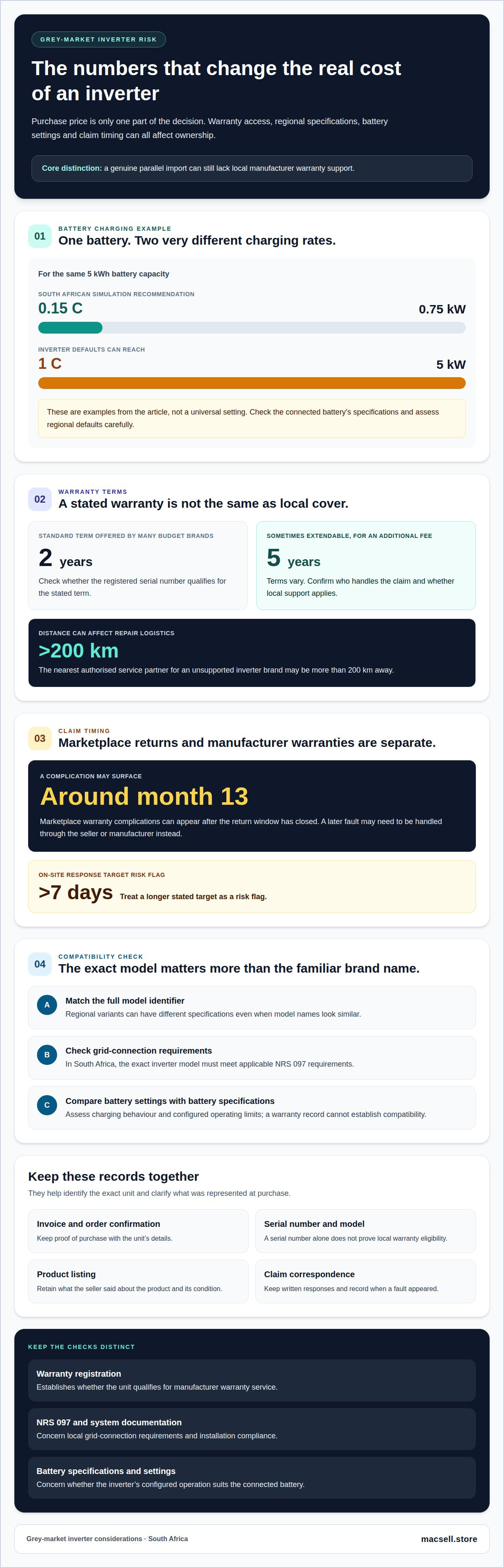
Serial-number registration links an inverter to its manufacturer’s warranty record and intended sales region. That record helps establish whether the unit qualifies for warranty service. A serial number alone doesn’t prove local eligibility. An imported model or regional variant can be genuine yet fall outside the manufacturer’s local warranty programme. Keep the invoice and serial-number details together; they help identify the specific unit if a claim arises. Marketplace warranty complications can appear after the return window closes, including around month 13.
Local support and warranty limitations
Local technical support covers fault diagnosis and warranty handling within the buyer’s region. Grey-market equipment intended for another region can leave its owner without local manufacturer support. The nearest authorised service partner for an unsupported inverter brand may be more than 200 km away. That distance can affect repair logistics and downtime. Warranty terms also vary: many budget inverter brands offer a 2-year standard warranty, sometimes extendable to 5 years for an additional fee. Check whether the registered serial number qualifies for the stated term.
Could direct importing bring customs, VAT or import duty costs? Yes. These charges can affect the landed cost, but they are separate from warranty eligibility. A warranty exclusion alone does not mean an import charge is payable.
Compliance records answer a different question from warranty registration. SANS means South African National Standards. A Certificate of Compliance records whether an installed solar system complies with South African requirements; it is not a manufacturer warranty certificate. Keep the inverter’s model and rating consistent with the system documentation. A Certificate of Compliance also does not prove subsidy eligibility: warranty cover, installation compliance and subsidy criteria are separate matters. For a system with a battery, check inverter compatibility and configured operating limits too. A warranty record cannot establish either.
Differences in product specifications between markets
An inverter designed for another market may differ in its grid settings, model configuration or battery charging behaviour. In South Africa, NRS 097 concerns grid connection, and the exact inverter model must meet applicable local requirements. A familiar brand name alone doesn’t establish that a particular regional version is suitable.
Import variants can have different specifications, even when their model names look similar. Compare the exact model identifier and technical documentation with the needs of the planned system. A foreign-language manual or a plug that does not match South African use may indicate that another market was intended, but neither sign alone proves import status.
Battery settings are another compatibility point. A South African simulation recommended limiting battery-backup charging to 0.15 C. For a 5 kWh battery, that rate corresponds to 0.75 kW. Inverter defaults can reach 1 C, which corresponds to 5 kW for the same 5 kWh capacity. These examples show why a regional default may need careful assessment against the battery’s requirements.
- Match the full inverter model identifier, not just the brand or product family.
- Compare the stated grid-connection requirements with NRS 097 for the intended South African system.
- Assess the inverter’s charging settings against the connected battery’s specifications.
A specification mismatch can affect more than installation. Grid settings that do not meet local requirements may prevent the inverter from working as intended, while unsuitable battery charging parameters can affect system operation. Treat the model number, documentation and battery compatibility as one set of specifications. Do not judge the unit by its headline rating alone.
For a system planned around a locally suitable inverter and battery combination, review South African inverter options alongside the relevant technical requirements.
Marketplace warranty claims and delays
A marketplace purchase may involve separate return and warranty processes. The platform’s return window applies to the transaction; the manufacturer’s warranty covers eligible faults under its own terms. Once the return period closes, you may need to seek support through the seller or manufacturer. This distinction matters if a fault appears later and the marketplace claim route is no longer available.
Keep the product listing, invoice, serial number and seller correspondence together. These records identify the exact inverter and document what was represented at purchase. For example, a listing that describes a unit as new may matter if its condition or regional variant is later disputed. Record the fault and when it appeared, then use the applicable marketplace claim process promptly.
Read warranty wording carefully. A so-called lifetime warranty may last only as long as the company providing it, which could be weeks or months. If the seller closes, changes ownership or stops handling claims, the practical route to support may disappear. The word “lifetime” alone does not explain who honours the warranty or what happens if the seller ceases to operate.
- Save the order confirmation, invoice and product listing.
- Keep serial-number details and written claim responses together.
- Separate a marketplace return request from a manufacturer warranty claim.
Response time affects system downtime. Treat an on-site service response target longer than 7 days as a risk flag. A cheaper inverter can become harder to manage if diagnosis, replacement parts or authorisation depend on a distant support channel. Read the claim process for its stated contact route, required evidence and service arrangements. If those details are difficult to locate, that uncertainty can complicate a fault claim.
For a marketplace claim, keep communication in writing and save each case reference. Describe the fault clearly, include the model and serial number, and state whether the inverter still operates. This creates a dated record of the issue and the response, helping distinguish a delivery or condition dispute from a later technical warranty claim.
How do grey market inverter prices compare with authorised South African sellers?
A price that seems too good to be true can be a warning sign, but price alone does not prove an inverter is grey-market stock. Compare like with like in South Africa: the exact model, intended market, condition, warranty eligibility and support route. A lower price for a different regional variant is not a direct comparison with the locally intended model.
Start with the full model identifier, not just the brand or headline rating. Inverters from the same manufacturer can differ in grid settings, battery compatibility or included components. If a listing omits the precise model, it is harder to tell whether the cheaper unit suits your system. Compare the product documentation and listed contents before treating the price difference as a saving.
Next, weigh the price against the purchase terms. An authorised South African sale may include a locally applicable manufacturer warranty, while a parallel import may not. A lower upfront price can therefore bring different repair or replacement risks. Consider the potential cost of a fault, how to make a claim and whether local technical support applies to that serial number.
- Match the exact model and rating across listings.
- Compare the warranty terms and who handles a fault claim.
- Check whether the listed contents and regional specifications match your system.
For example, a cheaper inverter with an unfamiliar model suffix may be intended for another market. Its headline rating could look suitable even if its grid configuration or battery settings differ. Assess these details alongside warranty access rather than relying on the advertised discount. If the specifications or support differ, the purchase price does not show the full value comparison.
Use the comparison to identify what matters for your system, not simply to find the lowest figure. Explore hybrid inverter options and compare their specifications with the requirements of your planned installation.
MacSell Solar Outlet: Hybrid Inverters
MacSell Solar Outlet offers hybrid inverters and related solar hardware for buyers planning a system around generation, storage and backup power. Its range includes the LuxPower 5kW Inverter - SNA5000 Hybrid Inverter and the Sunsynk 8KVA & 2X Hubble AM2 5.5 KWh Combo Kit.
These options offer a starting point for comparing inverter capacity, battery requirements and system components. MacSell Solar Outlet also sells lithium batteries. Match equipment to your system design, including applicable grid requirements and battery specifications, rather than choosing by headline rating alone.
To discuss equipment choices in light of the risks of buying grey-market inverters, contact MacSell Solar Outlet with your requirements.
Choose equipment around your system requirements
Your next decision is about fit, not simply how an inverter reaches the market. Set out the requirements for your installation, including grid connection, battery compatibility and the equipment’s support terms. This gives you a practical basis for comparing options and weighing the risks of buying grey market solar inverters against your system’s needs.
MacSell Solar Outlet offers hybrid inverters, lithium batteries and the Sunsynk 8KVA & 2X Hubble AM2 5.5 KWh Combo Kit. These offerings provide options to consider when planning an inverter-and-storage setup, without assuming that one configuration suits every property.
Use your system requirements to guide the discussion. Contact MacSell Solar Outlet to discuss the equipment options relevant to your solar setup, and take your next step with a clearer basis for choosing.
Frequently Asked Questions
Why is parallel importing a problem?
Parallel importing becomes a problem when an inverter’s regional version, warranty terms or support route do not suit a South African installation. The product may be genuine, yet the manufacturer may not service it locally. Separate the legality of importing goods from whether a particular model suits local grid connection and whether the seller has disclosed any warranty exclusion.
Are grey import inverters legal to sell or install in South Africa?
Parallel imports are legal in South Africa, but sellers must disclose when goods lack manufacturer warranty cover. That does not mean every imported inverter is suitable for installation. The exact model must meet applicable local grid-connection requirements, and the installed system needs appropriate compliance documentation. Import status alone neither proves local suitability nor confirms that an installation meets the relevant requirements.
How can buyers check an inverter’s compliance, origin and local support before purchase?
Compare the inverter’s full model identifier with its technical documentation and the model proposed for the system. Ask for written details of the intended sales region and warranty route, then check whether the stated support applies to that model. A foreign-language manual or mismatched plug may be a clue, but neither proves the unit’s origin by itself.
What are the main risks of buying a grey market solar inverter in South Africa?
The main risks include losing access to manufacturer warranty service, encountering a regional specification mismatch and facing delays if a fault claim passes between a marketplace, seller and manufacturer. For example, a unit may carry a familiar brand name but have different grid settings from the version intended for South Africa. A low purchase price does not resolve these support or compatibility issues.
Do grey market inverters have valid manufacturer warranties in South Africa?
Some grey-market inverters may have manufacturer warranty cover, but their status can exclude them from local service. Eligibility depends on the manufacturer’s terms and the inverter’s intended sales region. Read the written terms for the specific model, including who handles fault claims. A seller’s warranty and manufacturer coverage are separate arrangements, so do not assume one provides the other.
Are grey market solar inverters compliant with South African electrical and grid standards?
Not automatically. NRS 097 concerns grid connection in South Africa, and the exact inverter model must meet applicable local requirements. Installation compliance is a separate matter: a Certificate of Compliance records compliance for the installed system, while SANS 10142 applies to installations. A foreign-market label or familiar brand name alone doesn’t establish compliance with either requirement.