

Verify a Genuine Sunsynk Inverter in South Africa
A seller’s assurance alone isn’t enough to verify an inverter. To learn how to verify a genuine Sunsynk inverter in South Africa, use Sunsynk’s product warranty service to register the device or review existing warranty details, and check the product certification documents.
Check the paperwork before buying, especially if the inverter’s origin or warranty status is unclear. Warranty records and certification documents provide different information: one concerns warranty registration, while the other relates to product certification.
This guide explains how to assess a seller, what to check in certification documents and how to use the warranty service. Use the checklist to review the information before committing to a purchase.
Key Takeaways
- Assess a seller’s documentation and purchase records before deciding whether to buy.
- Use Sunsynk’s product certification documents to review product information separately from warranty registration.
- Use the warranty service to register a device or review existing warranty details, keeping in mind that older registrations may not appear in the new system.
- Consider the Sunsynk and Hubble combo kit alongside your system requirements when choosing equipment.
Finding verified distributors
Before paying, check the seller’s identity, written quotation and warranty-registration process. If you’re wondering how to verify a genuine Sunsynk inverter in South Africa, compare records for the specific unit, not just the seller’s claims.
Checking distributor status
Ask for the seller’s registered business name and a written quotation identifying the Sunsynk model and included equipment. Keep the seller’s details with the invoice and product documents. Together, these records link the transaction to the inverter being sold.
Establish how the warranty will be registered and what purchase evidence you’ll receive. Sunsynk’s warranty service supports device registration and searches for existing warranty details. Clear paperwork makes the purchase easier to trace. If model or seller details differ between records, resolve the discrepancy before paying.
Assessing prices and scam signals
There isn’t one typical Sunsynk inverter price in South Africa. The amount depends on the model and what the quotation includes. Compare like with like: an inverter-only quote isn’t directly comparable with a package that includes batteries or other equipment.
An unusually low offer can be a warning sign, but price alone doesn’t establish fraud. Check the model, included items, invoice and warranty process. Be cautious if the seller avoids written records, changes the quoted model or pressures you to pay immediately. These details matter more than the headline price.
Responding to unverified serial numbers or warranties
If a serial number or warranty record cannot be verified, pause the purchase. Keep the quotation and product details, then ask the seller to resolve the mismatch in writing. Sunsynk’s warranty service allows customers to register a device or search existing warranty details. A missing search result may need context: South African products registered using the old warranty form on or before 24/04/2024 may not appear in the new system.
Standard Sunsynk hybrid inverters, including 5kW, 8kW and 10kW models, have a stated 10-year manufacturer warranty. The Powerlynk 6kW inverter has a 5-year warranty. Registration requires proof of purchase, such as an invoice or receipt, and accurate details. Knowing how to verify a genuine Sunsynk inverter in South Africa means checking records together before committing.
Product certification documents
Sunsynk provides product certification documents through its support resources. Check that the paperwork corresponds to the inverter model being offered.
Checking serial numbers and authenticity
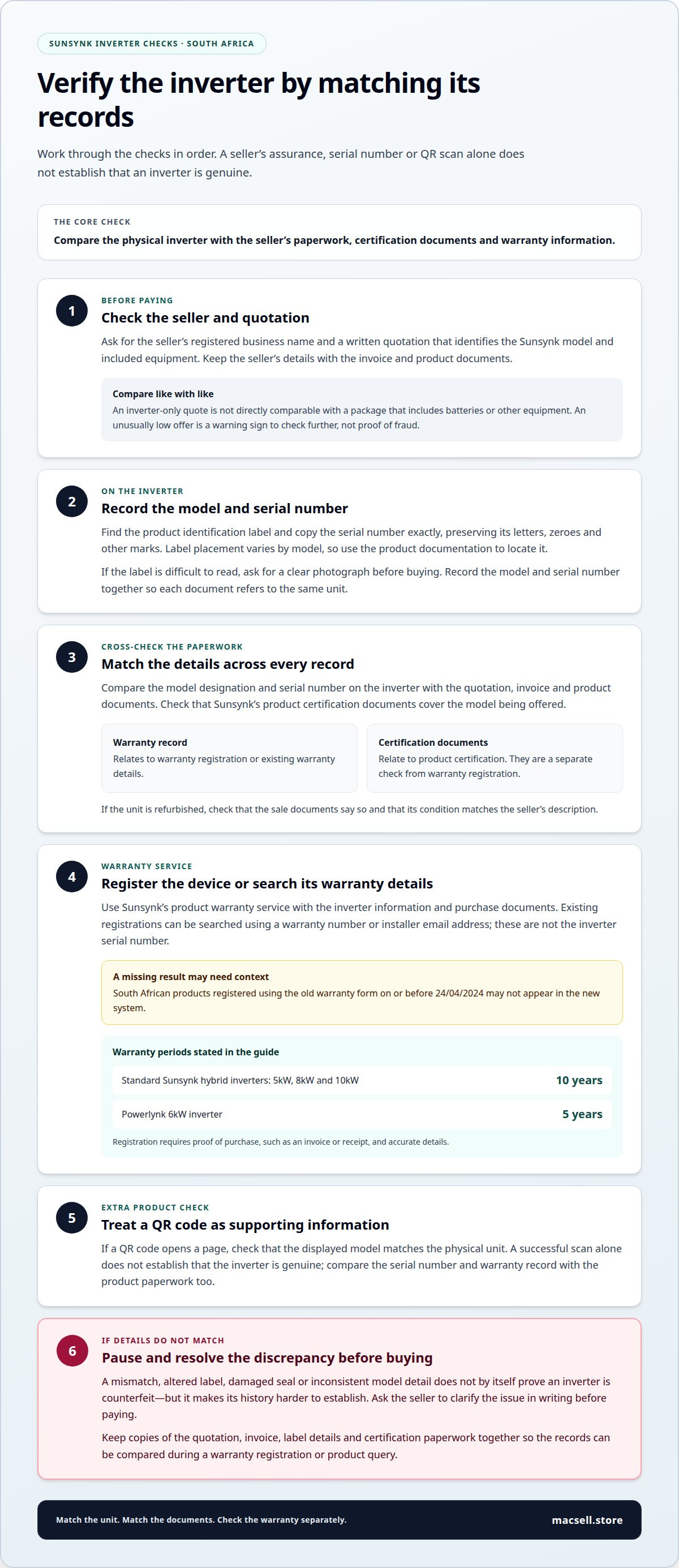
The serial number is on the inverter’s product identification label. Check the exterior casing and compare the number with the seller’s paperwork. Label placement varies by model, so use the product documentation to identify the right label instead of guessing its location.
Compare the model designation and serial number across the label, quotation, invoice and certification documents. A mismatch is a reason to pause and seek clarification before buying. Look for altered labels, damaged seals or inconsistent model details. These signs don’t prove an inverter is counterfeit, but they make its history harder to establish.
Sale documents should accurately describe a refurbished unit. Check whether it is identified as refurbished and whether its condition matches the seller’s description. Treat an unexplained difference between the casing, label and paperwork as a discrepancy to resolve, not proof of authenticity.
Using serial numbers and QR codes for verification
Sunsynk’s product warranty service lets customers register a device or search existing warranty details. Use the inverter’s serial number and purchase documents for the process. A QR code may provide product information, but it shouldn’t replace checking the serial number and warranty record against the inverter.
If a QR code opens a page, check that the displayed model information matches the physical unit. A successful scan alone doesn’t establish that the inverter is genuine. Sunsynk’s certification documents are available through its support resources; compare the document’s stated product scope with the model being sold.
Keep copies of the quotation, invoice, label details and certification paperwork together. That record makes it easier to explain a discrepancy during warranty registration or a product query. If you’re selecting equipment alongside these checks, review the available hybrid inverter options against your system requirements.
How to check a Sunsynk inverter serial number and authenticity in South Africa?
Use the serial number as one part of a traceable check, not as proof on its own. Match the inverter details with its product records and warranty information before completing the purchase.
Record and compare the inverter details
Copy the serial number exactly from the inverter’s identification label, preserving the original order of letters, zeroes and other marks. Compare it with the quotation, invoice and product documents, and check the model designation too. The paperwork should not link a serial number to a different model.
If the label is difficult to read, ask for a clear photograph before buying. A blurred image or a number that differs between documents prevents a reliable comparison. Record the model and serial number together so each document refers to the same unit.
Use Sunsynk’s warranty service
Sunsynk customers can register a device or check existing warranty details through its product warranty service. Use the inverter information and purchase documents to complete the relevant check. Existing registrations can be searched using a warranty number or installer email address. These search details are not the inverter serial number.
Keep the distinction clear: a warranty result helps establish the registration record, but doesn’t replace comparing the physical label with the product paperwork. For a second-hand unit, ask for its purchase documents and available warranty details. This gives you records to compare rather than relying only on the seller’s description.
Respond to mismatched or missing records
Pause if the serial number differs between the label, invoice or warranty information. Ask the seller to explain the specific mismatch in writing. A verbal explanation doesn’t replace consistent records. If a search finds no existing registration, use Sunsynk’s device registration process and retain the resulting documentation.
South African products registered on or before 24/04/2024 using Sunsynk’s old warranty form may not appear in the new system. A missing result for such a record needs to be considered alongside its date and paperwork. Keep copies of the label, invoice and correspondence together for any follow-up.
Can Sunsynk South Africa verify an inverter using its serial number or QR code?
Sunsynk’s warranty service supports device registration and searches for existing warranty details. This is a useful records check, but a QR scan alone isn’t proof of authenticity.
Use the serial number to identify the physical inverter and cross-check its documents. A QR code links to information associated with that code. Check that any displayed model details match the inverter label and purchase paperwork. If the code leads to details for another model, stop and resolve the mismatch before proceeding.
Keep product details and purchase records together for a warranty enquiry. Sunsynk allows existing warranty registrations to be searched using a warranty number or installer email address. These details locate a registration record; they aren’t interchangeable with the inverter’s serial number. Device registration and a warranty search answer different questions.
- Record: capture the serial number and model from the product label.
- Scan: use the QR code and note the information it displays.
- Compare: match model details across the label, invoice and any QR-linked page.
- Search: use the warranty number or installer email for an existing registration.
- Keep: retain screenshots, documents and seller correspondence together.
A QR destination and model details that match support a consistent paper trail, but don’t replace Sunsynk’s warranty records or product certification documents. A warranty entry also doesn’t establish that every item in a package matches the invoice. Check each inverter separately when a purchase includes multiple units.
If registration details conflict, preserve the exact serial number and search information. Sunsynk asks applicants to provide accurate details, because incomplete or inaccurate warranty information may affect a claim. For equipment selection alongside these checks, review hybrid inverter options against your system requirements.
MacSell Solar Outlet: Sunsynk 8KVA & 2X Hubble AM2 5.5 KWh Combo Kit
MacSell Solar Outlet offers the Sunsynk 8KVA & 2X Hubble AM2 5.5 KWh Combo Kit for buyers considering a Sunsynk inverter with Hubble batteries. Review the product and purchase documentation alongside your authenticity checks, so the equipment details are clear before you buy.
If you’re assembling a different system, MacSell Solar Outlet also sells hybrid inverters, lithium batteries and solar panels. Choose equipment according to your setup requirements, and make sure the model and product details match the documents for each item you buy.
For a Sunsynk and Hubble package or individual solar components, contact MacSell Solar Outlet to discuss your requirements.
Make your next purchase decision with confidence
Knowing how to verify a genuine Sunsynk inverter in South Africa helps you assess a purchase by checking product details, records and warranty information. Use the same approach for your final decision: match the equipment to your system requirements and keep the purchase documents together for future reference.
MacSell Solar Outlet offers the Sunsynk 8KVA & 2X Hubble AM2 5.5 KWh Combo Kit, lithium batteries and hybrid inverters. These options can help you consider inverter and battery equipment together or select components for your setup. Choose according to the hardware your system requires, rather than relying on a product name alone.
For help considering your solar hardware options, contact MacSell Solar Outlet. A clear equipment choice is a practical next step towards planning your system.
Frequently Asked Questions
What documents should accompany a genuine Sunsynk inverter in South Africa?
Ask for a sales invoice or receipt, model-specific product certification documents and warranty-registration information. The invoice should identify the inverter model and seller, making the purchase traceable. For an installed system, keep the installation photos and Certificate of Compliance with the warranty records. These documents serve distinct purposes: purchase evidence records the transaction, certification relates to the product, and installation documents relate to the completed system.
How do I verify whether a Sunsynk inverter seller is an authorised South African distributor or installer?
Request written evidence of the seller’s distributor status, then verify that claim directly with Sunsynk South Africa before paying. Treat distributor and installer credentials as separate checks: a seller’s status does not establish an installer’s qualifications. Sunsynk hybrid inverters must be installed by a registered electrician, with a minimum Certificate of Compliance required. Review the seller’s written product details and the installer’s relevant credentials as distinct records.
How do I check whether a Sunsynk inverter model is approved for use in South Africa?
Match the complete model designation on the inverter with the model named in its certification documents. Sunsynk provides product certification documents through its support resources. Check that the document applies to the exact model, rather than relying on a similar model name or general brand paperwork. For a South African installation, have the installer assess the model’s documentation against the system requirements and applicable installation standards.
What are typical Sunsynk inverter prices in South Africa, and what unusually low prices may signal a scam?
There isn’t one typical price: it depends on the inverter model and what the quotation includes, so compare like with like. An unusually low offer can signal risk, but price alone doesn’t prove fraud. Check the model, included equipment, invoice and warranty-registration process.