

Solar Panel and Inverter Combo South Africa: 2026 Hardware Procurement Guide
Why do high-wattage solar systems frequently fail to deliver energy independence during peak load shedding cycles? The failure isn't usually the raw power, but the lack of technical synchronisation within the solar panel and inverter combo South Africa homeowners rely on for backup. Most users experience the frustration of mismatched hardware, resulting in under-powered kits that cannot recharge sufficiently between outages. You require a system where every component, from the PV array to the lithium cells, operates with precise compatibility.
This procurement guide provides the technical specifications needed to master the hardware landscape for 2026 grid autonomy. We promise to clarify the compatibility requirements for Sunsynk and Deye hybrid inverters whilst ensuring your hardware meets the 30 September 2026 Eskom registration deadline. We'll examine the modular configurations for LuxPower systems, the specific discharge rates of Hubble AM2 batteries, and the essential certification requirements for a legal installation. This is a direct roadmap to building a reliable backup power kit that protects your hardware lifespan and eliminates grid reliance.
Key Takeaways
- Learn how to select the optimal solar panel and inverter combo South Africa requires for sustained energy independence during load shedding cycles.
- Understand the critical importance of BMS communication protocols to ensure your hybrid inverter and lithium battery bank function as a unified system.
- Master the "Solar-to-Inverter" ratio and MPPT voltage ranges to maximise energy harvest from your PV array.
- Identify essential hardware specifications, including IP65 environmental ratings and LiFePO4 chemistry, to ensure long-term equipment durability.
- Navigate the 2026 regulatory landscape by sourcing pre-configured hardware kits that simplify the registration process with Eskom.
Why Choose a Solar Panel and Inverter Combo in South Africa?
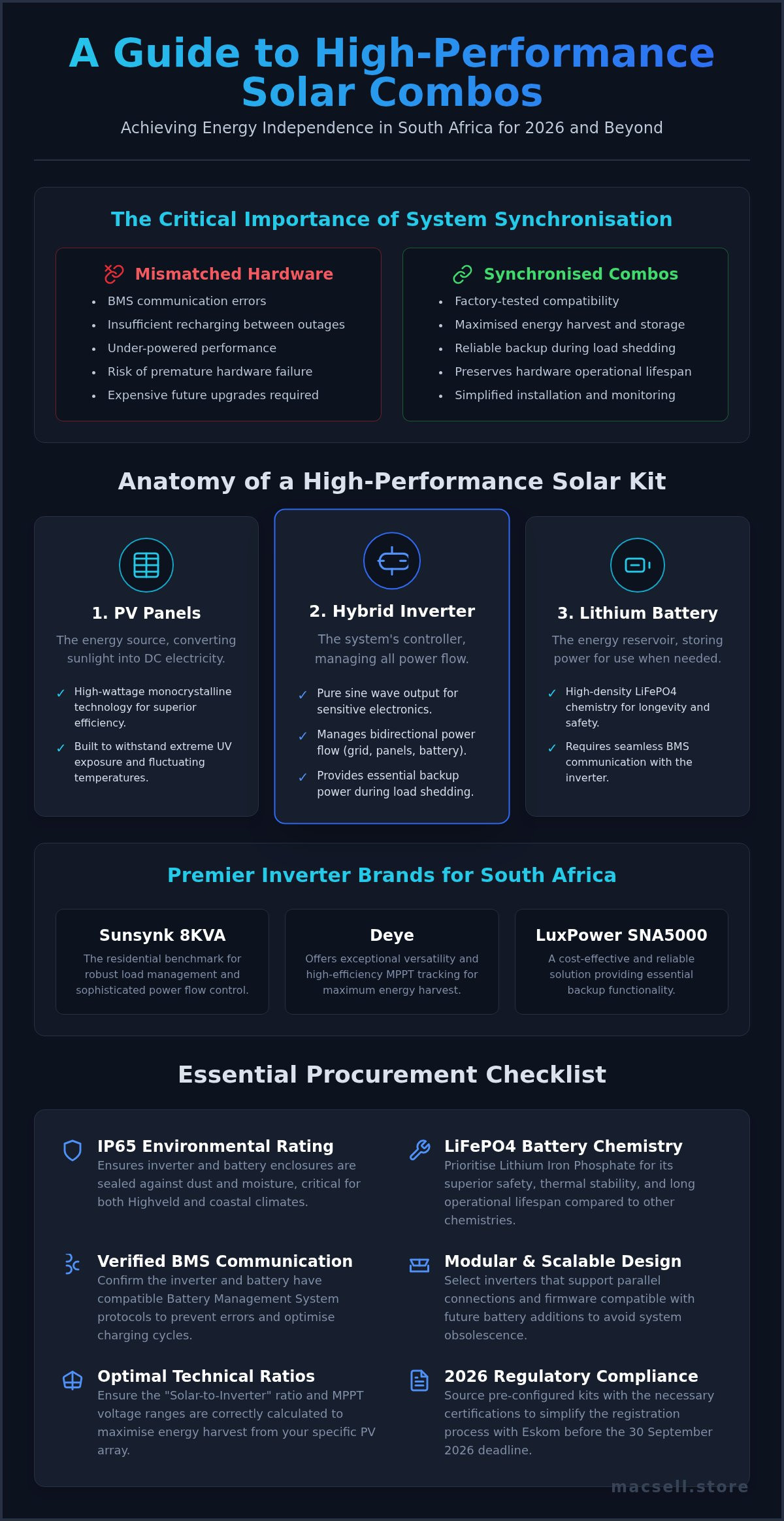
A solar panel and inverter combo South Africa homeowners select must function as a single, synchronised unit. This hardware set consists of three critical pillars: photovoltaic (PV) panels, a hybrid inverter, and lithium battery storage. Selecting these components as a pre-configured kit ensures that the technical specifications of each part align. This isn't merely about convenience; it's about hardware synergy. Integrated kits guarantee that the communication protocols between the inverter and the battery bank are factory-tested, preventing the common "BMS communication error" that plagues mismatched systems.
Procuring bundled hardware offers clear economic advantages for national delivery. Bulk shipping of panels, inverters, and batteries reduces logistical overhead. As the landscape of Solar power in South Africa shifts toward self-consumption, these combos provide a hedge against Eskom's frequent tariff increases. They offer immediate mitigation for load shedding whilst preparing your property for long-term grid independence. By sourcing a complete hardware kit, you avoid the technical debt of purchasing under-powered components that require expensive upgrades within 24 months.
The Role of the Hybrid Inverter in Modern Systems
The hybrid inverter is the primary controller for your energy ecosystem. It manages bidirectional power flow between the PV array, the lithium storage, and the national grid. For South African energy security, hybrid models are essential. Unlike standard grid-tied inverters, hybrid units continue to operate during load shedding by isolating your essential loads. High-performance combos utilize pure sine wave technology. This produces clean electricity suitable for sensitive medical equipment and home office hardware. It avoids the harmonic distortion and heat buildup associated with cheaper, modified sine wave alternatives.
Benefits of Integrated Solar Hardware
Integrated hardware simplifies the procurement process for your independent professional electrician. Standardised ports and compatible mounting hardware reduce the hours required for on-site configuration. These kits are specifically designed to manage the charging cycles of lithium ion solar battery units. Precise voltage regulation prevents over-discharge and thermal stress, which directly preserves your hardware's operational lifespan. Users also benefit from unified monitoring. A single manufacturer application provides real-time data on PV yield, battery state of charge, and house consumption without requiring third-party data loggers.
Anatomy of a High-Performance Solar Combo Kit
A high-performance solar panel and inverter combo South Africa requires must withstand extreme ultraviolet (UV) exposure and fluctuating temperatures. The core hardware triad includes high-wattage monocrystalline PV panels, a hybrid inverter, and high-density lithium storage. Build quality is paramount. You must prioritise hardware with an IP65 rating. This ingress protection level ensures the inverter and battery enclosures remain sealed against fine dust and moisture, which is critical for longevity in both Highveld and coastal environments. Selecting a solar panel and inverter combo South Africa residents can trust means looking beyond wattage to the structural integrity of the housing.
Scalability defines a superior kit. Your initial procurement should allow for parallel expansion. High-quality hybrid inverters support multiple units connected in parallel, enabling you to increase your output as your energy demands grow. When selecting your hardware, ensure the inverter's firmware is compatible with future battery additions to avoid system obsolescence. You can browse our specialised hardware inventory to find kits designed for modular growth.
Premier Inverter Brands: Sunsynk, Deye, and LuxPower
Three brands dominate the local landscape due to their proven reliability in grid-unstable environments. Sunsynk 8KVA units are the residential benchmark, offering robust load management and a sophisticated interface for managing complex power flows. Deye inverters provide exceptional versatility with high-efficiency MPPT tracking, which is essential for maximising energy harvest during low-light conditions. For those seeking a reliable entry point, the LuxPower SNA5000 is a cost-effective solution that provides essential backup functionality without the premium price tag of larger commercial units.
Solar Panel Technology for 2026
The 2026 market is dominated by high-efficiency imports, with 94 per cent of panels currently sourced from Chinese manufacturers. Monocrystalline panels are the standard for residential rooftops due to their superior conversion rates in restricted spaces. To ensure consistent performance, your combo should feature half-cut cell technology. This design reduces internal resistance and improves energy yield in partially shaded conditions, such as roofs with chimneys or vent pipes. Bifacial panels, which capture light from both sides, offer high value for ground-mount systems but provide marginal gains on standard dark residential tiles.
Matching Panel Wattage to Inverter Capacity
Precise hardware synchronisation is critical for the solar panel and inverter combo South Africa households use to achieve grid independence. The "Solar-to-Inverter" ratio defines the relationship between your DC solar array and the AC output of your inverter. Most modern hybrid inverters, such as Sunsynk or Deye models, support a DC-to-AC ratio of 1.2 or 1.3. An 8kW inverter can technically manage up to 10.4kW of solar panels. This oversizing ensures the system reaches its maximum conversion capacity earlier in the morning and maintains it during overcast conditions. You must exercise caution to avoid "clipping". Excessive oversizing leads to wasted energy potential once the inverter reaches its thermal and conversion limits.
Panel selection directly dictates string configuration. High-wattage 620W panels offer higher efficiency but carry a higher Open Circuit Voltage (Voc). You must calculate the total string voltage to ensure it stays within the inverter's Maximum Power Point Tracking (MPPT) range. In contrast, 450W panels provide greater flexibility for fragmented roof spaces where shorter strings are necessary. Mismatched voltages can prevent the inverter from "waking up" in the morning or cause permanent hardware damage if the maximum DC input voltage is exceeded on cold, high-voltage mornings.
Standard Configurations for South African Households
- 5kW Inverter Setups: Typically paired with 6 to 10 panels. These configurations are designed for essential load backup, including lighting, refrigeration, and home office hardware.
- 8kW Inverter Systems: The residential benchmark for managing large appliances and geysers. These systems usually require 12 to 18 panels to ensure the battery bank recharges whilst powering daytime loads.
- 12kW and Larger: Commercial-scale configurations that often utilise multiple MPPT inputs to manage different roof orientations or large-scale PV arrays.
Technical Specifications to Monitor
Open Circuit Voltage (Voc) and Short Circuit Current (Isc) are the non-negotiable parameters for system safety. Every inverter has a hard limit for DC input; exceeding this will immediately void your warranty. Temperature coefficients are equally vital. South African heat can cause panel temperatures to exceed 65°C, which reduces voltage output. High-quality panels with low temperature coefficients maintain better performance in these harsh environments. MPPT efficiency ensures the inverter extracts the maximum possible wattage from your PV array, which directly impacts the total solar panel for home price value over the system's 25-year lifespan.
Procurement Checklist: Evaluating Battery Compatibility
Battery compatibility is the final technical hurdle in selecting a solar panel and inverter combo South Africa requires for grid independence. Lithium Iron Phosphate (LiFePO4) chemistry is now the industry standard for 2026. It offers superior thermal stability and a significantly longer cycle life than older lead-acid alternatives. Since 2024, the price of LiFePO4 batteries has dropped by approximately 30 per cent, which has shortened the payback period for residential systems. Hardware procurement focuses on 48V systems for home use. You must ensure your hybrid inverter's DC bus voltage matches your battery bank's nominal voltage. Mismatched voltages result in immediate hardware failure.
C-ratings determine discharge performance and system reliability. A 1C-rated battery can supply its entire capacity in 60 minutes. If your household load exceeds this discharge rate during load shedding, the Battery Management System (BMS) will disconnect to protect the cells. Matching your peak load to your battery's C-rating is essential. Using a certified solar panel and inverter combo South Africa residents can trust ensures your BMS and inverter communicate correctly to manage these high-draw events.
Hubble Lithium Batteries: Technical Overview
The Hubble AM2 (5.5kWh) and AM5 (5.1kWh) models are the primary choices for a high-performance backup power kit South Africa homeowners select. The AM2 is specifically optimised for the Sunsynk 8KVA inverter, offering a high discharge rate suitable for large appliances. Current 2026 hardware typically provides 6,000 cycles at an 80 per cent depth of discharge (DoD). These units are modular. You can connect up to 15 units in parallel to scale your storage as your energy requirements increase over time.
Inverter-Battery Communication Protocols
Hardware "handshaking" occurs via CAN or RS485 communication ports. This protocol allows the battery BMS to dictate precise charging parameters to the hybrid inverter. Using non-compatible batteries forces the inverter into "Voltage Mode", which lacks real-time data on the state of charge (SoC). This leads to inefficient charging and reduced battery lifespan. Always ensure your inverter firmware is updated to the latest manufacturer version to maintain correct hardware behaviour and system safety.
Shop our pre-configured lithium battery and inverter bundles
MacSell Solar Outlet: Premium Inverter and Battery Bundles
MacSell Solar Outlet functions as a technical warehouse for premium energy components. We specialise in providing the hardware required for a robust solar panel and inverter combo South Africa can rely on during prolonged grid instability. Our model focuses exclusively on hardware procurement. This allows us to maintain a deep inventory of Sunsynk, Deye, and LuxPower units without the overhead of installation services. By sourcing directly from a specialised distributor, you ensure that every component in your kit is a genuine, warranty-backed product designed for the South African environment.
National logistics are handled via a dedicated supply chain. We facilitate the secure transport of fragile solar panels and heavy lithium storage units across the country. This ensures your equipment arrives in factory condition, ready for your chosen independent electrician to install. Our expertise lies in technical accuracy and hardware availability, making us the preferred partner for both residential owners and industry professionals seeking high-performance energy solutions.
Featured Combo: Sunsynk 8KVA & Hubble AM2
The Sunsynk Hubble combo kit represents our most requested residential configuration. This premium bundle includes the Sunsynk 8KVA hybrid inverter and two Hubble AM2 5.5kWh lithium batteries. For a standard four-bedroom home, this setup provides sufficient peak power to manage essential appliances whilst maintaining a reserve for high-draw items like geysers or borehole pumps. The 8KVA inverter's dual MPPT trackers allow for complex panel orientations, maximising energy harvest throughout the day. We provide comprehensive technical support for hardware-related warranty queries, ensuring your investment remains protected by manufacturer-standard guarantees.
How to Order Your Solar Hardware Kit
Navigating the MacSell Solar Outlet online store is a direct, transactional process. You select your required inverter capacity, battery storage, and PV array, then proceed through our secure payment gateway. National shipping timeframes vary based on location, but we prioritise rapid dispatch from our central inventory. Before your hardware arrives, we recommend reviewing our solar equipment checklist South Africa to ensure you have the necessary mounting rails, DC isolators, and cabling. This preparation ensures a seamless handover to your independent installer, reducing on-site delays and ensuring your system is commissioned according to manufacturer specifications.
Secure Your Energy Independence for 2026
Achieving total grid autonomy requires moving beyond basic backup power to a fully synchronised energy ecosystem. The most effective solar panel and inverter combo South Africa homeowners can deploy is one where the BMS communication protocols and MPPT voltage ranges are precisely matched. Prioritising hardware with IP65 ratings and LiFePO4 chemistry ensures your system withstands environmental stress whilst maintaining peak efficiency. With the 30 September 2026 Eskom registration deadline approaching, selecting certified hardware from brands like Sunsynk, Deye, and LuxPower is a critical requirement for a legal and safe installation.
MacSell Solar Outlet provides specialised technical hardware bundles with national delivery across the country. As an authorised retailer of industry-leading hardware, we focus on delivering the precise tools you need for an independent, professional installation. View our full range of Hybrid Solar Inverter and Battery Combos to begin your transition to reliable, self-generated power. Transitioning to solar is a practical investment that secures your energy future and protects your household from rising utility costs.
Frequently Asked Questions
Is it better to buy a pre-configured solar combo or individual components?
Buying a pre-configured solar panel and inverter combo South Africa homeowners select is generally superior due to guaranteed hardware synergy. These kits feature factory-tested communication protocols between the hybrid inverter and the lithium battery management system. Whilst you can source individual parts, mismatched components often lead to technical debt and communication failures. A pre-configured kit ensures that all hardware parameters, such as voltage ranges and discharge rates, align perfectly for immediate deployment.
How many solar panels do I need for a 5kW hybrid inverter?
A 5kW hybrid inverter typically requires between 6 and 10 high-wattage panels to reach its optimal DC-to-AC ratio. Most 5kW models, like the LuxPower SNA5000, support an oversized PV array of approximately 6,500W. This configuration ensures the system generates enough current to power your essential loads whilst simultaneously recharging the battery bank. Your specific panel count depends on the individual wattage of the modules, such as 450W or 550W units, and your available roof space.
Can I use any lithium battery with a Sunsynk or Deye inverter?
No, you cannot use any lithium battery; the hardware must support specific communication protocols like CAN or RS485. Sunsynk and Deye inverters require a "handshake" with the battery's BMS to manage charging cycles safely. Using non-compatible batteries forces the system into voltage-based charging, which lacks precision and can reduce the lifespan of the cells. We recommend using verified pairings, such as the Sunsynk 8KVA and Hubble AM2 combo, to ensure full technical compatibility.
What is the lifespan of a modern hybrid inverter and battery combo?
Modern hybrid inverters generally have an operational lifespan of 10 to 15 years, depending on environmental conditions and load management. High-quality lithium batteries, such as LiFePO4 units, are typically rated for 6,000 cycles at an 80 per cent depth of discharge. In a standard residential setting with daily cycling, this equates to over 10 years of reliable service. Maintaining an IP65-rated environment and avoiding extreme temperature fluctuations will further protect your hardware's longevity.
Does a solar panel and inverter combo include everything needed for installation?
A standard solar panel and inverter combo South Africa retailers provide typically includes the core technical components: the inverter, lithium storage, and PV panels. It does not include mounting rails, DC cabling, isolators, or trunking. These peripheral items are site-specific and must be sourced according to your roof type and cable run distances. Always consult a professional installer to finalise the full bill of materials required for a safe and legal electrical connection.
Can I expand my solar combo kit by adding more panels or batteries later?
Yes, most premium hybrid inverters are designed for modular expansion. You can increase your storage capacity by adding compatible lithium batteries in parallel or expand your PV array by utilising the inverter's secondary MPPT tracker. It's critical to ensure that any additional hardware matches the original specifications of your existing kit. We recommend planning for this scalability during your initial procurement to avoid the need for a complete inverter upgrade in the future.
How does a hybrid inverter manage power during load shedding?
A hybrid inverter manages power by instantly isolating your essential load from the national grid during a power failure. This process, known as anti-islanding, ensures safety for grid workers whilst allowing the inverter to draw energy from the battery bank or PV panels. The transition typically occurs in less than 20 milliseconds, preventing your computers or medical equipment from rebooting. The system prioritises solar energy for loads and uses the battery as a secondary buffer.
Why is a lithium battery preferred over lead-acid for solar combos?
Lithium Iron Phosphate (LiFePO4) is preferred due to its superior depth of discharge and cycle life. Lead-acid batteries generally only allow for a 50 per cent discharge and survive roughly 500 cycles. In contrast, lithium units support an 80 to 90 per cent discharge and offer 6,000 cycles. Lithium batteries are also more compact and maintain a consistent voltage output throughout the discharge cycle, making them far more efficient for high-draw household appliances.