

Solar Panel Prices South Africa: 2026 Hardware Procurement Guide
In 2026, the lowest upfront solar panel price is often the most significant technical risk a South African procurement manager can take. You're likely watching the volatile Rand/Dollar exchange rate with frustration as it dictates the shifting landscape of solar panel prices South Africa. It's increasingly difficult to track whether you're paying for yesterday's outdated PERC technology or today's high-efficiency N-Type cells whilst managing a strict budget.
This guide provides the technical clarity you need to navigate the 2026 hardware market, detailing current price-per-watt trends and identifying which specifications offer the highest return on investment. We'll examine the performance benchmarks of Tier 1 modules and explain how to streamline your procurement by pairing them with industry-standard hardware like Sunsynk and Deye inverters or Hubble lithium batteries. From analysing N-Type efficiency to evaluating the cost-effectiveness of pre-configured combo kits, you'll gain the precise data required for an informed, high-performance solar investment. We focus strictly on the hardware parameters that define system longevity and energy yield.
Key Takeaways
- Understand why N-Type TopCon technology has replaced PERC as the 2026 industry standard for module efficiency and thermal stability.
- Learn how to evaluate current solar panel prices South Africa by comparing the price-per-watt across 450W, 550W, and 600W+ hardware classes.
- Identify the critical technical requirements for matching panel strings to the specific MPPT voltage ranges of premium hybrid inverters.
- Discover the verification methods used to distinguish genuine Tier 1 hardware from inferior grey-market imports in the local retail market.
- Realise the logistical and financial benefits of sourcing pre-configured Sunsynk and Hubble combo kits through a specialised hardware distributor.
Current Solar Panel Market Trends in South Africa for 2026
The 2026 solar landscape in South Africa is defined by a technical supply chain. Global manufacturing shifts have moved away from legacy technologies, forcing local market recalibration. While international production costs have flattened, local retail margins remain sensitive to logistics and currency shifts. These variables directly impact solar panel prices South Africa, making real-time data essential for procurement. National energy policies, particularly those incentivising large-scale commercial decentralisation, keep demand for high-output modules high. Rapid stock turnover for premium hardware is now the market norm as users seek to mitigate the impact of rising utility costs through reliable self-generation.
The Rise of N-Type High-Efficiency Panels
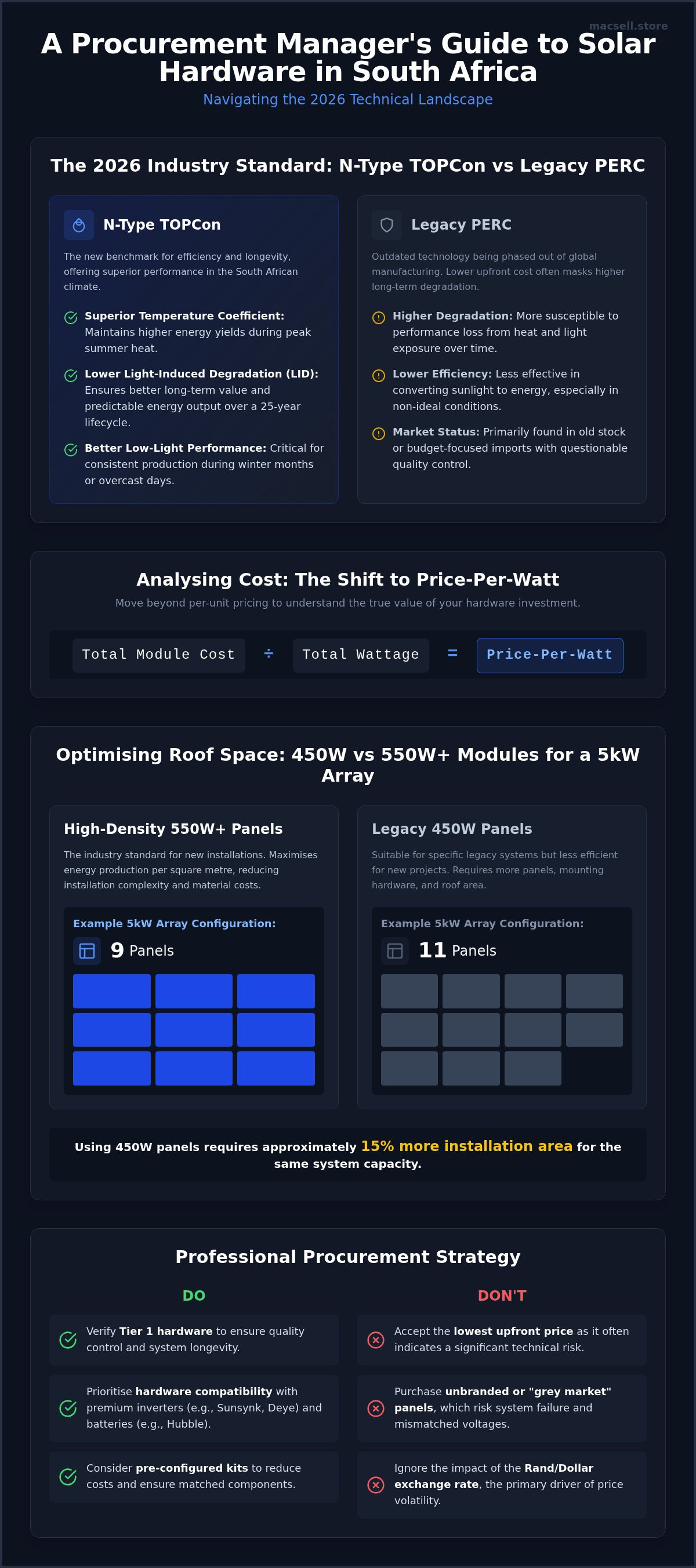
N-Type TopCon technology has officially superseded PERC as the industry benchmark for 2026. This hardware is the current choice for residential projects due to its superior temperature coefficient and lower Light Induced Degradation (LID). In the South African climate, N-Type panels maintain higher yields during peak summer heat. While the upfront cost carries a slight premium over PERC stock, the long-term value is found in reduced degradation. Most installations now focus on 550W+ panels to optimise roof space. N-Type cells also offer better performance in low-light conditions, which is a critical factor for consistent energy production during the winter months.
Pricing Drivers: Why Costs Vary Nationally
Several factors influence solar panel prices South Africa beyond manufacturing costs. Import duties and port logistics for Tier 1 hardware significantly impact final retail pricing. Bulk procurement remains the most effective strategy for reducing individual module costs; this is why pre-configured kits are increasingly popular. Choosing unbranded panels is a common procurement error. These modules often lack the quality control of Tier 1 brands, leading to higher system failure rates and mismatched string voltages. Professional buyers prioritise hardware with proven compatibility with premium hybrid inverters to avoid long-term maintenance issues.
The Rand/Dollar exchange rate remains the primary driver of hardware margins. Since solar modules are priced in USD at the manufacturer level, local distributors adjust prices frequently to maintain stock levels. National energy policies supporting grid-tied and hybrid configurations have shifted consumer focus toward high-end hardware. This focus ensures compatibility with advanced systems like Deye or LuxPower hybrid inverters. Professional procurement in 2026 requires a focus on technical specifications rather than just the lowest available price. Prioritising hardware longevity and efficiency ensures that the initial capital outlay translates into predictable energy yields over a 25-year lifecycle.
Analysing Solar Panel Prices by Wattage and Technology
Efficiency metrics and cell architecture are the primary factors determining solar panel prices South Africa. In 2026, the market has moved beyond evaluating panels by their price-per-unit, focusing instead on the price-per-watt. This metric reveals the true procurement cost across different module sizes. While 450W panels remain available for specific legacy applications, the 550W to 610W range now dominates the high-performance sector. Procurement managers must balance the initial hardware outlay with the long-term energy yield, especially when configuring systems for 5kW or 8kW residential loads.
The 450W to 550W Comparison
450W panels are technically suitable for smaller backup systems, such as those utilising a LuxPower 5kW inverter for basic load shedding relief. These modules are often more affordable per unit but require a larger physical footprint to reach a specific kilowatt capacity. In contrast, 550W modules have become the standard for Sunsynk 8KVA pairings due to their superior energy density. Using higher wattage modules reduces the total number of panels needed, which simplifies string configuration and reduces the cost of mounting rails and cabling. A standard 5kW array using 550W modules requires roughly nine panels, whereas a 450W array would require eleven, increasing the total installation area by approximately 15%.
Bifacial vs Monofacial: Is the Extra Cost Justified?
Bifacial technology allows for energy harvest from both the front and rear of the module. These panels utilise light reflected from the roof surface, which is particularly effective on South African white-painted or galvanised steel roofs. For ground-mount systems, the yield increase is even more pronounced. While Bifacial panels carry a higher procurement premium, they offer a faster return on investment in high-albedo environments. Bifacial modules can achieve up to a 25% yield increase in high-albedo environments compared to standard monofacial units. For most residential rooftop projects, the ROI sweet spot remains with 550W N-Type monofacial panels due to their lower upfront cost and high thermal stability. You can compare technical specifications and current solar hardware options to find the best fit for your specific array requirements.
Integrating Panels with Premium Inverter and Battery Kits
Hardware procurement requires a system-centric approach. While solar panel prices South Africa might attract your initial attention, the inverter's MPPT voltage range is the actual technical constraint. If your panel string voltage falls outside the inverter's operating window, the system won't start or will operate at significantly reduced efficiency. Most high-end hybrid inverters in 2026 require a specific minimum "startup" voltage, which dictates the minimum number of modules per string. Mismatched hardware leads to clipping, where excess solar energy is wasted because the inverter cannot process the incoming current.
Sunsynk 8KVA and Hubble AM2 Synergy
Procuring a Sunsynk Hubble combo kit ensures technical compatibility between the charge controller and the storage medium. The Sunsynk 8KVA features dual MPPTs, allowing for two independent panel arrays with different orientations. This is ideal for homes with complex rooflines where north-facing space is limited. The Hubble AM2 5.5 KWh battery is designed to handle high-input solar charging, which is critical when using 550W+ modules. To achieve maximum autonomy, size your array to cover both your daytime load and the full recharge requirements of your battery bank. Optimising your backup power kit South Africa involves calculating the discharge depth against the daily solar harvest to ensure the system remains balanced.
Deye and LuxPower Hardware Configurations
Deye hybrid inverters offer a robust alternative for scalable systems. When checking the Deye inverter price South Africa, consider the total system cost including the panel array. Deye units are known for their flexible string configurations, making them a favourite for expanding arrays over time. For entry-level residential setups, the LuxPower 5kW Inverter (SNA5000) remains a standard choice. A typical configuration for this unit includes two strings of six 550W panels. This setup ensures the voltage remains within the efficient MPPT range whilst providing enough current to charge lithium batteries rapidly after a power outage.
Lithium battery discharge rates directly influence your panel requirements. If you're running heavy loads during grid outages, your daytime solar production must be sufficient to replenish that energy before the next cycle. Higher discharge rates often necessitate a larger PV array, regardless of the individual solar panel prices South Africa. Efficiency losses during the conversion process mean you should aim for a panel capacity roughly 20% higher than your daily storage needs to maintain long-term battery health and system reliability.
Hardware Procurement Strategy: Buying Like a Professional
Professional procurement shifts the focus from simple installation quotes to technical asset management. A hardware-first approach allows you to control the quality of every component, ensuring that solar panel prices South Africa are evaluated alongside warranty stability. Identifying genuine Tier 1 panels amongst grey-market imports requires verifying serial numbers against official manufacturer databases. Grey-market modules often bypass authorised distribution channels, leaving you without local recourse if a module fails within its 25-year performance window. Professional buyers prioritise hardware with local technical support centres and clear RMA processes.
Verifying warranty terms is a critical step in the procurement cycle. For inverters and batteries, a "factory warranty" is only as strong as the local distributor's ability to service the unit. Check the following before finalising any hardware purchase:
- Confirmation of local repair centres for Sunsynk or Deye inverters.
- Clear documentation on battery cycle life vs calendar years.
- Linear performance guarantees for solar modules rather than tiered steps.
- Compatibility certificates for high-current DC circuit breakers and surge protection.
Bulk Buying and Pallet Pricing
Procuring bulk solar panels South Africa stock reduces the cost per watt significantly by spreading shipping and handling overheads across more units. A full pallet typically contains 31 to 36 modules, depending on the manufacturer's packaging. This is a strategic choice for residential estates or small businesses looking to standardise their hardware. Handling integrity is paramount during delivery. Solar cells are susceptible to micro-cracks from improper stacking or rough transport, which aren't visible to the naked eye but will degrade performance over time. Standardise your storage on-site by keeping modules upright and protected from moisture until the moment of mounting.
Component Matching and Compatibility
Technical compatibility extends beyond the main inverter and battery units. Ensure that MC4 connectors are brand-matched across your panel strings to prevent high-resistance points and potential fire risks. The communication between your lithium ion solar battery and the inverter's BMS is the most common failure point in DIY-led procurement. Using a dedicated solar equipment checklist South Africa helps track these minor but essential components. Sourcing individual parts requires more technical oversight than buying all-in-one bundles, but it offers the flexibility to choose best-in-class hardware for each system layer. Source your professional solar hardware directly from our national distribution network to ensure component synergy.
Sourcing Premium Solar Hardware from MacSell Solar Outlet
MacSell Solar Outlet operates as a specialised hardware-only retailer. We exclude installation and financing to focus entirely on component availability and technical accuracy. This model ensures that solar panel prices South Africa are kept competitive by removing the overheads associated with service-based business models. By maintaining a technical catalog of Tier 1 equipment, we provide procurement managers and independent installers with the exact specifications needed for high-performance arrays. Our inventory is managed for rapid dispatch, supporting national projects with reliable hardware supply chains that avoid the delays common in the 2026 market.
Expertly Curated Solar Inventory
Our catalogue prioritises Sunsynk, Deye, and LuxPower hybrid inverters due to their proven field performance and firmware stability. We maintain high stock levels of Hubble lithium batteries, specifically the AM2 5.5 KWh units, to ensure immediate compatibility with these inverter brands. Providing detailed data sheets and technical parameters is our priority; we understand that choosing the correct module depends on precise MPPT voltage and current limits. Every component in our warehouse is selected for its ability to integrate into a professional-grade power system, reducing the risk of hardware mismatch during deployment. This technical focus ensures that every 550W+ module we sell meets the strict efficiency benchmarks required for modern N-Type systems.
Streamlined National Procurement
The MacSell direct-to-consumer retail model eliminates hidden fees and the pressure of bundled service contracts. We support independent installers by providing a reliable source for specialised components, from high-wattage N-Type panels to specific DC protection hardware. Accessing the latest hybrid inverter price South Africa data allows you to build accurate project quotes without the volatility of unverified retail listings. For projects requiring rapid deployment, our pre-configured kits combine Sunsynk 8KVA inverters with Hubble storage, ensuring all primary components are technically matched before they leave the warehouse. MacSell provides the 2026 market with the solar panel for home price transparency required to make informed, data-driven procurement decisions.
Our national delivery scope ensures that premium hardware is accessible regardless of project location. By focusing on the retail sale of high-end components, we ensure that solar panel prices South Africa remain transparent and focused on hardware value. Whether you are sourcing a single replacement module or a full pallet for a new estate, our streamlined procurement process provides the technical clarity and logistical reliability essential for modern energy projects. We act as a dedicated warehouse partner, ensuring that your hardware arrives intact and ready for immediate configuration.
Optimising Your 2026 Solar Hardware Procurement
Success in the current energy market depends on technical precision and component synergy. Prioritising N-Type TopCon technology ensures your system remains efficient whilst legacy PERC modules phase out. You've seen how solar panel prices South Africa are influenced by exchange rates and cell architecture; it's essential to focus on the price-per-watt and long-term yield rather than just the initial outlay. Matching your array to the specific MPPT requirements of high-end inverters like Sunsynk or Deye is the most reliable way to secure your energy independence.
MacSell Solar Outlet serves as an authorised retailer for industry-leading brands including Sunsynk, Deye, and LuxPower. We offer specialised Sunsynk and Hubble combo kits designed for immediate compatibility and rapid deployment across the country. Our national delivery network ensures your hardware reaches you safely and efficiently. You can take control of your energy future by sourcing Tier 1 components directly from a dedicated warehouse partner. Browse our latest Solar Panel and Inverter Hardware range to find the right specifications for your project. Building a high-performance solar system starts with the right hardware choices today.
Frequently Asked Questions
What is the average solar panel price in South Africa for 2026?
2026 solar panel prices South Africa are primarily determined by the module's efficiency rating and cell technology. While market rates fluctuate based on international USD pricing and local shipping logistics, the industry has shifted toward a price-per-watt valuation model. N-Type TopCon modules currently command a technical premium due to their higher energy density and lower degradation rates compared to legacy PERC stock. Procurement focus should remain on Tier 1 hardware with local technical support availability.
Can I buy solar panels directly without an installation contract?
You can purchase solar panels directly from MacSell Solar Outlet without any requirement for an installation contract. We operate as a specialised hardware retailer, providing components to independent contractors, DIY-savvy homeowners, and property developers. This direct retail model allows you to manage your own project timeline and select your preferred installer. We focus strictly on the sale of premium hardware, ensuring you receive high-end components without the overheads of bundled service packages.
Which solar panel wattage is best for a Sunsynk 8KVA inverter?
550W to 610W modules are the most efficient choice for a Sunsynk 8KVA inverter. These higher wattage panels allow you to reach the inverter's maximum PV input capacity with fewer strings, simplifying the physical installation and reducing mounting costs. You must ensure the total open-circuit voltage of your string does not exceed the Sunsynk's 500V limit. Using larger modules provides a better balance between the inverter's dual MPPT trackers and daytime energy harvest.
What is the difference between N-Type and PERC solar panels?
N-Type panels use phosphorus-doped silicon, which eliminates Light Induced Degradation (LID) and offers better performance in high temperatures. PERC panels, whilst affordable, have higher degradation rates and lower efficiency ceilings. In the South African climate, N-Type technology provides a superior thermal coefficient, meaning energy yield remains stable during peak summer heat. For 2026 procurements, N-Type is the preferred standard for long-term reliability and higher lifetime energy production across all residential and commercial arrays.
Do solar panel prices include VAT and delivery in South Africa?
Retail solar panel prices South Africa usually include 15% VAT, but delivery costs are calculated separately based on the order volume and destination. At MacSell, we provide national delivery for all solar hardware, including full pallets and specialised combo kits. Shipping costs for solar modules are influenced by the need for specialised handling to prevent micro-cracks. We recommend reviewing the final checkout summary for a transparent breakdown of hardware costs and national logistics fees.
How many solar panels do I need to charge a 5.5kWh lithium battery?
Charging a 5.5kWh lithium battery like the Hubble AM2 typically requires a solar array of 3kW to 4kW to ensure a full recharge within standard peak sun hours. This equates to approximately six 550W panels or eight 450W modules. You must account for system conversion losses and daytime household consumption whilst the battery charges. Sizing your array slightly larger than the battery capacity ensures sufficient energy is available even during overcast weather or high-demand periods.
Are Sunsynk inverters compatible with all Tier 1 solar panels?
Sunsynk inverters are technically compatible with most Tier 1 solar panels, provided the electrical specifications match the inverter's MPPT input limits. You must verify that the maximum short-circuit current (Isc) of the panels does not exceed the inverter's rated input current per tracker. Most modern 550W modules fall within these parameters. It is essential to check the latest firmware compatibility when pairing inverters with specific lithium battery brands to ensure seamless communication and system efficiency.
What should I look for in a solar hardware warranty?
A professional solar hardware warranty should distinguish between the product warranty and the linear performance guarantee. Look for a minimum 10 to 12 year product warranty covering manufacturing defects and a 25 year performance guarantee ensuring the panels maintain at least 80% of their rated output. For inverters and batteries, ensure the warranty is supported by a local service centre. This prevents long delays if a unit requires technical assessment or a component replacement during its lifespan.