

Solar Panels: 2026 Procurement Guide for South Africa
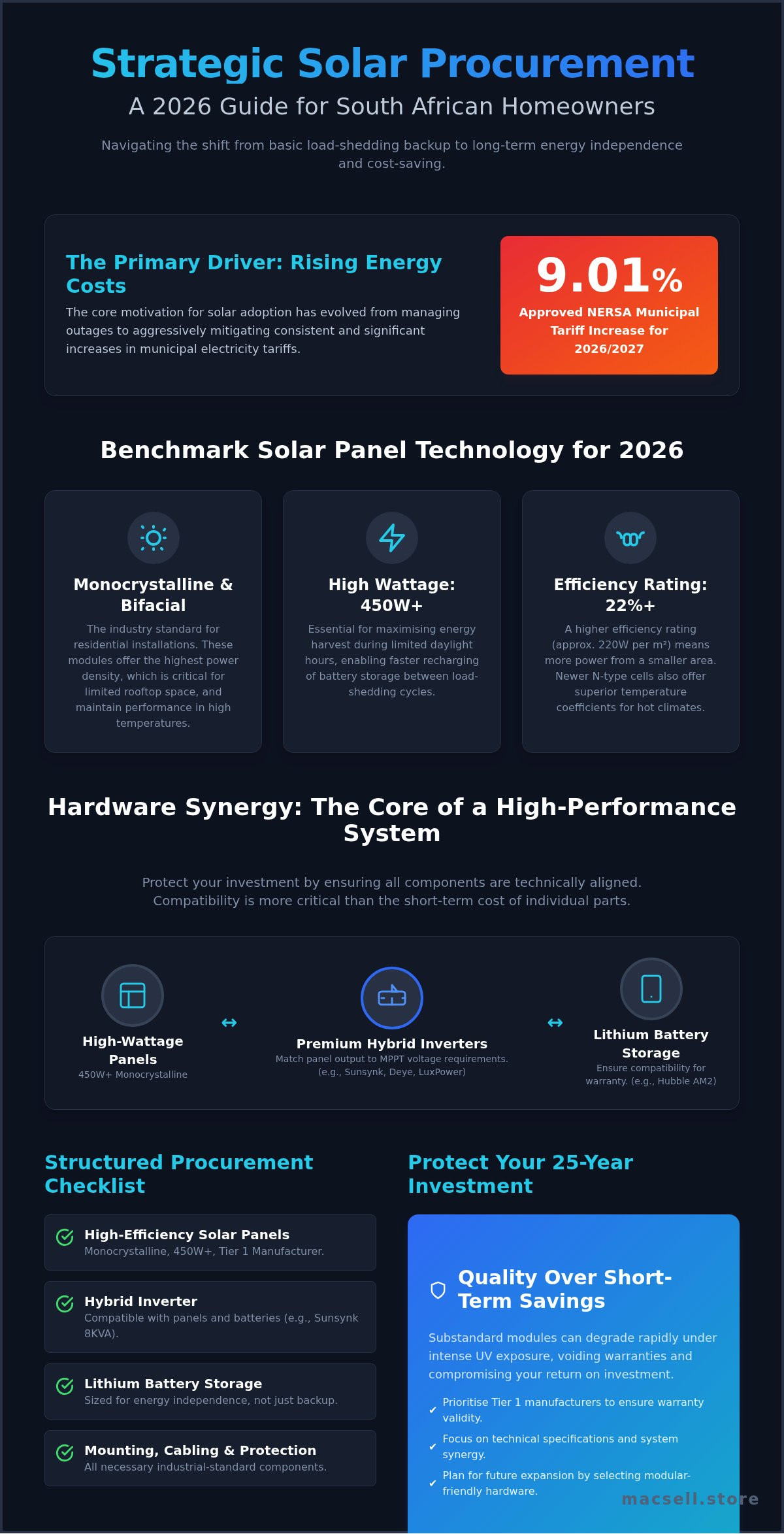
Is your solar investment engineered for decade-long performance or simply a reactive purchase against the next grid failure? Most South African property owners agree that energy independence is now a baseline requirement for financial stability. With NERSA approving municipal tariff increases of 9.01 per cent for the 2026/2027 period, the shift from basic backup power to aggressive cost-saving is essential. Finding the right solar panels for sale requires more than a cursory glance at peak wattage; it demands a precise understanding of how modern monocrystalline modules interact with high-end hybrid architecture.
You'll discover how to select high-efficiency hardware that integrates seamlessly with Sunsynk or Deye inverters whilst ensuring your lithium battery storage, such as Hubble AM2 units, operates within manufacturer warranty parameters. We provide a technical roadmap for 2026 procurement. This includes a breakdown of current module pricing, compatibility benchmarks for premium hybrid systems, and the impact of the revised Electricity Pricing Policy on your long-term return on investment.
Key Takeaways
- Identify why monocrystalline and bifacial modules are the 2026 benchmark for maximising energy yields against rising municipal tariffs.
- Master the technical alignment between panel wattage and the MPPT voltage requirements of LuxPower, Deye, and Sunsynk hybrid inverters.
- Streamline your hardware acquisition by sourcing high-efficiency solar panels for sale that guarantee compatibility with Hubble AM2 lithium batteries.
- Execute a phased procurement plan using a structured checklist to secure all necessary mounting, cabling, and protection components.
- Protect your 25-year system lifespan by prioritising hardware specifications and technical synergy over short-term cost savings.
Solar Panels for Sale: Navigating the South African Energy Landscape
The South African energy sector has undergone a fundamental shift. Temporary load-shedding measures are no longer the primary driver for solar adoption. Instead, property owners are prioritising permanent energy independence to mitigate the impact of consistent tariff hikes. With NERSA approving municipal electricity price increases of 9.01 per cent for the 2026/2027 period, the financial argument for high-output solar arrays is undeniable. Finding high-quality solar panels for sale is the first step in establishing a system capable of providing a 25-year operational lifespan. Hardware quality is the single most important determinant of long-term return on investment. Substandard modules fail under South Africa's intense UV exposure, leading to rapid degradation and voided warranties.
Procuring hardware directly through a specialised retail outlet offers distinct advantages for informed consumers. This transactional model allows for a more efficient selection of technical specifications, bypassing the inflated markups often associated with turnkey service providers. By focusing on premium components, you ensure that every part of the system, from the photovoltaic cells to the racking, meets industrial standards. High-wattage panels are now essential for mitigating higher load-shedding stages, as they maximise energy harvest during limited daylight hours. This efficiency is critical for recharging large-scale lithium storage before the next scheduled outage.
The Evolution of Solar Hardware in 2026
Panel technology has reached a point of high-intensity durability. Modern residential rooftops now standardise on 450W+ rigid monocrystalline modules. These units are engineered to maintain high efficiency even as ambient temperatures rise. Success in the current market is defined by technical synergy rather than simply searching for the lowest solar panel for home price. Professional-grade procurement involves understanding solar panel technology and its specific degradation rates. Newer N-type cells offer superior temperature coefficients, which is vital for the interior regions of South Africa where heat can significantly sap the performance of older polycrystalline variants.
Energy Independence vs. Load-Shedding Backup
There is a technical distinction between an emergency backup system and a full solar array. A basic backup power kit South Africa often focuses on short-term inverter and battery support without sufficient generation capacity. Achieving total energy independence requires a high-output array that can recharge lithium storage, such as Hubble AM2 units, whilst simultaneously powering high-draw appliances. When browsing solar panels for sale, you must account for future expansion. Selecting hardware that is compatible with premium hybrid inverters like the Sunsynk 8KVA or LuxPower SNA5000 ensures the system can scale as your energy requirements grow. This modular approach allows for a phased transition to a completely off-grid lifestyle.
Understanding Solar Panel Specifications and Efficiency Standards
Efficiency ratings and cell architecture define the performance ceiling of any renewable installation. In 2026, the market for solar panels for sale is dominated by monocrystalline technology due to its superior conversion rates and thermal stability. A 22 per cent efficiency rating translates to approximately 220 watts of power per square metre under Standard Test Conditions (STC). This high power density is vital for residential rooftops where space is a finite resource. Tier 1 status remains a critical procurement benchmark; it confirms that the manufacturer is financially stable enough to honour performance guarantees spanning 25 to 30 years. Selecting Tier 1 hardware reduces the risk of being left with unsupported equipment if a manufacturer exits the market.
Monocrystalline Cell Technology
Monocrystalline cells are the gold standard for high-efficiency residential solar. Their single-crystal structure allows for a more efficient flow of electrons, which is particularly beneficial during low-light mornings or high-heat afternoons. Unlike older polycrystalline variants, these modules maintain stable output when temperatures exceed 25 degrees Celsius. This stability is essential for effective lithium ion solar battery management. Consistent voltage from the array ensures that hybrid inverters can maintain a steady bulk charge phase, protecting the battery's cycle life and ensuring the system reaches full capacity before sunset.
Bifacial and Half-Cut Cell Advantages
Half-cut cell technology involves laser-cutting standard cells in half, which effectively doubles the number of cells on the panel. This configuration reduces internal resistance and improves the panel's durability against mechanical stress. It also allows the module to continue producing power even if the bottom half is shaded by debris or neighbouring structures. This architectural change is a significant leap from traditional full-cell designs that would lose 50 per cent or more of their output under similar shading conditions.
Bifacial panels offer double-sided energy generation by capturing light reflected off the surface beneath the array. These modules provide the highest return on investment when used on ground-mounted systems or flat concrete roofs treated with reflective coatings. You must ensure your mounting hardware is compatible with these designs to avoid rear-side shading that diminishes the bifacial gain. If you are ready to upgrade your current array, view our current hardware specifications to find the right technical fit for your project.
Matching Solar Panel Wattage to Hybrid Inverter Capacity
Technical compatibility between your photovoltaic array and hybrid inverter is the foundation of a high-yield system. When browsing solar panels for sale, you must prioritise the Maximum Power Point Tracker (MPPT) voltage range of your specific inverter. Most modern hybrid units operate within a defined DC input window. Exceeding the maximum voltage (Voc) will cause immediate hardware failure and void warranties. Conversely, failing to meet the start-up voltage results in a system that remains dormant during low-light periods. Strategic oversizing of the array, often up to 130 per cent of the inverter's rated AC output, is a standard 2026 practice. This over-clocking ensures the inverter reaches its peak capacity earlier in the morning and maintains it later into the evening. This configuration justifies the hybrid inverter price South Africa homeowners pay by maximising the utility of the hardware throughout the day.
Optimising for the Sunsynk 8KVA Inverter
The Sunsynk 8KVA inverter is designed for high-throughput residential applications. It features dual MPPT trackers, allowing for two independent strings of panels. This is ideal for properties with complex roof orientations, such as East-West splits. For an 8KVA unit, an array of 14 to 18 modules in the 450W to 550W range is typical. This setup ensures the system can handle household loads whilst simultaneously fast-charging lithium storage. The technical synergy is most evident in a pre-configured Sunsynk Hubble combo kit, where the charge parameters are factory-aligned to the Hubble AM2 battery specifications.
Sizing for LuxPower and Deye Systems
The LuxPower SNA5000 hybrid inverter requires careful string sizing to stay within its 100V to 480V MPPT range. With modern 550W panels, a string of 8 to 10 modules is often the optimal configuration. Deye inverters are particularly robust regarding high-current input. This is a requirement for the latest generation of large-format solar panels for sale that often exceed 13 Amps. Correct solar sizing is not just about peak output; it is about ensuring the battery charge rate is sufficient to replenish a 10kWh bank within the four to five hours of peak South African sunlight. Failure to match these specifications results in chronic undercharging and reduced battery longevity.
Hardware Procurement: A Checklist for Residential Solar Projects
Procurement efficiency requires a structured approach to ancillary components. Whilst most focus on the primary array, the success of a 25-year system depends on the protection and mounting infrastructure. It's often more effective to procure hardware in phases. This ensures that high-demand items, like specific hybrid inverters or large-format solar panels for sale, are secured when stock is available. For larger estates or multi-dwelling projects, purchasing bulk solar panels South Africa provides a significant logistics advantage. It ensures batch consistency in wattage and physical dimensions across the entire project.
Hardware-only purchases require strict adherence to documentation. You must verify that the warranty terms cover the equipment regardless of the independent installer used. Ensure all serial numbers are logged and that the supplier provides local warranty support. This avoids the risk of parallel imports that lack manufacturer backing in South Africa. When you are ready to secure your system, order high-end solar components directly to ensure technical compatibility.
The Core Hardware Checklist
- Solar panels: Matched wattage and quantity for the inverter's MPPT capacity as detailed in previous sections.
- Aluminium mounting rails and stainless steel roof hooks: Use high-grade materials to prevent corrosion and structural failure.
- DC circuit breakers and surge protection devices (SPDs): Mandatory for system safety and SANS 10142-1:2026 compliance.
- UV-resistant solar cabling: A 6mm minimum cross-section is recommended for long runs to minimise voltage drop.
Managing the Logistics of Heavy Hardware
Glass-based PV modules are fragile and require specialised handling. Ensure the delivery service uses appropriate racking to prevent micro-cracks that degrade performance over time. It's vital to store lithium batteries and inverters in a cool, dry environment before commissioning. High humidity or extreme temperatures can impact sensitive electronics during the storage phase. Always verify serial numbers upon arrival and match these against the documentation provided for local warranty activation. This methodical approach to sourcing solar panels for sale ensures that your hardware investment is protected from the point of purchase through to final system integration.
Sourcing Premium Solar Hardware from MacSell Solar Outlet
MacSell Solar Outlet operates as a specialised hardware-only retailer, catering to the specific requirements of independent contractors and informed property owners. This transactional model focuses on price transparency and inventory availability rather than the high markups associated with turnkey service providers. By removing installation and financing overheads, the outlet provides a direct route to Tier 1 equipment. When browsing solar panels for sale, you gain access to a curated inventory that prioritises technical synergy. This approach is essential for those who've already secured a qualified installer and require precise components to complete a high-performance system.
National delivery capabilities ensure that high-end energy solutions are accessible across South Africa. Every component, from high-wattage modules to heavy lithium banks, is handled through a logistics network designed for fragile electronics. This ensures the technical integrity of the hardware is maintained from the warehouse to your site. Pre-configured combo kits are a primary offering, designed to eliminate the risk of hardware mismatching between the inverter and the battery bank.
Premium Inverter and Battery Selection
The inventory includes the LuxPower SNA5000, a reliable 5kW hybrid inverter known for its robust performance in residential settings. For those requiring higher throughput, Deye inverters provide a versatile alternative that handles high-current modern solar panels with ease. These inverters are often paired with Hubble lithium batteries, specifically the Hubble AM2 5.5kWh units. This combination is engineered for high-cycle storage, providing the longevity needed to justify a large-scale solar investment. The Sunsynk 8KVA and 2X Hubble AM2 combo kit remains a benchmark for those seeking a pre-configured, high-output solution that guarantees seamless communication between the BMS and the inverter.
Why MacSell is the Trusted Hardware Partner
Reliability in the solar sector is built on technical accuracy. MacSell positions itself as an authoritative distributor that understands the specific parameters of the 2026 energy landscape. The focus remains on supplying the latest technology, including N-type monocrystalline modules and high-voltage hybrid architecture. This commitment to inventory variety allows you to source all necessary components, including UV-resistant cabling and SANS-compliant protection devices, from a single location. By acting as a specialised warehouse manager, the outlet provides the tools needed for energy independence without the unnecessary fluff of traditional sales pitches. It's a no-nonsense partner for those who prioritise performance, compatibility, and national availability.
Securing Your Energy Independence with Technical Precision
Successful solar integration in 2026 relies on technical synergy rather than just finding the lowest price per watt. You've seen that matching monocrystalline panel wattage to the specific MPPT ranges of Sunsynk or LuxPower inverters is non-negotiable for system longevity. By following a structured procurement checklist, you ensure that every component, from the mounting rails to the surge protection, meets the latest SANS standards. Finding the right solar panels for sale is only the first step; the real value lies in selecting hardware that guarantees compatibility with premium lithium storage.
MacSell Solar Outlet provides direct access to these industrial-grade solutions. As specialists in Sunsynk, Deye, and LuxPower hardware, we offer national delivery on all solar components to ensure your project stays on schedule. Our curated selection of Hubble lithium batteries provides the high-cycle storage needed for true energy independence. Browse the latest solar panels and hybrid hardware at MacSell Solar Outlet and take control of your energy future. Building a high-output array today is the most effective way to mitigate rising electricity costs and achieve lasting power security.
Frequently Asked Questions
What is the best solar panel for sale for home use in South Africa?
Monocrystalline N-type modules are currently the superior choice for residential applications. These panels offer the best thermal stability in South African heat and higher efficiency in low-light conditions. When browsing solar panels for sale, look for Tier 1 brands with a wattage between 450W and 550W. These specifications ensure maximum energy harvest whilst maintaining a manageable physical footprint on standard residential rooftops.
How many solar panels do I need to run a 5kW hybrid inverter?
A standard 5kW hybrid inverter, such as the LuxPower SNA5000, typically requires between 8 and 10 panels in the 550W range. The exact number depends on the inverter's MPPT voltage window and the specific open-circuit voltage of the modules. You should aim to reach the inverter's nominal operating voltage early in the day to ensure consistent battery charging and load support throughout the afternoon.
Is it better to buy solar panels in bulk or individually?
Purchasing in bulk is generally recommended for larger estates or multi-phased projects to ensure batch consistency. This prevents variations in panel dimensions or technical specifications that occur between different manufacturing runs. For smaller residential systems, individual procurement is sufficient, provided you source all modules from the same Tier 1 manufacturer to maintain uniform performance across the entire string and protect your long-term warranty.
What is the difference between monocrystalline and bifacial solar panels?
Monocrystalline panels use single-crystal silicon to achieve high conversion efficiency from the front surface. Bifacial panels are a variation of this technology that captures light on both the front and rear sides. Whilst monocrystalline is suitable for standard tiled roofs, bifacial modules provide the best return on investment when installed on flat, reflective surfaces or ground-mount systems where they can capture reflected light effectively.
Can I use any solar panel with a Sunsynk or Deye inverter?
Most modern solar panels for sale are compatible with Sunsynk or Deye inverters as long as the electrical parameters align. You must verify that the total string voltage stays within the inverter's MPPT range and that the panel's short-circuit current doesn't exceed the inverter's maximum input current. High-current panels over 13 Amps require specific inverter models designed for modern, large-format modules to prevent clipping.
What hardware do I need besides the solar panels for a full installation?
A full system requires several critical components beyond the photovoltaic modules. This includes aluminium mounting rails, stainless steel roof hooks, and UV-resistant solar cabling. You'll also need a hybrid inverter, such as a Sunsynk 8KVA or LuxPower unit, and lithium storage like the Hubble AM2. Essential safety hardware includes DC circuit breakers, surge protection devices, and a compliant combiner box to meet national wiring codes.
How long do modern solar panels last in South African conditions?
Tier 1 solar panels are engineered to last 25 to 30 years in harsh South African UV conditions. Most manufacturers provide a linear performance warranty guaranteeing that the modules will still produce at least 80 per cent of their original rated output after 25 years. Using high-quality mounting hardware and ensuring regular cleaning to remove dust and debris will help maintain this efficiency throughout the system's lifespan.
Does MacSell Solar Outlet provide installation services for the hardware sold?
No, MacSell Solar Outlet is a specialist hardware retailer and does not provide professional installation services. Our business model focuses on the direct sale of high-end components to independent contractors and informed property owners who have already secured their own installers. We also do not offer financing plans or emergency technical support; we prioritise providing national access to premium hardware at transactional, outlet-level prices.