

Solar Parts Cost: What Panels, Batteries and System Gear Cost
The right solar parts depend on whether you need daytime generation alone or stored power as well. To decide what solar parts to buy before hiring an installer, start with the core equipment: panels, roof mounting, an inverter and connecting wiring. Add a battery if you want to store energy for use at night or during a grid outage.
It’s easy to focus on panel costs, but the inverter, battery and mounting equipment also affect the system’s total cost and suitability. The right combination depends on your electricity use, roof space and condition, shading, and whether backup power is a priority. This guide explains what each main component does, how the system type affects your equipment list, and what to consider for your South African property and power needs. You’ll be better prepared to compare system options before installation planning begins.
Key Takeaways
- Match battery storage to your need for backup or overnight power, as well as your household’s energy use.
- Panel count depends on the system size and available roof space; roof condition and orientation also affect the design.
- Choose grid-tied, hybrid or off-grid equipment according to how you expect the system to work with the grid and stored energy.
- Shading can change which inverter setup suits your roof, so consider how panel-level equipment affects array performance.
Battery storage for backup and overnight use
For South African grid-connected systems, identify the applicable SANS requirements and NRS listings for the inverter and other grid-interface equipment before purchase. Panels, batteries and charge controllers must also suit the system design. Approval for one component does not automatically cover every part.
Optional battery storage
A solar battery stores energy from the panels for use when generation falls or stops. It’s optional if your system only needs to supply power while panels are producing, but it matters for overnight use and backup during grid outages. Battery choice depends on the loads you want to support and how long you need stored power to last. Solar batteries are typically deep-cycle, designed for repeated charging and discharging; reported lifespans are 10-20 years.
Backup power and bill savings
Battery storage can provide backup during an outage and store solar energy for use after the panels stop generating. It can also hold energy for use when electricity costs more, which may support savings if your usage pattern makes that worthwhile. For example, a household prioritising evening loads needs storage sized around those loads, not panel output alone. If net metering is unavailable, a battery may be worth considering. Outage frequency and any off-grid plans also affect the decision.
Charge controllers and battery safety
A charge controller regulates the connection between panels and a battery. It matters because the storage system needs compatible charging equipment, not simply a battery added to a panel array. Include battery disconnect switches in the system design. Fuses between the battery and inverter help protect that connection. These components must work with the inverter and battery, so plan them as part of the complete system.
Panels generate direct current, while the inverter converts it for household use and connects the system’s equipment. Before buying parts, map your intended loads, backup priorities and grid connection. This gives the installer a clear basis for matching panel output, inverter capacity and battery storage, rather than treating each component as a separate purchase.
Solar panels
Panel selection affects the roof area required and the amount of solar power generated. Start by establishing the system size your property needs, then compare panel types, output and fit with your roof.
Solar panel types and selection
Monocrystalline and polycrystalline panels are two common types with different efficiency and cost trade-offs. Monocrystalline panels are more efficient and expensive than polycrystalline panels. This matters when roof space is limited: higher efficiency can help meet the required system size with less area. The number of panels still depends on the system size needed to power your property.
Measure the usable roof space against the planned array, rather than relying on the roof’s full footprint. Vents, chimneys and other obstructions reduce the area available for panels. Compare each panel’s dimensions and stated output with that space and the system design. A roof without enough suitable area may not accommodate the panel count needed for your power requirements.
Panel brands
A panel brand identifies the manufacturer, whose product specifications determine the module’s output and physical fit. Compare the manufacturer’s datasheet, including stated output and dimensions, instead of choosing by name alone. Check that the selected panels suit the planned inverter and array design. This makes brand comparison about system compatibility, not just the label on a panel.
For example, panels from different manufacturers may vary in dimensions and output. Those differences affect how many will fit and how much power they can generate. Keep the panel model and its specifications consistent in the equipment plan, especially when pairing solar generation with battery storage.
Panel-level optimisation can help when shading or mismatched panels affects array output. Power optimisers are installed at each panel and send optimised direct-current output to a string inverter for conversion. They are not inverters themselves. This equipment can reduce the effect of shading and mismatch on system output, so consider it when roof conditions create uneven panel performance.
Before settling on a panel type or brand, record usable roof area, required system size and any shaded sections. Use those details to compare panels and optimisation needs with the planned system. You can also review solar panel options as part of that equipment comparison.
Grid-tied, hybrid, and off-grid system equipment
In South Africa, installations must follow the National Building Regulations and have a Certificate of Compliance. Grid connection arrangements depend on the utility and whether it offers net metering. A grid-connected system needs a net meter where that option is available.
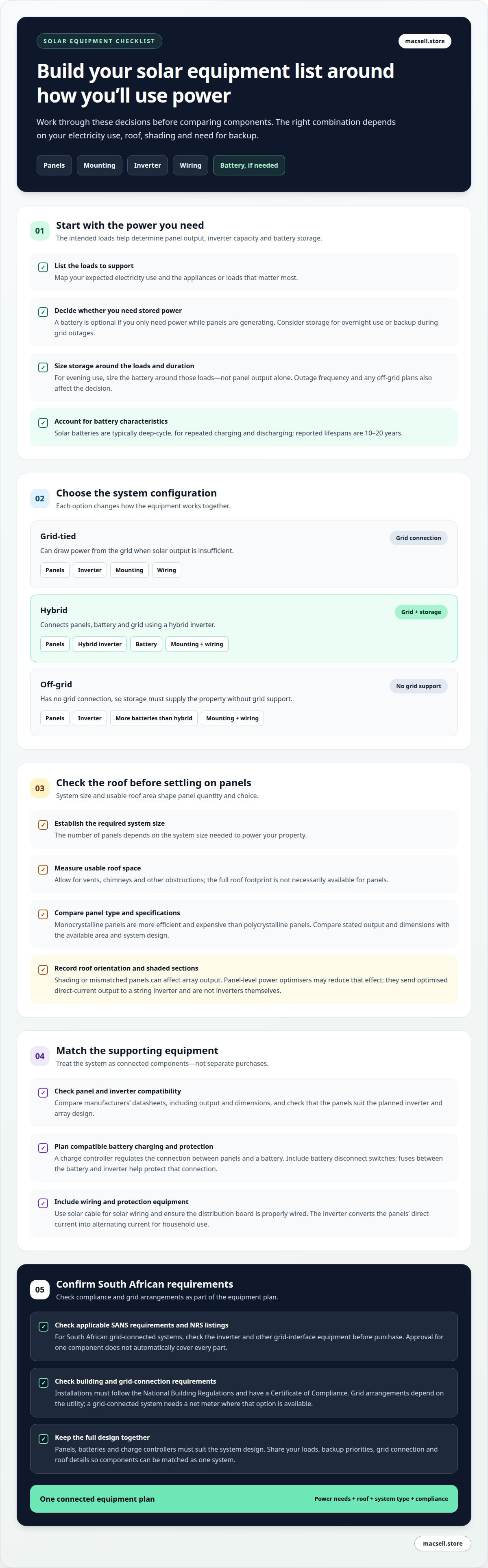
A residential solar system combines panels, mounting equipment, an inverter and wiring. The inverter converts the panels’ direct current into alternating current for household use. A grid-tied system can draw power from the grid when solar output is insufficient. A hybrid system adds battery storage and a hybrid inverter to connect the panels, battery and grid. An off-grid system has no grid connection, so its storage must be sized to supply the property without grid support.
These choices change the equipment list and the system’s overall cost. Off-grid designs need more batteries than hybrid systems because they cannot rely on the grid. A hybrid design adds storage and the equipment needed to manage it. Compare the components as a connected system, rather than treating the panels, inverter and battery as separate purchases. The loads you need to support and your expected usage determine which configuration is suitable.
Wiring and protection equipment matter too. Use solar cable for solar wiring and ensure the distribution board is properly wired. A solar installation should include fuses and surge protection between the panels and the MPPTs. A PV combiner box can bring multiple panel strings together with breakers, earthing and fuses. Battery systems also need an automatic transfer switch. Each component must suit the system design and be connected correctly.
Monitoring equipment tracks generation over time and can help identify changes in performance. An app or website may display output by hour, day or year, making system behaviour easier to review. Monitoring helps you check whether the system is operating as intended, but it does not replace correctly sized equipment or sound wiring. Include it in the equipment plan alongside the inverter and protection components.
Choosing equipment for shaded or differently oriented roofs
Roof orientation, condition and nearby shade affect which solar components suit an array. Map the roof faces and note shadows from trees, chimneys and other obstructions. Panels should face the sun, while debris from nearby trees can reduce their efficiency. This roof assessment helps determine panel placement and inverter configuration, rather than assuming every section will produce equally.
A string inverter connects panels in an array and converts their direct current into alternating current. If one panel is shaded, production across the wider array can fall. String inverters are therefore a practical choice for roofs with consistent exposure, but may be less suitable where shade regularly affects only part of the array. A local obstruction can influence output beyond the panel directly beneath it.
Microinverters attach to individual panels. If one panel is shaded, the others can continue producing, which may suit roofs with uneven shade or different orientations. Power optimisers offer another panel-level option: each unit conditions a panel’s direct-current output and sends it to a string inverter. Optimisers are not inverters, so the system still needs an inverter to convert the generated electricity to alternating current.
Compare these components with the roof’s actual layout. For example, a tree shading one roof area creates a different design issue from two roof faces receiving sunlight at different times. Racking must suit the roof type, and the roof must be structurally sound for panel weight and wind load. Panels and mounting equipment must also be correctly earthed. The right setup balances roof exposure, panel placement and conversion equipment instead of choosing components in isolation.
Use a roof plan showing orientation, obstructions and shaded areas to compare inverter options. Explore solar equipment for components suited to your system design.
MacSell Solar Outlet: Sunsynk 8KVA & 2X Hubble AM2 5.5 KWh Combo Kit
MacSell Solar Outlet offers the Sunsynk 8KVA & 2X Hubble AM2 5.5 KWh Combo Kit for readers considering a hybrid system with battery storage. The named components give you a specific equipment package to discuss alongside your planned loads, backup needs and roof design.
If you’re comparing parts individually, MacSell Solar Outlet offers lithium batteries, hybrid inverters and solar panels. Match each choice to your system plan: panel generation, inverter compatibility and the storage needed for your intended use. This helps you narrow down the hardware before discussing the installation design with your installer.
Explore the solar hardware range at macsell.store or contact MacSell Solar Outlet.
Turn your solar plan into a clear equipment brief
Before committing to purchases, write down the outcomes your system must support and the constraints your property presents. This gives your installer a focused starting point and ties equipment choices to your actual requirements. Deciding what solar parts to buy before hiring an installer is easier when you can explain which trade-offs matter most, such as backup capability, roof suitability or how the system connects to the grid.
Use that brief to compare proposed equipment as a complete system, not as a collection of unrelated components. Ask for the proposed configuration and how each part supports your priorities. If you’re still weighing hardware options, MacSell Solar Outlet can help you explore its solar equipment range.
Ask MacSell Solar Outlet about solar parts, then take your preferred system direction into the next planning conversation. A clear brief puts you in a stronger position to make practical decisions and move towards a solar setup that fits your needs.
Frequently Asked Questions
How much will your solar energy technology and equipment cost?
Solar equipment costs vary with system design, roof layout and backup requirements. Key cost drivers include the panel array, inverter, mounting hardware, protection and wiring, plus battery storage if included. A shaded roof or complex wiring can also affect the equipment plan. Compare itemised quotations by component and scope, then assess whether each part supports your intended use. No single equipment cost suits every South African property.
When is choosing the right equipment most important?
Equipment choice matters most when your roof has shading, limited usable space or more than one orientation. These conditions affect panel placement and how the system responds to uneven generation. Your priorities also matter if you need power during outages or want to operate independently from the grid. Define them early, because they determine which components belong in the proposed system and how those components must work together.
Which solar system components should homeowners in South Africa buy before hiring an installer?
Plan the panels, mounting equipment, inverter, wiring and protection as one system before purchasing. Add battery storage only if your intended use requires it, and include monitoring if you want to review system output. If you’re deciding what solar parts to buy before hiring an installer, prepare a component plan for the installer to assess. Installations must comply with SANS 10142, all parts, and be performed by a qualified electrical wireman or master electrician registered with the Department of Labour. A valid Certificate of Compliance is required.
How do I calculate the solar panel, inverter and battery sizes for my home?
Start with your electricity use and list the appliances you want the system to support. To work out what solar parts to buy before hiring an installer, consider which appliances may run simultaneously, then estimate their energy use and how long they need power. Panel sizing depends on the energy the system must generate and the roof’s usable, unshaded area. These figures form a practical design brief, not a parts list to buy blindly.
How do I choose a hybrid inverter compatible with solar panels, batteries and grid supply in South Africa?
Compare the inverter’s published input and output specifications with the panel array, battery and grid connection. Check that panel voltage and current are within the inverter’s operating ranges, and that battery voltage and communication requirements match. Consider the household’s expected simultaneous loads and whether the inverter supports your intended backup arrangement. Compatibility across these connections matters more than choosing an inverter by its capacity label alone.
Which lithium batteries are compatible with South African solar inverters, and what capacity is needed?
Compatibility depends on the inverter’s supported battery voltage, charging limits and communication requirements. Check those specifications against the battery documentation before choosing a model. Capacity depends on the appliances you need to run, their energy use and the duration of backup required. For example, prioritising lights and communications calls for a different storage plan than including high-demand appliances for extended use.