

Solar System Components South Africa: 2026 Hardware Procurement Guide
An expensive 8KVA inverter is nothing more than a wall ornament if your battery's BMS refuses to communicate with it. You've likely realised that achieving energy independence isn't just about buying parts; it's about ensuring those components actually talk to each other. Sourcing solar system components South Africa requires a technical eye to avoid the common pitfalls of mismatched voltages and incompatible communication protocols that plague many residential builds.
This 2026 procurement guide provides the technical clarity you need to select and match high-end hardware for maximum reliability. You'll learn how to distinguish between 5kW and 8KVA load requirements, understand the specific advantages of hybrid inverters like the LuxPower SNA5000, and see why pre-configured kits featuring Hubble AM2 lithium batteries are the current benchmark for residential backup. We'll outline the exact hardware combinations that guarantee system synergy, allowing you to procure professional-grade equipment without the noise of unnecessary service contracts.
Key Takeaways
- Understand the critical communication protocols required between lithium battery BMS and hybrid inverter firmware to ensure system synergy.
- Identify the essential solar system components South Africa relies on for energy independence, from high-wattage monocrystalline panels to management cores.
- Compare high-end management hardware, focusing on the specific performance parameters of the Sunsynk 8KVA and LuxPower SNA5000 units.
- Apply the 1:1 sizing rule to match battery kWh capacity with inverter kW output for efficient energy discharge and system stability.
- Utilise pre-configured hardware combo kits to eliminate brand compatibility issues and streamline the procurement of high-performance components.
Essential Solar System Components for South African Conditions
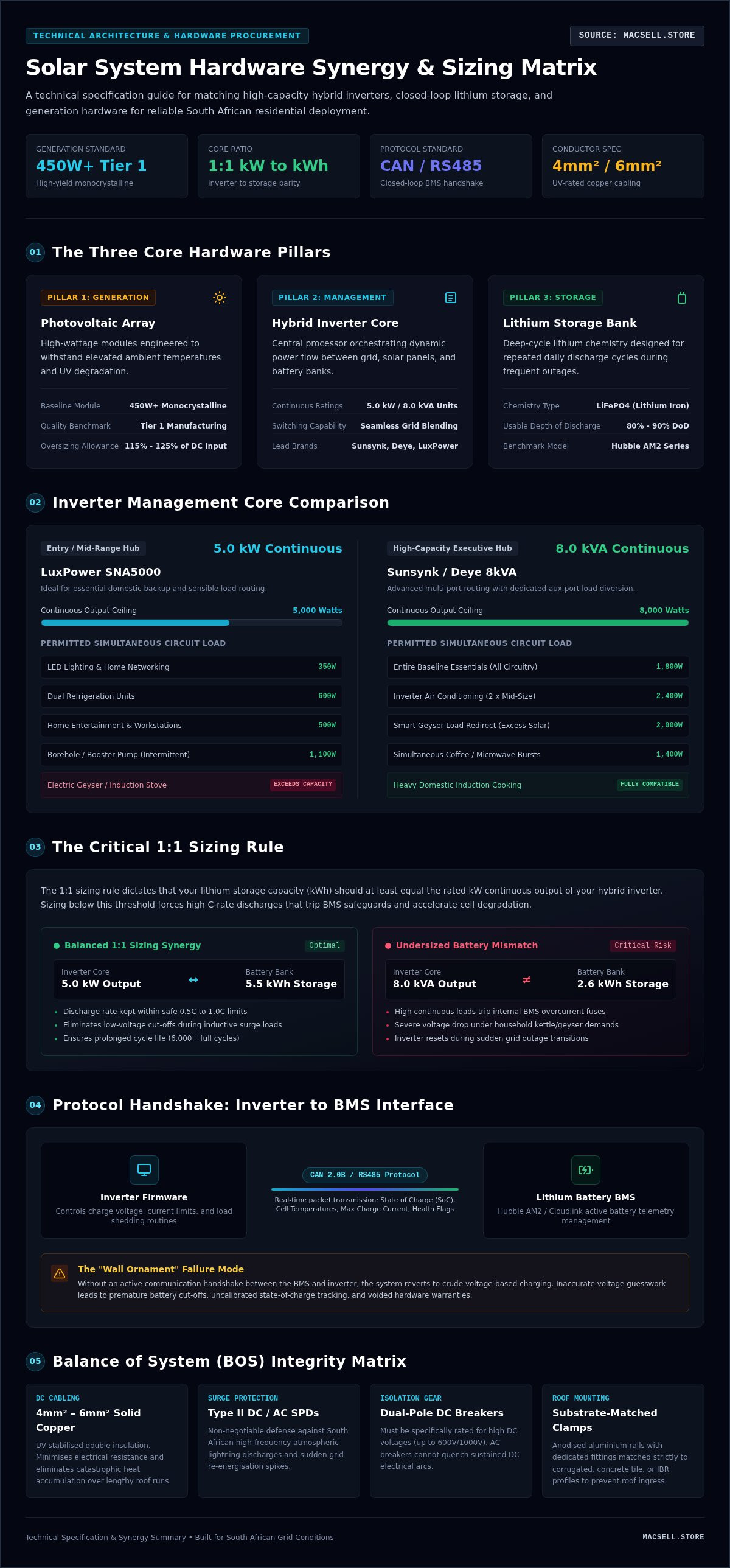
A high-performance solar strategy relies on three primary hardware pillars: generation, management, and storage. In the South African context, these components must withstand high ambient temperatures and frequent cycling caused by grid instability. Selecting the correct solar system components South Africa requires a technical understanding of how these pillars interact to maintain energy independence. Generation involves high-wattage monocrystalline panels, while management is handled by hybrid inverters that organise energy flow between the grid, panels, and battery bank. Storage, the final pillar, utilises lithium-ion batteries designed for deep discharge cycles during prolonged outages.
The Role of Photovoltaic (PV) Panels
By 2026, 450W+ monocrystalline panels have become the baseline standard for residential rooftops. These high-wattage modules provide superior efficiency per square metre, which is vital when roof space is limited. It's essential to source Tier 1 manufactured panels to ensure long-term durability against intense UV degradation. When sizing your array, calculate the total wattage based on your inverter's maximum DC input capacity. For example, a 5kW inverter typically handles a slightly oversized PV array to compensate for atmospheric losses and orientation inefficiencies. Understanding the full range of photovoltaic system components ensures your panels are electrically matched to your management hardware for peak yield.
Balance of System (BOS) Accessories
BOS components are the secondary hardware items that ensure system safety and longevity. High-quality DC combiner boxes and integrated surge protection devices are non-negotiable in South Africa due to the high frequency of lightning strikes and grid-induced surges. Mounting hardware must be selected specifically for your roof material, whether it's corrugated iron, concrete tile, or IBR, to ensure structural integrity and prevent water ingress. These accessories provide the physical and electrical framework that allows the primary solar system components South Africa to function without interruption.
Cable thickness is a critical technical parameter often overlooked during procurement. Undersized DC cables lead to significant voltage drops and dangerous heat buildup, which reduces overall system efficiency and increases fire risks. Ensure all 4mm or 6mm solar cabling is UV-rated and terminated with high-quality MC4 connectors. Correct grounding and the use of dedicated DC circuit breakers are also mandatory for compliance and equipment protection. These technical details distinguish a reliable, professional-grade hardware setup from a substandard assembly that might fail under the heavy load of a South African household.
Hybrid Inverter Hardware: The System Management Core
Hybrid inverters function as the central intelligence for modern solar system components South Africa. These units manage bidirectional energy flow, synchronising solar production with grid availability and battery storage. This capability is vital for navigating the frequent grid transitions experienced across South Africa. Understanding inverter and grid integration fundamentals helps in selecting hardware that maintains stability during rapid switching. Hybrids are superior to standard off-grid inverters because they can blend power sources, using solar to supplement the grid during peak tariff periods or high-demand cycles.
Comparing High-End Hybrid Brands
Sunsynk and Deye dominate the high-end market due to their robust firmware and parallel capabilities. Sunsynk hardware is frequently specified for its sophisticated load management, allowing users to redirect excess solar energy to non-essential appliances like geysers. Deye units offer high versatility and are known for their ability to scale, making them suitable for both residential and light commercial applications. For those requiring a reliable 5kW management core, the LuxPower SNA5000 is a cost-effective hybrid option that handles 5000W of continuous load with ease. It supports multiple charging priorities and integrates seamlessly with major lithium brands. When planning your procurement, checking a hybrid inverter price South Africa resource will help you budget for these 2026 hardware standards.
Understanding Inverter Load Capacity
Load capacity determines how many appliances your system can run simultaneously. An 8KVA inverter is the preferred choice for South African homes with high peak demands, as it provides the necessary headroom for inductive loads like pumps and compressors. Managing these loads is performed through the inverter software, where you can distinguish between essential and non-essential circuits. This ensures that during a power outage, your batteries aren't drained by heavy appliances. Every high-performance solar system components South Africa setup must include an inverter with pure sine wave output to ensure the safety of sensitive electronics. If you're looking to secure professional-grade hardware, you can browse our inventory of verified hybrid units designed for local conditions.
Lithium Battery Storage: Ensuring Reliable Energy Reserves
Lithium-ion technology has effectively replaced lead-acid as the favourite for South African solar storage. High-performance solar system components South Africa now demand storage units capable of rapid cycling and deep discharge. Unlike lead-acid, lithium batteries offer a Depth of Discharge (DoD) between 80% and 100%. This is critical for load shedding resilience, allowing households to utilise almost the entire rated capacity during extended outages without damaging the cell chemistry. Choosing lithium ensures your system can sustain essential loads throughout the night or during consecutive grid failures.
C-ratings are equally important when evaluating storage hardware. A 1C-rated battery can discharge its full capacity in one hour, providing the surge current necessary to start heavy appliances through your inverter. Matching the C-rating to your inverter's peak output prevents the Battery Management System (BMS) from tripping during high-demand events. If your battery is undersized for your inverter's discharge potential, the system will likely shut down when a pump or microwave starts up, regardless of the remaining state of charge.
Hubble Lithium Battery Specifications
The Hubble AM2 5.5 KWh and AM5 series represent the current industry standard for high-performance storage. These units utilise Prismatic LiFePO4 cells, known for thermal stability and high energy density. Advanced internal BMS hardware facilitates direct communication with Sunsynk or Deye hybrid inverters to optimise charging parameters. This data exchange prevents overcharging and balances individual cells to extend the unit's operational life. Procurement should focus on hardware that aligns with SAPVIA PV GreenCard quality assurance standards to ensure safety and compliance. For a technical deep dive into cell chemistry and voltage matching, consult our lithium ion solar battery technology guide.
Battery Lifespan and Cycle Count
Modern lithium units typically offer 6000+ cycles at 80% DoD. This translates to roughly 15 years of reliable service under normal daily cycling. Temperature control is the primary factor affecting health; maintaining a stable environment around 25°C ensures the battery reaches its rated lifespan. Performance degrades rapidly in high-heat environments, making ventilated storage areas a technical requirement. Whilst the initial procurement cost is higher than lead-acid, the cost-per-cycle is significantly lower over the hardware's life. Lithium-ion is the most cost-effective long-term storage solution for the South African market due to its high energy density and minimal maintenance requirements. Investing in high-cycle hardware ensures your solar system components South Africa build remains functional well into the next decade.
Sizing and Matching Components for Efficiency
System failure often stems from a technical mismatch between peak discharge requirements and battery capacity. Matching your battery bank to your inverter output is vital to prevent sudden shutdowns during high-load events. A standard rule of thumb for solar system components South Africa is to maintain a 1:1 ratio between inverter kW and battery kWh. For an 8KVA inverter, a minimum storage bank of 11kWh is recommended to ensure the Battery Management System (BMS) can handle the continuous current draw without triggering protective cut-offs. This balance ensures that the hardware operates within its designed thermal and electrical limits.
PV array sizing requires a different calculation logic. Your panel capacity must be large enough to power the household's daytime loads whilst simultaneously charging the battery bank for night-time use. If your daytime load is 3kW and you need to charge a 5.5kWh battery within five peak sun hours, you require at least 4.5kW to 5kW of panels. Ignoring this balance leads to chronically undercharged batteries and reduced hardware lifespan. Compatibility is the final technical hurdle; you must verify that your inverter firmware supports the specific CAN-bus or RS485 communication protocols of your battery's BMS to ensure accurate state-of-charge reporting.
The Sunsynk and Hubble Synergy
The pairing of Sunsynk 8KVA inverters with Hubble AM2 batteries has become a benchmark for reliability in South Africa. This hardware combination is favoured because the communication protocols are pre-validated, ensuring the inverter receives real-time data on cell voltage and temperature. Setting up this synergy requires selecting the correct battery type and protocol ID in the inverter's settings menu. For those seeking a pre-tested solution, procuring a Sunsynk 8KVA and Hubble AM2 combo kit eliminates the risk of component mismatching. This ensures all management and storage units work in a unified loop for maximum efficiency.
System Scalability
Organising your hardware procurement with future expansion in mind prevents wasteful spending. Adding batteries in parallel is the most common upgrade path; it increases both total storage capacity and the available discharge current for the inverter. If you plan to scale beyond 16kW of peak demand, you'll need hybrid inverters that support paralleling. This requires identical hardware models and specific communication cables to synchronise the AC output phases. You can view our scalable hardware options to find units that support multi-inverter configurations. These professional-grade solar system components South Africa are designed to grow with your energy needs, provided the initial BOS components are rated for the increased total current.
Procuring Solar Hardware Kits in South Africa
Procuring hardware directly allows for precise control over component quality. By selecting specific solar system components South Africa provides, you ensure that every part of the energy chain meets professional standards. Focusing on reputable brands like Sunsynk, Deye, and LuxPower ensures long-term warranty support and firmware compatibility. MacSell Solar Outlet operates as a specialised distributor, providing national delivery on all high-end solar components to support independent procurement and DIY builds.
Advantages of Solar Combo Kits
Pre-configured combo kits eliminate the technical risk of component mismatching. These packages are engineered to ensure that the inverter's charging profile aligns perfectly with the battery's BMS requirements. Buying inverters and batteries as a single package is often more cost-efficient than sourcing individual units from multiple vendors. For those prioritising a rapid setup, a backup power kit South Africa offers a streamlined path to energy independence. It simplifies the procurement process for homeowners who already have a trusted installer but need to secure the best hardware themselves.
Hardware Procurement Checklist
A rigorous checklist is essential when receiving your solar system components South Africa order. Verify all serial numbers upon delivery and complete warranty registration immediately to secure your investment. Ensure your order includes all necessary DC and AC protection components, such as surge arrestors and rotary isolators, as these are frequently omitted in basic hardware lists. These safety units are non-negotiable for protecting your management and storage cores from grid surges. For a detailed analysis of component pricing, refer to our solar system hardware cost breakdown South Africa. This ensures you have a complete inventory of necessary hardware before the physical setup begins.
Securing Your Energy Independence with Professional Hardware
Achieving energy independence requires a shift from generic part-gathering to strategic hardware matching. The synergy between your hybrid inverter and lithium storage bank is the foundation of a resilient system. By prioritising high-cycle batteries like the Hubble AM2 and robust management cores from Sunsynk or LuxPower, you eliminate the technical bottlenecks that lead to system failure. Sourcing the correct solar system components South Africa relies on today ensures your household remains operational through every grid transition.
Direct procurement gives you total control over component quality and warranty security. MacSell Solar Outlet acts as your specialised partner in this process. We're an authorised distributor of Sunsynk and Hubble hardware with a focus on high-performance hybrid inventory. We provide national shipping across South Africa to ensure you get professional-grade equipment regardless of your location. It's time to move beyond basic backup and invest in a system engineered for the long term.
Browse the full range of solar system components at MacSell Solar Outlet and start building a system that delivers consistent, reliable power for years to come.
Frequently Asked Questions
What are the three most important solar system components in South Africa?
The three primary hardware pillars for any reliable system are high-wattage monocrystalline solar panels, a hybrid inverter for energy management, and lithium-ion batteries for storage. These solar system components South Africa relies on must be technically matched to handle local grid instability. Without a management core like a Sunsynk or LuxPower unit, your generation and storage cannot communicate effectively, leading to system inefficiencies or frequent hardware shutdowns during load shedding events.
Can I use any lithium battery with a Sunsynk inverter?
No, you must ensure the battery's Management System (BMS) is compatible with Sunsynk's communication protocols. While many lithium batteries physically connect, they won't provide accurate state-of-charge data without a verified CAN-bus or RS485 link. Pairing a Sunsynk 8KVA with a Hubble AM2 is a proven combination because their firmware is pre-validated for synergy. Using unsupported brands may force the inverter into "Voltage Mode," which reduces battery lifespan and reporting accuracy.
Is a 5kW inverter enough for a standard South African household?
A 5kW inverter, such as the LuxPower SNA5000, is generally sufficient for standard essential loads like lights, Wi-Fi, and fridge-freezers. However, it's often inadequate for households running multiple high-draw appliances simultaneously, such as kettles, geysers, or air conditioners. For homes with higher peak demands, an 8KVA unit is preferred to provide the necessary headroom. You should calculate your peak concurrent wattage before procurement to avoid overloading the management hardware during outages.
How much do solar system components cost in South Africa?
Procurement costs vary significantly based on brand quality, technical specifications, and storage capacity. High-end solar system components South Africa, such as Tier 1 panels and lithium batteries, represent a higher initial investment but offer lower cost-per-cycle over their lifespan. Prices depend on current market availability and technical parameters. It's advisable to check a dedicated hardware cost guide to understand the current ZAR ranges for specific items like the Sunsynk 8KVA or Hubble AM2 units.
What is the difference between a hybrid and an off-grid inverter?
Hybrid inverters can blend power from the grid, solar panels, and batteries simultaneously to meet your household demand. They're designed to stay connected to the grid whilst supplementing energy during peak times. In contrast, off-grid inverters typically operate in a binary fashion, switching entirely between sources. Hybrids like Deye or Sunsynk units offer superior versatility for local users because they manage grid-tied and backup functions within a single, sophisticated management core.
Do I need to buy solar panels and batteries at the same time?
You don't need to buy everything at once; many users start with an inverter and battery for immediate backup during outages. This configuration functions as a large UPS system to keep essentials running. You can add solar panels later to charge the batteries and reduce your reliance on the grid. However, ensure your initial inverter is a hybrid model that supports PV input so you don't have to replace your management core during expansion.
How long do lithium solar batteries last compared to lead-acid?
Lithium-ion batteries typically last between 10 and 15 years, offering upwards of 6000 cycles at an 80% Depth of Discharge. Lead-acid alternatives generally fail after 2 to 3 years of frequent cycling, especially under the heavy discharge patterns required by South African grid failures. Whilst lithium hardware has a higher upfront cost in ZAR, its superior energy density and long-term reliability make it the most cost-effective storage solution for residential energy independence.
Why is a pure sine wave inverter necessary for home appliances?
Pure sine wave inverters produce electricity that is identical to, or cleaner than, the power provided by the national grid. This is essential for protecting sensitive electronics like laptops, LED televisions, and modern appliances with microprocessors. Modified sine wave units cause overheating in motors and can damage the power supplies of expensive hardware. All high-end hybrid inverters in our inventory provide pure sine wave output to ensure the safe operation of your household equipment.