

South Africa Load Shedding: 2026 Inverter Procurement Guide
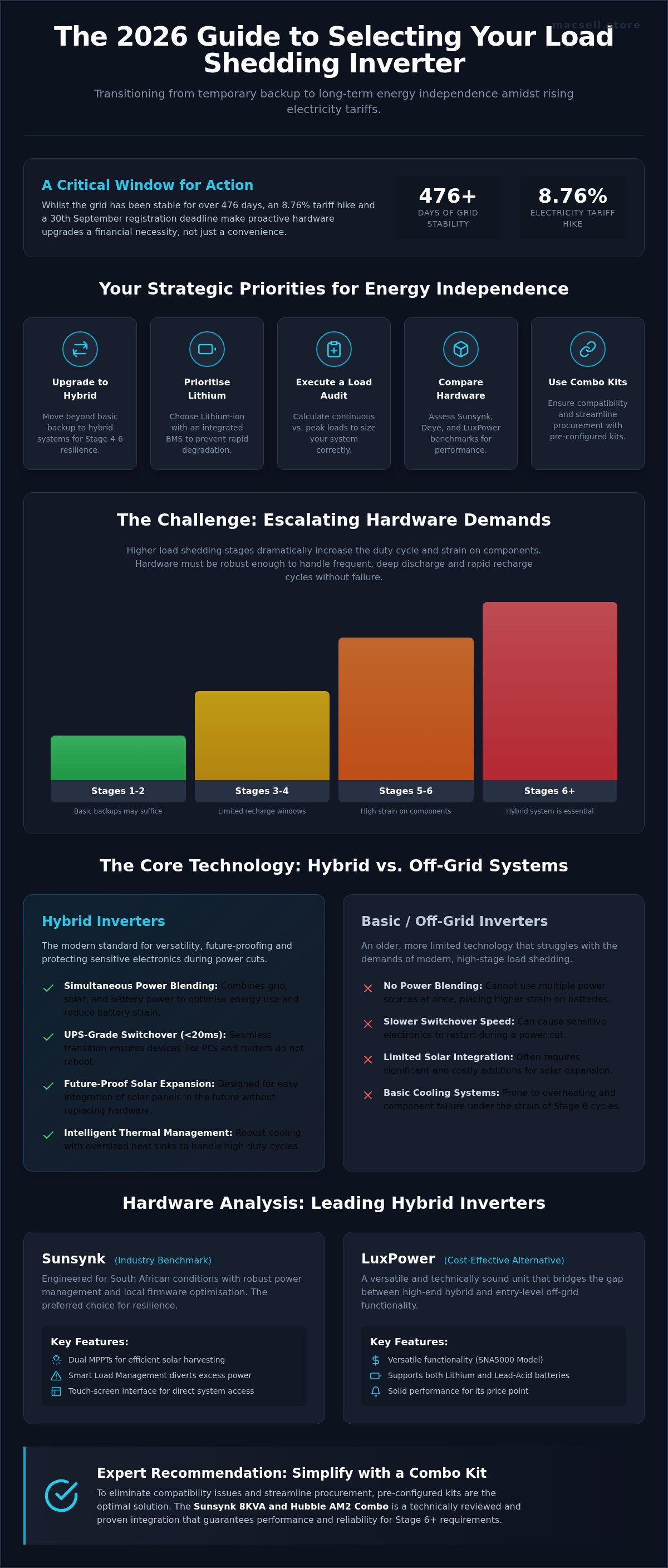
What if the 476-day absence of power cuts is actually the most critical window to finalise your energy strategy? While the grid has remained stable through the 2026 winter, the 8.76% electricity tariff hike and the 30 September registration deadline have shifted the priority from basic survival to long-term financial autonomy. Selecting a high-performance inverter for load shedding South Africa is no longer just about keeping the lights on; it's about mitigating rising costs and avoiding the rapid battery degradation common in low-tier hardware. You likely recognise that current stability is the ideal time to upgrade before the next cycle of infrastructure pressure.
This guide provides the technical clarity you need to master 2026 hardware requirements and identify the precise hybrid inverter configurations for true energy independence. We'll deliver a direct comparison of Sunsynk and LuxPower performance benchmarks to ensure your system handles Stage 6+ requirements without failure. You'll learn the specific advantages of the Sunsynk 8KVA and Hubble AM2 combo, understand the limitations of off-grid hardware, and gain the technical insight required for successful procurement of high-end solar components.
Key Takeaways
- Transition from basic backup units to hybrid hardware to ensure system stability during Stage 4 to Stage 6 load shedding cycles.
- Identify the optimal inverter for load shedding South Africa by comparing the technical architecture and performance benchmarks of Sunsynk, Deye, and LuxPower hardware.
- Prioritise lithium-ion battery technology and integrated Battery Management Systems (BMS) to protect components from rapid degradation during deep discharge.
- Execute a precise load audit to distinguish between essential and non-essential circuits while calculating continuous load versus peak surge requirements.
- Streamline procurement by utilising pre-configured combo kits, such as the Sunsynk 8KVA and Hubble AM2 integration, to guarantee hardware compatibility.
Understanding Load Shedding Stages and Inverter Requirements
An inverter serves as the technical bridge between stored energy and usable household power. Its primary function is converting Direct Current (DC) from lithium batteries into the Alternating Current (AC) required by domestic appliances. Throughout the South African energy crisis, hardware requirements have evolved from simple standby units to sophisticated energy centres. For users seeking an inverter for load shedding South Africa, the distinction between modified and pure sine wave output is critical. Modified sine wave units produce "stepped" electricity that can damage sensitive electronics or cause motors to run inefficiently. Pure sine wave hardware is mandatory for protecting compressors, LED screens, and modern computer power supplies.
Energy demands in 2026 prioritise hardware that is lithium-ready. Whilst older lead-acid systems were common, they cannot survive the depth of discharge required by modern load shedding schedules. Stage 4 to Stage 6 schedules provide very limited windows for battery replenishment. This frequency demands an inverter capable of high-rate charging and high cycle life compatibility. Hybrid hardware is now the industry standard because it manages these transitions with greater precision than entry-level backup kits.
Duty Cycles and Hardware Strain
Hardware longevity is directly linked to thermal management during frequent power transitions. Duty cycle is the ratio of time an inverter operates under active load versus its idle or cooling period within a specific timeframe. High-stage load shedding increases the duty cycle significantly, placing immense strain on internal capacitors and cooling fans. Standby backup units often lack the robust cooling systems found in active hybrid inverters. Premium hybrid hardware utilises intelligent fan profiles and oversized heat sinks to maintain component integrity during the rapid cycling typical of Stage 6 environments.
Hybrid vs Off-Grid Hardware
Hybrid inverters provide the most versatile path for users planning future solar expansion. Unlike basic off-grid units, hybrid systems can blend utility, solar, and battery power simultaneously to meet household demand. This blending capability reduces the immediate strain on the battery bank, extending its overall lifespan. Another technical advantage is the switchover speed. High-end hybrid units offer UPS-grade performance, often switching in under 20 milliseconds. This ensures that sensitive equipment, such as routers and desktop computers, remains operational without rebooting when the grid disconnects. Hybrid hardware represents a long-term investment in national energy independence rather than a temporary fix for power outages.
Hybrid Inverter Hardware: Sunsynk, Deye, and LuxPower Compared
Selecting an inverter for load shedding South Africa requires assessing internal component quality rather than just peak output ratings. Sunsynk remains the benchmark for national resilience due to its robust power management and local firmware optimisation. Deye offers a nearly identical hardware architecture with high parallel scalability. LuxPower provides a cost-effective yet technically sound alternative with the SNA5000 model. Hardware durability often comes down to enclosure material. Stainless steel enclosures, typical of higher-end hybrid units, offer superior heat dissipation and environmental protection compared to standard polycarbonate options found in entry-level backup systems.
Performance Parameters of Sunsynk Hardware
The Sunsynk 5kW and 8kVA hybrid models are engineered for the specific demands of the South African grid. These units feature dual Maximum Power Point Trackers (MPPTs). This allows for efficient solar harvesting across different roof orientations. The smart load management system is a standout feature. It permits users to divert excess solar power to non-essential loads, such as geysers, without draining the battery bank. The touch-screen interface provides immediate access to system parameters without requiring external modules. For a comprehensive hardware breakdown, view the Sunsynk 8KVA and Hubble AM2 Combo Kit technical review.
LuxPower and Deye Functionality
The LuxPower SNA5000 is a versatile unit that bridges the gap between off-grid and hybrid functionality. It supports both lithium and lead-acid batteries, though lithium is the 2026 standard for high-cycle environments. It's favoured for its straightforward installation and reliable performance in residential backup configurations. Deye inverters excel in scalability. Their parallel capabilities allow for multiple units to be linked, making them suitable for large residential or light commercial applications. Their architecture supports complex energy environments where multiple power sources must be managed simultaneously.
Monitoring capabilities differ across these brands. Sunsynk and Deye utilise similar Wi-Fi logger systems that provide granular data on energy flow and battery health. LuxPower offers a dedicated monitoring portal that is often cited for its clean, user-friendly interface. Professional installers usually select between these brands based on the specific requirements for remote management and future system expansion. When you're ready to secure high-performance hardware, you can browse our certified inverter range for immediate national delivery.
Pairing Lithium Batteries for Load Shedding Resilience
Modern energy independence relies on the shift from lead-acid to lithium-ion solar battery technology. Traditional backup batteries often fail within 18 months when subjected to the frequent cycling of Stage 4 to Stage 6 schedules. Lithium-ion cells provide a significantly higher energy density and deeper discharge capability. Most premium lithium units offer over 6000 cycles at 80% Depth of Discharge (DoD), which equates to roughly 10 years of daily use. When selecting an inverter for load shedding South Africa, hardware compatibility with the battery’s communication protocol is essential for system longevity.
The Battery Management System (BMS) acts as the internal controller for the battery bank. It monitors cell voltage, temperature, and current flow to prevent overcharging or deep discharge damage. For a system to operate efficiently, the inverter and BMS must communicate via CAN or RS485 ports. This active data exchange allows the inverter to adjust its charging profile in real-time based on the battery's health. Without this integration, the system relies on voltage-based charging, which is less accurate and can lead to premature hardware failure during intense power outages.
Hubble Lithium Battery Integration
Hubble AM2 and AM5 models are specifically engineered for high-performance South African hardware kits. These units utilise high-grade prismatic cells and offer seamless integration with Sunsynk and Deye inverters. A major technical advantage is the Hubble Cloudlink module. This peripheral allows for remote hardware diagnostics and firmware updates, ensuring the system remains optimised without requiring on-site technical intervention. You can find more detail on these specifications in our guide to Lithium Ion Solar Battery Technology.
Discharge Rates and Load Balancing
C-ratings define how quickly a battery can supply power to your inverter. A 1C rating means a 5.5kWh battery can deliver a continuous 5.5kW output. Many budget batteries only offer a 0.5C rating, meaning they can only supply half their capacity at any given time. If your household load exceeds this discharge rate, the BMS will trigger a safety shutdown even if the battery has remaining energy. Matching your battery capacity to your inverter for load shedding South Africa ensures that heavy appliances, such as kettles or microwaves, don't overwhelm the system whilst the grid is down. Proper load balancing requires maintaining a ratio where the battery bank can comfortably support the inverter's peak demand during active discharge cycles.
Sizing Your Backup Power Supply for Residential Loads
Accurately sizing an inverter for load shedding South Africa begins with a comprehensive load audit. You must separate essential circuits, such as lighting, security, and communications, from non-essential, high-draw loads like geysers and ovens. Calculating peak demand involves more than just summing wattage ratings. You've got to account for surge requirements. These are the momentary power spikes needed to start inductive loads like fridge compressors or borehole pumps. These spikes often reach three to five times the running wattage. Failing to account for this will trigger inverter overload protection, causing system restarts during power transitions.
The 5kW System: Ideal for Essential Backup
A 5kW hybrid system serves as the standard entry point for essential residential backup. This configuration typically supports LED lighting, Wi-Fi routers, televisions, and a single energy-efficient refrigerator. Hardware limitations become apparent when high-wattage resistive loads are introduced. A standard 2000W kettle or a geyser element consumes nearly half the inverter's capacity instantly, leaving little headroom for other appliances. For a detailed breakdown of these configurations, consult our Home Inverter and Battery Combo guide.
The 8KVA System: Full Household Resilience
The 8kVA system provides full household resilience for larger properties. This hardware manages intensive loads including air conditioning units, pool pumps, and multiple kitchen appliances simultaneously. The technical advantage of 8kVA Sunsynk hardware lies in its higher passthrough capability and superior thermal management. Balancing these loads effectively often requires a larger battery bank. Integrating two or more Hubble batteries ensures sufficient runtime during Stage 6 schedules whilst maintaining a healthy discharge rate. It's a more robust solution for users who don't want to compromise on lifestyle during grid outages.
Future-proofing your hardware is a strategic financial decision. Whilst a 5kW unit might meet your current essential needs, choosing an 8kVA inverter for load shedding South Africa now prevents the sunk cost of replacing hardware when you eventually add solar panels or electric vehicle chargers. It's more cost-effective to over-specify the inverter initially than to parallel smaller units later. You can order high-capacity hybrid hardware directly from our national inventory to secure your energy independence.
Procuring Premium Inverter and Battery Combo Kits
Hardware compatibility is the primary technical hurdle in establishing a resilient energy system. Pre-configured combo kits eliminate the risk of communication failures between the inverter firmware and the battery management system. The Sunsynk 8KVA and Hubble AM2 combo is the gold standard for residential applications in South Africa. This specific pairing ensures that the inverter's charging parameters are perfectly aligned with the lithium cell chemistry. Procuring an inverter for load shedding South Africa as part of a validated kit guarantees that the discharge rates and surge capacities are balanced for Stage 6+ reliability.
Transactional efficiency is a priority for technical buyers and independent contractors. Sourcing individual components from multiple vendors often leads to logistical delays and warranty complications. Authorised hardware distributors provide a single point of accountability for the entire power train. This streamlined procurement model is especially effective for those who have already secured an independent installer and require high-performance hardware for immediate deployment.
Solar Hardware Procurement Without Installation
MacSell Solar Outlet specialises in the national retail of high-end solar components without the overhead of installation or financing services. This focus allows for a more agile inventory, ensuring that the latest Sunsynk, Deye, and LuxPower models remain available for rapid dispatch. Technical buyers benefit from national delivery on all hybrid inverters and lithium batteries, allowing for hardware-only procurement across the country. For a complete list of hardware options, view our Backup Power Kit South Africa procurement guide.
Final Hardware Checklist for Load Shedding
Successful procurement requires a final verification of the system's peripheral components. A robust inverter for load shedding South Africa cannot function safely without the correct protection hardware. Your procurement list should include:
- Hybrid Inverter: Sunsynk, Deye, or LuxPower with pure sine wave output.
- Lithium Battery: Hubble AM2 or AM5 with integrated BMS communication.
- DC Disconnect: High-voltage circuit breakers for battery isolation.
- Surge Protection: AC and DC surge arrestors to protect against grid spikes.
- Communication Cables: Verified CAN/RS485 cables for inverter-battery data sync.
Verifying warranty terms is essential for hardware-only sales. Authorised retailers ensure that all manufacturer warranties remain intact, provided the installation is performed by a qualified professional. Securing your energy independence in 2026 requires moving beyond temporary backup solutions. By investing in a high-cycle hybrid system today, you protect your household against both future grid instability and rising electricity tariffs. You can browse our current inventory to secure premium hardware for your 2026 energy strategy.
Securing Your 2026 Energy Strategy
Transitioning from basic backup to a comprehensive hybrid energy centre is the most effective method for managing 2026 tariff increases and grid volatility. High-performance hardware, like the Sunsynk 8KVA and Hubble AM2 combo, ensures your system survives the heavy duty cycles of Stage 6 schedules. You'll avoid the premature failure associated with entry-level kits by prioritising pure sine wave output and integrated BMS communication. Selecting a technically sound inverter for load shedding South Africa requires matching surge capacity to your specific residential load profile.
MacSell Solar Outlet provides the precise components needed for national energy independence. As an authorised retailer of Sunsynk and LuxPower, we specialise in premium technical specifications and Hubble lithium battery integration. We provide efficient national hardware delivery for technical buyers who prioritise reliability. You can browse our range of high-end hybrid inverters and battery combos to secure your power requirements today. Building a reliable energy future starts with selecting the correct hardware.
Frequently Asked Questions
What is the best inverter for load shedding in South Africa?
The Sunsynk 8kVA hybrid model is widely considered the best inverter for load shedding South Africa due to its robust power management and local technical support. It handles high-stage load shedding cycles better than budget alternatives. Its ability to blend grid and solar power makes it a future-proof choice for residential energy independence. This hardware provides the thermal management required for the frequent switching intervals seen in 2026.
Can I use a hybrid inverter without solar panels for load shedding?
Yes, hybrid inverters function perfectly as high-performance backup systems without solar panels. They charge lithium batteries using utility power whilst the grid is active and switch to battery power during outages. This setup allows you to secure your energy supply immediately and add solar panels at a later date. It is a more efficient solution than standard off-grid units because it manages the transition with UPS-grade speed.
How long will a 5kWh lithium battery last during load shedding?
A 5kWh lithium battery typically supports a 500W load for approximately 10 hours or a 1000W load for roughly 5 hours. Actual runtime depends on your appliance inventory and the depth of discharge settings on your inverter. Using high-draw appliances like kettles or heaters will significantly reduce this duration. Efficient management of essential circuits is necessary to maximise runtime during extended outages or Stage 6 schedules.
Is Sunsynk better than Deye for residential backup power?
Sunsynk and Deye share similar hardware architectures; however, Sunsynk is often preferred for South African residential use due to its specialised firmware and user interface. Both brands offer high reliability and parallel scalability for expanding energy storage. The choice usually depends on current stock availability and the specific monitoring requirements of the user. Both systems provide the necessary protection for sensitive electronics during grid transitions.
What size inverter do I need to run a fridge and TV during load shedding?
A 5kW hybrid inverter is the recommended size for running a fridge, television, and essential lighting. Whilst these appliances have a low continuous draw, refrigerators require a high surge current to start the compressor. A 5kW unit provides sufficient headroom to handle these momentary spikes without triggering overload protection. It also allows for additional essential loads, such as Wi-Fi routers and laptop chargers, to remain active simultaneously.
Why are lithium batteries recommended over lead-acid for load shedding?
Lithium batteries are recommended because they offer over 6000 cycles compared to the 500 cycles typical of lead-acid units. They support a depth of discharge up to 100% without damage, whilst lead-acid batteries fail quickly if discharged beyond 50%. This longevity is crucial for a reliable inverter for load shedding South Africa. Lithium technology also maintains a consistent voltage throughout the discharge cycle, protecting your hardware from low-voltage strain.
Can I add more batteries to my hybrid inverter later?
Most modern hybrid inverters allow you to expand your battery bank by adding more units in parallel. For example, you can start with a single Hubble AM2 and add additional modules as your energy requirements grow. It is essential to ensure that the new batteries are the same model and have compatible firmware versions. Parallel expansion increases both your total storage capacity (kWh) and the available discharge current (Amps) for your household.
Does MacSell offer installation services for solar hardware?
MacSell Solar Outlet does not offer professional installation services, solar financing, or emergency technical support. We focus strictly on the national retail and delivery of premium solar hardware and pre-configured combo kits. Customers are responsible for sourcing a qualified electrician or solar installer to commission their hardware. This hardware-only model ensures we maintain high stock levels of Sunsynk, Deye, and LuxPower components for immediate procurement.