

Sunsynk vs Victron Energy: Off-Grid Reliability in South Africa (2026 Guide)
Is your solar inverter actually engineered to survive the relentless cycle of Stage 6 load shedding, or are you simply purchasing a high-priced countdown to hardware failure? For South African site managers and homeowners, the distinction between a standard backup system and true off-grid reliability is often measured in the ability to handle extreme thermal stress and frequent grid switching. You already know that choosing the wrong hardware results in catastrophic replacement costs and extended downtime during critical power outages.
This technical comparison of Sunsynk vs Victron Energy off-grid reliability South Africa provides a direct analysis of how these systems perform under local conditions. We focus on the engineering differences between Sunsynk’s integrated hybrid technology and the modular, transformer-based architecture of Victron Energy. You'll gain a clear verdict on hardware lifespans, surge load capabilities for heavy appliances, and the current status of local warranty support. We examine which system offers the most efficient path to energy independence while managing the specific electrical demands of the South African market. This guide ensures your procurement decisions are based on performance data rather than marketing hype.
Key Takeaways
- Identify how thermal management and surge capacity determine hardware survival during the intense cycling of Stage 6 load shedding.
- Compare Sunsynk’s integrated hybrid design against Victron’s modular architecture to determine the most efficient path for your off-grid scaling requirements.
- Evaluate Sunsynk vs Victron Energy off-grid reliability South Africa by reviewing technical benchmarks such as switchover speeds and mean time between failures.
- Understand the critical role of BMS communication and why the Sunsynk 8KVA and Hubble AM2 combo kit is a proven reliability benchmark.
- Assess local warranty turnaround times and spare part availability to secure the long-term maintenance of your energy independence hardware.
The Off-Grid Challenge: Defining Reliability for South African Solar
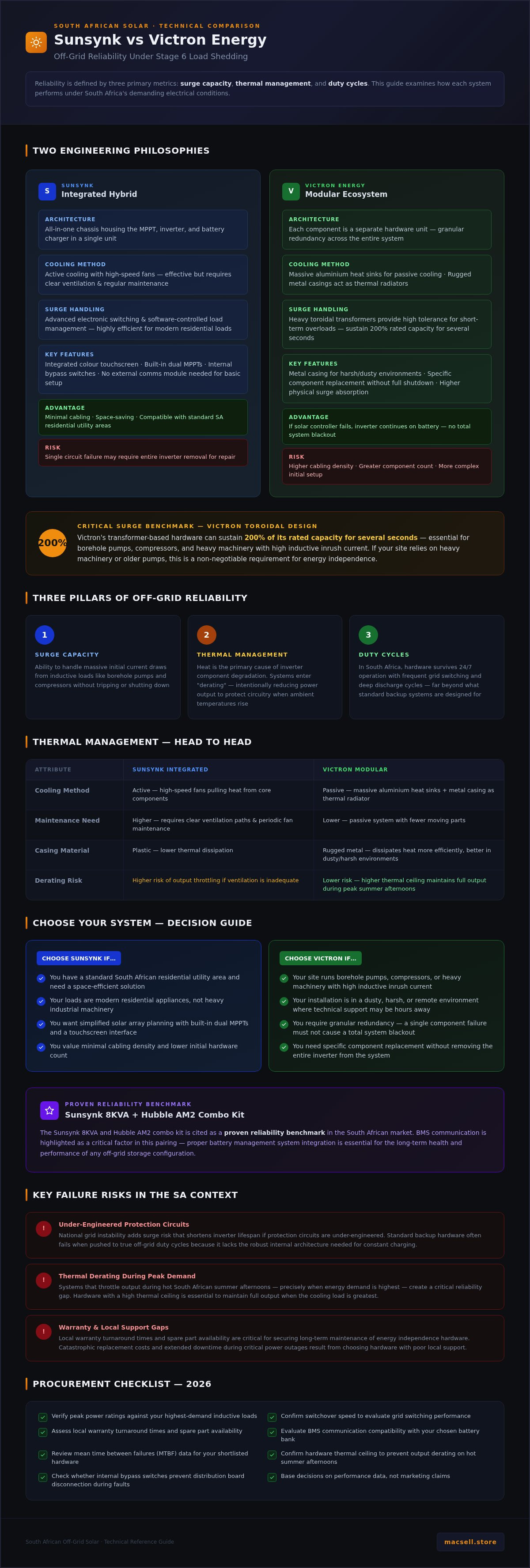
Reliability in off-grid energy systems is defined by three primary metrics: surge capacity, thermal management, and duty cycles. In South Africa, hardware isn't just providing occasional backup; it's surviving 24/7 operation under intense thermal stress. Evaluating Sunsynk vs Victron Energy off-grid reliability South Africa requires moving beyond basic data sheets to understand how components react to frequent grid switching and deep discharge cycles. Standard backup hardware often fails when pushed to true off-grid duty cycles because it lacks the robust internal architecture needed for constant charging. National grid instability adds a layer of surge risk that can shorten an inverter's lifespan if its protection circuits are under-engineered.
Surge Capacity and Load Management
High-demand appliances like borehole pumps and compressors create massive initial current draws. These inductive loads can easily trip an undersized or poorly engineered inverter. Peak power ratings are critical here. Sunsynk hybrid inverters manage these spikes through advanced electronic switching and software-controlled load management. This approach is highly efficient for modern residential loads. Victron Energy, conversely, relies on heavy toroidal transformers in many of their off-grid models. This physical hardware provides a high tolerance for short-term overloads, allowing the system to absorb surges without immediate shutdown. If your site relies on heavy machinery or older pumps, the hardware's ability to sustain 200% of its rated capacity for several seconds is a non-negotiable requirement for independence.
Thermal Endurance in Local Climates
Heat is the primary cause of inverter component degradation. When ambient temperatures rise, hardware enters "derating," a state where it intentionally reduces power output to protect internal circuitry. Sunsynk units typically utilise active cooling systems with high-speed fans to pull heat away from the core components. This method is effective but requires clear ventilation paths and regular maintenance. Victron hardware often features massive aluminium heat sinks for passive cooling, paired with rugged metal casings that act as thermal radiators. Metal dissipates heat more efficiently than plastic alternatives and offers better protection in dusty or harsh environments. Choosing hardware with a high thermal ceiling ensures your system maintains its full output even during peak summer afternoons. Reliable power requires hardware that won't throttle itself when the cooling load is highest.
Technical Architecture: Sunsynk Integrated vs Victron Modular
Choosing between Sunsynk and Victron involves selecting between two distinct engineering philosophies. Sunsynk utilises an all-in-one hybrid approach. It houses the MPPT, inverter, and battery charger within a single chassis. This design minimises cabling density and saves space, making it compatible with standard South African residential utility areas. Victron Energy operates on a modular ecosystem. Each component is a separate hardware unit. When assessing Sunsynk vs Victron Energy off-grid reliability South Africa, site managers must decide if they value the compact efficiency of an integrated unit or the granular redundancy of a modular setup.
Hardware complexity directly impacts long-term maintenance. An integrated system offers a lower initial hardware count, but a failure in one internal circuit can necessitate the removal of the entire inverter for repair. Modular systems allow for specific component replacement. If a solar controller fails in a Victron system, the inverter continues to operate on battery power. This reduces the risk of a total system blackout. It's a critical consideration for energy independence where technical support might be hours away.
Sunsynk Hybrid Inverter Hardware
Sunsynk inverters feature integrated colour touchscreens for local configuration and real-time monitoring. This removes the need for external communication modules for basic setup. The hardware includes built-in dual MPPTs, which simplify solar array planning for roofs with multiple aspects. Reliability is further bolstered by internal bypass switches. These allow the grid or a generator to power the load directly during electronic faults without disconnecting the entire distribution board. For those looking for a proven benchmark, the Sunsynk 8KVA and Hubble AM2 combo offers a highly integrated and reliable solution.
Victron Energy Modular Components
The Victron range is built around the MultiPlus-II and Quattro inverter/charger units. These devices are engineered for high-duty cycles and heavy transformer-based durability. By using separate SmartSolar MPPT controllers, the system remains operational even if one controller encounters a fault. The Cerbo GX communication centre serves as the system's brain, coordinating data between all modular parts and providing extensive logging. This modularity offers a level of customisation that integrated units cannot match, particularly for complex off-grid requirements.
Space requirements differ significantly between the two brands. A Sunsynk 8KVA installation is compact and neat. A comparable Victron system requires a larger wall area to accommodate the inverter, multiple MPPTs, and the necessary DC busbars. Cabling density is naturally higher in modular systems, requiring more complex cable management to meet national safety standards. Both systems provide high-end performance, but the physical footprint of the hardware is a deciding factor for many South African homeowners.
Off-Grid Reliability Benchmarks: Head-to-Head Comparison
Objective performance data is essential when evaluating Sunsynk vs Victron Energy off-grid reliability South Africa. Mean Time Between Failures (MTBF) has become a primary metric for 2026 hardware assessments. Modern Sunsynk iterations have significantly narrowed the gap with traditional transformer-based systems by refining their high-frequency switching circuits. Switchover speeds for both brands remain within the UPS-grade threshold; typically clocking in at under 20 milliseconds. This ensures that sensitive electronics, such as servers and medical equipment, remain operational during a total grid collapse. Efficiency ratings also differ based on the conversion path. Sunsynk high-frequency inverters often show superior DC-to-AC efficiency in standard residential applications, whilst Victron hardware excels in maintaining stability during low-power idle states common in remote off-grid sites.
Durability and Build Quality
Physical weight serves as a reliable indicator of internal architecture. Victron MultiPlus-II units are significantly heavier than Sunsynk equivalents due to their large copper toroidal transformers. These transformers provide superior physical resilience against electrical noise and high-heat environments. Ingress Protection (IP) ratings are equally important for South African installations. Many Sunsynk models carry an IP65 rating, which allows for installation in semi-exposed areas where dust and moisture are present. Conversely, most Victron inverter/charger units are IP21-rated; they require a clean, indoor environment to prevent component degradation. High-quality capacitors and robust thermal pads are standard in both brands, but the choice of cooling, active fans in Sunsynk versus massive passive heat sinks in Victron, affects long-term maintenance cycles.
Software and Monitoring Ecosystems
The monitoring layer is where diagnostic reliability is won or lost. Victron Remote Management (VRM) provides forensic-level data, allowing technicians to view granular performance metrics for every individual component in the modular chain. It is the preferred tool for complex troubleshooting. The Sunsynk Logger offers a more accessible interface for the average user, focusing on daily yield and consumption statistics. Both platforms support remote firmware updates; this is vital for adapting to changing grid parameters without a site visit. Software stability is high across both ecosystems, though Victron’s open-source approach allows for deeper integration with third-party home automation systems. For most residential users, the Sunsynk app provides sufficient control, whilst industrial users typically favour the data density of VRM.
Firmware frequency is another factor. Sunsynk pushes updates to improve compatibility with emerging battery technologies. Victron updates focus on expanding the feature set of their GX communication centres. Both brands ensure that remote assistance is possible, reducing the need for physical hardware swaps in the event of a software-related glitch. Reliable monitoring isn't just a luxury; it's the primary defence against system failure in an off-grid environment.
Battery Compatibility: Securing the Storage Layer
The synergy between an inverter and its storage bank defines the actual uptime of any off-grid system. Reliability is not just about power conversion; it is about the accuracy of the Battery Management System (BMS) communication. Without a stable data link, the inverter cannot accurately manage discharge depths or charge curves. This failure results in premature degradation or sudden system trips during high-demand periods. Correctly managing these parameters is the only way to preserve the long-term lithium ion solar battery lifespan required for energy independence.
Hubble AM2 and Sunsynk Integration
The Sunsynk 8KVA and Hubble AM2 combo has established itself as a national benchmark for hardware compatibility. This pairing utilises high-speed CAN-bus communication to ensure the inverter receives real-time cell voltage and temperature data. Such integration allows the system to handle charging rates between 0.5C and 1C with precision. In high-demand South African households, this ensures that heavy inductive loads do not cause the battery to disconnect due to voltage sag. The plug-and-play nature of this combination reduces configuration errors that often plague mixed-brand installations.
Victron and Third-Party Battery Support
Victron Energy maintains a rigorous "allow-list" for third-party lithium brands. This modular approach requires specific configuration via the Venus OS, typically hosted on a Cerbo GX device. Whilst this offers immense flexibility, it introduces more potential failure points in the communication chain. Reliability depends heavily on the quality of the RJ45 communication cables and the correct termination of the CAN-bus network. When comparing Sunsynk vs Victron Energy off-grid reliability South Africa, Victron offers superior granular control over battery health parameters, provided the hardware is procured and configured to the manufacturer's exact specifications.
Effective storage management requires hardware that can sustain high discharge cycles without losing communication sync. Sunsynk’s integrated approach simplifies this for the end-user. Victron’s modular system provides a deeper level of diagnostic data, which is essential for large-scale off-grid sites. Both brands require high-quality lithium components to reach their rated lifespans. You can procure premium lithium batteries and hybrid inverters directly from our national distribution centre to ensure hardware compatibility.
Procuring Hardware: Warranty and Local Support in 2026
Reliability in off-grid systems is measured by both continuous uptime and the speed of recovery following a hardware fault. For South African users, the choice between Sunsynk and Victron often rests on the efficiency of local repair centres and the immediate availability of spare parts. Evaluating Sunsynk vs Victron Energy off-grid reliability South Africa requires a clear understanding of the manufacturer support ecosystem. Sunsynk maintains a robust local presence with dedicated service centres capable of rapid board-level repairs. Victron Energy relies on a network of authorised repair partners, offering a modular support structure where individual components like MPPTs or communication centres can be serviced or replaced without decommissioning the entire system.
Warranty Terms and Conditions
Standard warranties for high-end inverters in 2026 typically range from five to ten years, depending on the specific model and battery integration. Validating these guarantees requires strict adherence to registration requirements immediately following hardware procurement. Manufacturers often exclude damage resulting from poor ventilation, insect infestation, or surge events that exceed the internal protection limits. Out-of-warranty support is a significant differentiator; Victron’s modularity often makes sourcing specific internal parts easier for older units, whilst Sunsynk’s integrated design typically requires complete module swaps. Always confirm the specific warranty duration for your batch before finalising procurement.
Procurement Strategy for Energy Independence
Hardware-only procurement through a specialised hybrid inverter retailer ensures you receive current stock with the latest firmware revisions. This approach is ideal for managed installations where technical specifications are pre-defined by a site engineer. Purchasing pre-configured backup power kits reduces the risk of component mismatch, ensuring that the inverter and battery BMS communicate effectively from day one. National distribution ensures that critical components are available for rapid dispatch, minimising downtime during extended load shedding periods.
Before purchasing off-grid hardware, complete this final checklist:
- Verify the current firmware version supports your chosen lithium battery brand.
- Confirm the availability of local repair centres for the specific model.
- Ensure the IP rating matches your intended installation environment.
- Check for the inclusion of necessary communication cables and busbars.
Focusing on hardware-only procurement allows for a transparent investment in high-end components without the complexity of bundled service contracts or financing hidden costs. This methodical approach ensures your energy independence is built on a foundation of technical accuracy and long-term support availability.
Securing Your Energy Independence with Proven Hardware
Selecting the correct architecture is the final step in securing a resilient power system. Whether you prioritise the compact, integrated design of Sunsynk or the granular redundancy of Victron’s modular ecosystem; your decision should be based on long-term thermal endurance and surge capacity. The Sunsynk vs Victron Energy off-grid reliability South Africa comparison demonstrates that both brands provide the technical foundation needed to survive Stage 6 load shedding when paired with high-quality lithium storage and precise BMS communication.
To start your procurement process, Browse our range of Sunsynk and Victron-compatible hardware at MacSell Solar Outlet. As official stockists of Sunsynk and Deye hardware, we provide high-performance Hubble AM2 battery combos and ensure nationwide delivery on all solar components. You can build a system that remains operational for decades with the right hardware choices. Your path to sustainable energy independence is well within reach.
Frequently Asked Questions
Which is more reliable for pure off-grid use, Sunsynk or Victron?
Victron is traditionally more reliable for pure off-grid use due to its heavy-duty transformer-based design. Sunsynk is a high-performance hybrid that excels in residential and light commercial settings across the country. The choice depends on your specific duty cycle and load profile. Victron's modularity offers granular redundancy, while Sunsynk provides an efficient, integrated solution for modern off-grid energy systems that require a smaller physical footprint and simpler configuration.
Does Victron Energy have a local repair centre in South Africa?
Victron Energy operates through a nationwide network of authorised service and repair partners rather than a single factory-owned facility. These centres handle component-level repairs for MultiPlus and Quattro units to ensure long-term hardware survival. This decentralised model ensures that spare parts are accessible through professional channels for out-of-warranty support. Users should verify the status of their nearest authorised partner to ensure manufacturer-standard maintenance and warranty protection for their modular hardware components.
Can I use Hubble batteries with a Victron inverter system?
Hubble lithium batteries are compatible with Victron systems via the Venus OS and Cerbo GX communication modules. Successful integration requires specific CAN-bus cables and configuration of the GX device to recognise the Hubble BMS. This setup allows for accurate state-of-charge reporting and managed charging. It is a popular configuration for those seeking the modularity of Victron hardware paired with the high-density storage of the Hubble AM2 series.
What is the expected lifespan of a Sunsynk 8KVA hybrid inverter?
A Sunsynk 8KVA hybrid inverter is engineered for a service life of approximately 10 to 15 years, provided it is installed in a well-ventilated, dust-controlled environment. The actual lifespan depends on thermal management and the frequency of high-surge events. Regular maintenance of the active cooling fans and keeping the unit within its rated duty cycle are essential. Sunsynk's 2026 hardware iterations feature improved capacitor sets to ensure long-term stability.
Why is Victron hardware significantly more expensive than Sunsynk?
Victron hardware commands a higher price because of its modular architecture and heavy transformer-based construction. Each component, including the inverter, charger, and MPPT, is built as a standalone industrial-grade unit. This design uses more copper and aluminium than high-frequency hybrid alternatives. Additionally, the extensive software ecosystem and forensic-level monitoring provided by the VRM portal contribute to the overall procurement cost for professional-grade energy independence hardware.
Is Sunsynk or Victron better at handling Stage 6 load shedding?
Both brands effectively manage Stage 6 load shedding, but they approach the challenge differently. Sunsynk offers a faster, integrated response that is ideal for residential sites with high-frequency cycling. When discussing Sunsynk vs Victron Energy off-grid reliability South Africa, Victron’s transformer design handles the physical stress of frequent grid reconnection more robustly. Sunsynk’s high-speed switching is more efficient for modern electronics, while Victron excels in high-heat, heavy-load environments common in remote areas.
Do I need a separate MPPT if I choose Victron hardware?
Victron’s modular philosophy requires a separate SmartSolar MPPT controller for solar integration. Unlike the Sunsynk 8KVA which has built-in MPPTs, Victron separates the solar charging function from the inverter unit. This increases the total hardware count but provides a significant reliability advantage. If one component fails, the rest of the system remains operational, ensuring your battery bank continues to charge even if the inverter unit requires servicing or replacement.
What happens to my warranty if I install the hardware myself?
Manufacturer warranties typically require a certificate of compliance from a registered electrician to remain valid. Installing the hardware yourself without professional sign-off often voids the guarantee on high-end components. Manufacturers like Sunsynk and Victron specify that faults resulting from incorrect DC protection or poor cabling are not covered under their terms. Always ensure a qualified professional commissions the system to protect your investment in premium energy hardware and maintain your warranty status.