

Deye 8kW vs 12kW Hybrid Inverter for Large Homes: How to Choose
The higher-rated inverter isn’t automatically the safer choice. In the Deye 8kW vs 12kW hybrid inverter for large homes comparison, floor area isn’t the deciding factor. What matters is whether the inverter can support the appliances you expect to run at the same time, and whether its phase and hardware limits suit your property.
It’s reasonable to focus on the headline kW rating when you’re concerned about keeping essential loads running during an outage. But inverter output is only one part of the system. A 12kW rating won’t, by itself, confirm that the model matches your household wiring, battery bank or solar array. An 8kW option may also be suitable if your simultaneous demand is lower and loads are managed carefully.
This comparison explains how to estimate household demand and compare relevant model specifications, including phase, surge capacity, MPPTs, PV input and battery compatibility. You’ll also see which appliances and usage patterns can tip the decision towards more capacity, and what hardware details to gather before selecting a system.
Key Takeaways
- Use an appliance list and realistic run-together scenarios to estimate the demand your inverter needs to cover.
- Separate inverter power from battery storage and daily energy use when comparing system requirements.
- The Deye 8kW vs 12kW hybrid inverter for large homes decision depends on peak demand and the exact model’s verified limits.
- Compare model identifiers and datasheet details, including phase, continuous output and surge capacity, before choosing.
- Assess inverter, battery and solar panel compatibility as parts of one system, not as separate headline ratings.
Why inverter capacity matters in a large South African home
Inverter capacity sets a limit on how much electrical power the unit can supply at a given moment. An inverter’s kW rating represents its power-output limit, not the amount of energy stored for later use. During load shedding, the inverter must handle the combined demand of appliances running together. The battery’s usable energy affects how long those supported loads can run.
Battery capacity is generally stated in kilowatt-hours (kWh), while inverter output is stated in kilowatts (kW). A larger battery does not, by itself, raise the inverter’s output limit, and a higher-rated inverter does not, by itself, provide more stored energy. Solar panels, batteries and inverters each have separate ratings and compatibility requirements. For a general overview of solar inverter technology, see how an inverter converts and manages power within a photovoltaic system.
Floor area is a poor sizing shortcut. Two homes with similar layouts can have different electrical demands because of occupancy, appliance choices and daily routines. A large home with efficient appliances and staggered use may have a lower simultaneous peak than a smaller, all-electric home running several high-demand appliances at once. Start with measured or estimated load, not the number of rooms.
Why a large home does not automatically need a 12kW inverter
Count the appliances likely to operate together rather than judging demand by household size. A household running air conditioning in several rooms while cooking and heating water will have a different peak from one that uses those appliances at separate times. Higher capacity can provide more output headroom, but it isn’t automatically more efficient or necessary. Base the Deye 8kW vs 12kW hybrid inverter for large homes choice on actual loads and the exact model limits.
Which household loads matter during load shedding?
Separate routine use from backup priorities. Backing up the whole home is different from keeping selected circuits available, and neither inverter rating guarantees that every appliance can run together. Use appliance labels or technical data to estimate demand, including equipment that draws extra power at start-up. Then organise loads by priority:
- Essential: lighting, refrigeration, communications equipment and selected plug points.
- Discretionary: entertainment equipment, additional lighting or appliances that can be switched off during an outage.
- High-demand: electric geysers, stoves, pool pumps and air conditioning. Their operating and start-up demand can materially affect which loads can run simultaneously.
Decide which category each appliance belongs to during normal operation and which belongs in the backup plan. You may choose to exclude or manage high-demand loads during an outage, even if they’re used routinely when grid power is available. This list gives you a practical basis for comparing expected peak demand with an inverter’s verified continuous and surge output.
What 8kW and 12kW mean in a Deye hybrid inverter system
An inverter’s rating describes its power output. It doesn’t tell you how much energy the system can store or how much your household uses in a day. Those are separate figures, and each affects system design. For the Deye 8kW vs 12kW hybrid inverter for large homes decision, compare the exact model’s continuous output, surge capability and phase configuration alongside its battery and PV limits.
Model numbers alone aren’t enough. South African variants can differ, so use the exact manufacturer datasheet for the unit being considered. Treat the headline rating as a starting point, not a complete specification or a guarantee that every appliance can run at once.
Inverter power, battery storage and energy use are different measures
Inverter output is measured in kW; battery energy capacity and household energy use are measured in kWh. A kilowatt describes the rate of power supplied at a particular moment. A kilowatt-hour describes energy stored or consumed over time. A higher-output inverter can support greater power demand within its limits, but it doesn’t increase stored battery energy or extend backup duration by itself. Runtime also depends on usable battery capacity, loads and system operation.
Check the whole system, not only the inverter rating
A suitable design matches the inverter to the battery bank and solar array. The datasheet identifies the battery voltage range and supported communication arrangements. The battery manufacturer’s compatibility information helps establish whether monitoring and control can work as intended. Don’t assume that batteries with the same nominal voltage are automatically interchangeable.
On the PV side, compare maximum input limits, the number of MPPTs and the permitted operating range. MPPT configuration affects how panel strings can be arranged, while voltage and current limits constrain the design. Panel count alone doesn’t establish compatibility: string voltage and current must also stay within the inverter’s documented limits.
Phase is another key detail. The Deye 8kW and 12kW classes are commonly compared as single-phase and three-phase options respectively, but the exact South African model variant and its datasheet should determine the final comparison. A three-phase unit must suit the property’s supply and the distribution of loads across phases.
- Continuous output: the power available during sustained operation, subject to the model’s conditions and limits.
- Surge capability: short-duration output for starting loads, including the permitted magnitude and duration.
- Battery specifications: voltage range, charge and discharge limits, and supported communication protocols.
- PV specifications: input voltage and current limits, MPPT count and string-design requirements.
Compare these fields for the exact models, not just the 8kW and 12kW labels. This makes it easier to identify a mismatch before choosing compatible battery and solar panel hardware. Explore the Deye hybrid inverter range as part of a complete system comparison.
Deye 8kW vs 12kW: compare specifications and household use
A useful comparison starts with the exact South African model code, not only the capacity shown in a product description. Deye has different model variants, and specifications can’t safely be inferred from an 8kW or 12kW label alone. The table below contrasts the broad capacity and phase information available with details to compare against the datasheet for the precise unit.
| Comparison field | Deye 8kW class | Deye 12kW class |
|---|---|---|
| Exact model identifier | Use the code on the South African unit’s nameplate and matching datasheet; don’t infer it from “8kW”. | Use the code on the South African unit’s nameplate and matching datasheet; don’t infer it from “12kW”. |
| Rated output class | 8kW; verify the model’s continuous output rating and operating conditions. | 12kW; verify the model’s continuous output rating and operating conditions. |
| Phase | Single-phase in the comparison described for these classes; confirm the exact variant. | Three-phase in the comparison described for these classes; confirm the exact variant. |
| Surge, PV, MPPT and battery details | Check the exact model datasheet. | Check the exact model datasheet. |
Which Deye specifications should the comparison table include?
Use the matching manufacturer datasheet to record continuous output, surge power and the duration of any surge rating. Note PV voltage and current limits, MPPT count, supported battery voltage and communication requirements. If a figure varies by model or operating condition, record that condition rather than treating one number as universal. This prevents a headline capacity from standing in for the limits that determine system compatibility.
How do the two capacities map to different load profiles?
The capacity difference matters most when several loads operate simultaneously. Compare the combined demand of the planned backup circuits with each model’s documented continuous output, then account for start-up surges separately. Appliance count alone can mislead: a few high-demand loads may draw more than a longer list of modest loads. Use appliance nameplates or manufacturer specifications for wattage rather than assumed averages.
For the Deye 8kW vs 12kW hybrid inverter for large homes decision, an 8kW class may fit a planned load profile that stays within its verified limits. A 12kW class may offer more output headroom, but its three-phase configuration also makes phase compatibility central to the choice. Neither class can be assumed to run every household appliance during an outage.
Before selecting, match the model code across the product label and datasheet, then compare the fields side by side. Mark any unavailable or variant-dependent figure for verification rather than substituting an estimate. This keeps the comparison focused on the actual inverter and household demand, not capacity labels alone.
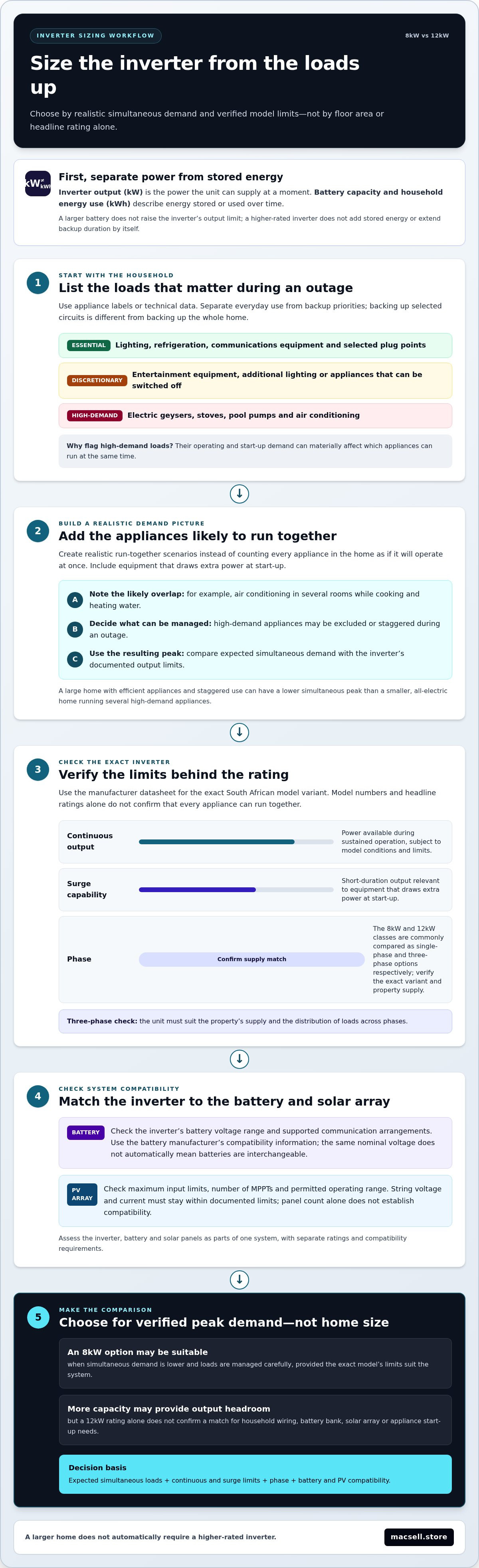
How to choose the right Deye inverter size for your household
Use a load-based method rather than choosing by property size. Define which appliances the system must support, estimate the demand they create together, then compare it with the exact inverter and system specifications.
- List the loads. Record the appliances you want powered, using each appliance’s nameplate or manufacturer data for its input rating. Include essential backup circuits and high-demand items such as a geyser, stove, pool pump or air conditioner if you expect to use them.
- Set priorities. Mark which loads are essential during an outage and which can be switched off or delayed. Decide whether your backup plan covers selected circuits or aims to support broader household use. This keeps the comparison grounded in what you actually need.
- Map simultaneous use. Note which appliances typically run together, both during normal use and load shedding. Add the running demand for each realistic combination. Don’t total every appliance in the house if they won’t operate at the same time, or assume they’ll always be used separately.
- Compare output limits. Match the estimated peak with the exact Deye model’s verified continuous output. Check surge capacity separately for appliances with high start-up demand, including the surge rating’s duration and conditions. A model’s headline kW rating alone doesn’t show whether it can handle every combination.
- Check the complete system. Compare the inverter’s limits with battery discharge capability and PV input requirements. Confirm that the battery’s voltage and communications suit the inverter, and that the panel-string design remains within documented PV limits.
Build a realistic household load profile
Keep separate estimates for sustained running demand and short start-up surges. For example, a motor-driven appliance may draw more power briefly as it starts than it does once running. Use its documented figures rather than guessing. A simple table with columns for appliance, rating, priority, start-up behaviour and likely run time makes assumptions visible and helps identify which loads may need managing during an outage.
Check compatibility and leave room for future requirements
Account for planned changes, such as adding an appliance or changing how the home is occupied, but don’t assume the system can expand without limits. Battery capacity, inverter limits, PV inputs and phase configuration all affect what can be added. The home inverter and battery combo guide provides further context on pairing components.
Inverter sizing is one part of wider hardware selection. For the Deye 8kW vs 12kW hybrid inverter for large homes choice, select the capacity that meets the measured peak and fits verified system limits, with practical headroom for expected loads. Compare Deye hybrid inverter options alongside compatible battery and solar panel hardware.
Choose Deye inverter hardware with a complete system in view
The right choice depends on household peak demand, the backup loads you want to support and the exact inverter’s documented limits. A 12kW model may suit a system that needs more output headroom or a compatible three-phase configuration. An 8kW model may be sufficient if the intended loads remain within its verified continuous and surge ratings. Neither capacity is a universal fit for every large home.
Keep the comparison focused on the complete system. Battery discharge capability affects the power available from storage, while battery capacity affects how much energy can be supplied over time. PV input limits and panel-string design set separate boundaries. A higher inverter rating cannot compensate for an unsuitable battery or incompatible solar array.
Prepare a hardware checklist before selecting a model
Gather the information in one place before comparing product specifications. This makes gaps and mismatches easier to spot, particularly where a model variant affects phase, output or system compatibility.
- Household demand: Record the appliances expected to run together, their nameplate ratings and any start-up surge figures.
- Backup plan: Identify essential circuits and note which discretionary or high-demand loads can be switched off during an outage.
- Battery details: List the battery model, voltage, discharge limits and documented inverter communication compatibility.
- PV details: Note the panel specifications and proposed string arrangement, then compare them with the inverter’s input and MPPT limits.
- Inverter variant: Match the exact model identifier and South African variant to its manufacturer datasheet. Compare phase, continuous output and surge limits against the intended configuration.
For product-focused research, a Deye inverter specification guide can help you review model information. Battery selection deserves the same attention: the lithium-ion solar battery guide explains battery considerations relevant to system planning.
Compare Deye hardware through MacSell Solar Outlet
MacSell Solar Outlet retails Deye products and related solar hardware, including hybrid inverters, lithium batteries and solar panels. Compare these components together when matching a system to household demand. The Deye 8kW vs 12kW hybrid inverter for large homes decision should follow the load assessment and datasheet comparison, not floor area or a headline rating alone.
Once you have your load list, battery details and PV requirements, browse Deye inverter and solar hardware at MacSell Solar Outlet to compare components for your system.
Take your system shortlist to the next step
Before settling on a model, turn your household load assessment into a practical shortlist. Note the exact inverter variant, required phase, expected peak demand and the battery and PV components it needs to work with. This gives you a clear basis for comparing hardware and keeps the decision tied to your system plan rather than a capacity label alone.
The Deye 8kW vs 12kW hybrid inverter for large homes decision depends on your intended loads and the limits in the relevant datasheets. If your plans change, revisit the shortlist before adding equipment so the inverter and supporting components remain suited to the system.
MacSell Solar Outlet retails Deye products and hybrid inverter hardware nationally, alongside lithium batteries and solar panels for wider system planning. Browse Deye solar hardware at MacSell Solar Outlet and compare components against your household requirements.
Frequently Asked Questions
Is a Deye 12kW inverter always better for a large home?
No. A 12kW unit is appropriate only if the household’s measured simultaneous demand, backup priorities and the exact model’s documented limits justify it. A large property with selected circuits backed up and high-demand appliances switched off may not need the higher rating. Conversely, several loads running together can make extra output useful. For the Deye 8kW vs 12kW hybrid inverter for large homes decision, compare real peak demand, not room count.
Can a Deye 8kW inverter run several high-demand appliances at once?
It may, but the answer depends on the appliances’ combined running demand, their start-up surges, the inverter’s phase and the exact model’s documented output. For example, a pump or air conditioner can draw extra power briefly as its motor starts. Compare that surge with the model’s permitted surge rating, including its duration. Also consider which phase each load uses, especially in a three-phase system.
How much battery capacity should I pair with a Deye 8kW or 12kW inverter?
Size the battery for the loads you plan to back up and the duration you need, rather than matching its capacity to the inverter’s kW rating. Inverter output describes power; battery capacity describes stored energy. Estimate the energy those circuits use over the intended backup period, then account for usable battery capacity and the battery’s documented charge and discharge limits. The inverter and battery must also be compatible.
Do Deye 8kW and 12kW hybrid inverters support the same batteries?
Not necessarily. Battery compatibility can differ between inverter models and variants, including supported voltage ranges and communication requirements. Check the exact inverter datasheet and the battery manufacturer’s compatibility documentation for the battery model you’re considering. A battery with a suitable nominal voltage may still not meet the inverter’s communication or operating requirements. Treat compatibility as a model-specific match rather than assuming one battery suits every Deye hybrid inverter.
Can I expand a Deye inverter system later?
Possibly, but expansion depends on the exact model’s documented support for parallel operation, the system design and the limits of its connected components. Adding another inverter, battery or solar panels involves different compatibility and capacity checks. Before selecting hardware, consider likely future loads and compare them with the inverter, battery and PV limits. Don’t assume that every Deye variant supports the same expansion method or configuration.
Does a higher-rated inverter make a home use more electricity?
No. A higher-rated inverter provides a higher potential power-output limit; it doesn’t make appliances consume energy by itself. Actual electricity use depends on the connected loads, how much power they draw and how long they operate. Having more inverter capacity available won’t increase consumption if household routines and appliance use stay unchanged. Keep the inverter’s power rating separate from energy consumed over time.