

LuxPower ECO Hybrid SNA vs LXP: 2026 Comparison Guide
The SNA may look like the straightforward choice, but a series label alone won’t tell you whether it suits your system. In this LuxPower ECO Hybrid SNA vs LXP series comparison, the deciding details are the exact model, its verified specifications and how you plan to use it.
Model names and suffixes can make like-for-like comparisons difficult, and specifications don’t automatically carry across a whole series. The right match depends on your solar array, battery, expected loads and whether grid interaction or backup is part of the plan.
This guide compares SNA and LXP variants using model-specific manufacturer information and practical system requirements. It uses the LuxPower SNA5000, sold by MacSell Solar Outlet, as one SNA-series example, without assuming its specifications apply to other models. You’ll see which ratings and compatibility details to compare, where each series may fit, and what to verify before buying. For grid-connected plans in South Africa, model-specific approval is also an important consideration.
Key Takeaways
- Use the LuxPower ECO Hybrid SNA vs LXP series comparison to focus on exact model variants, not assumptions based on series names.
- Compare datasheet ratings such as output, battery voltage and PV input before matching an inverter to your system.
- Assess your loads, desired backup duration and available solar input to narrow down suitable models.
- Record your existing panels, battery and operating priorities, then check compatibility against the precise model code and its documentation.
- Use the LuxPower SNA5000 as one SNA-series example, not as a specification reference for every SNA or LXP model.
LuxPower ECO Hybrid SNA vs LXP: what is being compared?
Compare exact LuxPower model variants, not series names alone. “ECO Hybrid SNA” and “LXP” identify product series, but the labels don’t establish that every model shares the same electrical limits, operating modes or compatibility. This LuxPower ECO Hybrid SNA vs LXP series comparison is useful only when it matches specific models against the documentation for those models.
Model-level comparison matters because the full model code identifies the unit whose ratings and compatibility must match your system. Similar-looking names aren’t enough to establish a like-for-like match. Confirm the complete code and the relevant datasheet before assessing a unit against your planned panels, battery and loads.
In South Africa, planned grid interaction also makes model identification important. A series label alone doesn’t establish suitability for a particular grid-connected setup. General solar inverter principles explain an inverter’s conversion role, but can’t confirm the limits or operating modes of a particular LuxPower model.
How to read LuxPower model names and suffixes
Start with the full code shown on the product label and in the manufacturer documentation. The SNA5000 is one SNA-series example sold by MacSell Solar Outlet, not a template for every SNA unit. Record every letter and number, including any suffix, then match it to the datasheet for that precise variant.
A similar base name can still refer to a different variant. Don’t infer output, battery voltage, PV input or other specifications from a neighbouring model’s datasheet. If the code on the listing, label and datasheet doesn’t align, resolve the model identity before comparing specifications.
What a fair SNA-versus-LXP comparison includes
Use manufacturer documents that identify the precise model and relevant generation. Compare the same categories under equivalent assumptions, such as the intended operating mode and system configuration. This helps distinguish actual differences from variations in how specifications are presented.
Separate published specifications from forum discussions and user reports. Those accounts may describe individual experiences, but could refer to different model codes, firmware or system conditions. Treat them as context, not a substitute for the manufacturer’s model-specific limits and compatibility information.
For each candidate, note the document title or revision alongside the model code. This gives you a clear reference for comparing rated output, battery voltage and PV input without transferring figures between variants. The same approach applies when reviewing technical information about the LuxPower SNA5000: use it for that model, not as a specification sheet for the whole SNA range or an LXP model.
Compare SNA and LXP specifications that shape system performance
Series labels aren’t enough to size a system. Compare the full model codes against LuxPower datasheets and compatibility documents. Keep each model’s rated output, battery requirements and solar-input limits tied to its own source rather than borrowing figures from a similar variant.
Record the source for every model-specific value, including the document title or revision and the exact model code it covers. If a document doesn’t state a figure or condition, leave that field blank rather than estimating.
| Specification | SNA exact variant | LXP exact variant |
|---|---|---|
| Rated AC output | Copy from exact model datasheet | Copy from exact model datasheet |
| Battery voltage | Copy supported voltage range | Copy supported voltage range |
| Maximum PV input and voltage range | Copy limits from exact model datasheet | Copy limits from exact model datasheet |
| MPPT configuration | Record count and relevant limits | Record count and relevant limits |
| Battery communications and operating modes | Include only documented details | Include only documented details |
| Source and verification date | Document title or revision; date checked | Document title or revision; date checked |
Power, solar input and operating limits
Rated inverter output describes the AC power it can supply under the conditions stated by the manufacturer. It isn’t battery capacity, commonly expressed in kWh, or the solar panels’ potential generation. Keep these measures separate when estimating loads and backup duration.
Compare surge output only where the datasheets define equivalent duration and test conditions. For PV input, check the maximum permitted power, voltage range and MPPT configuration for each exact unit. Keep the system within the applicable inverter and panel limits. A higher array rating doesn’t override an inverter’s stated input constraints.
Battery compatibility and system integration
Check the inverter’s supported battery voltage and the manufacturer’s compatibility information for the specific battery model and configuration. Record communications protocols only where official documentation names them. A shared voltage or connector doesn’t by itself establish that battery communications or operating modes are compatible.
Battery capacity affects how much stored energy is available; inverter output affects the loads that can be supplied at a given time. Consider both when comparing options. A lithium-ion solar battery technology guide can explain battery terminology, whilst the inverter’s compatibility documents remain the reference for a particular pairing.
For a practical system comparison, match inverter requirements to your intended battery and solar hardware. MacSell Solar Outlet supplies hybrid inverters, lithium batteries and solar panels. Browse its solar hardware range as you narrow down the components for your system.
Which LuxPower series fits your South African backup-power priorities?
Start with the job the inverter must do, then compare candidate models against their documented output and system limits. An SNA or LXP label alone can’t tell you whether a particular variant will support your household’s loads, desired backup duration or planned solar input. There’s no universal series winner: the suitable choice depends on the exact model and system configuration.
Choose an inverter by matching your priority loads and battery plan to the verified output and input limits of the exact model.
For load-shedding planning, separate what you want powered during an outage from what you use when grid power is available. Backup performance depends on the complete setup and operating conditions. Choosing a series does not guarantee a particular duration or uninterrupted supply.
For households prioritising essential-load backup
Make an essential-load list before comparing model codes. Include the appliances that must run together, their power demand and whether any have a starting surge. Compare both the combined running demand and relevant surge requirement with the exact inverter datasheet. A model’s headline output alone may not show whether it can handle a particular group of loads operating simultaneously.
- Separate essential circuits from loads you can switch off during an outage.
- Note each appliance’s running demand and starting behaviour from its documentation or rating plate.
- Estimate backup duration from the expected load and the battery’s usable energy, using documented system limits and allowing for conversion losses.
Don’t assume a larger battery will overcome an inverter output limit, or that a higher output rating means longer backup. They are separate parts of the system calculation.
For systems prioritising solar and battery integration
If you already own panels or a battery, those components can narrow the candidate list. Match the panel array to the selected inverter’s documented PV input limits and configuration. Check battery voltage and manufacturer compatibility information for the exact battery and inverter variants. A similar model name or matching voltage alone doesn’t establish full compatibility.
For a new system, define your priorities first: which loads need backup, how much solar input is planned and what battery configuration is required. Then compare those needs with model-specific limits. Treat existing equipment as a design constraint, not proof that a particular SNA or LXP model will fit.
A home inverter and battery combo hardware guide can help organise the components to assess together. Use it alongside exact datasheets, and keep load-shedding expectations realistic: available battery energy, actual demand and the system’s operating limits all affect how long selected loads can be supported.
MacSell Solar Outlet supplies hybrid inverters, lithium batteries and solar panels for system planning. Browse its solar hardware range as you compare components for your backup priorities.
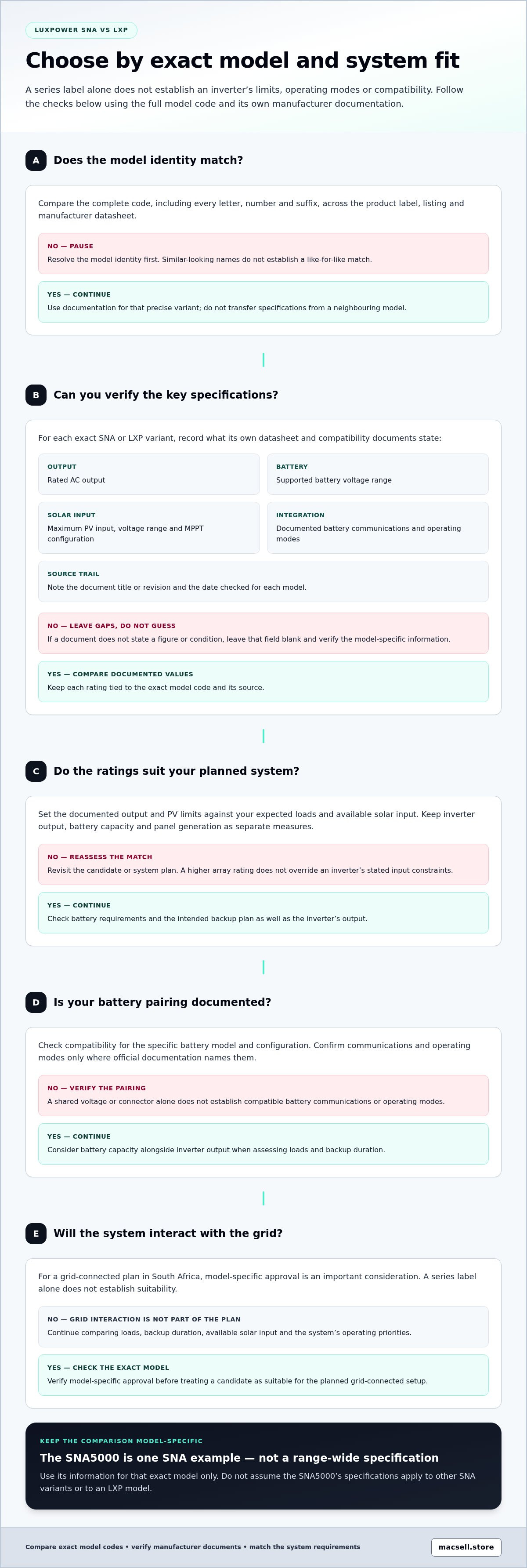
Use this checklist to choose between an SNA and LXP model
Turn your system requirements into a shortlist before comparing series labels. This five-check sequence keeps the decision tied to your loads, existing equipment and exact model documentation. In a LuxPower ECO Hybrid SNA vs LXP series comparison, an apparent advantage matters only if it addresses a requirement your system has.
Five checks before settling on a model
Work through the checks in order. Record your existing equipment and intended operating priorities so you can assess each candidate against the same requirements.
- List the loads. Record essential appliances, their running demand and any high-starting-current equipment. Consider which loads may operate at the same time, then compare the combined requirement with the exact inverter’s documented output and surge limits.
- Set the backup priority. Note which circuits you want supported during load-shedding and how long you’d like them to run. Backup duration depends on load and battery configuration, so don’t treat inverter output as a measure of stored energy or runtime.
- Document existing components. Record the full battery model and configuration, panel details and any other equipment that will remain in the system. These details can rule out models whose documented limits or compatibility requirements don’t match your equipment.
- Check battery requirements. Compare the inverter’s battery voltage and supported communication requirements with official compatibility information for the exact battery and inverter variants. A matching voltage alone doesn’t establish full compatibility.
- Verify PV limits and model identity. Compare output, PV input limits and relevant operating modes using the exact manufacturer datasheets. Match the complete model code to the documents and note each document revision or verification date.
Avoid common comparison errors
Don’t compare unlike model generations or rely on shortened names. A suffix can identify a different variant, so a specification from a similar-looking model may not apply. Forum posts can describe an individual setup, but one user’s configuration isn’t a manufacturer-wide specification.
Keep product ratings separate from installation design and expected system outcomes. A datasheet defines equipment limits; it doesn’t establish how a particular household will be wired or configured, or what it will receive during an outage. A higher rating may also be irrelevant if it doesn’t address a real requirement.
For example, additional output capacity won’t resolve a battery-communication mismatch, and a larger PV input limit has little value if your planned array doesn’t need it. Prioritise the constraints that affect your system first.
Once your shortlist meets those checks, compare the relevant hybrid inverter options against your documented requirements. MacSell Solar Outlet supplies hybrid inverters, batteries and solar panels.
Where the LuxPower SNA5000 fits and what to do next
The LuxPower 5kW Inverter - SNA5000 Hybrid Inverter is one SNA-series model sold by MacSell Solar Outlet. It gives buyers a specific model to include in the comparison, but its name alone doesn’t establish whether it suits a particular system. Match its manufacturer specifications to your loads, battery, panels and intended operating priorities before selecting it.
This distinction matters throughout a LuxPower ECO Hybrid SNA vs LXP series comparison. The SNA5000 can anchor an SNA review, but it shouldn’t stand in for every SNA variant or be compared with an LXP based only on a similar rating or shortened model name. Keep each candidate’s exact model code tied to its own documentation.
What the confirmed SNA5000 example tells the buyer
The product name identifies a 5kW SNA5000 hybrid inverter. For output, battery and PV limits, operating modes and compatibility, use the manufacturer datasheet for the exact model. Don’t assume features or specifications from another SNA model apply. A hybrid inverter hardware buying guide can help structure the wider component review, but the datasheet is the reference for model-specific figures.
Before deciding, compare the documented limits with the appliances you plan to run, the backup duration you’re targeting and the solar input you expect to use. Battery capacity and compatibility matter too. A match on one specification doesn’t prove the complete system will meet every operating priority.
Next steps for a system-ready hardware decision
Prepare a short record for each candidate. Include the full inverter code, battery model and configuration, panel details, essential loads and whether your priority is backup, solar use or another documented operating mode. Use manufacturer documentation to compare ratings and compatibility. Keep document revisions or verification dates with your notes, especially when model names or suffixes look similar.
- Match the inverter’s rated output to the loads you expect to run together.
- Compare battery voltage and communication requirements with official compatibility information.
- Check the planned PV array against the exact inverter’s documented input limits.
- Keep inverter output, battery energy and solar generation as separate system measures.
These checks help distinguish a useful specification advantage from one that won’t affect your planned setup. A higher rating may not be relevant if your loads don’t require it; a feature or operating mode matters only if it supports your intended system and is documented for that exact model. Equipment selection and expected system performance are related, but not interchangeable, decisions.
MacSell Solar Outlet supplies solar hardware, including hybrid inverters, lithium batteries and solar panels. Explore solar hardware at MacSell as you organise the components for your comparison.
Turn your comparison into a system-ready shortlist
Turn your preferred model into a documented system brief. Record the inverter code, battery and panel models, priority loads and operating goals together. This gives you a clear basis for checking compatibility if product variants or system plans change.
The LuxPower ECO Hybrid SNA vs LXP series comparison is most useful when it leads to a match between verified model limits and the equipment you intend to use, rather than a choice based on the series name alone. MacSell Solar Outlet’s solar hardware range includes the LuxPower 5kW Inverter - SNA5000 Hybrid Inverter, as well as hybrid inverters, lithium batteries and solar panels for South African buyers.
Use your shortlist to explore components for your planned system. Explore solar hardware at MacSell and take the next step with a clearer selection.
Frequently Asked Questions
What is the main difference between LuxPower SNA and LXP inverters?
Broadly, the SNA range is associated with off-grid and backup-focused use, whilst LXP models are positioned for more advanced hybrid operation. Treat that distinction as a starting point, not a substitute for checking individual specifications. If exporting power or managing grid interaction matters, check the precise model’s documented modes and South African grid-connection status. Capabilities can vary by model and generation, so don’t apply a series-level description to every unit.
Is the LuxPower SNA5000 the same inverter as an LXP5K-LV?
No. SNA5000 and LXP5K-LV are different model codes, so don’t treat them as the same inverter or assume their specifications are interchangeable. Compare their own manufacturer datasheets, including output ratings, battery requirements, PV limits and operating modes. A shared 5kW description, where stated, wouldn’t prove equal performance or compatibility. MacSell Solar Outlet sells the LuxPower 5kW Inverter - SNA5000 Hybrid Inverter.
Can LuxPower SNA and LXP inverters use the same batteries?
Possibly, but only where the exact inverter and battery variants are compatible. Compare battery voltage, supported communications and configuration conditions in the manufacturers’ documentation. A battery may meet an inverter’s voltage requirements but still lack a supported communications protocol for the intended setup. Check compatibility information for both complete model codes; don’t infer compatibility because two inverters belong to the same brand or series.
Which LuxPower inverter is better for load shedding in South Africa?
There isn’t one best choice for every load-shedding setup. Start with the circuits you need to keep running, including appliances that may operate simultaneously, then match their demand and starting behaviour to the candidate inverter’s documented limits. Battery capacity and expected load also affect backup duration. If the system will connect to the grid, check the exact model’s current approval status against the relevant connection requirements.
How do I compare the PV input of SNA and LXP models?
Use the datasheets for the exact models and compare more than maximum PV power. Record the permitted PV voltage range, maximum input voltage, input current and MPPT configuration where specified. Then check that the planned panel-string arrangement falls within the inverter’s limits under the intended design conditions. Don’t use a figure from a similarly named model or assume a larger maximum input rating improves a system that won’t use it.
Do LuxPower SNA and LXP models support parallel operation?
Parallel operation is model-specific, so a series name alone can’t establish support. Check the precise model’s manual to see whether parallel operation is permitted, how many units are supported and whether settings, communications or matching conditions apply. Also distinguish parallel capability from simply installing multiple inverters: the permitted arrangement and system design must follow the manufacturer’s instructions. If the manual doesn’t cover the exact model code, don’t assume another variant’s guidance applies.
What should I check before buying a LuxPower hybrid inverter?
Before choosing, note your priority loads, battery model and configuration, panel details, and whether the system needs backup or grid interaction. Match these against the exact inverter’s datasheet and compatibility documents. In this LuxPower ECO Hybrid SNA vs LXP series comparison, suffixes matter: verify the complete model code, operating limits and any relevant South African grid-connection approval. Keep the source documents with your system notes for an accurate like-for-like decision.