

Sunsynk 8kW vs 12kW three-phase inverter comparison: which suits your system?
The 12kW inverter isn’t automatically the safer choice. If your loads, phase supply or planned solar array don’t need the extra capacity, a larger unit may add complexity without meeting a real system requirement. A useful Sunsynk 8kW vs 12kW three phase inverter comparison starts with how your system will operate, not just the headline rating.
It’s reasonable to wonder whether an 8kW model will handle several appliances running at once, or whether a 12kW model will be oversized or incompatible with your design. Product titles can also make it hard to distinguish rated output from kVA figures. The exact model code and datasheet are essential for a like-for-like comparison.
This guide explains how to check the relevant Sunsynk datasheets and match inverter capacity to your three-phase supply, peak and simultaneous loads, and realistic plans for expansion. It also covers compatibility factors such as phase output, battery voltage, PV input limits and parallel operation. The aim is to help you make a considered choice for a South African system.
Key Takeaways
- The Sunsynk 8kW vs 12kW three phase inverter comparison is about inverter capacity and phase configuration, not the total size of your solar system.
- Use the exact model datasheets to distinguish rated output in kW from kVA and compare specifications that affect system compatibility.
- Base your capacity choice on your three-phase supply and documented peak and simultaneous loads, not household size alone.
- Check how the inverter fits with your planned solar panels, batteries and any realistic future expansion.
- MacSell supplies solar hardware nationally in South Africa, including the Sunsynk 8KVA and 2X Hubble AM2 5.5 KWh Combo Kit.
Sunsynk 8kW vs 12kW three-phase inverters: what is actually being compared?
A like-for-like Sunsynk 8kW vs 12kW three phase inverter comparison looks at the output ratings of two inverters in a three-phase configuration. It isn’t a comparison of complete solar systems. The inverter rating also doesn’t tell you the total capacity of the panels or batteries connected to it. Those components have separate specifications and need to be assessed as part of the system design.
A package may combine an inverter with a particular battery and panel arrangement, but that alone doesn’t show how two inverter models compare. Keep the inverter, battery storage and PV array distinct in your calculations, then check how they work together.
What does three-phase mean for an inverter?
Three-phase describes the AC supply and output configuration. It is separate from battery capacity, usually expressed in kWh, and solar-panel capacity, commonly stated in kW. A three-phase inverter is intended for a three-phase system, but don’t assume a property has a three-phase supply because the planned inverter or loads require one. Confirm the actual supply configuration. For background, Three-phase electric power describes the underlying electrical arrangement.
Phase configuration also affects how output is delivered across the system. The total rating doesn’t show the allowable output on each phase or how loads are balanced. These details depend on the model, so check the manufacturer’s datasheet rather than assuming all three-phase inverters behave alike.
Why 8kW and 12kW labels need model-level checking
Start with the complete model code, not a shortened product title. The model codes identified for this comparison are SUNSYNK-8K-SG04LP3 and SUNSYNK-12K-SG04LP3. Match each code to its own datasheet before comparing specifications. A similar-looking label, or a listing that says “8KVA”, may use a different unit or describe another product. It isn’t proof of the model’s rated output in kW.
Read specification lines separately. Rated AC output describes continuous inverter output under stated conditions; apparent power, expressed in kVA, is a different electrical measure. Surge capacity is a short-duration output figure, while PV input limits describe the solar array the inverter can accept. These figures aren’t interchangeable. Voltage values, phase output, battery compatibility and operating limits also depend on the exact model and its datasheet.
- Confirm the supply: establish whether the property has three-phase AC.
- Identify the model: record the full code from the product label or datasheet.
- Compare like with like: check rated AC output separately from kVA, surge and PV input figures.
The practical decision is whether the verified inverter output suits your documented loads and the complete system design. A 12kW rating isn’t automatically better, and an 8kW label doesn’t prove that a model will suit every load profile. Use the datasheet details below to assess which specifications affect your choice.
Sunsynk 8kW vs 12kW: which datasheet specifications differ?
The model codes identified for this comparison are SUNSYNK-8K-SG04LP3 and SUNSYNK-12K-SG04LP3. Both are identified as three-phase hybrid inverter models, but a model name alone isn’t a substitute for the current datasheet. The table distinguishes the stated model class from electrical values that must be read directly from the matching documentation.
| Specification | SUNSYNK-8K-SG04LP3 | SUNSYNK-12K-SG04LP3 |
|---|---|---|
| Model class | 8kW | 12kW |
| Rated continuous AC output | Confirm value and conditions in the model datasheet | Confirm value and conditions in the model datasheet |
| Phase configuration | Three-phase | Three-phase |
| AC voltage values | Datasheet-dependent; verify nominal and permitted range | Datasheet-dependent; verify nominal and permitted range |
| Output per phase and phase limits | Datasheet-dependent | Datasheet-dependent |
| Surge capacity | Datasheet-dependent | Datasheet-dependent |
| PV input limits and battery interface | Confirm against inverter and battery documentation | Confirm against inverter and battery documentation |
Compare rated AC output, phase limits, surge capability, voltage, PV input and battery compatibility using the exact model datasheets. Don’t infer these values from the 8kW or 12kW label.
AC output, phase balance and surge figures
Check the continuous AC output rating and any per-phase limits in each datasheet. A total rating doesn’t show how much power can be delivered to a particular phase. Surge capability, where specified, is a separate short-duration rating, not continuous output. To assess whether several appliances can run together, compare their expected demand with the inverter’s stated output and phase limits.
PV input, battery interface and system compatibility
Compare each model’s documented PV voltage and current ranges, maximum PV input and relevant operating conditions. Then match the inverter’s battery voltage and communications requirements with the battery documentation. Don’t assume compatibility from brand alone. The Sunsynk and Hubble combo kit technical review offers related hardware context, but it doesn’t replace checking the datasheets for your selected components.
For broader background on solar technology and industry topics, the Solar Energy Industries Association (SEIA) provides general resources, but it isn’t a source for Sunsynk model specifications. Base the comparison on the manufacturer’s technical documents and your system requirements. MacSell’s solar hardware range includes hybrid inverters, lithium batteries and solar panels.
When is a Sunsynk 8kW or 12kW three-phase inverter the better fit?
A higher rating isn’t automatically the better choice. The useful question in a Sunsynk 8kW vs 12kW three phase inverter comparison is whether the verified output of each exact model suits your loads, backup priorities and system design. A 12kW label alone doesn’t show that your property needs the extra capacity, while an 8kW label alone doesn’t prove that it will be sufficient.
Start with a load assessment, not a household-size rule. List the equipment you intend to run, its documented power demand and which items may operate at the same time. Pay particular attention to periods of overlap, such as cooking alongside other high-demand activities. Compare the expected peak and simultaneous demand with the inverter’s rated output and phase-related limits.
When an 8kW model may meet the design requirement
An 8kW model may suit a system when the measured or documented peak and simultaneous loads fall within its verified output limits, including any applicable per-phase restrictions. The backup plan matters too. Supporting selected essential circuits creates a different load profile from backing up a wider range of circuits. Decide what must run during an outage, then assess those loads together rather than assuming every appliance will operate at once.
When to assess a 12kW model
Assess the 12kW option if your documented demand exceeds what the 8kW model can provide within its stated limits. A higher rating may also be relevant if the design includes greater simultaneous demand or specific planned load growth. The supply configuration and connected components still need to suit the system. Check the exact inverter specifications and the limits of the rest of the design before treating the higher rating as usable capacity.
Separate three questions that are often blurred together:
- Inverter output: how much AC power the inverter can supply under the datasheet’s stated conditions.
- Battery storage: how much energy is available and how long it can support the selected loads. A larger inverter doesn’t add battery capacity or automatically extend backup duration.
- Solar generation: how much energy the PV array can produce. A higher inverter rating doesn’t create more sunlight or increase panel capacity by itself.
These components need to work as a set. A battery stores energy for later use, while panels contribute generation when conditions allow; neither changes the inverter’s rated output. Choosing a higher-output inverter won’t resolve limited storage or insufficient PV capacity. Match each component to the intended operating plan.
Future expansion can inform the decision, but make it specific. Identify the loads or circuits you expect to add, estimate their documented demand and include them in the assessment. Avoid choosing extra inverter capacity for an undefined possibility. The better fit is the model whose verified output, phase capability and component compatibility cover your intended loads and realistic growth.
How to choose between Sunsynk 8kW and 12kW: a system-check checklist
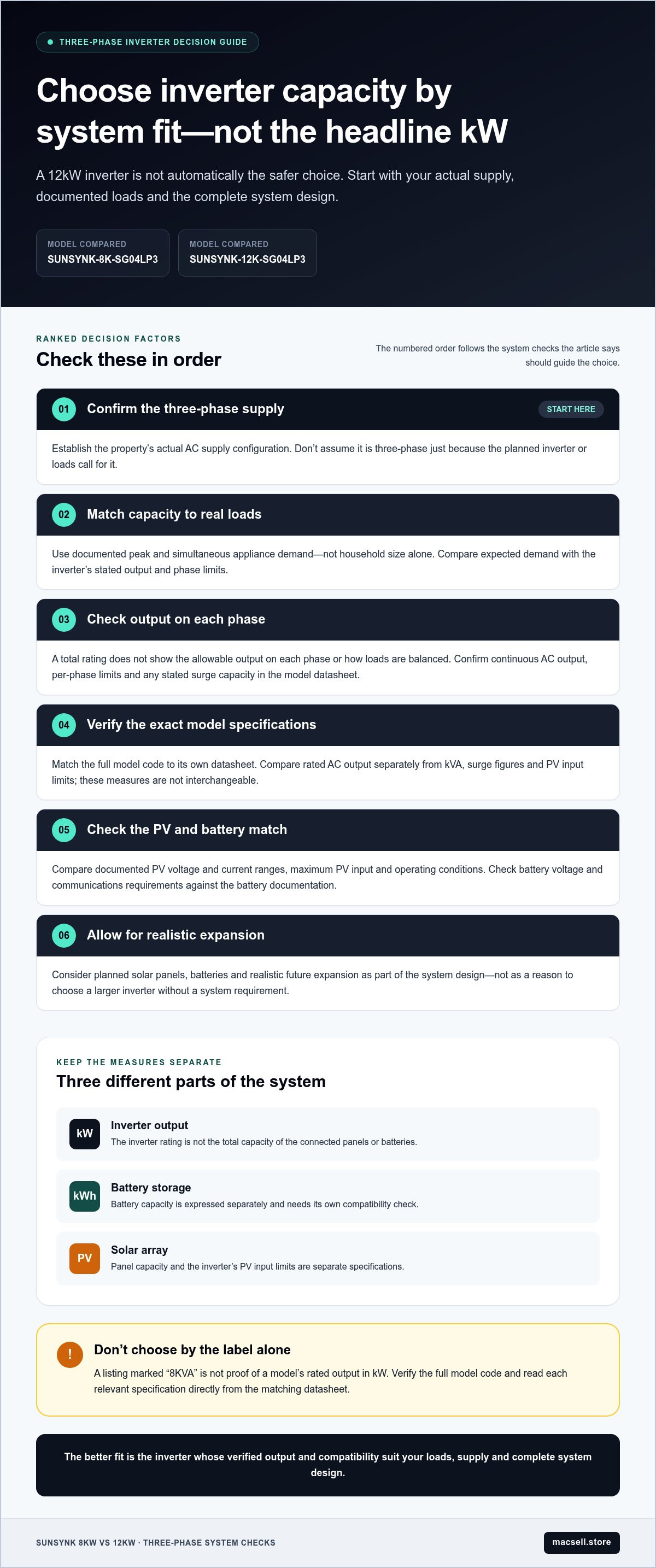
Follow a consistent sequence before deciding between the two capacities. This keeps your Sunsynk 8kW vs 12kW three phase inverter comparison tied to the actual supply, load profile and hardware, rather than assumptions based on property size. Record the findings and compare them with the exact inverter datasheet.
- Confirm the supply. Establish whether the installation has a three-phase supply compatible with the selected inverter. Don’t infer the supply type from the planned system or the appliances you want to run.
- Record the loads. List the equipment to be supported, its documented demand and which items may operate at the same time. Separate essential backup loads from non-essential loads.
- Set backup priorities. Decide which circuits should remain powered during an outage. Use that backup profile and expected simultaneous demand to assess required inverter output.
- Identify the exact model codes. Match the product label and listing to the full model code. A shortened name can make it harder to distinguish a three-phase model from another variant.
- Compare the datasheets and components. Check output and phase limits, then assess the battery, PV array and protection design against the selected inverter’s documented requirements.
Start with supply, loads and backup priorities
Measured readings or documented equipment specifications are more useful than broad household-size assumptions. Note whether a load runs continuously, starts intermittently or overlaps with other high-demand equipment. Then decide whether your backup plan covers selected circuits or a wider set of loads. That choice changes the load profile to evaluate, even in properties with similar occupancy.
Compare the same circuits and operating conditions against both model datasheets. If the property’s supply configuration doesn’t match the inverter’s requirements, a higher output rating won’t resolve the mismatch. A planned three-phase system also doesn’t prove that the existing supply is already three-phase.
Check the complete hardware combination
Match the inverter’s battery voltage and communications requirements to the chosen battery documentation. Review the PV array configuration against the model’s input limits, and assess the protection design as part of the wider system. Batteries affect stored energy; panels affect generation; protection components are part of the electrical design. None replaces the need to confirm inverter output.
The home inverter and battery combo guide provides broader component-matching context, while the hybrid inverter buying guide covers wider hardware-selection considerations. Use them as supporting reading, then rely on the exact model and component documentation for technical limits.
Once you’ve recorded your supply, load requirements and datasheet checks, compare compatible solar hardware options for your planned system. The aim is a matched set of components, not the largest inverter label available.
Choosing and sourcing Sunsynk inverter hardware through MacSell
MacSell Solar Outlet is a South African retailer of solar hardware, including hybrid inverters, lithium batteries and solar panels. For readers comparing inverter options, a product listing is a useful starting point for identifying hardware, but it doesn’t replace model-level technical documentation. The Sunsynk 8kW vs 12kW three phase inverter comparison depends on exact model codes, verified output ratings and compatibility with the planned system.
Product titles may use different units or describe a combined hardware package. Read the full name, then distinguish what the listing identifies from what the inverter datasheet specifies. An inverter-and-battery kit name alone doesn’t establish that its inverter is one of the three-phase models being compared or that it is technically equivalent to another model carrying an 8kW or 12kW label.
How the listed Sunsynk and Hubble kit relates to this comparison
MacSell lists the Sunsynk 8KVA & 2X Hubble AM2 5.5 KWh Combo Kit. It is an example of inverter-and-battery hardware, but the product name does not establish equivalence with either three-phase model or specify the kit’s detailed electrical characteristics. For related component context, see the Sunsynk 8KVA and Hubble AM2 combo guide.
Keep the comparison grounded in the exact code and manufacturer datasheet for rated AC output, phase configuration, voltage and operating limits. Assess battery compatibility against the inverter and battery documentation. Treat the combo kit as a related hardware example, not as proof of a 12kW package or a like-for-like comparison between two three-phase units.
Next steps for a considered hardware choice
Before selecting components, bring together the supply details, documented loads and backup priorities, then compare them with the model datasheets. Check the battery interface, PV input limits and protection design across the complete planned system. This helps distinguish an inverter that meets the required output from a higher-rated model that may not suit the rest of the hardware.
- Start with the model code: make sure the product listing and datasheet refer to the same inverter.
- Use documented demand: compare expected simultaneous loads with verified output and phase limits.
- Check connected components: match battery and PV specifications to the inverter’s stated requirements.
MacSell offers solar hardware across inverters, batteries and panels. Browse MacSell solar hardware to explore the available categories and use the technical criteria above to guide your selection.
Make your next hardware decision with confidence
Keep a record of the selected model code, the datasheet used for comparison and the assumptions behind the system design. If the design changes, update those details before choosing hardware. A clear record makes it easier to spot when a revised load plan or component choice no longer matches the inverter specification.
A disciplined Sunsynk 8kW vs 12kW three phase inverter comparison should lead to a documented choice, not simply a preference for the larger number. Use that record when comparing inverters and related solar components, and don’t rely on a product title alone for technical decisions.
MacSell supplies solar hardware nationally in South Africa. Browse Sunsynk and solar hardware at MacSell to explore options for your planned system. With your requirements clearly defined, you can move to the next stage with a considered hardware choice.
Frequently Asked Questions
Is a Sunsynk 12kW inverter always better than an 8kW model?
No. A 12kW model is a better fit only if its verified output addresses your system’s actual demand and its specifications suit the supply and connected hardware. If your load assessment shows that planned simultaneous loads fit within the 8kW model’s limits, the extra inverter capacity may not provide a useful benefit. Compare the full datasheets with your system requirements rather than choosing by rating alone.
Can a Sunsynk 8kW inverter run a three-phase property?
Only if the exact inverter model has three-phase output and the supply and system design are compatible. Start the Sunsynk 8kW vs 12kW three phase inverter comparison with the complete model code, not simply “8kW”. Consider how the property’s loads are distributed across phases. A qualified electrical professional should verify the supply and assess the design’s phase requirements.
What is the difference between an 8kW and 8kVA Sunsynk inverter?
kW measures real power, while kVA measures apparent power. They are related but different electrical quantities, so an 8kVA label doesn’t automatically mean the inverter provides 8kW of rated output. The relationship depends on the power factor and model specifications. Check the exact model datasheet for its rated AC output in both units, where given, and don’t use the product title alone to size loads.
How do I know whether my property has a three-phase supply?
Use the property’s electrical connection records or supply documentation as a starting point, then have the supply configuration verified by a qualified electrical professional. Don’t rely on the number of appliances, the size of the property or a solar quote to establish it. Avoid opening electrical equipment or attempting live measurements yourself. Confirming the supply first helps prevent comparing a three-phase inverter with a system that has different requirements.
Can I add more solar panels to a Sunsynk 8kW or 12kW inverter later?
Possibly, but any future panel additions must remain within the selected inverter’s PV input limits. The added panels’ electrical characteristics, string arrangement and existing array all matter, as do available roof space and panel orientation. Before expanding, compare the proposed array configuration with the exact inverter datasheet and existing system records. A higher inverter rating alone doesn’t confirm that more panels can be connected.
Does a 12kW inverter provide more battery backup time than an 8kW inverter?
No, not by itself. Backup duration depends primarily on usable battery energy and the loads drawing power, as well as system operating limits and conversion losses. A 12kW inverter may be able to supply more power if its specifications and system design allow, but that doesn’t mean it stores more energy. For a practical estimate, consider battery capacity alongside the expected load over the backup period.
Are Sunsynk three-phase inverters compatible with Hubble lithium batteries?
Compatibility depends on the exact inverter and battery models, not just the Sunsynk and Hubble brand names. Compare the inverter’s supported battery voltage and communications requirements with the battery documentation, including any stated operating limits. MacSell lists the Sunsynk 8KVA & 2X Hubble AM2 5.5 KWh Combo Kit as a hardware package, but that listing shouldn’t be taken as proof that every Sunsynk three-phase model supports every Hubble battery.