

Deye microinverter or string hybrid inverter for home backup
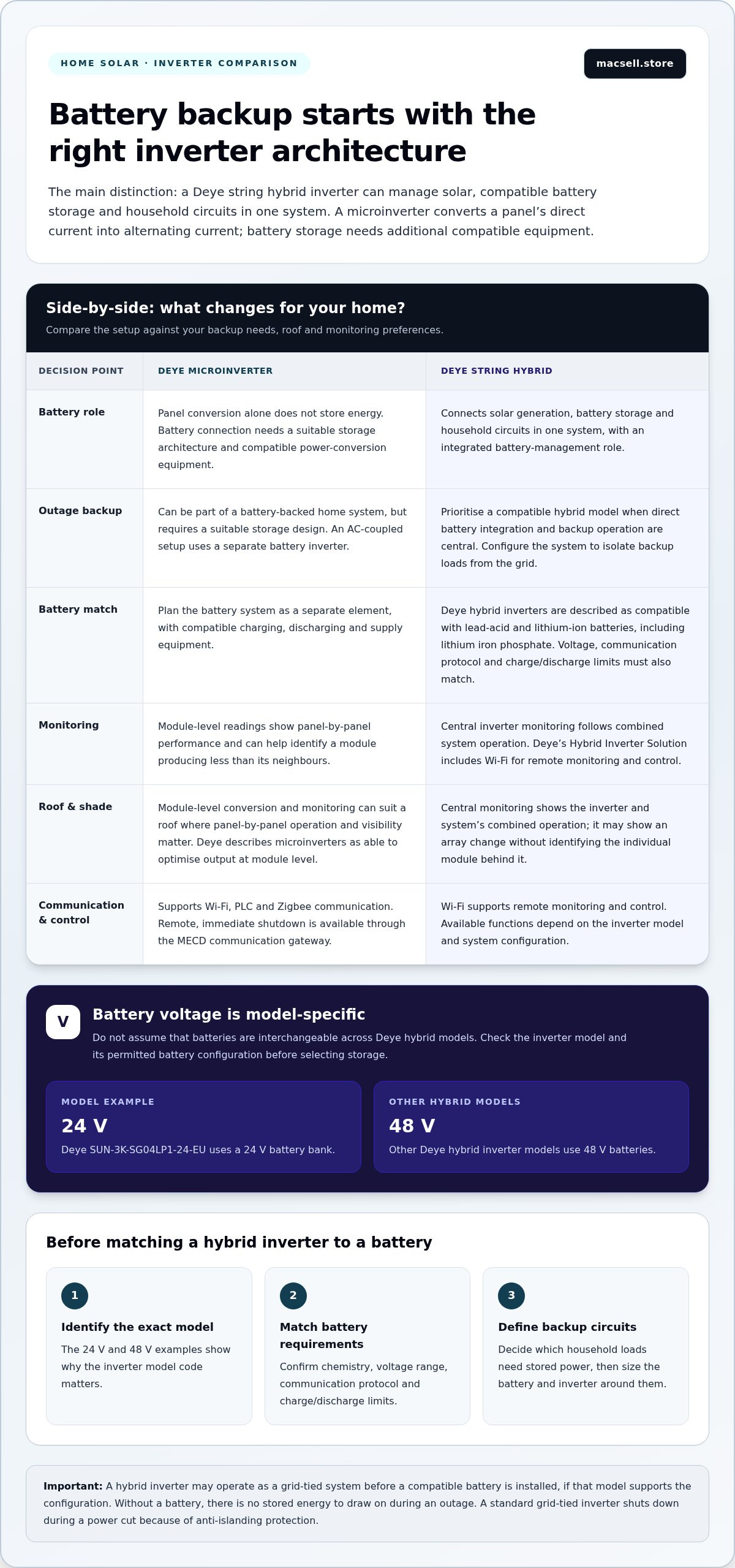
For home backup, a Deye string hybrid inverter is generally the more suitable option because compatible Deye hybrid models support batteries and can operate in on-grid, off-grid and grid-tied modes. A microinverter converts a solar panel’s direct current into alternating current and can optimise output at module level. In the Deye microinverter versus Deye string hybrid inverter comparison, the key question is whether battery-based backup or panel-level operation matters more for your home.
Both options can suit a solar system, but they work differently and affect battery integration, monitoring and system design. This guide compares backup capability, battery compatibility, monitoring, shade performance, home setup and lifespan considerations. You’ll also see how to match the inverter architecture to your roof, household loads and expansion plans, so you can make a practical choice for South African conditions.
Key Takeaways
- Prioritise battery support and backup operation if keeping selected home circuits running during outages is your main goal.
- Compare module-level monitoring with centralised system monitoring to see which setup gives you the visibility you need.
- Use your roof’s shading, panel layout and future expansion plans to narrow down the inverter architecture.
- Assess lifespan alongside warranty terms, access for servicing and the operating conditions of your installation.
- Match inverter power, MPPT inputs, voltage and battery requirements to your solar array and household loads.
Battery compatibility and battery-ready operation
For backup power, the key difference is whether the inverter can manage stored energy. Deye identifies its SUN-12/14/16K-SG01LP1-EU Series as a hybrid inverter series supporting batteries and backup generators. A microinverter converts a solar module’s direct current into alternating current, but that conversion alone does not store energy. A battery system needs compatible power-conversion equipment to charge, discharge and supply household loads.
A Deye string hybrid inverter can connect solar generation, battery storage and household circuits in one system. Deye hybrid inverters are described as compatible with lead-acid and lithium-ion batteries, including lithium iron phosphate batteries. Chemistry is only one compatibility requirement: the battery’s voltage range, communication protocol and charge and discharge limits must also match the inverter’s supported settings.
Check the inverter’s battery voltage before selecting storage. The Deye SUN-3K-SG04LP1-24-EU uses a 24 V battery bank, whilst other Deye hybrid inverter models use 48 V batteries. These are not interchangeable assumptions: the battery bank must match the specific inverter model. Confirm the model’s permitted battery configuration and communication requirements when planning the system.
- Identify the inverter model. Deye’s 24 V and 48 V examples show why the model code matters.
- Match the battery chemistry and voltage. Lead-acid and lithium options require compatible operating settings.
- Plan the backup loads. Decide which circuits need stored power, then size the battery and inverter around them.
A hybrid inverter can often run as a grid-tied system before a compatible battery is installed, allowing a staged setup with solar first and storage later, provided the model supports that configuration. Without a battery, however, the system cannot draw on stored energy during an outage. A standard grid-tied inverter shuts down during a power cut because of anti-islanding protection, so solar panels alone do not guarantee backup.
Microinverters can form part of a battery-backed home system, but battery connection requires a suitable storage architecture. An AC-coupled setup uses a separate battery inverter to manage charging and supply, adding equipment and coordination compared with a hybrid inverter’s integrated battery-management role. In either design, outage operation depends on configuring the system to isolate backup loads from the grid.
For the Deye microinverter versus Deye string hybrid inverter decision, prioritise a hybrid model when direct battery integration and backup operation are central requirements. Consider microinverters when module-level conversion suits the roof, and plan battery storage as a separate system element. The practical choice depends on battery voltage and chemistry, intended backup circuits and the inverter’s supported operating modes.
Remote monitoring and control
Monitoring differs in where each Deye system measures solar production. Deye microinverters provide module-level monitoring, letting you view performance panel by panel and spot a module producing less than its neighbours. A string hybrid inverter monitors the central inverter and the system’s combined operation. Deye’s Hybrid Inverter Solution includes Wi-Fi connectivity for remote monitoring and control.
On a roof with uneven shade, module-level data can help pinpoint which panel’s output has changed. A central reading may show a change across the array without identifying the individual module behind it. This distinction is useful for fault investigation and routine performance reviews. Deye describes microinverter monitoring as supporting easier operation and maintenance, while the hybrid system’s Wi-Fi connection provides remote access to monitoring and control.
Deye microinverters support Wi-Fi, PLC and Zigbee communication, offering different ways to transfer system data depending on the design. Wi-Fi uses a wireless network, PLC carries communication over power lines, and Zigbee is a wireless communication protocol. The chosen connection affects how monitoring equipment communicates with the inverter. A stable communication path is needed for remote data to reach the monitoring interface.
- Review module-level readings. Compare individual panel output to spot a change isolated to one module.
- Review central inverter data. Use the hybrid inverter’s Wi-Fi monitoring to follow overall system operation.
- Consider communication design. Match Wi-Fi, PLC or Zigbee support to the microinverter system’s communication setup.
Control functions also differ. Deye says its microinverters can be shut down remotely and immediately through the MECD communication gateway. This provides a central way to issue a shutdown command to the microinverter system. The gateway is a specific part of that control pathway, not a feature to assume is present in every monitoring setup. Deye’s hybrid solution supports remote monitoring and control through Wi-Fi, while available controls depend on the inverter model and system configuration.
Monitoring can also help with everyday checks. Some inverter displays show energy produced during the last 24 hours. That figure gives a recent production snapshot, not a panel-by-panel diagnosis. For example, a homeowner comparing daily production can use the display to notice a changed trend, then use module-level monitoring where available to narrow down a panel-specific issue.
Choose according to the visibility and control you need: module-level detail and MECD gateway shutdown for microinverters, or Wi-Fi remote monitoring and control through a Deye hybrid inverter. If you’re comparing system components alongside these monitoring needs, explore the solar hardware range available for home systems.
Choosing an inverter architecture for a home
Microinverters cost more than standard string inverters, and their position near solar panels can make servicing less accessible. In a string system, a shaded or underperforming panel can reduce output from its series-connected string.
A string inverter connects panels in series, raising the string voltage before converting the electricity. This can suit a simple, shade-free South African roof with a consistent panel layout. One central unit handles the connected array, which can make servicing more accessible than reaching equipment beside individual modules. The trade-off is that a string’s performance can be limited by its weakest panel. Roof sections facing different directions or receiving uneven sunlight need careful string design.
Microinverters convert panel output individually, allowing each module to operate with its own inverter, depending on the product design. Deye microinverters use independent MPPT to harvest power from each panel. This can reduce the effect of one shaded or underperforming module on the rest of the array. For example, if a chimney shades one panel in the afternoon, other modules can keep producing without that panel setting the performance of the whole string.
Plan around the roof before choosing equipment. Map panels by orientation, shade and likely future additions. A clear, unshaded roof with a uniform layout often favours a string arrangement. A roof with separate shaded areas may benefit from panel-level conversion. Microinverters can also be easier to extend panel by panel, while adding capacity to a string system may require checking the inverter inputs and available capacity.
System changes matter too. You can upgrade a standard inverter by replacing it with a hybrid inverter or adding a secondary battery inverter in an AC-coupled system. These options affect equipment layout and how the solar and storage components interact. A Deye hybrid inverter suits designs that bring solar, storage and household supply together, while microinverters prioritise individual-module conversion.
- Choose string architecture for a simple, shade-free roof and a centralised inverter location.
- Consider microinverters where panel-level output control can help manage separate shade conditions.
- Allow for access because string inverters are centralised, whilst microinverters sit near the panels.
- Plan expansion around how new panels will connect to the existing inverter architecture.
- Include storage plans early, especially if a standard inverter may later need hybrid or AC-coupled equipment.
The practical choice depends on roof conditions, service access and system plans. For a uniform roof, a string setup offers a straightforward central architecture. For varied shade or staged panel expansion, microinverters offer module-level flexibility. Weigh these priorities against backup requirements before selecting the Deye architecture for your home.
Inverter lifespan
High-quality string solar inverters, including hybrid models, typically last 10 to 15 years. That gives a useful planning range for a Deye string hybrid inverter, but it isn’t a guaranteed service life for every installation. Actual operating conditions, system design and maintenance all affect how long equipment performs reliably.
There isn’t an equivalent lifespan figure in the available facts for Deye microinverters. Don’t assume a microinverter will last as long as a string inverter, or longer, based only on its architecture. Compare the specific model’s warranty, operating requirements and replacement arrangements before treating lifespan as a deciding advantage.
Warranty length and equipment lifespan are related, but they aren’t the same measure. A quality solar inverter warranty should be five years or more. A warranty sets the period and terms for eligible claims; it doesn’t predict exactly when an inverter will stop operating. Read the coverage alongside your expected replacement plan.
Installation conditions affect the workload placed on inverter electronics. Restricted airflow around a central inverter, for example, can limit heat dissipation, and excessive heat can place additional stress on electronic components. Correct installation, suitable ventilation and regular checks for dust or blocked airflow help support reliable operation. The same principle applies to microinverters, where the mounting environment near solar modules matters.
Architecture also changes the practical impact of a component failure. A central string inverter concentrates conversion in one unit, so a fault there can affect the connected array. A microinverter system distributes conversion across panel-level units, so a fault may be isolated to one module’s conversion path. This affects diagnosis and replacement planning, but doesn’t promise that either design will last longer.
- Compare warranty terms. Use five years or more as the stated quality benchmark, then read the model’s actual coverage.
- Plan for replacement. Consider access to the central unit or panel-level equipment when organising future maintenance.
- Protect operating conditions. Keep inverter ventilation clear and follow the model’s installation requirements.
- Separate lifespan from output. A system producing energy today doesn’t prove every component will last for the same period.
For a household comparing Deye microinverters with a string hybrid, lifespan alone can’t settle the choice. The 10 to 15-year typical range applies to high-quality string inverters, including hybrid types, while microinverter lifespan needs model-specific assessment. Factor in warranty coverage, equipment access and the consequences of a component failure alongside backup and monitoring needs.
In South Africa, practical planning also means considering the maintenance needs of the whole system. A battery, panels and inverter may have different replacement schedules. Keep model details and warranty documents together to make it easier to identify the relevant component and arrange servicing if performance changes.
What are the rated power, MPPT, voltage, and battery specifications of Deye microinverters and hybrid inverters?
Deye microinverters have power ratings from 300 W to 2000 W, while Deye hybrid inverters cover larger household system capacities. The listed hybrid range includes single-phase models rated from 3 to 16 kW and three-phase models rated from 8 to 12 kW. These figures describe different equipment roles, so compare them against the system design rather than treating them as direct equivalents.
MPPT, or maximum power point tracking, manages the operating point used to harvest energy from solar panels. Deye microinverters use independent MPPT, allowing each panel to be tracked separately. A hybrid inverter’s MPPT arrangement is model-specific, so match the number of trackers and supported panel connections to the roof layout. Separate roof orientations can affect how a string is grouped across the available trackers.
Output voltage also varies by inverter model. Deye lists microinverter output voltages of 220 V, 230 V and 127 V. Deye hybrid single-phase systems are listed at 220-240 V and 50 Hz, while three-phase systems are listed at 380-415 V and 50 Hz. In South Africa, the home’s supply arrangement and intended loads help determine which output configuration is appropriate.
- Microinverter power: 300 W to 2000 W, with independent MPPT for panel-level tracking.
- Hybrid power: single-phase models from 3 to 16 kW, and three-phase models from 8 to 12 kW.
- Microinverter output: listed at 220 V, 230 V and 127 V.
- Hybrid output: single-phase 220-240 V at 50 Hz; three-phase 380-415 V at 50 Hz.
Battery voltage is a key model-selection check. The Deye SUN-3K-SG04LP1-24-EU uses a 24 V battery bank. Other Deye hybrid inverter models use 48 V batteries. Select the battery configuration for the exact inverter model; the voltage groups are not interchangeable assumptions. Battery chemistry and communication requirements also need to match the inverter’s supported setup.
For example, a household planning a single-phase installation can compare expected solar output and loads with the hybrid model’s power rating. A home with three-phase supply needs to assess the listed three-phase range instead. For microinverters, compare each unit’s rating with the panels it serves, then consider the combined system output. These checks help you avoid choosing by headline wattage alone.
Use the model datasheet to compare rated output, MPPT inputs, voltage and battery-bank requirements side by side. These specifications determine how panels, household supply and storage fit together. Explore hybrid inverter options when narrowing your system architecture and capacity.
MacSell Solar Outlet: Sunsynk 8KVA & 2X Hubble AM2 5.5 KWh Combo Kit
MacSell Solar Outlet is a useful next step if your home backup plan centres on a hybrid inverter and battery storage. Its Sunsynk 8KVA & 2X Hubble AM2 5.5 KWh Combo Kit brings those named components together as a hardware option for a home system. The right setup still depends on your household loads, solar array and backup priorities.
You can also explore hybrid inverters, lithium batteries and solar panels as separate hardware categories when planning a system or comparing components. These options are relevant if you’re weighing inverter architectures or planning storage alongside solar generation.
For hardware options to match your home backup requirements, contact MacSell Solar Outlet or visit macsell.store.
Turn your preferred inverter design into a system plan
Your Deye microinverter versus Deye string hybrid inverter decision should lead to a practical system plan, not just a model comparison. Set out which household circuits need backup, how your roof affects panel placement and whether battery storage is part of the design. These priorities give you a clearer basis for matching inverter and storage hardware.
MacSell Solar Outlet offers hybrid inverters, lithium batteries and the Sunsynk 8KVA & 2X Hubble AM2 5.5 KWh Combo Kit. These are options to consider as you move from comparing architectures to selecting components for your home. Focus on how each item fits your intended system, rather than choosing on a single specification alone.
For a practical next step, contact MacSell Solar Outlet today to discuss hardware options for your home backup plan. A clear set of requirements will help you move forward with confidence.
Frequently Asked Questions
Final verdict: which one is right for your home?
A string hybrid inverter is usually the stronger fit if battery-backed home supply is your main objective. Choose microinverters if panel-level operation better suits a roof with variable shading or a staged expansion plan. Before deciding, list the appliances and circuits you want powered during an outage, then consider how roof layout and future solar plans affect the design.
How do they compare on cost, maintenance, and performance?
Microinverters are generally more expensive than standard string inverters, while a centralised string inverter may be easier to access. Performance depends on the roof and system design: panel-level conversion can limit the impact of one underperforming module, while a weak panel can affect string output. Compare total system components, maintenance access and expected energy use, not just inverter purchase cost.
Microinverter vs string inverter: what is the difference?
A microinverter converts solar-panel output at module level, with each panel able to have its own inverter depending on the product design. A string inverter connects panels in series and handles their combined output centrally. In practice, this changes how panel performance is managed, how system data is viewed and where equipment is located. The difference matters most when the roof has varied shade or orientations.
When is a microinverter the better choice?
A microinverter can suit a roof where panels experience different shade conditions or where you want to add panels in stages. Independent MPPT lets you track each module’s output separately, which can reduce one shaded panel’s effect on other modules. Consider equipment location and system design too. For battery backup, include the storage-conversion arrangement in your design rather than assuming microinverters alone provide outage power.
Which inverter is best suitable for your needs?
Start with your backup priorities and electrical setup. Identify the household circuits you want to support, whether the home has single-phase or three-phase supply, and how shade and panel placement vary across the roof. Then compare the inverter’s output rating, battery compatibility and monitoring functions with those needs. A system designed around essential loads may have different priorities from one intended to supply a broader range of household equipment.
Which inverter is better for shaded roofs?
Microinverters can be advantageous when shade falls on separate panels at different times, because independent MPPT tracks each module’s output. For example, a tree might shade one roof section in the morning while another remains clear. A string design can still suit a roof with consistent sunlight, but panel grouping and shade patterns need consideration. The roof layout, not the inverter name alone, determines the comparison.
Which inverter is better if you want to expand later?
Microinverters are often easier to extend panel by panel, which can suit a homeowner adding solar capacity in stages. A string system may also be expandable, but additional panels must fit the inverter’s input capacity and string design. For example, a planned roof extension could affect panel grouping and available inverter capacity. Set out likely expansion plans before choosing, so the initial architecture supports the intended future layout.
What is the difference between a Deye microinverter and a Deye string hybrid inverter?
A Deye microinverter converts solar output at module level, while a Deye string hybrid inverter manages a connected solar array and supports battery operation. Deye microinverters offer independent MPPT for panels; hybrid models can work with compatible batteries and support backup configurations. The choice involves more than conversion: consider whether your priority is panel-level operation, integrated battery management or a system designed around both solar and storage.