

Freedom Won eTower vs Hubble AM2: Price per kWh and value
The Freedom Won eTower vs Hubble AM2 price per kWh comparison has no clear winner based on capacity alone. The Hubble AM2 is listed at 5.5 kWh; compare each battery’s price against its usable energy to assess value on a like-for-like basis.
It’s easy to focus on the purchase price, but backup depends on more than the price per unit of capacity. Discharge limits, the loads you need to run and inverter communications all affect how well a battery suits your system.
This comparison explains how to assess price per kWh, capacity and discharge, then consider backup requirements and inverter compatibility. Use these factors to weigh the options against your household’s power needs.
Key Takeaways
- Compare like-for-like battery costs by separating the battery price from delivery, installation and any required accessories.
- Assess usable energy and discharge limits against the loads you need to keep running during an outage.
- Include inverter communication and system configuration in your comparison, not just battery capacity.
- Consider a Sunsynk and Hubble AM2 combo kit when comparing a battery with a coordinated hardware package.
Do listed South African prices include VAT, delivery, installation, or accessories?
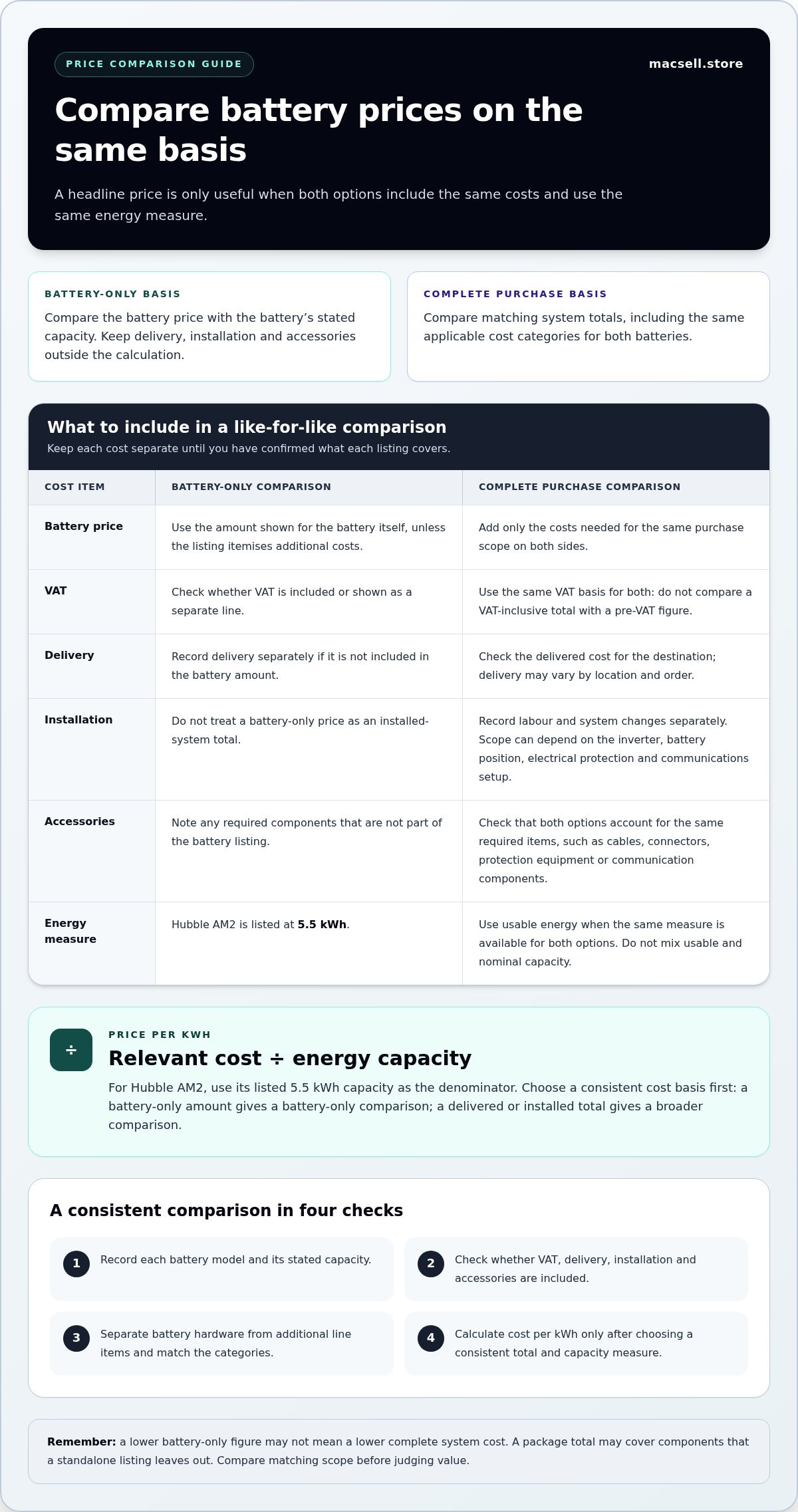
A listed battery price is the amount shown for the battery itself, unless its description itemises additional costs. For a South African comparison, treat VAT, delivery, installation and accessories as separate cost categories. Their inclusion affects the total amount paid, but does not change the battery’s stated energy capacity. Hubble AM2 is listed at 5.5 kWh, so compare like-for-like system totals before using that figure to assess cost per kWh.
VAT is a tax component that a price listing may show as included or as a separate line. Read the wording attached to each Freedom Won eTower and Hubble AM2 price. An explicit “VAT included” label indicates that the displayed amount includes VAT; a separate VAT line shows it as an additional component. Keep the treatment consistent in your comparison. For example, don’t compare a VAT-inclusive total for one battery with a pre-VAT figure for the other. The figures need to represent the same basis before they can support a fair value assessment.
Delivery is the charge associated with transporting the battery to its destination. A product listing and a delivered total can therefore represent different costs. Note whether delivery appears as a separate line, is included in the displayed amount, or varies according to the destination and order. For a household in Pretoria and one elsewhere in South Africa, the delivery component may not be identical. Keep the battery price and delivery charge separate in your notes, then combine them only when comparing the complete purchase cost.
Installation is the work required to connect and configure a battery within a solar system. A battery-only price should not be treated as an installed-system total. Installation scope can depend on the existing inverter, battery position, electrical protection and communications setup. A Freedom Won eTower or Hubble AM2 comparison should therefore distinguish hardware from labour and system changes. If the quoted scope includes installation, record that separately from the battery amount. If it does not, don’t assume installation is covered simply because the battery is being compared with a complete system.
Accessories are components required for the intended configuration in addition to the battery itself. Depending on the system, these may include cables, connectors, protection equipment or communication components. Requirements depend on the inverter and installation design. A battery listing that excludes cables, for example, is not directly comparable with a package that includes them. Record what each option includes, separating essential system hardware from optional items.
Price per kWh is the relevant cost divided by the energy capacity used in the comparison. For Hubble AM2, use the listed 5.5 kWh capacity as the denominator, while keeping the selected cost basis consistent. A battery-only figure produces a battery-only comparison; a delivered or installed total answers a broader question. Use usable energy where the same measure is available for both options. Don’t mix usable and nominal capacity, or a lower apparent cost per kWh may simply reflect different inputs.
Use this sequence to organise a South African comparison:
- Record the battery model and its stated capacity, such as Hubble AM2 at 5.5 kWh.
- Identify whether each displayed figure includes VAT, delivery, installation and accessories.
- Separate battery hardware from any additional line items, keeping the same categories for both options.
- Calculate cost per kWh only after choosing a consistent total and capacity measure.
This method makes the comparison more useful than a headline price alone. A lower battery-only figure may not represent the lower complete system cost once delivery, installation or required accessories are included. Equally, a package total may cover components that a standalone listing leaves out. Comparing the same scope for Freedom Won eTower and Hubble AM2 gives a clearer view of value without treating different inclusions as a battery performance advantage.
Check the product specification alongside the price, since physical fit and handling can affect delivery and installation planning without showing that either is included. The Hubble AM-5 and AM-5+ have listed usable energy of 5.12 kWh per unit, dimensions of approximately 599.67 × 509.62 × 173 mm, nominal voltage of 51.2 V, and weight of approximately 51-53 kg.
The listed warranty for Hubble AM-5 batteries is 10 years; treat it as a warranty term, not as evidence that installation, delivery or accessories are included.
Hubble sunsynk
Battery capacity is the energy a battery is listed to store. The Hubble AM-2 is listed at 5.5 kWh, a useful starting point for assessing backup needs. That figure alone does not describe how long a system will run. Runtime depends on the energy available for use and the combined demand from connected appliances. A fridge, lights and communications equipment draw differently from high-demand appliances. List the essential loads first, then consider whether one battery or a larger bank better matches their use.
Battery discharge is the rate at which stored energy can supply a connected system. The research figures for 100 A relate to Hubble AM-5 and AM-5+ batteries, not the AM-2. Don’t transfer those models’ discharge rating to an AM-2 comparison. For an AM-2 and SunSynk system, assess the battery’s own discharge limit alongside the inverter’s requirements and the loads expected during an outage. Energy capacity and discharge rate answer different questions: stored energy affects duration, whilst discharge capability affects how much power can be drawn at once.
CAN bus is a communications link that lets a battery and inverter exchange system information. SunSynk inverters have been reported as compatible with both Hubble and Freedom Won batteries through CAN bus. Communication matters because it helps the inverter respond to battery information as part of system operation. A compatible battery model is only one part of the match. The inverter model, communication connection and configuration all form part of the working system. Check the supported protocol and settings for the specific combination rather than assuming that two products communicate simply because they share a battery voltage.
Parallel expansion means connecting batteries together to increase the available bank capacity. Hubble AM-2 batteries can be connected in groups of up to 15. That gives a system designer room to scale beyond a single 5.5 kWh unit, subject to the inverter and battery configuration. More batteries increase stored energy, but they don’t automatically increase the inverter’s output capacity. For example, a larger bank may extend backup duration for the same essential loads, while the inverter still determines the power supplied to them.
Backup capacity is the usable energy and output available to support chosen loads during an outage. Start by separating appliances that must remain on from those that can be switched off. Then estimate their combined demand and the hours they need backup. This shows whether a single 5.5 kWh AM-2 is a suitable starting point or whether a parallel bank better fits the requirement. Include starting demand from equipment with motors, as its momentary draw can differ from normal running demand.
For a SunSynk configuration, compare these points before deciding how many batteries you need:
- Match the exact inverter and battery models, including their communication method.
- Use the AM-2’s listed 5.5 kWh capacity, not specifications belonging to AM-5 or AM-5+.
- Size the bank for the essential loads and desired backup duration.
- Keep battery-bank capacity separate from inverter output capability.
The Freedom Won eTower vs Hubble AM2 price per kWh comparison is meaningful only when the selected systems meet the same backup task. A lower cost per unit of energy cannot show whether the inverter communicates with the battery or whether the configuration supplies the required loads. Compare the complete system design, not only the battery label. For a ready-matched Hubble and SunSynk hardware option, consider the Sunsynk 8KVA and Hubble AM2 combo kit as a reference point for assessing battery and inverter requirements together.
A Power Forum member reported using two Hubble AM-2 batteries with a SunSynk 8.8K inverter. That example offers a point of reference, but it does not establish that every AM-2 and SunSynk combination is configured in the same way. Before choosing a bank, check the specific inverter and battery documentation, confirm CAN bus support and settings, and compare the battery’s discharge limit with the loads that need to run. Also distinguish added stored energy from the power the inverter can supply: additional batteries may support longer operation, while the inverter remains central to the output available at any moment. Treat a reported pairing as a prompt for model-specific checks, then size the system around essential appliances and the expected outage duration.
MacSell Solar Outlet: Sunsynk 8KVA & 2X Hubble AM2 5.5 KWh Combo Kit
MacSell Solar Outlet offers the Sunsynk 8KVA & 2X Hubble AM2 5.5 KWh Combo Kit as a practical reference when comparing battery options within a broader system. It brings a Sunsynk inverter and two Hubble AM2 batteries together, helping you assess a paired configuration against your backup needs.
Consider this option when you’re evaluating Hubble AM2 alongside an inverter, rather than comparing battery capacity alone. Review the expected loads, battery-bank capacity and inverter communications together; those factors shape whether a system suits your requirements. MacSell Solar Outlet also offers lithium batteries, hybrid inverters and solar panels for readers considering individual hardware components.
For details about the combo kit or related solar hardware, contact MacSell Solar Outlet or visit macsell.store.
Choose the system around your next step
Use the Freedom Won eTower vs Hubble AM2 price per kWh comparison as a starting point, then define the backup outcome you want. Decide which household loads matter most during an outage and how your preferred battery needs to work with the inverter. That gives you a clearer basis for selecting a system, rather than treating the lowest unit cost as the only measure of value.
If you’re considering Hubble hardware with a Sunsynk inverter, MacSell Solar Outlet offers the Sunsynk 8KVA & 2X Hubble AM2 5.5 KWh Combo Kit, alongside lithium batteries and hybrid inverters. Use those options as a practical next step when shaping your equipment requirements.
Contact MacSell Solar Outlet for advice on the hardware that fits your solar system plans. A clear set of requirements will help you move towards a more informed battery decision.
Frequently Asked Questions
What are the usable kWh capacities of the Freedom Won eTower and Hubble AM-2?
The Hubble AM-2 is listed at 5.5 kWh.
How do the batteries compare in depth of discharge and usable capacity?
The Hubble AM-2’s listed capacity is 5.5 kWh, but capacity and discharge limits are different measures. The 100 A discharge figure applies to the AM-5 and AM-5+, not the AM-2.