

Lithium Battery Kits in South Africa: 2026 Setup Guide
What if the largest battery isn’t the best choice for your backup needs? When comparing lithium battery storage kits South Africa, capacity alone won’t tell you how long your essential loads will run or whether the inverter can work with the battery. Usable capacity, power demand and system compatibility all matter.
A pre-configured kit can simplify the comparison by grouping key hardware together. Choosing a standalone battery gives you more flexibility, but means matching its specifications to your inverter yourself. Either route can work, provided the battery and inverter suit your loads and the way you plan to use stored power.
This guide explains which components a storage kit may contain and how to compare nominal and usable capacity, inverter output and compatibility. You’ll also see how a combo kit compares with separately selected hardware, using the Sunsynk 8KVA & 2X Hubble AM2 5.5 KWh Combo Kit as an example. Use the steps to narrow down options for your home or business and avoid choosing components that don’t match your requirements.
Key Takeaways
- A battery storage kit groups storage hardware with compatible power-conversion equipment for backup, solar storage, or both.
- Understand how power moves between panels, the inverter, battery and household loads before comparing lithium battery storage kits South Africa.
- Compare nominal and usable capacity separately, then match battery output and voltage to your expected loads and inverter.
- List essential appliances and the backup duration you need to narrow down suitable kit options.
- Record your existing inverter and battery model details before assessing replacement or expansion components.
Lithium Battery Storage in South Africa: Key Benefits
A battery storage kit typically pairs a battery with power-conversion equipment, often a hybrid inverter, and may include connection hardware. Depending on the system design, it can provide backup power during grid interruptions, store solar generation for later use, or do both.
A hardware kit is not necessarily a complete installed system. Solar panels, mounting equipment, wiring and protection devices may be separate, and installation is not part of MacSell Solar Outlet’s hardware sales. Compare the listed kit contents with the components your system requires. To estimate battery capacity, start with the loads you want to run and how long you need backup. Household size alone is not a reliable sizing guide.
Lithium is a broad battery category, not a single chemistry. Lithium iron phosphate (LFP) batteries are one type used in energy storage. Chemistry affects battery characteristics, so compare the specifications for the specific product rather than assuming all lithium batteries perform identically. For buyers comparing lithium battery storage kits South Africa, reviewing the battery and inverter together makes it easier to assess whether the hardware suits the intended use.
What components can a lithium battery storage kit contain?
The battery stores energy, while a hybrid inverter manages power conversion between the battery, solar panels, the grid and household loads. Connection hardware links the system components. A battery management system (BMS) monitors battery operation and provides protective controls. Kit contents vary, so check the product listing for what is included and identify any additional hardware your system needs.
When does battery storage make sense in South Africa?
Storage can help keep selected appliances running during a grid interruption, subject to system design and the inverter’s output limits. In a solar setup, the battery can store surplus generation for use later, such as when panels aren’t producing enough to meet current demand. A battery alone doesn’t determine runtime: usable energy, appliance demand, inverter limits and system settings all affect how long chosen loads can operate.
Start by defining the purpose. A backup-focused setup prioritises the circuits you need during an interruption. A solar-storage setup also considers when generation exceeds household use and when stored energy will be needed. A system can be designed for both, but the balance depends on its components and configuration. List your essential appliances first, then use that list to compare capacity and inverter compatibility.
How Lithium Battery Storage Kits Work with Hybrid Inverters
A hybrid inverter manages energy moving between solar panels, the grid, a battery and household circuits. Solar generation can supply active loads and charge the battery. When generation is insufficient, the inverter can draw from stored energy or the grid, depending on its settings and system design. During a grid interruption, backup operation depends on the inverter’s configuration and the circuits it supplies.
A lithium battery storage kit pairs a lithium battery with a compatible hybrid inverter and may include connection hardware to manage stored energy for household use. The battery stores energy; the inverter controls conversion and power flow. Because these components have different ratings, a kit’s battery capacity alone doesn’t describe the system’s full capability.
Battery capacity, output and backup duration
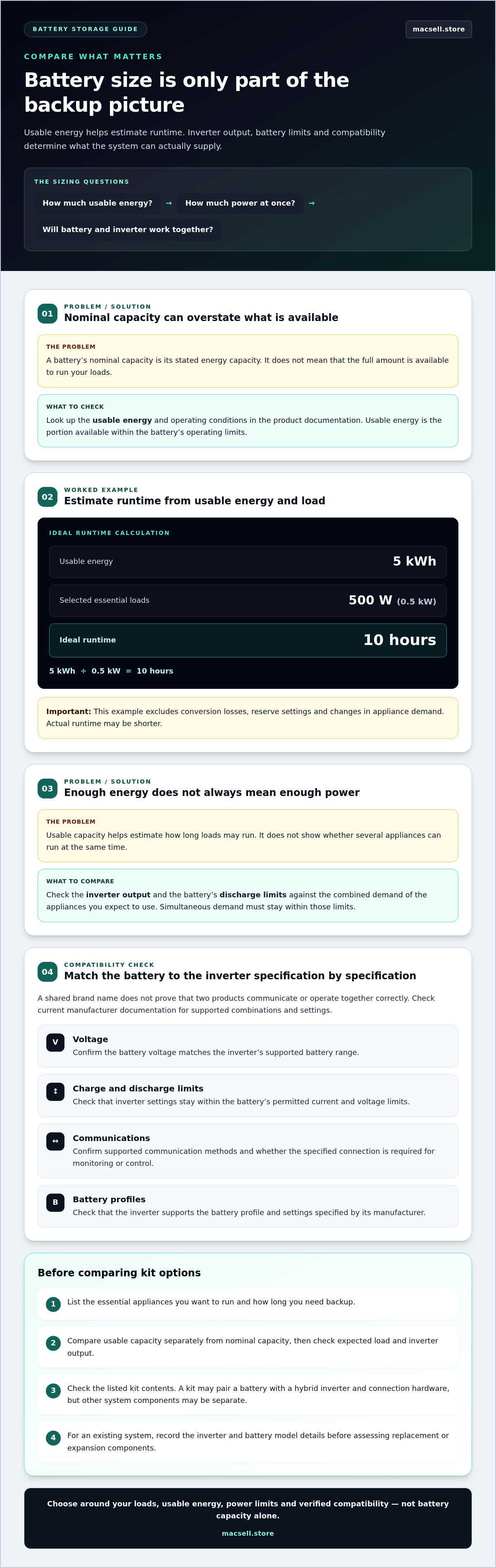
Nominal capacity, measured in kilowatt-hours (kWh), is the battery’s stated energy capacity. Usable energy is the portion available within the battery’s operating limits. Don’t assume the full nominal figure can power your loads. Check the product documentation for usable capacity and operating conditions.
For a simple estimate, assume a battery has 5 kWh of usable energy and the selected essential loads draw a steady 500 watts, or 0.5 kW. Dividing 5 kWh by 0.5 kW gives an ideal runtime of 10 hours. This example excludes conversion losses, reserve settings and changes in appliance demand, so actual runtime may be shorter.
Energy and power answer different sizing questions. Usable capacity helps estimate how long loads may run. Inverter output and battery discharge limits determine how much power the system can supply at once. Even with energy remaining, simultaneous appliance demand must stay within those limits.
Battery management and inverter compatibility
Before pairing components, compare the battery and inverter documentation across these specifications:
- Voltage: Confirm the battery voltage matches the inverter’s supported battery range.
- Charge and discharge limits: Check that inverter settings stay within the battery’s permitted current and voltage limits.
- Communications: Confirm supported communication methods and whether the specified connection is required for monitoring or control.
- Battery profiles: Check that the inverter supports the battery profile and settings specified by its manufacturer.
The battery management system (BMS) monitors battery operation and applies protective controls. A shared brand name doesn’t prove that two products communicate or operate together correctly. Use current manufacturer documentation to verify supported combinations and settings before purchase. When comparing lithium batteries and hybrid inverters, treat each pairing as a specification match, not a brand-name assumption.
How to Compare Lithium Battery Storage Kits for Your Loads
Start with the appliances you need to keep running, not the largest capacity figure on a product label. Separate essential circuits, such as communications equipment or selected lights, from optional loads. Record each appliance’s rated power, expected running time and whether it’s essential during an interruption. Some appliances draw a brief starting surge, so compare both the inverter’s continuous output and surge capability with the combined demand.
Battery capacity estimates how much energy a kit can store, whilst inverter output determines how much power it can supply at once. Assess both against your loads. A high kWh rating won’t compensate for an inverter that can’t handle appliances running simultaneously, and a powerful inverter won’t extend runtime if usable battery energy is limited.
Which loads should the kit support?
Decide whether you need short-duration backup for a small group of essential appliances or longer energy storage beyond a grid interruption. Add up expected energy use over the period you want to cover. For a fair runtime comparison, use the same appliances, running times and demand assumptions for every kit. Treat each estimate as indicative because actual use and system limits affect results.
How to compare kit configurations fairly
Use manufacturer specifications and the current product listing to complete a side-by-side comparison. Record the same details for each option, and separate confirmed figures from any information that still needs verification.
| Comparison point | What to record | Why it matters |
|---|---|---|
| Battery chemistry | The chemistry stated in the product documentation | Identifies the battery type being compared |
| Capacity | Nominal capacity and stated usable energy, in kWh | Separates the headline rating from energy available for use |
| Voltage | Battery voltage and inverter-supported range | Helps establish whether the components can be paired |
| Output | Battery discharge limits and inverter continuous and surge output | Shows whether the system can meet demand at once |
| Compatibility | Supported battery profiles, settings and communications | Checks that the inverter and battery are designed to work together |
Also record exactly what the kit includes. A listed combination may group a battery and inverter, whilst solar panels, mounting equipment or other system hardware may be separate. Check the product listing rather than assuming these items are included.
For buyers comparing lithium battery storage kits South Africa, the largest nominal kWh figure isn’t automatically the best fit. Compare usable energy and expected runtime using identical load assumptions, then check voltage, output and compatibility. Avoid ranking options by unsupported lifespan, savings or performance claims. Use documented specifications to judge how each configuration matches your requirements.
A South African Buyer’s Checklist for Battery Kit Compatibility
Use this checklist before buying a kit, replacing a battery or planning an expansion. Keep the relevant product manuals and listings together so you can compare specifications directly.
- List the loads. Record essential appliances, their rated power, expected running time and any starting surge.
- Set a backup target. Decide which circuits need power and for how long. Use the same load assumptions when comparing options.
- Record existing equipment. Note the inverter and battery model names, model numbers and specification details before considering replacement or additional storage.
- Check battery limits. Compare nominal and usable capacity, voltage, and charge and discharge limits with the inverter’s requirements and the expected loads.
- Confirm kit contents. Check the product listing for included batteries, inverter and connection hardware. Identify whether solar panels or other system components are separate.
Check the specifications before selecting a kit
Match the battery’s voltage and supported chemistry to the inverter documentation. Check continuous charging and discharging limits, not just headline capacity, and make sure they suit the intended operating conditions. Confirm the required communications connection and supported battery profile in current manufacturer documentation. A matching brand name alone doesn’t establish compatibility.
For a replacement or expansion, confirm that the manufacturer approves the proposed combination. Adding batteries can be subject to supported configurations, system design and operating limits. Don’t assume a new unit can be connected to an existing battery simply because the model or brand appears similar.
Plan for solar, backup and future changes
Decide whether the setup will use existing or new solar panels, or store energy without adding panels. Then consider whether essential loads may change, such as adding equipment or needing longer backup. Those changes can affect capacity and inverter requirements. Actual runtime, savings and battery lifespan depend on the specific equipment, settings and usage, so don’t treat generic estimates as a system guarantee.
This checklist helps narrow down lithium battery storage kits South Africa buyers can compare on real requirements rather than capacity headlines. For a practical next step, compare available lithium battery and inverter hardware.
Explore MacSell Lithium Battery Storage Kits and Hardware Options
Once your load requirements and compatibility checks are clear, compare a combo with individual batteries and inverters. A combo gives you a defined hardware pairing to assess as a starting point. Selecting components separately offers flexibility, but requires you to match each specification and confirm that the products are supported together.
A hardware combo isn’t automatically a complete solar system. Panels, mounting equipment, protection devices and cabling may be separate, and MacSell Solar Outlet sells hardware rather than providing installation services. Review the current product listing to establish what the kit contains and what additional equipment your system needs.
A listed Sunsynk and Hubble combo as a comparison example
The Sunsynk 8KVA & 2X Hubble AM2 5.5 KWh Combo Kit is a specific inverter-and-battery combination to assess against your requirements. Don’t infer usable energy, runtime, communication method or other specifications from the product name. Use the product listing and manufacturer documentation for the details.
Compare the listed components with your checklist: intended loads, required backup duration, battery limits, inverter output and supported settings. This keeps the decision focused on whether the hardware suits your requirements, rather than treating a packaged combination as a guaranteed match for every home or business. MacSell also sells individual lithium batteries and hybrid inverters, which you can assess using the same criteria.
Choose the next hardware step
If you’re still learning battery fundamentals, continue with a lithium-ion solar battery technology guide. If you’re comparing a broader home setup, a home inverter and battery combo guide can help you review packaged hardware options. Use these topics to build product knowledge, then refer to current product listings and manufacturer documents for exact specifications and inclusions.
For lithium battery storage kits South Africa buyers, the practical next step is to compare the listed battery and inverter hardware against the loads and compatibility requirements you’ve identified. Browse lithium batteries, hybrid inverters and storage kits.
Choose a Storage Setup That Fits Your Requirements
Choose lithium battery storage kits South Africa based on essential loads, desired backup duration and verified inverter compatibility, not battery capacity alone. Compare usable energy with nominal capacity, and check that inverter output and battery limits suit the appliances you plan to run.
Pre-configured kits provide a practical starting point for reviewing paired hardware, while individual batteries and inverters let you compare components separately. MacSell’s range includes Hubble lithium batteries and Sunsynk, LuxPower and Deye products, as well as the Sunsynk 8KVA & 2X Hubble AM2 5.5 KWh Combo Kit. Use product information to assess specifications and included components against your checklist.
Ready to compare your options? Browse MacSell lithium batteries, hybrid inverters and storage kits and identify the hardware that aligns with your planned system.
Frequently Asked Questions
What is included in a lithium battery storage kit in South Africa?
A lithium battery storage kit commonly combines a battery with a compatible inverter and may include connection hardware. Contents vary, so check the product listing for what is included. Solar panels, mounting equipment and installation may be separate. MacSell Solar Outlet lists the Sunsynk 8KVA & 2X Hubble AM2 5.5 KWh Combo Kit. Use its product listing for confirmed specifications and components rather than inferring them from its name.
How do I choose the right lithium battery capacity for my home?
Choose capacity based on the appliances you need to run and the backup duration you’re targeting, not household size alone. List essential loads, their power use and expected running time, then estimate the energy required. Compare that figure with the battery’s usable energy, not just nominal capacity. Also check inverter output and battery limits. Together, these details help establish whether the setup can supply the required power for the intended period.
Can I use any lithium battery with a hybrid inverter?
No. The battery and inverter must be compatible according to their manufacturers’ specifications. Compare battery voltage, supported chemistry, charge and discharge limits, communications requirements and supported battery profiles. A matching brand name doesn’t prove that a particular combination will communicate or operate correctly. Use current documentation for the exact models and settings. This compatibility check applies to individual components as well as pre-configured lithium battery storage kits South Africa buyers are considering.
How long will a lithium battery storage kit power essential appliances?
Runtime depends on usable battery energy and the combined energy demand of the appliances. As a basic estimate, divide usable capacity in kWh by the average load in kW. For instance, an illustrative 5 kWh usable supply divided by a steady 0.5 kW load gives an ideal estimate of 10 hours. Actual runtime may be shorter due to conversion losses, reserve settings, changing demand and system limits.
Is a lithium battery storage kit suitable for backup during load-shedding?
Yes, a suitably configured battery and hybrid inverter system can provide backup for selected appliances during load-shedding. The inverter must support backup operation, and the relevant circuits need to be part of the system design. Decide which loads are essential, then check their combined running demand and any starting surges against inverter and battery output limits. Battery capacity alone can’t establish which appliances the system can power or for how long.
Can I add more lithium batteries to an existing inverter system?
Sometimes, but expansion depends on the inverter’s supported configurations, the battery manufacturer’s requirements and the system’s operating limits. Before adding storage, record the exact inverter and battery model details. Check approved battery combinations, voltage, charge and discharge limits, communications and configuration settings in current manufacturer documentation. Don’t assume a battery can be added simply because it shares a brand name or product range with the existing unit.
What should I compare when buying a lithium battery storage kit?
Compare battery chemistry, nominal and usable capacity, voltage, charge and discharge limits, inverter output and documented compatibility. Match every option against the same essential loads and backup-duration assumptions. Check the current listing for included components, and note whether panels or other system hardware are separate. MacSell Solar Outlet sells pre-configured kits and individual batteries, inverters and solar panels, giving you hardware options to assess against your system requirements and manufacturer specifications.