

Hubble AM2 vs AM4: Lithium Battery Specifications Compared (2026)
The higher-capacity battery isn’t automatically the better fit. The Hubble AM2 vs AM4 lithium battery specifications show a clear difference in nominal energy and system voltage: Hubble lists the AM2 at 5.5 kWh and 48 V, while the AM4 Revision 3 is listed at 2.56 kWh and 25.6 V. Those differences can affect which inverter and system configuration are suitable.
Capacity is an easy place to start, but it won’t tell you how much energy your system can use, what output it can support, or whether its communication settings match your inverter. Listings may also refer to different revisions or present specifications inconsistently.
This comparison brings the AM2 and AM4 together across the same fields, including rated capacity, charging and discharging current, chemistry, cycle life, dimensions and parallel capability. It explains which figures matter for system design and what to confirm against current Hubble documentation and your inverter’s compatibility information before buying. MacSell Solar Outlet sells Hubble lithium batteries and hybrid inverters, including a confirmed Sunsynk 8KVA and 2X Hubble AM2 5.5 KWh Combo Kit. AM4 availability isn’t confirmed.
Key Takeaways
- Use the Hubble AM2 vs AM4 lithium battery specifications to compare both models against consistent, manufacturer-verified fields.
- Check the exact model revision and current Hubble documentation before relying on figures from a retailer listing.
- Assess usable energy and battery output against your household loads, not nominal capacity alone.
- Compare the battery’s voltage, current limits and communications support with your inverter’s documentation.
- Before choosing, ask a qualified system professional to check expansion requirements and installation space.
Hubble AM2 vs AM4: what the comparison needs to establish
Compare documented specifications and system fit, not model names alone. Hubble’s product pages list the AM2 at 5.5 kWh nominal energy and 48 V, and the AM4 Revision 3 at 2.56 kWh and 25.6 V. These figures show important differences, but don’t answer every design question. The available product information doesn’t establish all AM2 and AM4 specifications, including a like-for-like usable-energy value.
The Hubble AM2 vs AM4 lithium battery specifications may also differ by revision or listing. Before relying on a figure, match it to current, model-specific Hubble documentation. Don’t fill gaps with assumptions or combine figures from different product generations.
Which battery specifications matter in a direct comparison?
Nominal energy, measured in kilowatt-hours (kWh), is the battery’s stated energy capacity. Usable energy is the portion available to supply loads under the manufacturer’s specified conditions. These terms aren’t interchangeable: a nominal kWh figure alone doesn’t confirm how much energy a household can draw.
Check power and current ratings separately. Continuous discharge describes the output a battery can sustain, while peak discharge refers to a short-duration limit, if the manufacturer specifies one. Compare both with the inverter and expected loads, and don’t treat a peak rating as continuous. Check nominal voltage, charge limits and operating conditions using matching units and equivalent conditions. If a specification isn’t stated in the relevant documentation, mark it as unconfirmed.
Why exact model identification comes before comparing figures
Record the full model name, product code and revision shown on each product label and datasheet. Check the document date and source, then confirm that the figures refer to the same model generation. Retailer listings can be a useful starting point, but verify technical values against current Hubble documentation. Hubble identifies the AM4 figure used here as Revision 3, so don’t assume it applies to another revision.
Nominal capacity is the battery’s stated energy rating; usable energy is the amount available to supply loads under the manufacturer’s specified conditions.
For system design, confirm communication requirements and the Battery Management System (BMS), which monitors and manages battery operation. This overview of the Battery Management System (BMS) explains the general role of a BMS, but doesn’t confirm AM2 or AM4 inverter compatibility. Check compatibility separately against current battery and inverter documentation.
Hubble AM2 vs AM4 specifications: build a verified comparison table
The table distinguishes manufacturer-listed figures from details that still need checking. Hubble’s product pages don’t show a publication date; the figures below were checked on 29 September 2026. Confirm the exact battery revision and its current datasheet before using these specifications in a system design.
| Specification | Hubble AM2 | Hubble AM4 Revision 3 |
|---|---|---|
| Model code / revision | Exact product code not established in the cited material; verify the unit label and datasheet. | Revision 3; exact product code not established in the cited material. Confirm against the unit label and datasheet. |
| Cell chemistry | Li-ion prismatic cells (NMC). Hubble support article, dated 6 December 2022. | LiFePO4 (LFP). Hubble AM4 product page, undated; checked 29 September 2026. |
| Nominal energy | 5.5 kWh. Hubble AM2 product page, undated; checked 29 September 2026. | 2.56 kWh. Hubble AM4 product page, undated; checked 29 September 2026. |
| Rated capacity (5-hour rate) | 117 Ah. Hubble AM2 product page, undated; checked 29 September 2026. | 100 Ah. Hubble AM4 product page, undated; checked 29 September 2026. |
| Nominal voltage | 48 V. Hubble AM2 product page, undated; checked 29 September 2026. | 25.6 V. Hubble AM4 product page, undated; checked 29 September 2026. |
| Equalised charge voltage | 53.8 V. Hubble AM2 product page, undated; checked 29 September 2026. | 27.6 V. Hubble AM4 product page, undated; checked 29 September 2026. |
| Maximum continuous charge / discharge current | 100 A / 100 A. Hubble AM2 product page, undated; checked 29 September 2026. | 100 A / 100 A. Hubble AM4 product page, undated; checked 29 September 2026. |
| Usable energy and peak current | Not established in the cited product page. | Not established in the cited product page. |
| Parallel capability | Up to 15 units. Hubble AM2 product page, undated; checked 29 September 2026. | Up to 15 units. Hubble AM4 product page, undated; checked 29 September 2026. |
| Communications | Cloudlink-ready per Hubble product page; specific CAN/RS485 details and inverter requirements need model-level confirmation. | Cloudlink-ready per Hubble product page; specific CAN/RS485 details and inverter requirements need model-level confirmation. |
| Operating limits and protection | Not established here; confirm in the exact model datasheet. | Not established here; confirm in the exact model datasheet. |
Capacity, voltage and output ratings
Hubble’s undated AM2 and AM4 product pages, checked on 29 September 2026, list the AM2 at 5.5 kWh and 48 V, and the AM4 Revision 3 at 2.56 kWh and 25.6 V. These are nominal energy and voltage figures, not confirmed usable energy. The pages list 100 A continuous current ratings, but don’t establish a peak-current figure. Don’t turn a current rating into a power claim without accounting for the documented voltage and operating conditions.
Communications, protection and operating limits
Cloudlink-ready status doesn’t, on its own, confirm direct CAN or RS485 support for a particular inverter. Check the exact battery and inverter documentation for protocols, cables, settings and supported operating limits. The IEC 62619:2022 safety standard is a relevant safety reference for industrial lithium batteries, but its listing alone doesn’t establish certification of either model.
For a South African system, ask a qualified system professional to check the design against the selected inverter and battery documentation. You can also explore Hubble battery and hybrid inverter hardware; AM4 availability isn’t confirmed.
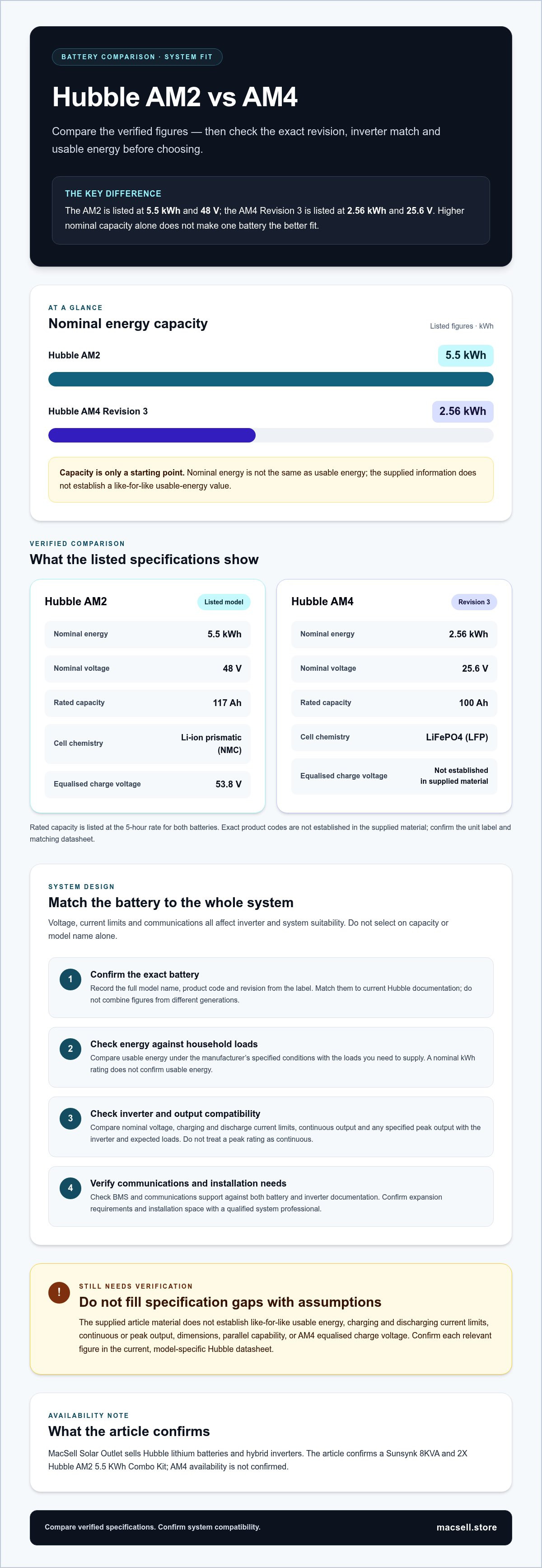
How AM2 and AM4 specifications affect inverter compatibility and system design
A battery can have suitable storage capacity and still be the wrong match for an inverter. The Hubble AM2 vs AM4 lithium battery specifications comparison is useful at system level only when the battery’s voltage, current limits and communications are checked against the exact inverter model and its requirements.
Check the inverter before choosing a battery model
Start with the inverter’s battery voltage range and supported lithium communication protocols. Then check the manufacturers’ compatibility information for the exact battery and inverter models, including revisions. A similar model name or matching voltage alone doesn’t establish compatibility or confirm that battery monitoring and control will work as intended.
For a Sunsynk system, check the current manufacturer documentation for the specific inverter’s approved battery settings, firmware or configuration requirements, and communication method. MacSell Solar Outlet sells hybrid inverter hardware and a Sunsynk and Hubble AM2 combo kit, but that doesn’t confirm compatibility with every Sunsynk model or AM2 revision. Verify the precise pairing before purchase.
Match capacity and discharge limits to the intended loads
List the loads you need to back up, such as refrigeration, lighting or communications equipment. Record each item’s power demand and how long it needs to run. Then compare the combined demand with the inverter’s output capability and the battery’s documented continuous discharge limit. Treat peak ratings separately: a short-duration peak figure doesn’t show what the battery can supply continuously.
Rated battery capacity isn’t the same as energy available at household sockets. Usable energy, inverter conversion and other system losses affect what reaches the loads. Backup duration therefore depends on the selected battery configuration, load profile and operating conditions. A capacity label alone can’t guarantee a runtime.
Example check, not a runtime estimate: If your backup plan covers a fridge, lights and a router, gather the appliance and inverter specifications, estimate how long each load must run, then compare total demand with the battery’s documented usable energy and continuous output limits. The information here doesn’t verify every input for a specific inverter pairing or numerical runtime, so a fixed estimate wouldn’t be reliable.
For system-specific questions about battery settings, communications, expansion or load planning, speak to a qualified system professional who can check current manufacturer documents. MacSell Solar Outlet is a hardware retailer, not an installation service provider.
Which Hubble battery should you choose? Compare use cases and expansion needs
Choose based on system requirements, not the larger number on a capacity label. Hubble lists nominal energy of 5.5 kWh for the AM2 and 2.56 kWh for AM4 Revision 3, but the available figures don’t establish usable energy for either model. Confirm usable energy, inverter compatibility and the relevant model revision before making a recommendation.
When a model’s documented capacity may suit the system
Start with the loads you want to back up. For each appliance, note its rated power and the number of hours you expect to run it. Multiply power in kilowatts by operating hours to estimate energy demand in kilowatt-hours, then add the loads together. This is a planning estimate, not a runtime guarantee: actual demand varies, and inverter conversion and other system losses affect the energy delivered.
Compare the estimate with the battery’s verified usable energy, not nominal capacity alone. If Hubble documentation confirms that a model’s usable energy meets the requirement, and the inverter’s voltage, current and communications requirements also match, that model may suit the design. If usable energy or compatibility information is missing, don’t infer it from the nominal kWh rating.
The AM2’s higher nominal energy doesn’t automatically mean better performance in every system. Its listed nominal voltage is 48 V, while AM4 Revision 3 is listed at 25.6 V. A model is a candidate only if the inverter is designed for its battery voltage and the documented limits support the intended loads.
What to check before planning parallel batteries
Hubble’s product pages list parallel capability of up to 15 units for both models. Before planning an expansion, confirm the current limit and instructions for the exact revision. Check the approved wiring arrangement, inverter limits, and any requirements for matching models, firmware or state of charge. Don’t assume the AM2 and AM4 can be mixed in one bank unless Hubble explicitly documents that configuration.
- Identify the exact battery and inverter models and revisions.
- Confirm usable energy, continuous output and communications in current manufacturer documentation.
- Ask a qualified system professional to check space, wiring and manufacturer-approved parallel arrangements.
Use the Hubble AM2 vs AM4 lithium battery specifications to shortlist options, then check the final system design against the relevant manufacturer guidance. MacSell sells Hubble lithium batteries and hybrid inverters; AM4 availability isn’t confirmed. Explore confirmed Hubble battery and inverter hardware.
Hubble AM2 vs AM4: final pre-purchase checklist and next steps
Before ordering, verify the exact battery and inverter combination, not just the model names. Hubble’s product pages list the AM2 at 5.5 kWh nominal energy and 48 V, and the AM4 Revision 3 at 2.56 kWh and 25.6 V. These are nominal figures; the available information doesn’t establish usable energy for either model. Check the current datasheet for the specific unit you’re considering.
Five checks to complete before ordering
- Identify each model. Record the full battery and inverter model names, product codes and revisions from their labels.
- Verify the documents. Check the latest model-specific manufacturer datasheets and note their publication or revision dates.
- Confirm compatibility. Compare the inverter’s supported battery voltage, current limits, communication protocol and configuration requirements with both manufacturers’ documentation.
- Match energy and output to your needs. Compare documented usable energy and continuous discharge ratings with the loads you plan to run. Don’t treat nominal capacity as guaranteed energy at the loads.
- Check the full system design. Ask a qualified system professional to confirm installation space, wiring, expansion arrangements and operating conditions.
Where to find product and system information
For details on the confirmed Sunsynk and AM2 hardware offering, look for the Sunsynk 8KVA and Hubble AM2 Combo Kit guide. For background on battery terms and operation, consult the lithium-ion solar battery technology guide. These guide titles are included for reference; no destination URLs were supplied for them.
MacSell sells solar hardware, including Hubble lithium batteries and hybrid inverters, but doesn’t provide installation services. Confirm battery selection, system design and installation with appropriately qualified professionals using current manufacturer guidance.
Review confirmed Hubble hardware options
Use the Hubble AM2 vs AM4 lithium battery specifications as a starting point, then verify every figure against the datasheet for the exact revision. AM4 availability at MacSell isn’t confirmed, so check current listings rather than assuming it’s offered. To review the retailer’s confirmed Hubble battery and other solar hardware options, browse solar hardware at MacSell.
Choose your battery with the system in view
The Hubble AM2 vs AM4 lithium battery specifications point to different system requirements, particularly voltage and nominal energy. Neither figure alone confirms how much energy will be available to household loads or whether a battery suits your inverter.
Before choosing, verify the exact model revision against current Hubble documentation. Check usable energy, continuous discharge limits and communication requirements, then compare them with your inverter specifications, essential loads and available installation space. A qualified system professional can help confirm the design and installation requirements.
MacSell sells Hubble lithium batteries and hybrid inverter hardware, including the confirmed Sunsynk 8KVA and 2X Hubble AM2 5.5 KWh Combo Kit. AM4 availability isn’t confirmed, so check product listings rather than assuming it’s offered. Browse solar hardware at MacSell to review the confirmed offerings and take the next step with a clearer view of your system needs.
Frequently Asked Questions
What is the main specification difference between the Hubble AM2 and AM4?
The main differences are nominal energy, voltage and cell chemistry. Hubble lists the AM2 at 5.5 kWh and 48 V, with NMC cells, while AM4 Revision 3 is listed at 2.56 kWh and 25.6 V, with LiFePO4 cells. Both product pages list a maximum continuous charge and discharge current of 100 A. Check the exact model revision and current Hubble documentation before relying on these figures.
How much usable capacity do the Hubble AM2 and AM4 batteries provide?
A verified usable-energy figure isn’t established for either model in the product information referenced here. The listed 5.5 kWh for the AM2 and 2.56 kWh for AM4 Revision 3 are nominal energy ratings, not confirmed energy available to household loads. Ask Hubble or your system designer to confirm the usable-energy rating for the exact revision. Don’t estimate it by applying an assumed depth of discharge.
Are the Hubble AM2 and AM4 compatible with the same inverter?
Not necessarily. The AM2 is listed at 48 V and AM4 Revision 3 at 25.6 V, so an inverter must support the selected battery’s voltage range. Check the exact inverter and battery models against both manufacturers’ compatibility information. Confirm communication protocols, configuration settings and current limits as well. A shared brand or similar product label doesn’t prove compatibility, and support for one model or revision doesn’t automatically apply to another.
Can Hubble AM2 and AM4 batteries be connected in parallel?
Hubble’s product pages list parallel capability for up to 15 units for each model, but that doesn’t confirm that AM2 and AM4 can be mixed in one battery bank. Don’t combine different models unless Hubble explicitly approves that configuration for the exact revisions. Before planning expansion, verify unit limits, wiring arrangements, inverter support and any requirements for matching batteries, firmware or state of charge in current manufacturer documentation.
Which Hubble battery is better for backup power?
Neither is automatically better; the right choice depends on your loads and inverter. The AM2 has the higher listed nominal energy, but that figure alone doesn’t establish usable energy or runtime. Calculate the energy required by essential appliances over the intended backup period, then compare it with verified usable energy and continuous discharge limits. Factor in inverter compatibility and system losses, and ask a qualified system professional to check the design.
What should I check before buying a Hubble AM2 or AM4 battery?
Confirm the exact battery model, product code and revision, then check its current Hubble datasheet. Verify nominal voltage, usable energy, continuous discharge rating and communications against the exact inverter documentation. Match the battery to your expected loads, installation space and expansion plans. If a specification or compatibility detail is missing, ask Hubble or a qualified system professional to confirm it rather than relying on an inconsistent retailer listing.