

Revov 2nd LiFe vs Hubble AM2 New Cell: 2026 Comparison
A new-cell battery is not automatically the better fit. In this Revov 2nd LiFe battery vs Hubble AM2 new cell comparison, the right choice depends on verified specifications, inverter communication and your backup requirements, not cell history alone.
It is sensible to question product figures when capacity, cycle life and test conditions are not presented on the same basis. Revov 2nd LiFe batteries use repurposed EV cells, while the Hubble AM2 uses new prismatic cells. That difference alone does not show which battery will suit your setup. The exact model matters too: the Revov R100, for example, has been discontinued, so check the specific unit and current datasheet before comparing figures.
This 2026 comparison explains which specifications can be compared directly, what capacity and cycle-life claims mean under different conditions, and what to confirm about inverter protocols, firmware and configuration. Use the checks below to match either option to your inverter and backup loads, then assess the available lifecycle evidence against your system requirements.
Key Takeaways
- Check the exact model and current datasheet for each battery. Do not assume every Revov 2nd LiFe or Hubble AM2 variant has the same specifications.
- Assess cell history as one factor in suitability, not as a stand-alone measure of battery performance.
- Compare usable energy, output, cycle life and warranty only when the figures have clearly stated, comparable test conditions.
- Before choosing, check the inverter’s battery profile, voltage and current limits, communications protocol and firmware.
- Match the battery to your backup loads and system requirements, then compare value using verified usable capacity rather than a headline rating.
Revov 2nd LiFe vs Hubble AM2: What is being compared?
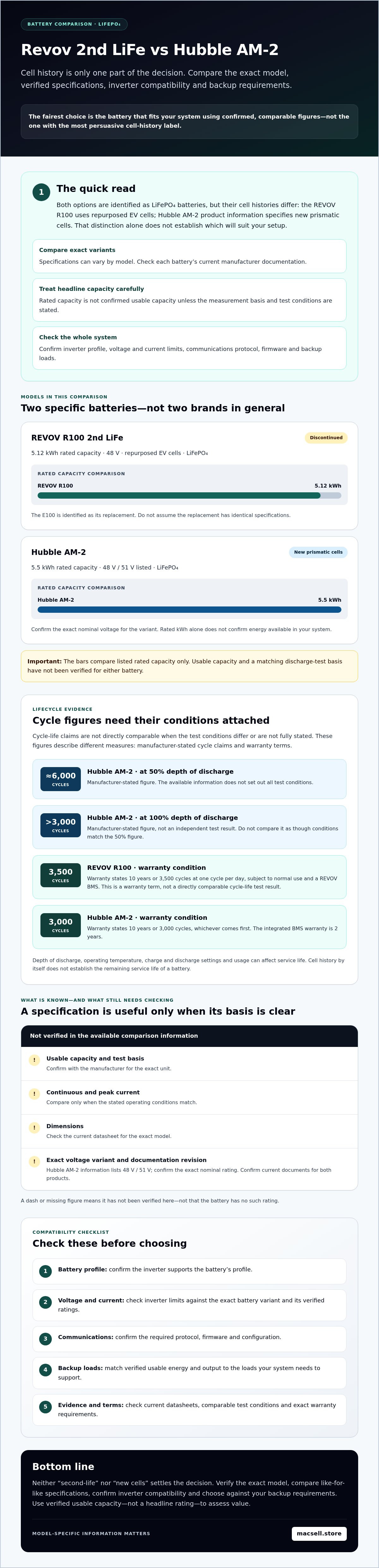
Make the comparison using exact models, not brand names alone. Here, the REVOV option is the R100 2nd LiFe 5.12 kWh 48 V battery, and the Hubble option is the AM-2 5.5 kWh 48 V battery, described in current product information as using new lithium-ion prismatic cells. Their rated capacities differ, but those figures alone do not confirm how much energy either battery makes available in a system.
Cell history and battery chemistry are separate considerations. Both products are identified as LiFePO₄. For an overview of LiFePO₄ chemistry, see this reference. REVOV describes the R100 as a 2nd LiFe product using repurposed EV cells, while Hubble AM-2 product information specifies new prismatic cells.
Which exact battery variants are in scope?
Model and document version matter. The REVOV R100 has been discontinued, with the E100 identified as its replacement. Do not use specifications from another REVOV family, such as the R9, or assume the replacement has identical specifications. The information available for this comparison does not establish current datasheet publication dates or a Hubble AM-2 revision. Confirm both against the manufacturer’s latest documentation before buying.
Which specifications can be compared fairly?
The table separates listed ratings from details that still need confirmation. Capacity figures are product-rated values. The available information does not confirm a matching usable-capacity measurement basis or discharge test conditions. A dash means the figure has not been verified here, not that the battery has no such rating.
| Specification | REVOV R100 2nd LiFe | Hubble AM-2 |
|---|---|---|
| Voltage | 48 V | 48 V / 51 V listed; confirm exact nominal rating for the variant |
| Capacity | 5.12 kWh rated | 5.5 kWh rated |
| Usable capacity and test basis | Not verified; confirm with manufacturer | Not verified; confirm with manufacturer |
| Continuous and peak current | Not verified | Not verified |
| Dimensions | Not verified | Not verified |
| Warranty | 10 years or 3,500 cycles at one cycle per day, subject to normal use and a REVOV BMS | 10 years or 3,000 cycles, whichever comes first; integrated BMS warranty: 2 years |
Compare current ratings only when the continuous or peak conditions match. Likewise, do not treat rated kWh as usable kWh without a stated measurement basis. This Revov 2nd LiFe battery vs Hubble AM2 new cell comparison is a starting point. Confirm missing specifications and exact warranty terms in the current model documents before deciding whether either battery suits your system.
Cell history, LiFePO₄ chemistry and battery lifespan: what the labels mean
LiFePO₄ describes the battery chemistry: lithium iron phosphate is used in the cells’ electrode material. “New cell” and “second-life” describe the cells’ history before they were assembled into a battery. Chemistry can help explain how a battery behaves, but it does not reveal an individual cell’s age, condition or previous use.
What does “2nd LiFe” mean for this REVOV model?
For the REVOV R100, the available product information identifies the cells as repurposed electric-vehicle cells. This supports describing the model as second-life, but does not establish the previous vehicle, cell age or history. Nor does the information specify the R100’s cell-by-cell capacity tests, grading thresholds, matching process or quality-control results. Ask REVOV for model-specific documentation instead of assuming the process is identical across its battery range.
A battery management system (BMS) monitors and controls battery operation. The R100 warranty information specifies use with a REVOV BMS and normal operating conditions. That requirement is important, but it does not replace evidence about cell selection or testing. Request the current datasheet and warranty terms for the exact model.
Does a new-cell description guarantee a longer lifespan?
No. New cells do not guarantee a longer service life in a particular system. Cell condition is one factor; operating temperature, charge and discharge settings, depth of discharge and usage also affect the result. Cell history alone cannot establish remaining service life without model-specific test evidence.
Hubble AM-2 product information describes new lithium-ion prismatic cells and states approximately 6,000 cycles at 50% depth of discharge, and more than 3,000 cycles at 100% depth of discharge. These are manufacturer-stated figures, not independent test results. The available information does not set out all test conditions, so do not treat them as directly comparable with another model’s cycle claim.
The REVOV R100 warranty is stated as 10 years or 3,500 cycles at one cycle per day, subject to normal use and use with a REVOV BMS. A warranty threshold is not the same as a published cycle-life test under matching conditions. The R100 is discontinued, so confirm which warranty terms apply to any specific unit being considered.
For this Revov 2nd LiFe battery vs Hubble AM2 new cell comparison, request evidence for the exact model: cell provenance, grading and test records, cycle-test depth of discharge and conditions, and warranty exclusions. MacSell Solar Outlet sells Hubble hardware, including Hubble lithium batteries. Check the specific product details before comparing it with a REVOV battery.
Revov 2nd LiFe vs Hubble AM2: compare capacity, output and value
Capacity indicates stored energy; output indicates how much power the battery can supply at a given time. Both affect backup performance, but they answer different questions. The R100 and AM-2 have stated ratings of 5.12 kWh and 5.5 kWh respectively. These are nominal figures, not confirmed usable energy measured under matching test conditions.
| Specification | REVOV R100 2nd LiFe | Hubble AM-2 |
|---|---|---|
| Rated energy | 5.12 kWh | 5.5 kWh |
| Verified usable energy and test basis | Not confirmed; check current manufacturer documentation | Not confirmed; check current manufacturer documentation |
| Continuous and peak output | Not verified | Not verified |
| Dimensions | Not verified | Not verified |
| Warranty | 10 years or 3,500 cycles at one cycle per day, subject to stated conditions | 10 years or 3,000 cycles, whichever comes first; integrated BMS warranty: 2 years |
| Published cycle-life figures | Warranty cycle limit; comparable test basis not confirmed | Approximately 6,000 cycles at 50% DoD; above 3,000 at 100% DoD |
Missing output figures matter. A battery’s continuous power rating relates to the loads it can support together, while peak output applies only for a specified short duration. Without verified ratings and conditions for both models, do not assume either can run a particular appliance or combination of loads. Usable energy most directly affects backup duration; continuous and peak output determine which loads the battery can support.
How should buyers assess long-term value?
Compare cycle-life claims only when depth of discharge, temperature and test methodology align. The Hubble figures distinguish between 50% and 100% depth of discharge, so they should not be treated as a single figure directly comparable with the REVOV warranty cycle limit. Warranty coverage and cycle-life testing are also different measures.
To estimate price per usable kWh, divide each battery’s current quoted price in rand by its manufacturer-confirmed usable kWh. Use quotes for the exact model and include only comparable items in the calculation. This is a screening measure, not total ownership cost: service life depends on usage and operating conditions, and system costs may also depend on the installation configuration. Request current datasheets and written quotes before ranking value in this Revov 2nd LiFe battery vs Hubble AM2 new cell comparison.
Check inverter compatibility and backup-load requirements before choosing
Matching battery voltage to inverter voltage does not confirm that the two will work together. Compatibility can depend on the exact inverter model, battery profile, communications protocol, firmware and configuration. Before treating either option as compatible, verify the complete pairing against current manufacturer documentation.
Will either battery work with the existing inverter?
Check these five items against the inverter and battery documents:
- Inverter model: Record the full model designation and firmware version.
- Supported battery profile: Confirm the exact battery model or approved profile is listed by the inverter manufacturer.
- Voltage range: Check the battery’s operating voltage against the inverter’s permitted range.
- Current limits: Match the battery’s continuous charge and discharge limits to the inverter settings and requirements.
- Communications: Confirm CAN or RS485 support, cable pinout, firmware and required battery-profile settings.
Manufacturer compatibility information names Sunsynk among the inverter brands supported by both ranges. The REVOV R100 uses a Pylontech CAN protocol, while Hubble AM-series batteries are described as offering native CAN integration with Sunsynk and other brands. These broad claims do not confirm every model, firmware version or configuration. Compatibility information for a different REVOV battery, such as an E300, also does not prove compatibility for an R100.
How should backup loads shape the decision?
Start by listing the loads you need during an outage. Note each appliance’s running demand and, where relevant, its starting demand. Add the loads likely to run at the same time, then compare the total requirement with the inverter’s output and the battery’s verified continuous and peak limits. Nominal kWh alone cannot predict runtime.
Estimate backup duration using manufacturer-confirmed usable energy, expected load and realistic system losses. Treat the result as an estimate, not a guarantee; actual runtime depends on operating conditions and appliance use. Consider parallel batteries only if both manufacturers confirm the specific configuration, communications setup and operating limits.
MacSell sells solar hardware, including a listed Sunsynk 8KVA and 2X Hubble AM2 5.5 KWh combo kit. Check the current listing and exact kit configuration when reviewing Hubble AM2 hardware options. Product sales do not include installation. Direct electrical design and installation questions to a qualified professional.
Which battery should you choose, and what should you verify before buying?
There is no universal winner. Choose the battery whose documented specifications, warranty conditions and communications match your inverter and backup requirements. Consider a REVOV option only if the exact model’s cell history, test evidence and inverter fit meet your needs. Consider the Hubble AM2 only if its verified specifications, cell description and system compatibility do the same. This Revov 2nd LiFe battery vs Hubble AM2 new cell comparison is useful when you assess exact models rather than brand labels alone.
Use this pre-purchase checklist
Before committing, request and check:
- Exact model identifiers and current datasheets for the battery and inverter. Confirm revisions and publication dates.
- Written warranty terms, including conditions, exclusions and whether cycle limits apply.
- Cell history and test evidence for the specific battery model. Ask what testing and grading information is available.
- Usable capacity and current limits, with discharge conditions and continuous or peak ratings clearly stated.
- Communications requirements, including supported battery profile, CAN or RS485 protocol, pinout and firmware settings.
- Package configuration, checking the quoted battery quantity and inverter model against your system plan.
Do not rely on a similar model’s datasheet or a voltage match as proof of compatibility. If an essential specification is missing or the test basis differs, request confirmation from the manufacturer before comparing performance or value.
Where to find the related hardware information
For further system context, review the Sunsynk 8KVA and Hubble AM2 combo kit guide, the lithium-ion solar battery technology guide and the home inverter and battery combo guide. These offer related hardware information, but they do not replace model-specific compatibility checks.
MacSell Solar Outlet sells Hubble hardware, including a listed Sunsynk 8KVA and 2X Hubble AM2 5.5 kWh combo kit. Check the current listing and exact configuration before purchase. Hardware sales do not include installation or financing. Browse Hubble battery hardware at MacSell Solar Outlet.
Choose the battery that fits your system
The Revov 2nd LiFe battery vs Hubble AM2 new cell comparison points to a practical decision, not a universal winner. Compare exact model datasheets, confirmed usable capacity and output limits, warranty conditions, and inverter communication requirements. Cell history matters, but it cannot establish service life without model-specific test evidence.
Before buying, confirm the battery suits your inverter and backup loads, then check the current product and warranty details. MacSell Solar Outlet sells Hubble lithium batteries and lists a Sunsynk 8KVA and 2X Hubble AM2 combo kit. Hardware retail is available nationally across South Africa; installation is not provided. Check the current listing and exact kit configuration before deciding.
Browse Hubble battery hardware at MacSell Solar Outlet and use the verified details to choose a product that suits your system.
Frequently Asked Questions
Is the REVOV 2nd LiFe battery better than the Hubble AM2 with new cells?
Neither is automatically better. The right choice depends on verified model specifications, inverter compatibility and backup requirements. In this Revov 2nd LiFe battery vs Hubble AM2 new cell comparison, the R100 is rated at 5.12 kWh and the AM-2 at 5.5 kWh, but those nominal figures do not confirm usable energy or output under matching conditions. Compare current datasheets, warranty terms and system fit before deciding.
What does “2nd LiFe” mean on a REVOV battery?
For the REVOV R100, available product information describes repurposed electric-vehicle cells used in stationary storage. “Second-life” refers to prior use, not a different battery chemistry. However, the information available here does not establish the cells’ individual history, grading thresholds or test results. Ask for current, model-specific documentation on cell provenance, capacity testing and quality control. Do not assume details for one REVOV model apply to its entire range.
Does a new-cell Hubble AM2 last longer than a second-life battery?
Not necessarily. New cells alone do not establish a battery’s service life; temperature, charge settings, depth of discharge and usage also matter. Hubble states approximately 6,000 cycles at 50% depth of discharge and above 3,000 cycles at 100%, while the REVOV R100 warranty is 10 years or 3,500 cycles at one cycle per day, subject to conditions. These figures are not directly comparable without matching test methods and conditions.
Can a REVOV 2nd LiFe or Hubble AM2 battery work with my inverter?
It may, but confirm the exact pairing in current inverter and battery documentation. Check the inverter model, firmware, supported battery profile, voltage range, current limits and communications protocol, including CAN or RS485 settings and cable pinout where applicable. REVOV and Hubble describe compatibility with several inverter brands, but broad compatibility claims do not guarantee every model or configuration. Voltage matching alone is not proof of compatibility.
How much usable energy does each battery provide?
The REVOV R100 is rated at 5.12 kWh, while the Hubble AM-2 is rated at 5.5 kWh. These are stated capacity figures, not confirmed usable-energy values on a matching test basis. Ask each manufacturer for usable capacity, depth-of-discharge limits and test conditions for the exact model. Use verified usable energy, rather than nominal kWh alone, when estimating backup duration.
What should I compare in the warranty and cycle-life specifications?
Check the warranty duration, cycle limit, exclusions and conditions, including required battery management equipment and operating requirements. The R100 warranty is stated as 10 years or 3,500 cycles at one cycle per day, subject to normal use and a REVOV BMS. Hubble AM-2 is stated as 10 years or 3,000 cycles, whichever comes first, with a separate 2-year warranty for its integrated BMS. Compare cycle figures only when depth of discharge and test conditions match.
Can I connect multiple REVOV 2nd LiFe or Hubble AM2 batteries in parallel?
Only if the manufacturer confirms parallel operation for the exact battery model and system configuration. Hubble AM-series information states support for up to 15 units, but confirm that this limit applies to the AM-2 variant and check inverter, communications and configuration requirements. The available information here does not confirm a parallel limit for the REVOV R100. Do not assume another model’s limits apply; verify current documentation before connecting batteries.