

Hubble AM5 vs Freedom Won Home Lithium Battery: A South African Buyer’s Comparison for 2026
Which battery gives your home more practical backup: one with more usable energy, or one that can deliver more power at once? The Hubble AM5 vs Freedom Won home lithium battery comparison turns on both questions, not headline capacity alone. For the Hubble AM-5 / AM-5+ and Freedom Won Lite Home 5/4, listed usable energy is 5.12 kWh and 4 kWh respectively, while their discharge ratings differ substantially.
It’s easy to focus on kilowatt-hours when estimating backup, but the inverter, household loads and battery operating limits also shape what a system can support. Model name and revision matter too: specifications, communications and expansion rules can vary. For a like-for-like comparison, use the relevant manufacturer datasheets. This guide compares usable energy, continuous and peak output, inverter compatibility, configuration and warranty, then explains how those specifications relate to common backup priorities and what to assess before choosing battery hardware for a South African home.
Key Takeaways
- Compare nominal capacity, usable energy and output power as separate specifications when estimating what a battery can support.
- The Hubble AM5 vs Freedom Won home lithium battery decision starts with the exact model and revision, then turns on system fit and backup priorities.
- Match the battery’s inverter compatibility and communication requirements to your existing hardware before settling on a configuration.
- List essential loads and desired backup duration, then use current manufacturer datasheets to assess the system against those needs.
- MacSell’s solar hardware range includes Hubble lithium batteries and hybrid inverters, as well as a separate Sunsynk and Hubble AM2 combo kit.
Hubble AM5 vs Freedom Won: what should a home battery comparison answer?
The better choice depends on the exact battery model, its compatibility with your inverter and the backup priorities it needs to meet. For a useful Hubble AM5 vs Freedom Won home lithium battery comparison, first match the model identifiers and datasheets, then assess energy, power and system fit. A headline kilowatt-hour figure alone can’t tell you whether a battery will support your essential circuits or for how long.
Three terms answer different questions:
- Nominal capacity or energy describes the battery’s stated storage, commonly shown in kilowatt-hours (kWh).
- Usable energy is the amount available for use under the manufacturer’s stated operating limits.
- Output power, often expressed as current in amperes (A) or power in kilowatts (kW), describes the rate at which energy can be supplied.
Stored energy indicates how much electricity is available; output power indicates how quickly the battery can deliver it. A battery may have enough stored energy for a long backup period but still be unsuitable for a load that exceeds its permitted output. The inverter and system configuration also affect what the home can use. For general context on household battery storage, see Understanding Home Energy Storage Systems.
Which exact Hubble AM5 and Freedom Won models are being compared?
This comparison uses the Hubble AM-5 / AM-5+ and Freedom Won Lite Home 5/4 model names. Treat these as distinct identifiers, not interchangeable labels. Check the manufacturer datasheet for the exact model and revision being considered. Compare one battery with one battery, then assess any multi-unit configuration separately. Limits can depend on the model or system configuration, so don’t apply a figure from one version or setup to another.
What does “better for home use” mean?
Define the outcome before judging either option. Do you need longer backup for a small group of essential circuits, support for a greater load, whole-home backup or room to expand the system later? These are separate requirements. A battery comparison can narrow the choice, but system performance also depends on the inverter, connected loads and intended configuration.
For example, a household prioritising lights, internet and selected appliances should estimate their combined demand and how many hours they need to run. A whole-home plan needs a broader load assessment, particularly if several high-demand appliances might operate together. In either case, compare the battery’s usable energy and output limits with the load profile. Don’t treat nominal capacity as a guaranteed runtime.
Compatibility is another decision, not a footnote. The battery, inverter and communication setup must work together within the relevant manufacturers’ requirements. Record model, revision and configuration details before comparing figures, so you don’t apply a specification to the wrong hardware. The next step is to review the specifications that determine practical backup side by side.
Compare Hubble AM5 and Freedom Won specifications side by side
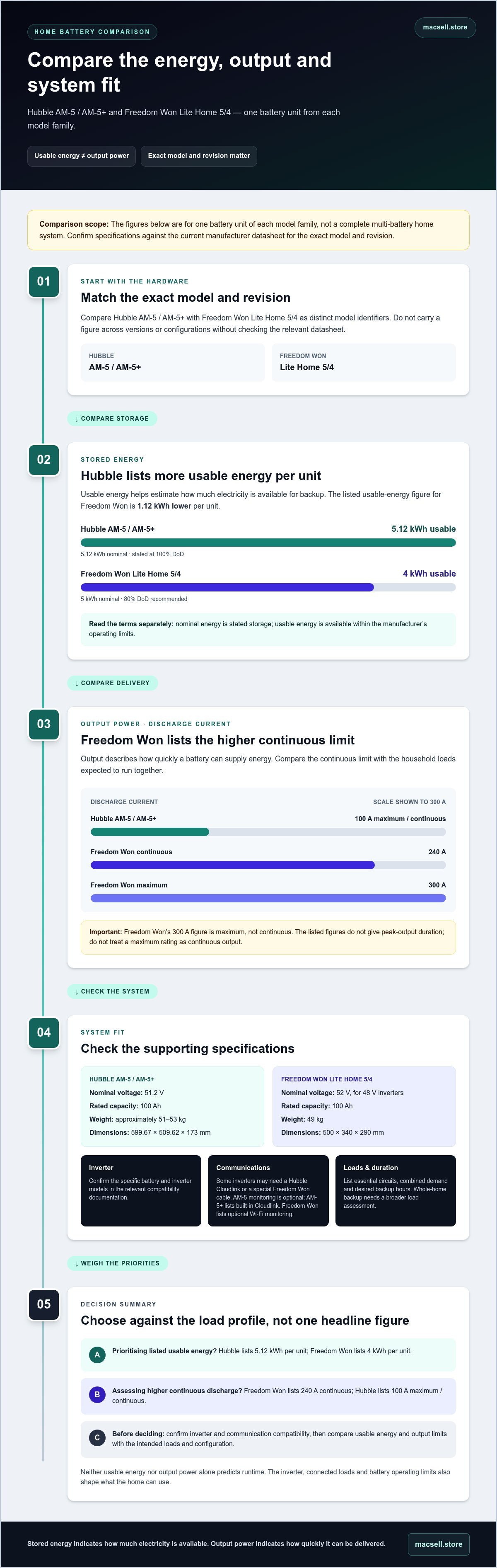
The figures below compare one battery unit from each model family, not a complete multi-battery home system. Hubble’s AM-5 and AM-5+ share several listed electrical figures, but monitoring and parallel-unit limits differ by version. Use the exact model and revision shown on the battery’s manufacturer documentation, and confirm the figures against its current datasheet before finalising a design.
| Specification | Hubble AM-5 / AM-5+ | Freedom Won Lite Home 5/4 |
|---|---|---|
| Nominal energy | 5.12 kWh | 5 kWh |
| Usable energy | 5.12 kWh, stated at 100% DoD | 4 kWh, 80% DoD recommended |
| Nominal voltage | 51.2 V | 52 V, for 48 V inverters |
| Rated capacity | 100 Ah | 100 Ah |
| Discharge limit | 100 A maximum / continuous | 300 A maximum; 240 A continuous |
| Weight and dimensions | Approximately 51-53 kg; 599.67 × 509.62 × 173 mm | 49 kg; 500 × 340 × 290 mm |
Usable energy helps estimate how much backup is available; output power indicates how quickly the battery can supply it. Neither figure alone predicts runtime. Actual backup depends on the connected load, inverter losses and the limits set for the battery configuration. The figures above don’t give duration conditions for peak output, so don’t treat a maximum current rating as continuous power.
Capacity and discharge: how much backup can each configuration provide?
The listed usable-energy figure for Freedom Won is 1.12 kWh lower per unit than Hubble’s, while its stated continuous discharge limit is higher. That doesn’t make either battery the automatic winner. Compare the continuous rating with the loads expected to run together, and use usable energy when estimating backup duration. Check the model-specific datasheet for operating limits and any peak-output duration.
Compatibility, communications and expansion
Both manufacturers list compatibility with a range of inverter brands, but the specific battery and inverter models must appear in the relevant compatibility documentation. A Hubble Cloudlink may be needed for full communication with some inverters; AM5+ lists built-in Cloudlink, while monitoring for the AM-5 is optional. Freedom Won lists optional Wi-Fi monitoring and notes that some inverter connections may need a special cable.
Expansion limits also depend on version: Hubble lists up to 8 or 15 units, depending on model, while Freedom Won lists up to 20. These are stated parallel limits, not a guarantee that every inverter can support the maximum. Warranty terms differ too, so compare their conditions as well as their duration: Hubble lists 10 years, while Freedom Won states 10 years or 4,000 cycles at 80% DoD. Browse solar batteries and hybrid inverters to explore battery and inverter hardware.
Which battery fits your inverter, loads and backup priorities?
A higher headline capacity doesn’t automatically make a battery the better home choice. Compare how each option fits the inverter already installed, the loads you intend to run and the backup duration you need. In the Hubble AM5 vs Freedom Won home lithium battery decision, those constraints can matter more than a small difference in nominal energy.
Start with the system you have, not a theoretical combination. If the inverter is staying, its supported battery list, voltage range, charge and discharge limits, and communication options narrow the practical choices. A battery’s electrical characteristics may appear suitable, but that alone doesn’t establish a manufacturer-approved or tested pairing. Check compatibility documentation for the exact inverter and battery models, including the required communication protocol, cable or device.
When should inverter compatibility decide the choice?
Make compatibility the first filter if replacing the inverter isn’t part of the plan. Sunsynk and Victron are listed as brands compatible with both options, but a brand-level match isn’t enough: compatibility can depend on the particular inverter model and battery revision. Check the inverter manufacturer’s supported-battery information, then confirm the communication requirements and operating limits for that pairing.
How do household loads change the comparison?
Build a simple load list before estimating backup duration. Separate essential circuits from appliances you’d run only if power allows. Record each device’s running power and likely operating hours. Include appliances that may run at the same time, since their combined demand affects whether the battery and inverter can supply them.
- Essential loads: identify items such as lighting, internet equipment and refrigeration, then estimate how long they need to run.
- High-demand loads: note appliances with substantial running demand or a start-up surge, and check both battery output and inverter capability.
- Backup target: decide whether the priority is selected circuits for a defined period or a broader set of household loads.
For an illustrative estimate, add the energy used by each load over the chosen period, then compare the total with the usable energy of the proposed battery configuration. State your assumptions: actual device consumption, operating hours, inverter losses and battery limits all affect the result. Without measured or manufacturer-supported inputs, a runtime figure is an estimate, not a promise.
A household focused on essential circuits may favour the battery configuration that meets its energy target and pairs cleanly with its inverter. A home prioritising several simultaneous loads should also pay close attention to continuous output and inverter capacity. Future expansion may influence the decision, but only supported configurations count. There’s no universal winner: choose the option whose documented compatibility, usable backup and output profile match how your home will use the system.
Use this checklist to choose between Hubble AM5 and Freedom Won
Turn the comparison into a practical decision by working through the same information for both options. Record exact model numbers first, including the battery revision and inverter model. This helps prevent a specification from one version being applied to another and makes the Hubble AM5 vs Freedom Won home lithium battery comparison easier to verify.
What information to gather before choosing
Start with your existing system and intended use. Note the inverter make and model, battery voltage, documented compatibility and whether this is a new system, an expansion or a replacement. For more on battery fundamentals and how lithium-ion storage fits into a home system, read this lithium-ion solar battery technology guide.
- Identify the inverter. Record its exact model and the battery communication method or configuration specified by the manufacturers.
- List the loads. Write down essential appliances, their power requirements and the periods they need to run. Include loads likely to operate at the same time.
- Set the backup need. Define which circuits matter and how long you want them supported. Separate essential backup from whole-home ambitions.
- Compare current datasheets. Use the exact battery model and revision. Record usable energy, discharge limits, voltage, compatibility and any conditions attached to each figure.
- Check the configuration. Compare the intended number of batteries, inverter limits, communication requirements and supported expansion arrangements.
How to make a fair final comparison
Put both options in one table and compare like with like: a single unit against a single unit, or equivalent multi-battery configurations. Label unknown or non-equivalent figures rather than filling gaps with estimates. Assess usable energy and output alongside compatibility, load requirements and expansion plans. For a wider system view, use the home inverter and battery combo guide.
Read the warranty wording carefully. A stated term alone doesn’t establish equal coverage, so note any cycle limit, depth-of-discharge condition, throughput limit or other qualification. The listed Hubble warranty is 10 years with unlimited cycles within the warranty, while the Freedom Won listing states 10 years or 4,000 cycles at 80% DoD. These wordings aren’t directly equivalent. Compare the current manufacturer terms and conditions rather than ranking the batteries by years alone.
Once your table is complete, prioritise the model that meets the inverter requirements and backup target with fewer compromises. MacSell’s solar battery and inverter hardware range includes components for home systems.
Choose compatible battery hardware for your home system
Use one decision rule: select the battery whose verified specifications fit your inverter, intended configuration and backup requirement. The Hubble AM5 vs Freedom Won home lithium battery comparison can narrow the options, but the final choice needs to work as part of the complete system, not just look suitable on a battery datasheet.
Keep the selected battery aligned with the full system
Before settling on a model, match the exact battery and inverter identifiers against current manufacturer compatibility information. Then review the intended configuration as a whole: battery quantity, communication requirements, usable energy and output limits all need to suit the system design. A model name alone isn’t enough if a revision or inverter configuration changes the relevant requirements.
For a separate example of a defined system, MacSell lists a Sunsynk 8KVA and two Hubble AM2 5.5 kWh combo kit. This is an AM2-based hardware option, not an AM5 equivalent, and its configuration shouldn’t be used to infer AM5 specifications. The Sunsynk 8KVA and Hubble AM2 combo guide covers that distinct system reference.
Battery choice is only one part of the hardware plan. Review the other system components alongside it, including the inverter and solar equipment, using this solar hardware checklist for South Africa. This keeps the battery decision connected to the broader equipment requirements rather than treating storage as a standalone purchase.
Explore the relevant hardware range
MacSell Solar Outlet is a national retailer of solar components, lithium batteries and hybrid inverters in South Africa. Its range includes Hubble lithium batteries and inverter hardware, as well as pre-configured equipment packages such as the separate AM2 combo above. Browse the range with your system requirements in mind, keeping each battery model and configuration distinct.
Before choosing, keep your comparison notes together: the exact battery and inverter models, the configuration being assessed, the backup requirement and the manufacturer specifications used. If any of those details change, revisit the fit rather than carrying over a conclusion from a different setup. The strongest choice is the one supported by matching documentation and a clear connection to your household’s intended use.
Browse MacSell’s solar battery and inverter hardware to explore components for your home system.
Make your next battery decision with confidence
Start with your system requirements. Keep the exact battery and inverter identifiers together with the manufacturer specifications you used, so your decision stays tied to the intended configuration. The Hubble AM5 vs Freedom Won home lithium battery comparison is most useful when it leads to a clear hardware plan, rather than a preference based on a single headline figure.
MacSell supplies solar hardware nationally across South Africa, including Hubble lithium batteries and hybrid inverters. Browse the range with your compatibility and backup requirements in mind, then focus on components that fit the system you’re planning.
Browse solar batteries and inverter hardware at MacSell Solar Outlet and take the next step towards a well-matched home energy system.
Frequently Asked Questions
Is the Hubble AM5 compatible with every hybrid inverter?
No. Compatibility depends on the exact battery and inverter models, their communication method and the supported system configuration. A general statement that two brands are compatible doesn’t prove every model combination will communicate correctly. Check the inverter manufacturer’s battery compatibility documentation for the specific Hubble AM5 version, then match the required settings, cable or communication device to the system. This matters especially when adding a battery to an existing inverter.
Can I compare Hubble AM5 and Freedom Won using nominal capacity alone?
No. Nominal capacity is only one specification; it doesn’t show how much energy the manufacturer permits you to use or how quickly the battery can deliver it. For a fair Hubble AM5 vs Freedom Won home lithium battery comparison, use the same number of units and compare usable energy, continuous output and system compatibility. Check the operating conditions attached to each figure rather than assuming the largest headline number means longer or stronger backup.
How do I estimate how long a home lithium battery will power my appliances?
Estimate each appliance’s energy use by multiplying its running power in watts by the hours it will operate, then divide by 1,000 to convert watt-hours to kilowatt-hours. Add the appliance estimates for the same backup period and compare the total with the battery configuration’s usable energy. Treat the result as an estimate: inverter conversion losses, changing appliance demand and start-up surges can affect what the system supplies in practice.
Can I add more batteries to a Hubble AM5 or Freedom Won system later?
Potentially, but expansion depends on the battery version, inverter and manufacturer-supported configuration. Before planning an addition, check whether the existing system supports the proposed battery count and whether its communication setup and inverter limits remain suitable. Don’t assume that a battery from the same brand will automatically expand an existing installation. Record the current model identifiers and compare them with the relevant manufacturer documentation before changing the system.
What is the difference between usable energy and battery output power?
Usable energy describes the amount of stored electricity available for use, usually measured in kilowatt-hours. Output power describes the rate at which electricity can be supplied, usually measured in kilowatts. Think of energy as the size of a water tank and power as the flow rate from its tap. A battery needs enough usable energy for the intended duration and sufficient output, alongside a suitable inverter, for the loads running at once.
Should I choose a battery based on its warranty period?
No. Warranty duration is one factor, not a complete measure of suitability. Read the conditions alongside the stated term, including any cycle limit, depth-of-discharge requirement, exclusions or installation requirements. Two warranties with the same number of years may describe different coverage. Compare the current manufacturer documents for the exact models, then weigh those terms against inverter compatibility, usable energy and the backup duty you expect from the system.
Do Hubble AM5 and Freedom Won home batteries work without solar panels?
They may be used in a system without solar panels if the compatible inverter and configuration support charging from another source, such as the grid. The battery still needs an appropriate inverter and charging arrangement; the battery alone doesn’t determine how it can be charged. Check the inverter’s operating modes and the battery manufacturer’s documentation for the intended setup. Without solar generation, the system’s available energy depends on its charging source and usage.
Is the Hubble AM2 combo kit the same as a Hubble AM5 battery?
No. The Sunsynk 8KVA and two Hubble AM2 5.5 kWh combo kit is a separate hardware configuration using AM2 batteries. The Hubble AM5 is a different battery model, so the AM2 kit’s configuration and specifications shouldn’t be used as evidence for an AM5 comparison. Keep the exact model names distinct when reviewing datasheets or planning system compatibility, especially when comparing a pre-configured package with an individual battery.