

Hubble Lithium vs Pylontech US3000C: South Africa Comparison (2026)
The battery with the larger headline capacity isn’t automatically the better fit. If you’re weighing up storage for your home or business, the Hubble Lithium vs Pylontech US3000C comparison South Africa buyers need starts with usable capacity, inverter compatibility and the loads you plan to run. Online specifications can be difficult to compare when nominal and usable capacity are presented differently.
Before choosing, compare the current datasheets for the exact models, check the battery against your inverter’s model and firmware, and estimate the backup energy and power your appliances require. This guide compares the Hubble AM2 and Pylontech US3000C using the model figures cited below, while pointing out what to verify for your own system. Battery limits, communication requirements and parallel expansion rules can vary by configuration, so confirm them before ordering.
Key Takeaways
- The Hubble Lithium vs Pylontech US3000C comparison South Africa buyers need focuses on one Hubble AM2 versus one Pylontech US3000C, not each brand’s full battery range.
- Compare nominal and usable capacity separately. A nominal figure is not automatically the energy available for use.
- Check your inverter’s exact model, firmware and approved battery communication setup before selecting a unit or planning parallel expansion.
- Use your loads, required runtime and charging window to work out which configuration suits your system.
- MacSell lists a Sunsynk 8KVA combo with two Hubble AM2 batteries. Confirm current stock and specifications, and arrange installation separately with a suitably qualified professional.
Hubble AM2 vs Pylontech US3000C: what this comparison can tell you
This is a model-to-model comparison: one Hubble AM2 against one Pylontech US3000C. It doesn’t cover every battery sold by either brand. Comparing these specific models avoids broad brand-level claims and makes it easier to check the figures against your own system.
Capacity needs careful interpretation. Nominal capacity is the stated energy rating; usable capacity is the energy the manufacturer specifies as available for discharge within stated operating limits. The manufacturer datasheets cited for this comparison list the Hubble AM2 at 5.5 kWh nominal capacity and the Pylontech US3000C at 3.552 kWh nominal and 3.37 kWh usable capacity. These nominal and usable figures are not directly equivalent. For background on the underlying chemistry and terminology, see this overview of lithium-ion battery technology.
Those figures help frame the comparison, but they can’t determine how a battery will perform in a complete installation. Suitability depends on the exact inverter and compatibility settings, the number of batteries, the loads to be backed up and the installation design. A battery’s specifications describe the product; system results also depend on how the components are configured and operated.
Why battery quantity changes the comparison
One unit of each model represents a different amount of stated storage. Compare single-unit figures first, then assess a multi-unit arrangement separately against manufacturer limits and inverter requirements. A comparison featuring two US3000C batteries does not describe the capacity or performance of one unit. Check the battery quantity in any online comparison before using it to guide a purchase.
What South African buyers should verify first
Write down your inverter make, exact model and firmware version, along with the make, model and configuration of any batteries already installed. Then check approved pairing, communication protocol and operating limits against current manufacturer documentation. A battery datasheet on its own can’t guarantee a particular runtime or installation outcome. For foundational terminology before comparing system details, read the lithium-ion solar battery technology guide.
Hubble AM2 and Pylontech US3000C specifications, compared fairly
The figures below are model-specific. They distinguish stated nominal energy from usable energy and flag details to confirm in the latest manufacturer documentation. Current limits, dimensions and communication options can vary by model revision or system configuration. Don’t substitute figures from another battery in the same brand’s range.
| Specification | Hubble AM2 | Pylontech US3000C |
|---|---|---|
| Nominal capacity | 5.5 kWh | 3.552 kWh |
| Usable capacity | Verify against current datasheet | 3.37 kWh |
| Nominal voltage | 48/51 V, confirm model documentation | 48 V |
| Cell chemistry | Lithium-ion prismatic cells | Lithium iron phosphate (LiFePO₄) |
| Dimensions | Verify | Verify |
| Continuous and peak current | Verify limits and test conditions | Verify limits and test conditions |
| Cycle-life claim | Approximately 6,000 cycles at 50% DoD; over 3,000 at 100% DoD | Over 6,000 cycles at 95% DoD |
| Warranty | 10 years or 3,000 cycles, whichever comes first | 10 years; verify current terms and conditions |
| Communication | CAN bus | Verify supported protocol for your system |
In short: the AM2 has the higher stated nominal capacity per unit, while the US3000C has a published usable-capacity figure. To compare them for a particular installation, also check current limits, dimensions and system-specific communication details.
Capacity, power and battery configuration
Nominal kWh is the manufacturer’s stated energy rating; usable kWh is the energy specified as available for discharge under defined limits. The Pylontech figures above come from its published US3000C specifications. Confirm the Hubble AM2’s usable-energy figure in its current datasheet rather than inferring it from nominal capacity. Discharge limits and battery current affect how much power is available at once, so total energy alone can’t tell you whether several appliances can run simultaneously. Check the power demand of the loads you want to use, including any start-up demand, as well as their required runtime. Adding units increases total storage, but plan a parallel configuration only after confirming supported unit counts and inverter limits.
Chemistry, communications and warranty conditions
The manufacturer information identifies LiFePO₄ chemistry for the US3000C and lithium-ion prismatic cells for the AM2. Hubble specifies CAN bus communication; verify the US3000C’s supported protocol and inverter pairing from current documentation. Cycle-life figures use different depth-of-discharge conditions, so they aren’t directly equivalent or a promise of a set number of years. Warranty eligibility also depends on the written terms. The global battery deployment trends provide wider context, but don’t replace model datasheets.
For a Hubble-based system, you can review MacSell’s Sunsynk 8KVA and two Hubble AM2 combo. Confirm current specifications and compatibility before ordering.
Which battery fits your inverter, loads and expansion plans?
The better fit depends on the system you need, not a brand-level verdict. Start by listing the appliances you want to keep running, their power demand and how long they need backup. Separate essential loads from those you can switch off, and consider whether appliances with motors have start-up demands that affect the system’s power requirement. Then check whether your solar or grid charging window can restore the energy you expect to use. This Hubble Lithium vs Pylontech US3000C comparison South Africa is most useful when you assess those requirements alongside the manufacturer’s usable-capacity and discharge limits.
Inverter matching matters just as much. Confirm that the exact battery model is approved for your inverter, then check the required communication setup and applicable firmware. A battery’s CAN or RS485 capability alone doesn’t confirm that a pairing will work. Eskom’s work on storage at grid scale provides useful context on the role of storage in the electricity system, but household battery sizing still needs to be based on your own loads and equipment. See Eskom's BESS rollout programme.
| Your system requirement | Hubble AM2 may fit if… | Pylontech US3000C may fit if… |
|---|---|---|
| Backup energy | Verified usable capacity meets your runtime requirement. | Its documented usable capacity, or a verified multi-unit setup, meets your requirement. |
| Inverter pairing | Your exact inverter model and firmware support the AM2 and its communication setup. | Your exact inverter model and firmware support the US3000C and its communication setup. |
| Expansion | The manufacturer’s current parallel limits and inverter rules suit your planned battery count. | Documented parallel support and inverter limits suit your planned battery count. |
| Charging window | Your system can recharge the planned storage within the available window. | Your system can recharge the planned storage within the available window. |
When the Hubble AM2 may suit the system
The AM2 is worth assessing if its verified usable capacity and approved inverter pairing meet your backup-runtime and power requirements. MacSell lists a Sunsynk 8KVA combo with two Hubble AM2 batteries. Treat this as a specific hardware example, not a recommendation for every system. Check the current specifications and compatibility against your setup. For more detail, see the Sunsynk and Hubble combo technical review.
When the Pylontech US3000C may suit the system
The US3000C may suit a system if its usable capacity, inverter approval and supported expansion match your planned loads and configuration. Check the inverter manufacturer’s current approved battery list, then confirm firmware and communication requirements before ordering. For a broader system-level matching framework, use the home inverter and battery combo guide.
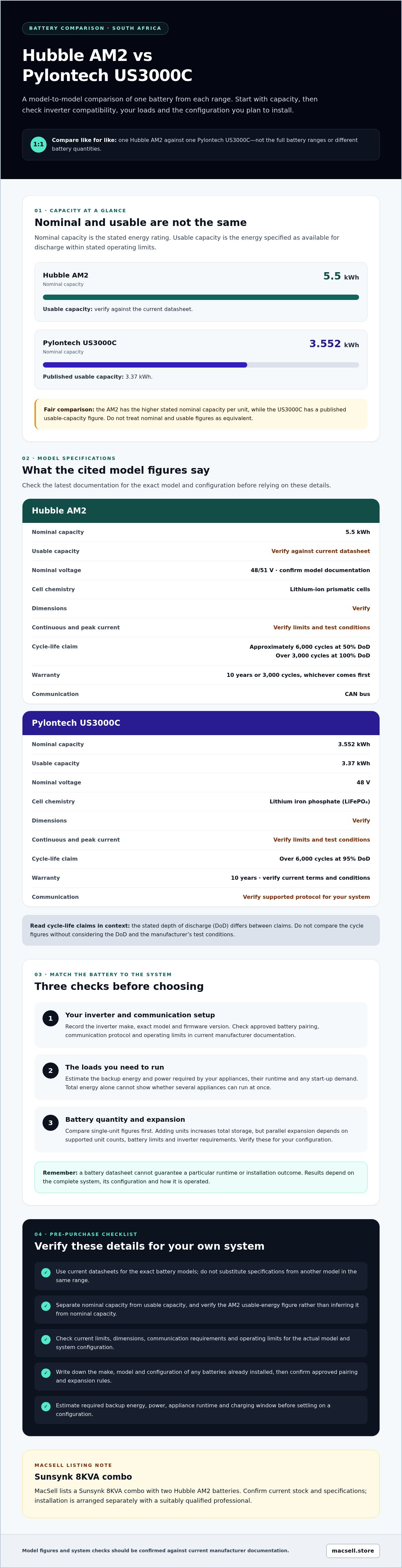
A pre-purchase checklist for choosing between the batteries
Use this checklist to turn the Hubble Lithium vs Pylontech US3000C comparison South Africa into a decision for your system. Record the details and confirm them against current manufacturer documentation before ordering. A compatible battery brand alone isn’t enough.
- Record your inverter details. Note the make, exact model and firmware version. Include any inverter settings that affect battery communication or operation.
- Document existing batteries. Write down each battery’s exact model, quantity, age if known and how the units are connected. Don’t assume a new battery can be added to an existing bank without manufacturer approval.
- Check the approved pairing. Confirm that the exact battery model appears in the inverter manufacturer’s current compatibility documentation. If it doesn’t, ask the relevant manufacturers to clarify support before purchase.
- Confirm communication requirements. Check the required cable, CAN or RS485 protocol, settings and firmware versions. Similar connectors don’t necessarily mean compatible communication.
- Verify battery limits. Check usable capacity, continuous and peak current conditions, permitted battery count, wiring arrangement and configuration-specific operating limits in the current datasheets.
- Match the whole system to your loads. Compare the planned battery configuration with the appliances you need to run, their power demand, required runtime and available charging window. Don’t choose by headline kWh alone.
- Confirm the order details. Ask the retailer to confirm the exact model name, included accessories, current stock and warranty documentation. Keep the relevant datasheets and compatibility information with your system records.
Compatibility rule: verify the complete battery-inverter combination, including model, firmware, communication setup and configuration, not the battery brand alone.
Datasheets can help establish product limits, but they don’t replace checks of the complete electrical installation. Arrange installation and electrical checks separately with a suitably qualified professional. MacSell sells solar hardware, including a listed Sunsynk 8KVA combo with two Hubble AM2 batteries. It doesn’t provide installation or financing.
To check the listed Hubble hardware, review MacSell’s Hubble AM2 combo. Confirm current stock, specifications and compatibility before ordering.
Where to source Hubble hardware and plan your next step
Make the final choice using system-specific checks, not a brand-level verdict. Confirm capacity against your backup loads, compatibility with your exact inverter, the planned battery configuration, warranty terms and current product supply. In this Hubble Lithium vs Pylontech US3000C comparison South Africa, those checks help turn published specifications into a practical purchase decision.
What MacSell’s confirmed Hubble offering includes
MacSell lists the Sunsynk 8KVA & 2X Hubble AM2 5.5 KWh Combo Kit. It combines a Sunsynk inverter with two Hubble AM2 batteries, but that doesn’t make it the right configuration for every home, inverter setup or backup requirement. Compare the listed hardware with your load and compatibility requirements, and confirm the exact product details and availability with the retailer before ordering. MacSell sells solar hardware; Pylontech US3000C availability is not confirmed.
Final checks before buying either model
Before placing an order, recheck the latest datasheet for the exact battery model and the inverter manufacturer’s compatibility documentation. Confirm usable capacity, current limits, communication requirements, permitted battery quantity and applicable warranty terms. These details can affect whether a battery works with your existing system and whether a planned expansion is supported.
Use this final checklist:
- Capacity: Does the verified usable energy match the loads and runtime you need?
- Compatibility: Is the exact battery approved for your inverter model and firmware?
- Configuration: Are the battery count, wiring arrangement and operating limits supported?
- Warranty: Have you checked the current written terms and conditions?
- Supply: Has the retailer confirmed the exact model, included accessories and current stock?
Arrange installation and electrical checks separately with a suitably qualified professional. A product comparison can guide your hardware choice, but installation requirements must be assessed for your specific system.
Ready to review MacSell’s confirmed Hubble hardware? Browse MacSell Solar Outlet and confirm the product details and availability before purchasing.
Make your battery choice with confidence
The Hubble Lithium vs Pylontech US3000C comparison South Africa comes down to a few system-specific checks: compare usable capacity on a like-for-like basis, confirm the battery is approved for your exact inverter and firmware, and verify the planned battery quantity and configuration. Check current datasheets and warranty terms before ordering. Headline capacity alone can’t confirm runtime or compatibility.
MacSell sells lithium batteries and hybrid inverter hardware nationally in South Africa. Its listed Sunsynk 8KVA & 2X Hubble AM2 5.5 KWh Combo Kit is one Hubble-based option to assess against your system requirements. Confirm current product details and stock with the retailer. The Pylontech US3000C is included in this comparison, but its availability from MacSell isn’t confirmed.
Installation and electrical checks must be arranged separately with a suitably qualified professional. To review the available hardware, browse MacSell Solar Outlet’s solar hardware and confirm that your selected configuration suits your inverter, loads and plans.
Frequently Asked Questions
Is the Hubble AM2 compatible with the Pylontech US3000C?
Not automatically. The Hubble AM2 and Pylontech US3000C are separate battery models, and compatibility depends on the inverter and battery-bank design. Don’t connect or operate them together in parallel unless both battery manufacturers and the inverter manufacturer explicitly approve that exact combination and configuration. Check current compatibility documentation, communication requirements, firmware and operating limits first. If approval isn’t documented, use a supported battery configuration instead.
Which has more usable capacity, the Hubble AM2 or Pylontech US3000C?
The Pylontech US3000C has a specified usable capacity of 3.37 kWh. The Hubble AM2 is listed at 5.5 kWh nominal capacity, but that figure isn’t its confirmed usable capacity. Check the current AM2 datasheet for its usable-energy specification before making a direct comparison. The Hubble Lithium vs Pylontech US3000C comparison South Africa buyers make should compare usable capacity with usable capacity, not nominal capacity with usable capacity.
Can I connect Hubble AM2 and Pylontech US3000C batteries in parallel?
Don’t assume you can connect them in parallel. Different battery models may use different BMS behaviour, communication protocols and operating limits. A mixed bank requires explicit approval for the exact batteries, inverter, firmware and wiring arrangement from the relevant manufacturers. Confirm the approved configuration and any restrictions in current documentation before buying or connecting equipment. If the mixed setup isn’t supported, don’t treat parallel connection as an expansion option.
How do I check whether my inverter supports the Pylontech US3000C?
Check the inverter manufacturer’s current approved battery list for the exact US3000C model and your inverter’s full model number. Then confirm the required firmware, communication protocol, cable and settings. Compatibility can depend on the specific inverter version, so a general statement that an inverter supports Pylontech batteries may not be enough. If the pairing isn’t listed, ask the inverter or battery manufacturer to confirm support before ordering.
Is Hubble AM2 better than Pylontech US3000C for load shedding?
Neither is automatically better for load-shedding backup. The right option depends on the usable capacity supported in your setup, the appliances you need to run, their combined power demand and the required backup runtime. Also confirm inverter compatibility, battery current limits and charging arrangements. Compare current datasheets and size the complete system around your actual loads. A battery’s nominal kWh rating alone can’t confirm how long it will power your chosen appliances.
Does MacSell Solar Outlet install Hubble or Pylontech batteries?
No. MacSell Solar Outlet sells solar hardware, including lithium batteries and hybrid inverters, but doesn’t provide professional installation. Its confirmed Hubble offering includes the Sunsynk 8KVA & 2X Hubble AM2 5.5 KWh Combo Kit; Pylontech US3000C availability isn’t confirmed. Arrange installation and electrical checks separately with a suitably qualified professional, and confirm the exact battery, inverter compatibility, current stock and warranty documentation before purchasing.