

Load Shedding Kit South Africa: 2026 Hardware Procurement Guide
A high-capacity battery is functionally useless if your inverter cannot manage the discharge rate during a Stage 6 blackout. Many homeowners investing in a load shedding kit South Africa find themselves stranded because of mismatched components or misunderstood technical specifications. It's frustrating to watch a system fail under heavy appliance loads despite spending significant capital. You likely want a setup that delivers consistent power without the confusing jargon of KVA versus kW ratings or battery cycle life. We understand that reliability is the only metric that matters when the grid goes dark.
This 2026 hardware procurement guide bridges the gap between complex engineering and practical household application. You'll master the technical requirements needed to build a robust backup system that survives the most demanding schedules. We'll detail the necessary hardware components, including the high-performance synergy between Sunsynk hybrid inverters and Hubble lithium batteries. We also examine versatile options like the LuxPower SNA5000 and Deye systems. This overview of the 2026 technical landscape provides the clarity required to procure a system that provides genuine energy independence and long-term durability whilst avoiding common hardware failures.
Key Takeaways
- Identify the three core pillars of a high-performance load shedding kit South Africa: hybrid inverters, lithium storage, and essential protection gear.
- Distinguish between 5kW and 8KVA hardware configurations to correctly manage essential and non-essential appliance loads during peak demand.
- Evaluate why Hubble lithium batteries are specifically engineered to withstand the high discharge cycles required during Stage 6 load shedding.
- Understand the technical synergy between Sunsynk and Hubble components to ensure system longevity and hardware compatibility.
- Develop a procurement strategy for sourcing authentic hardware from authorised retailers to protect manufacturer warranties and ensure product reliability.
Essential Components of a Reliable Load Shedding Kit
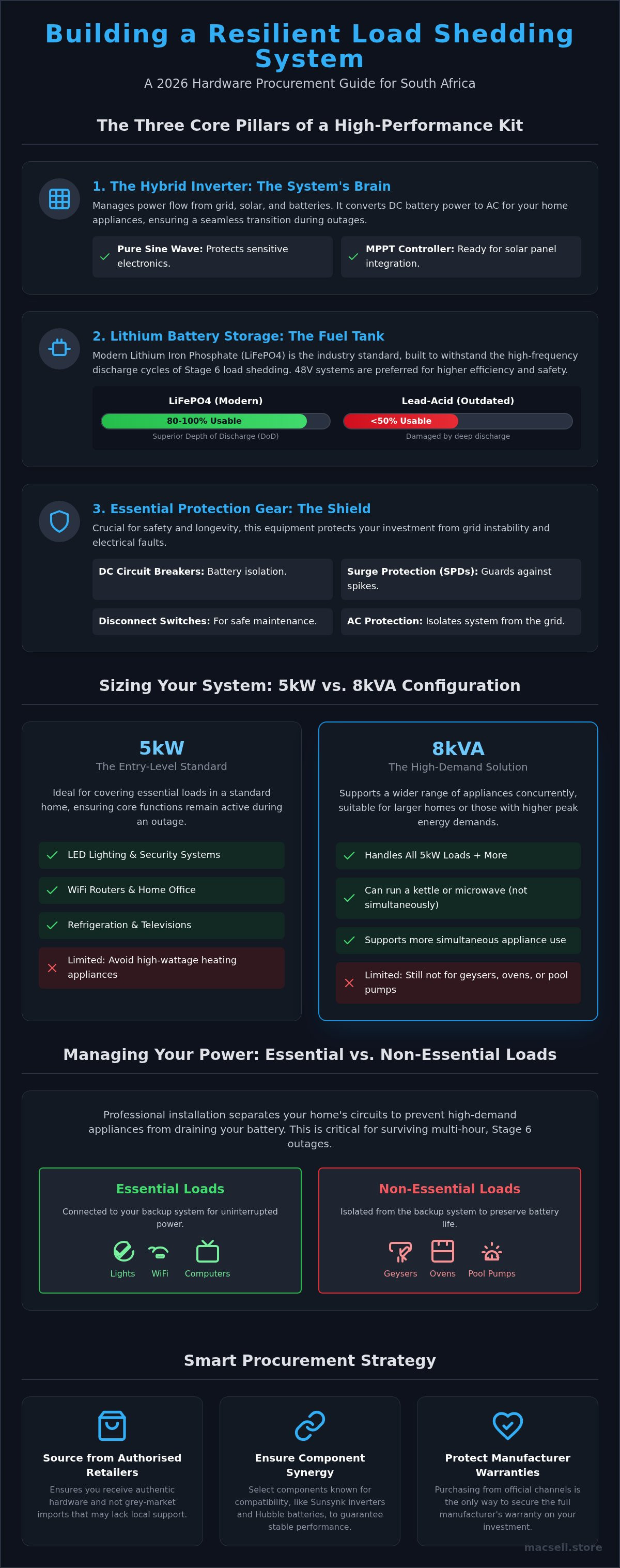
A reliable load shedding kit South Africa is more than a standalone battery; it's a sophisticated power management system. Given the ongoing South African energy crisis, hardware must be selected for high-frequency cycling and seamless integration. The system comprises three primary pillars: the hybrid inverter, lithium battery storage, and specialised protection gear. These components must work in perfect synergy to ensure your household remains powered during Stage 6 events without hardware failure.
Pure Sine Wave technology is a non-negotiable requirement for modern electronics. Standard appliances, including refrigerators, LED televisions, and sensitive computer power supplies, require a clean wave to prevent motor overheating and circuit damage. Whilst basic UPS-style backups are designed for short-term computer protection, a true hybrid system provides sustained power for a full home. It manages multiple energy inputs and ensures that the transition from grid power to battery storage is imperceptible to your devices.
The Hybrid Inverter: Managing Your Power Flow
The inverter acts as the system's brain, converting Direct Current (DC) from batteries into the Alternating Current (AC) required by your home. Modern hybrid units, such as those from Sunsynk and Deye, manage grid, solar, and battery inputs simultaneously. These units feature Maximum Power Point Tracking (MPPT) controllers. This allows for immediate or future solar panel integration without requiring additional hardware. A high-quality hybrid inverter ensures that the battery is charged efficiently from the grid when power is available, ready for the next scheduled outage.
Lithium Battery Storage: The Fuel Tank of Your System
Lithium Iron Phosphate (LiFePO4) technology has replaced outdated Lead-Acid and Gel batteries as the industry standard. LiFePO4 offers a superior Depth of Discharge (DoD), typically allowing users to utilise 80% to 100% of the stored capacity without damaging the cells. In contrast, Lead-Acid units fail rapidly if discharged beyond 50% during frequent Stage 6 rotations. For residential load shedding kit South Africa applications, 48V systems are the preferred architecture. This standard reduces current flow, minimises heat, and improves overall efficiency compared to lower-voltage 12V or 24V alternatives.
Protection gear ensures the long-term safety of your hardware investment. A complete system should include:
- DC Circuit Breakers: Essential for battery isolation and overcurrent protection.
- Surge Protection Devices (SPDs): Guards against voltage spikes when the grid returns after an outage.
- Battery Disconnect Switches: Allows for safe maintenance and emergency shutdown.
- AC Protection: Includes breakers and changeover switches to isolate the backup system from the main municipal supply.
Sizing Your Kit: 5kW vs 8KVA Hardware Configurations
Selecting the correct capacity for a load shedding kit South Africa prevents system trips during peak demand periods. A standard three-bedroom home typically requires between 5kW and 8KVA of inverter capacity depending on concurrent appliance usage. Accurate sizing involves calculating the total wattage of all devices intended to run simultaneously during an outage. The National Energy Crisis Committee (NECOM) roadmap highlights the importance of household investment in independent power to maintain domestic stability whilst the national grid undergoes restructuring.
Professional wiring separates your home's circuits into essential and non-essential loads. Essential loads, such as lights, WiFi routers, and security systems, are permanently connected to the backup system. Non-essential loads, including geysers, ovens, and pool pumps, are isolated to prevent them from draining the battery reserves. This distinction is critical for maintaining power throughout Stage 6 rotations. You can browse various system capacities at MacSell Solar Outlet to find a match for your specific household load profile.
The 5kW Entry-Level Standard
A 5kW system is the baseline for modern residential backup. It handles LED lighting, refrigeration, and home entertainment systems with ease. However, it has distinct limitations. You don't want to run heavy heating elements like kettles or hair dryers on this tier whilst other appliances are active. The LuxPower 5kW Inverter – SNA5000 Hybrid Inverter and Deye 5kW models are industry-leading choices for this configuration. They offer reliable performance for users who prioritise connectivity and basic comfort over high-demand appliance usage.
The 8KVA High-Performance Configuration
Larger households or those requiring a "business-as-usual" experience should opt for the 8KVA standard. This capacity manages heavy surges from microwaves, washing machines, and pressure pumps without triggering overload protection. The Sunsynk 8KVA and Hubble AM2 combo kit is the gold standard for this requirement. It provides superior surge handling for motor-driven equipment and allows for more flexible power usage during extended blackouts.
To calculate your expected runtime, divide the total battery capacity in kilowatt-hours (kWh) by your average hourly load in kilowatts (kW). For example, a 5.5kWh battery supporting a constant 500W (0.5kW) load provides approximately 11 hours of backup, assuming a 100% depth of discharge. Understanding this ratio ensures your load shedding kit South Africa meets your specific endurance needs during the most severe load shedding stages.
Lithium Battery Selection for South African Grid Conditions
Stage 6 load shedding requires hardware capable of enduring up to three discharge cycles within a single 24-hour window. This high-frequency demand renders traditional lead-acid and gel batteries obsolete. A modern load shedding kit South Africa must utilise lithium iron phosphate (LiFePO4) technology to maintain performance over several years. Hubble Lithium batteries are specifically engineered for these local discharge patterns, offering high thermal stability and a cycle life that exceeds 6,000 charges at recommended depths of discharge.
The Battery Management System (BMS) is the critical safety component within any lithium unit. It monitors individual cell voltages, balances charges, and provides protection against over-current and short circuits. For those requiring deep technical specifications on cell architecture and thermal management, our guide on lithium ion solar battery technology provides a comprehensive hardware breakdown. Without a robust BMS, batteries risk permanent damage during the rapid recharging phases typical of Stage 4 and higher.
Capacity vs. Discharge Rate
Discharge rates, often expressed as 1C or 0.5C, determine how much power you can pull from the battery at any given moment. A 1C rating allows a 5.5kWh battery to deliver 5.5kW of instantaneous power. In contrast, a 0.5C rating limits that same battery to 2.75kW. High-surge appliances like kettles require the higher discharge capabilities found in premium units. The Hubble AM2 5.5kWh is a versatile building block for a load shedding kit South Africa. Paralleling multiple AM2 units increases both your total runtime and the available discharge current to support larger household loads.
Inverter-Battery Communication
Hardware synergy depends on active communication between the inverter and the battery BMS via CAN or RS485 protocols. This digital link allows the battery to "tell" the inverter its exact state of charge and temperature. Uncoordinated kits often rely on voltage-based guesses, which lead to premature shutdowns or "BMS Error" codes. Standardised communication ensures the inverter adjusts its charging profile in real-time, which significantly extends the lifespan of the lithium cells. Proper cable termination and DIP switch configuration are essential steps to establish this link and avoid common system faults.
Procurement Strategy: Buying Hardware for Independent Installation
Sourcing hardware from a specialist outlet ensures access to professional-grade components without the markups often associated with full-service installation packages. This direct procurement model allows you to select a load shedding kit South Africa that meets specific technical standards rather than accepting whatever stock a contractor has on hand. You can verify every component against our solar power hardware checklist to ensure no critical protection gear or cabling is omitted from your order.
Authenticity verification is vital for Sunsynk and Deye hardware. Genuine units possess unique serial numbers that must be registered with the manufacturer to activate the warranty. Always check for official branding and intact security seals on the chassis. Sourcing from an authorised retailer guarantees that the hardware is specifically built for the 230V South African grid and complies with the latest NRS 097-2-1 standards. This compliance is essential for legal grid-tie registration before the September 2026 deadline.
Before your electrician arrives, confirm their experience with hybrid inverter programming. Ask if they are registered with the Department of Employment and Labour (DoEL) and if they possess the correct tools for crimping heavy-gauge battery cables. You must also verify that they understand the specific CAN bus communication requirements for Hubble batteries. Proper preparation ensures the hardware is configured correctly the first time, preventing avoidable system faults.
Warranty and Technical Support
Local warranty support is a major advantage of procuring through domestic specialist distributors. International units might lack local repair centres, which leads to weeks of downtime during a failure. Keep your original invoices and serial number stickers in a safe place. These documents are your only leverage for hardware claims. The distributor acts as the technical liaison between the consumer and the manufacturer; they provide a layer of security that "grey market" imports lack.
Future-Proofing Your Load Shedding Kit
A well-designed load shedding kit South Africa should be expandable. Ensure the selected inverter has a high enough PV input voltage to support future solar panel strings. Battery cabinets should have physical space for at least two additional modules. This foresight prevents the need for a complete system overhaul when you decide to move from basic backup to full energy independence. Always select hybrid hardware that is compatible with current 2026 grid-tie regulations to avoid future compliance issues.
You can order premium hybrid hardware directly from our national inventory to begin your backup project.
MacSell Solar Outlet: Your Technical Hardware Partner
MacSell Solar Outlet operates as a specialised national retailer focusing on high-performance hardware for residential and commercial backup. Our inventory features authorised Sunsynk, LuxPower, Deye, and Hubble components. We prioritise technical accuracy and stock availability for users building a custom load shedding kit South Africa. By maintaining a direct, transactional model, we provide hardware-only solutions that respect your technical specifications and procurement timelines. Our national delivery infrastructure is designed to handle the secure transport of heavy-weight lithium batteries and hybrid inverters to your doorstep. We act as a reliable partner for those who understand their power requirements and seek the best tools to achieve energy independence.
Premium Combo Kits for Energy Independence
The Sunsynk 8KVA and Hubble AM2 combo represents the gold standard for South African households requiring high-capacity backup. This specific pairing ensures seamless communication between the inverter and the lithium BMS. For budget-conscious buyers, the LuxPower 5kW Inverter – SNA5000 Hybrid Inverter offers a versatile hybrid platform that supports essential loads whilst maintaining hardware reliability. Hardware-only procurement eliminates hidden service markups often found in bundled installation quotes. This allows you to allocate your budget towards superior components, such as multiple Hubble AM2 5.5 KWh modules, ensuring longer runtimes during Stage 6 events.
Procuring Your Kit Today
Direct hardware sourcing allows for the immediate acquisition of critical stock. This is vital when the national supply chain tightens during severe load shedding stages. You can browse the complete backup power kit South Africa range through our digital inventory to compare technical specifications. Before finalising your inverter and battery selection, verify the following hardware parameters:
- Inverter Capacity: Ensure the 5kW or 8KVA rating matches your calculated peak surge requirements for heavy appliances.
- Battery Compatibility: Confirm the presence of CAN/RS485 communication ports for proper Hubble or Deye integration.
- Protection Gear: Include DC breakers and surge protection devices as part of your core procurement list to safeguard your investment.
- Expansion Potential: Select hybrid models that allow for the addition of solar panels or extra battery modules as your energy needs grow.
By focusing on technical excellence and hardware synergy, you can build a system that outlasts the grid. Visit our inventory to select your components and secure your energy future.
Securing Energy Independence with Professional Hardware
Building a resilient load shedding kit South Africa requires a methodical approach to component selection. Successful systems depend on the technical synergy between high-performance hybrid inverters and lithium storage units. Prioritising authorised hardware from brands like Sunsynk and Hubble ensures your household survives the rigorous demands of Stage 6 cycles without hardware failure. Direct procurement protects your manufacturer warranties and allows for precise control over your system's expansion path.
MacSell Solar Outlet serves as an authorised Sunsynk and Hubble retailer, offering a specialist technical hardware inventory for those who value efficiency and performance. We provide national South African delivery on all heavy-weight components to ensure your project stays on schedule. You can Browse Premium Load Shedding Kits at MacSell Solar Outlet to secure the exact hardware needed for a reliable backup solution. Investing in verified equipment is the most effective way to manage your power needs with professional confidence.
Frequently Asked Questions
What is the best load shedding kit for a standard home in South Africa?
The Sunsynk 8KVA and Hubble AM2 combo kit is the most reliable configuration for a standard three-bedroom home. This setup provides enough surge capacity to handle heavy appliances like microwaves and kettles whilst maintaining essential lights and connectivity. It's the gold standard for a load shedding kit South Africa because it offers hardware synergy that prevents system trips during Stage 6 blackouts. Smaller 5kW systems are suitable for basic backup but lack the headroom for larger households.
Can I run my geyser on a 5kW load shedding kit?
Running a geyser on a 5kW inverter is technically possible but highly discouraged. A typical geyser element draws 3kW to 4kW, which consumes the majority of the inverter's capacity and leaves very little room for other appliances. This often leads to system overloads and rapid battery depletion. For households needing to power heating elements, an 8KVA inverter is the safer technical choice. Alternatively, geysers should be kept as a non-essential load isolated from the backup system.
How long will a 5.5kWh lithium battery last during Stage 6 load shedding?
A 5.5kWh lithium battery provides approximately 11 hours of runtime if you maintain a constant load of 500W. However, during Stage 6 load shedding, where blackout periods can extend to four hours, increasing the load to 2kW will reduce your runtime to less than three hours. You must calculate your average hourly consumption to ensure your battery capacity matches the duration of the scheduled outage. Adding a second 5.5kWh module is recommended for total energy security.
What is the difference between an off-grid and a hybrid inverter?
Off-grid inverters operate independently and cannot feed excess power back into the municipal supply. Hybrid inverters, such as the LuxPower SNA5000 or Sunsynk models, manage grid, solar, and battery inputs simultaneously. They are more efficient for residential use because they can blend power sources to meet demand. Hybrid systems also comply with the latest NRS 097-2-1:2024 standards, which is a mandatory requirement for grid-tied installations in South Africa as of 2026.
Do I need solar panels for a load shedding kit to work?
You don't need solar panels for a load shedding kit to function. The system acts as a high-capacity backup that charges from the grid when electricity is available. However, solar panels are a valuable addition for future-proofing your energy independence. They allow the batteries to recharge during the day even when the grid is down for extended periods. Most hybrid inverters we stock include MPPT controllers, making it easy to add solar panels at a later stage.
Is a Sunsynk inverter better than a Deye inverter for home use?
Sunsynk and Deye inverters share similar hardware architecture and are both highly reputable brands for residential backup. Sunsynk is often preferred in the local market due to its specific firmware and user-friendly interface designed for South African conditions. Both brands offer excellent reliability and communication protocols for Hubble lithium batteries. The choice usually depends on specific feature requirements and current stock availability. Both options provide a robust foundation for any load shedding kit South Africa.
Can I install a load shedding kit myself?
Self-installation is not permitted under South African electrical regulations. You must use a qualified electrician registered with the Department of Employment and Labour to install your hardware. Professional installation is required to obtain a Certificate of Compliance (CoC), which is essential for insurance purposes and legal SSEG registration with Eskom. Since the registration deadline for systems up to 100kVA is September 30, 2026, ensuring your system is professionally certified is a critical step in the procurement process.
What maintenance does a lithium-based load shedding kit require?
Lithium-based systems require minimal maintenance compared to older lead-acid technology. You should ensure the inverter and battery cabinet are kept in a cool, dust-free, and well-ventilated environment to prevent thermal throttling. It's also important to periodically inspect cable terminations to ensure they remain tight and secure. Most modern systems allow you to monitor cell balancing and state of charge via the digital interface, which helps identify any potential BMS issues before they cause a system failure.