

Sunsynk Powerlynk XL all-in-one system review South Africa: buying guide
An all-in-one system can be the wrong fit even when its headline capacity looks right. This Sunsynk Powerlynk XL all in one system review South Africa starts with the practical question: will the system support your essential loads for the backup time you need? The all-in-one format may simplify system planning, but you still need to check the exact model, included components and operating limits.
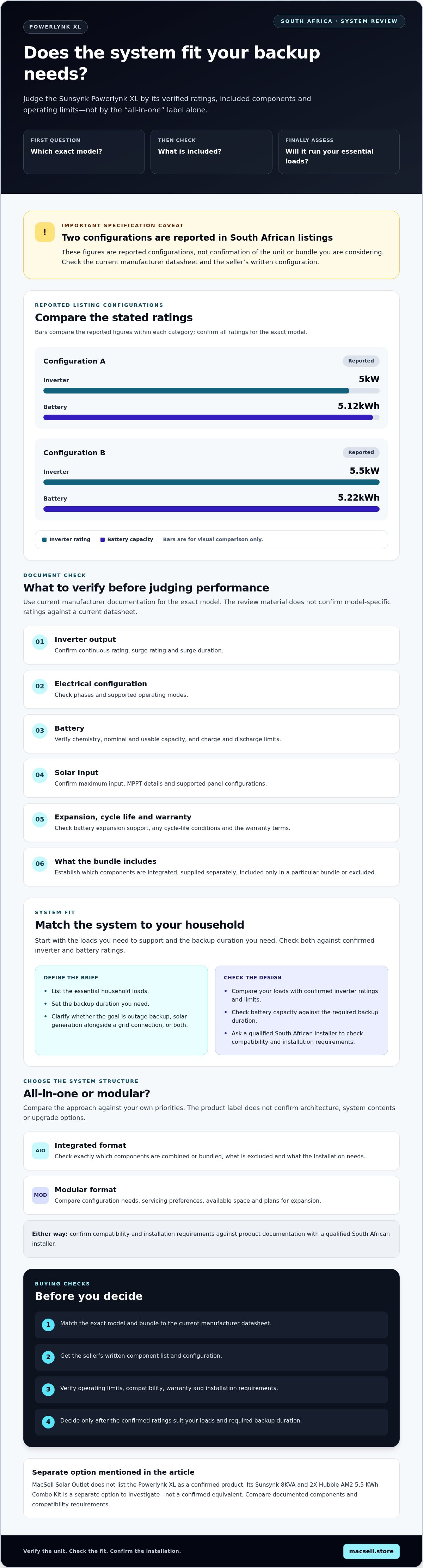
It’s reasonable to expect one clear specification. However, South African listings show two common configurations: a 5kW inverter with a 5.12kWh battery, and a 5.5kW inverter with a 5.22kWh battery. Check the current manufacturer datasheet and the seller’s written configuration before buying, rather than relying on the product name alone.
This guide will help you assess the Powerlynk XL against your household loads and backup requirements, verify its specifications and warranty, and compare an all-in-one setup with a modular alternative. It also covers compatibility, expandability and the installation checks to discuss with a qualified South African installer, so you can decide which system structure suits your plans.
Key Takeaways
- This Sunsynk Powerlynk XL all in one system review South Africa focuses on verified system fit, not the all-in-one label alone.
- Check manufacturer documentation for continuous output, surge ratings, operating limits, warranty terms and the exact components included.
- Compare integrated and modular designs against your available space, configuration needs, servicing preferences and plans for expansion.
- List essential household loads and the backup duration you need, then check these against confirmed inverter and battery ratings.
- Before buying, confirm compatibility and installation requirements using product documentation and a qualified South African installer.
Sunsynk Powerlynk XL all in one system: what the review should establish
Verdict framework: the Powerlynk XL is worth considering only if its confirmed ratings match your household loads and backup requirements. The phrase “all-in-one” doesn’t establish what hardware is integrated, what comes in the box or which additional components the installation needs. A useful Sunsynk Powerlynk XL all in one system review South Africa separates documented product facts from practical implications and details that still need checking.
Start with the current manufacturer datasheet for the exact model, then compare it with the seller’s written bundle description. The available research identifies different configurations in the market, but these details don’t confirm a specific unit. Until you check the documentation, treat ratings, operating limits, included components and warranty terms as unconfirmed. Don’t infer them from the product name or a retailer listing alone.
What does all-in-one mean in a solar backup system?
“All-in-one” generally describes how system components are packaged or combined, but the label doesn’t specify which ones. A system may integrate some combination of inverter, battery and control electronics, or be supplied as a bundle of separate parts. A battery energy storage system (BESS) stores electricity for later use. That category-level description doesn’t confirm the Powerlynk XL’s architecture.
Check the manufacturer’s documentation for the exact model and a component-by-component list. Confirm whether the inverter and battery are integrated, supplied separately or included only in a particular bundle. Check what is excluded and whether configurations differ between listings. Without that evidence, claims about installation simplicity, system contents or upgrade options would be assumptions.
Who should consider reviewing this system?
The system is relevant to buyers comparing integrated hardware for household backup, solar generation or both. Start by defining the goal: keeping selected essential loads running during an outage is a different design brief from using solar generation alongside a grid connection. The system’s confirmed functions and limits must suit its intended use.
Assess the loads you want to support, the backup duration you need and the planned solar and grid arrangement. Then ask a qualified South African installer to check the design and product compatibility against current documentation. Those checks determine whether the system fits; the “all-in-one” label doesn’t.
MacSell Solar Outlet does not list the Powerlynk XL as a confirmed product. Its Sunsynk 8KVA and 2X Hubble AM2 5.5 KWh Combo Kit is a separate option to investigate, not a confirmed equivalent. Compare its documented components and compatibility requirements before choosing between system designs.
Powerlynk XL specifications to verify before judging performance
Performance depends on the exact unit and its documented limits. The available research reports two configurations in the South African market: a 5kW inverter with a 5.12kWh battery, and a 5.5kW inverter with a 5.22kWh battery. Treat these as reported configurations, not confirmed specifications for a particular unit. Check the model and bundle against current manufacturer documentation before relying on either set of figures.
Specification check: no model-specific ratings below are confirmed against a current manufacturer datasheet available for this review. Use the datasheet as the source for the figures you need to assess system fit.
| Specification | What to confirm | Source or status |
|---|---|---|
| Inverter output | Continuous rating, surge rating and surge duration | Verify in current manufacturer datasheet |
| Electrical configuration | Phases and supported operating modes | Verify in current manufacturer datasheet |
| Battery | Chemistry, nominal and usable capacity, charge and discharge limits | Verify in current manufacturer datasheet |
| Solar input | Maximum input, MPPT details and supported panel configurations | Verify in current manufacturer datasheet |
| Expansion and cycle life | Battery expansion support and any cycle-life conditions | Verify in current manufacturer documentation |
Inverter output and supported loads
Continuous output is the power available during normal operation. A peak or surge rating, if specified, applies only under the manufacturer’s stated conditions and for the stated duration. Don’t treat the two ratings as interchangeable. Confirm phases and operating modes too, since these affect how the system can be configured.
Household demand is the combined load running at the same time, not simply the sum of every appliance’s label rating. Motors and other equipment may draw extra power at start-up, so check both running and startup demand against the inverter limits. Have the proposed installation design assessed before deciding which appliances it can support.
Battery capacity, charging and solar input
Nominal capacity isn’t necessarily the amount of energy available to use. Confirm usable capacity, chemistry, permitted charge and discharge rates, and any cycle-life conditions stated by the manufacturer. Runtime depends on usable storage, actual load demand and system operating conditions, so a capacity figure alone can’t predict backup duration.
For solar use, check the maximum solar input, MPPT specifications and permitted panel configurations. Grid-connected systems also require regulatory checks. Review the national regulations for solar installation and confirm project requirements for your connection with the relevant authority.
For a separate hardware option, MacSell Solar Outlet lists its Sunsynk and Hubble combo kit. It is not a confirmed Powerlynk XL equivalent. Check the product details and compatibility before comparing configurations.
Powerlynk XL versus modular solar hardware: which approach fits?
The practical difference is how the system is assembled and how much choice you have over individual components. An integrated design may reduce the number of separately selected units, while modular hardware lets buyers specify an inverter and battery separately. The Powerlynk XL’s actual architecture, footprint and replacement options need confirmation from current manufacturer documentation before they can be compared as product-specific facts.
| Consideration | Integrated system | Separate inverter and battery |
|---|---|---|
| Space and layout | May combine components or package them together; confirm the actual design and dimensions. | Components can be positioned separately, subject to cable, ventilation and installation requirements. |
| Configuration | May offer a defined configuration; check supported modes and included hardware. | Offers a choice of components, but each must be compatible and correctly configured. |
| Servicing and replacement | Ask whether components can be serviced or replaced independently. | A fault may affect one component, but replacements remain subject to compatibility and warranty terms. |
| Future expansion | Check permitted battery additions and system limits; don’t assume expansion is supported. | May allow more component choice, but expansion still depends on inverter, battery and system limits. |
Integrated system or separate inverter and battery?
A buyer who prioritises a defined, coordinated configuration may prefer an integrated approach, provided the documented package matches the required loads. A buyer who wants more choice over inverter and battery models may favour separate components. Neither layout guarantees a smaller footprint or simpler installation: compare actual dimensions, wiring requirements and the proposed installation plan.
Separate hardware can give you more choice if a component needs replacement, but that doesn’t mean any replacement will work. Check warranty conditions, approved pairings and configuration requirements first. For the Powerlynk XL, confirm what can be serviced or replaced independently rather than inferring flexibility from the all-in-one label.
What to check for expansion and compatibility
Before planning an upgrade, ask the manufacturer or supplier to confirm supported battery combinations, parallel operation, firmware requirements and any capacity limits in writing. Check the exact inverter and battery models, communication method and solar-panel input requirements against manufacturer documentation. A panel or battery that appears suitable by headline rating may still be incompatible with the system.
For broader context on battery chemistry and operation, consult a lithium ion solar battery technology guide. MacSell Solar Outlet’s Sunsynk 8KVA and 2X Hubble AM2 5.5 KWh Combo Kit is a separate hardware option to investigate, not a Powerlynk XL equivalent. A Sunsynk 8KVA and Hubble AM2 combo kit technical review can help frame that comparison, but verify the kit’s components and compatibility against its own product information.
How to assess Powerlynk XL suitability for South African household loads
Size the system around the circuits you need to keep running, not the number of appliances in the home. Backup needs vary by household and usage pattern, so no single runtime can be promised from a product name or battery capacity alone. This Sunsynk Powerlynk XL all in one system review South Africa uses a practical check: define the loads, estimate their energy use, set a backup target and compare the result with confirmed system limits.
Create a realistic essential-load list
Separate essential circuits from high-demand or non-essential appliances. Record each essential appliance’s running demand and, where relevant, its start-up demand. Use its rating label or measured data rather than estimating. Note how often and for how long it runs during a typical backup period.
Use this four-step process:
- List essential loads. Include only the circuits you expect to use during an outage.
- Measure demand. Record simultaneous running loads and start-up requirements, especially for equipment with motors.
- Set the backup period. Decide how long those loads need to run and account for actual usage patterns, rather than assuming continuous operation.
- Check system ratings. Compare the resulting power and energy requirements with the exact model’s verified continuous output, surge limits and usable battery capacity.
For a rough energy estimate, multiply an appliance’s power in kilowatts by the hours it runs. Add the essential loads’ estimated energy use, then have the figures checked against the battery’s documented usable capacity and the system’s operating limits. This is a planning method, not a runtime guarantee. Actual performance depends on demand and operating conditions.
Check installation and system design before purchase
Ask a qualified installer to assess the property supply, distribution board, essential-load circuits and proposed system arrangement. Have them confirm the required electrical protection and installation design against applicable South African standards and compliance requirements. A product rating alone doesn’t confirm that the system can be connected as planned.
Before committing, provide the installer with the appliance list, measured demand, target backup period and current product datasheet. Ask them to identify compatibility or design constraints and clarify what documentation is needed for the planned installation. A solar power hardware checklist for South Africa can also help organise component questions, but it doesn’t replace a site-specific assessment.
For a separate equipment-planning step, review solar hardware options and compare product information with your installer’s compatibility requirements. MacSell Solar Outlet sells hardware, not installation services.
Final Powerlynk XL buying checks and hardware next steps
Proceed only when the exact unit, its limits and the proposed installation match your requirements. If you can’t confirm the current manufacturer datasheet or the seller’s bundle description, treat ratings, included components, expansion options and warranty terms as uncertain. A product name or retailer listing isn’t a substitute for written details.
Questions to resolve before placing an order
Ask the seller or manufacturer to confirm the precise model and package contents in writing. Compare that information with the current datasheet and resolve these points before paying:
- Model and bundle: What exact model is supplied, and which inverter, battery, cables and accessories are included?
- Performance and warranty: What are the documented output, storage, operating limits and warranty terms?
- Compatibility: Are the proposed batteries and solar panels supported, and are additional components required?
- Installation plan: Who will design, install and test the system, and what compliance documentation applies?
- Ongoing support: Who handles product queries, warranty claims and technical support after installation?
A qualified South African installer should assess the property and confirm the electrical design, protection and installation requirements. MacSell Solar Outlet sells solar hardware, but doesn’t provide installation, financing or emergency technical support. Arrange those responsibilities separately before ordering.
When to compare another hardware configuration
Compare systems by their verified ratings, component compatibility and ability to meet your required loads, not by brand or the “all-in-one” label. If documentation for the Powerlynk XL remains incomplete, pause until the seller or manufacturer supplies the missing details. A home inverter and battery combo hardware guide can help structure a separate component comparison, but use the specifications for the exact products under consideration.
MacSell’s confirmed Sunsynk 8KVA and 2X Hubble AM2 5.5 KWh Combo Kit is another configuration to investigate, not a Powerlynk XL equivalent. Assess it using its own product information, bundle contents and compatibility requirements. The right choice depends on whether its documented setup suits your design and load needs.
Final check: proceed only when the model and bundle are confirmed, the ratings meet your requirements, compatibility is documented, and installation and support arrangements are clear. To compare available equipment, browse MacSell’s solar hardware range and review the product details before purchase.
Choose your system with confidence
The right backup system matches your essential loads, required backup period and installation plan. This Sunsynk Powerlynk XL all in one system review South Africa highlights the key buying test: verify the exact model, included components, output ratings, usable battery capacity, compatibility and warranty against current manufacturer documentation. If those details aren’t confirmed, pause before treating the system as a match.
Compare integrated and separate-component designs using documented features, not assumptions about flexibility or ease of installation. Have a qualified South African professional check the load assessment, system design and installation requirements before you commit.
MacSell Solar Outlet is a national South African solar hardware retailer. Its confirmed Sunsynk 8KVA and 2X Hubble AM2 5.5 KWh Combo Kit is a separate configuration to consider, not a Powerlynk XL equivalent. MacSell sells equipment and does not provide installation or financing.
Browse MacSell’s solar hardware range and compare product information against your requirements. With the specifications and responsibilities clear, you can make a practical, well-informed choice.
Frequently Asked Questions
What is the Sunsynk Powerlynk XL all-in-one system?
The Sunsynk Powerlynk XL is presented in South African listings as an all-in-one solar and backup system, but confirm the exact unit’s architecture before assuming which components are integrated or included. The term may describe a combined system or a packaged bundle. Check the manufacturer’s current datasheet and the seller’s written contents list to establish whether the inverter, battery and other required components are supplied together.
What are the Sunsynk Powerlynk XL specifications?
Two configurations reported in South African listings are a 5kW inverter with a 5.12kWh battery and a 5.5kW inverter with a 5.22kWh battery. These figures don’t confirm the specifications of a particular unit. In this Sunsynk Powerlynk XL all in one system review South Africa, the key advice is to verify the exact model’s continuous and surge output, usable battery capacity, operating limits, solar input, included components and warranty against current manufacturer documentation.
Is the Sunsynk Powerlynk XL suitable for a home in South Africa?
It may suit a home if the exact model’s verified output and usable storage meet the household’s essential-load demand and backup-duration target. List the circuits you want to support, record their running and start-up demand, then compare those figures with the datasheet. Also check the intended solar and grid configuration, compatibility and installation requirements with a qualified South African professional. The all-in-one label alone can’t establish suitability.
Can the Powerlynk XL run during load-shedding?
It can provide backup during load-shedding only if the specific system is designed, configured and installed to supply the required circuits when grid power is unavailable. Confirm the model’s operating modes, changeover arrangements and supported loads in its documentation. Backup duration depends on usable battery capacity, demand and system conditions, so don’t rely on a fixed runtime estimate without assessing your own loads and design.
How do I size a battery and inverter for household backup?
First identify essential appliances and circuits, then record running power, start-up demand and how long each will operate. Add the simultaneous running loads to assess inverter demand; estimate energy use by multiplying power by operating time. Compare the totals with documented inverter limits and usable battery capacity, allowing for system operating conditions. A qualified installer should check the figures and proposed design before you select hardware.
Can I expand the Powerlynk XL system later?
Don’t assume expansion is supported. Confirm in current manufacturer documentation whether the exact model permits additional batteries, which battery combinations are approved, and whether parallel operation or firmware requirements apply. Ask the seller to confirm compatibility in writing before purchase, including any required additional components. If expansion details aren’t documented for your precise configuration, treat future capacity increases as unconfirmed and plan around the system’s verified limits.
Does MacSell Solar Outlet install the Powerlynk XL?
No. MacSell Solar Outlet sells solar hardware but doesn’t provide installation, financing or emergency technical support. The Powerlynk XL is not listed as a confirmed MacSell offering. Arrange system design and installation separately with a qualified professional, and confirm product supply, compatibility and support responsibilities directly with the relevant seller or manufacturer. MacSell’s confirmed Sunsynk and Hubble combo kit is a separate hardware option, not a Powerlynk XL equivalent.