

Solar Backup for SA Homes: 2026 Hardware Procurement Guide
With Eskom's residential solar capacity hitting 9.1 GW in 2026, is your current hardware actually capable of total grid independence? Most homeowners realise that a basic battery and inverter setup isn't enough to survive the current load shedding stages. You've likely experienced the confusion of trying to match lithium storage with hybrid controllers or the genuine fear of purchasing low-quality grey market units. It's a complex procurement process where compatibility errors lead to expensive system failures. Finding a reliable solar backup for home South Africa requires a technical focus on hardware synchronisation rather than just brand names.
This guide ensures you master the specific hardware requirements for a high-performance 2026 installation. We'll provide the exact specifications needed to choose between Sunsynk, Deye, and LuxPower units with complete confidence. You'll learn how to navigate the March 2026 SSEG registration deadline and select components like the Hubble AM2 that integrate seamlessly with your chosen inverter. We'll break down the technical standards for hybrid systems and the procurement steps necessary for long-term energy resilience.
Key Takeaways
- Identify the critical technical shift from temporary backup to full grid independence when planning a solar backup for home South Africa in the 2026 regulatory environment.
- Evaluate the performance differences between Sunsynk 8KVA and LuxPower SNA5000 hybrid inverters to ensure your system core handles multi-stage load shedding efficiently.
- Recognise Lithium Iron Phosphate (LiFePO4) as the 2026 hardware standard, focusing on high-cycle units like the Hubble AM2 5.5 KWh for long-term storage reliability.
- Determine the correct system scale by matching household load to inverter capacity and integrating high-output solar panels of 450W or greater.
- Secure your investment through direct hardware procurement of premium brands such as Deye, ensuring compatibility and avoiding the technical failures common with low-quality hardware.
The Evolution of Home Solar Backup in South Africa (2026)
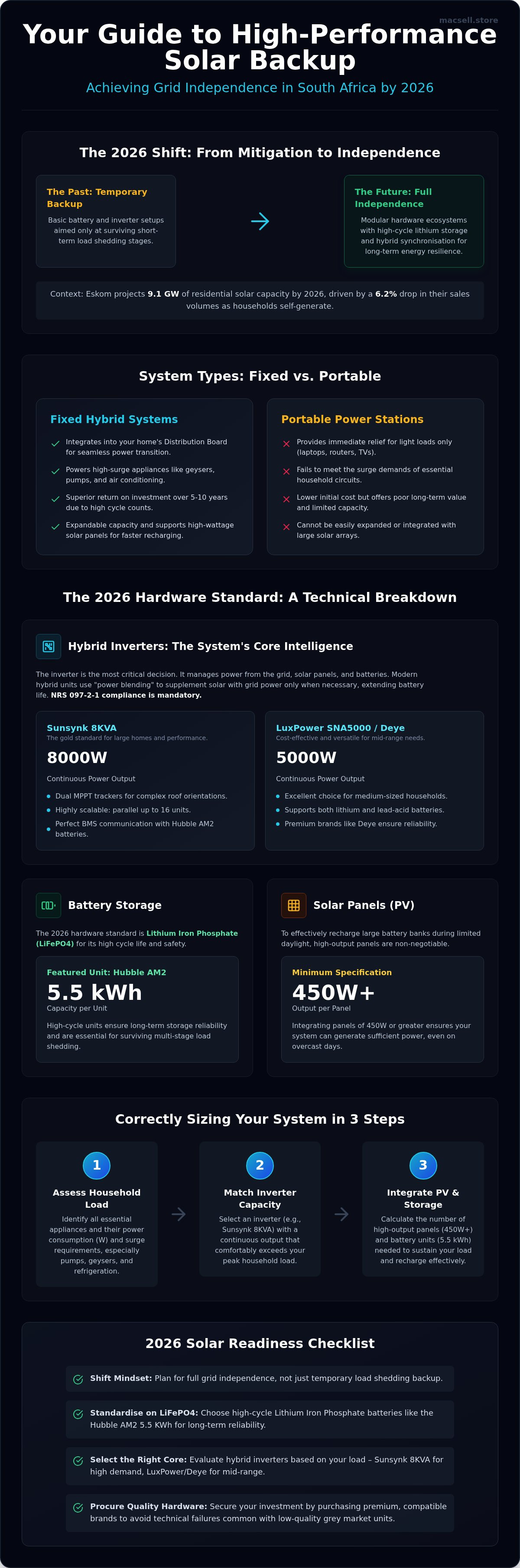
The 2026 residential energy landscape has transitioned from reactive load shedding mitigation to proactive grid independence. Eskom's 2026 financial year data indicates a 6.2% drop in sales volumes; a direct consequence of South African households moving towards self-generation. A reliable solar backup for home South Africa is no longer defined by a temporary battery box but by a modular hardware ecosystem. High-cycle lithium storage and hybrid synchronisation have become the technical benchmarks for system longevity. Hardware reliability is the primary factor in system endurance. Systems using inferior components often suffer from inverter clipping or battery management system (BMS) failures within the first three years of operation.
Fixed Hybrid Systems vs Portable Power Stations
Portable power stations provide immediate relief for light loads like laptops and routers. However, they typically fail to meet the surge demands of essential household circuits such as geysers, air conditioning, or pressure pumps. Fixed hybrid systems integrate directly into the Distribution Board (DB), allowing for seamless transitions between power sources. This integration ensures that high-current appliances remain operational during extended outages. Whilst portable units seem cost-effective initially, fixed hardware offers a superior return on investment over a five to ten year period due to higher cycle counts and expandable capacity. Integrated systems also support the inclusion of high-wattage panels, which is necessary for recharging large battery banks during limited daylight hours.
The Role of Hybrid Technology in Energy Resilience
Modern home energy storage systems rely on hybrid inverters to manage multiple inputs. These units simultaneously coordinate Eskom grid power, solar PV generation, and battery discharge. A critical feature of these systems is "power blending." During low-light periods or high-demand peaks, the inverter draws precisely the required deficit from the grid to supplement solar production. This prevents unnecessary battery drain and keeps the storage bank at optimal voltage levels. Intelligent management extends the lifespan of the storage bank by reducing depth-of-discharge frequency. A hybrid inverter functions as the central intelligence of a solar backup by synchronising power supply with real-time household demand. High-voltage lithium storage further enhances this efficiency by reducing conversion losses during heavy load periods.
Hybrid Inverters: The Technical Core of Residential Backup
Selecting a high-specification inverter is the most critical decision for a resilient solar backup for home South Africa. The inverter manages the conversion of DC power from panels and batteries into usable AC power for your household. In 2026, safety protocols such as Neutral-Earth (N-G) bonding are non-negotiable. Proper N-G bonding ensures that your Earth Leakage protection functions correctly during a grid failure. These technical requirements are influenced by the evolving landscape of South Africa's renewable energy policy, which mandates strict adherence to NRS 097-2-1 standards for all grid-tied systems. Failure to follow these safety standards can lead to hardware damage or voided insurance claims.
Sunsynk 8KVA: Performance and Load Management
The Sunsynk 8KVA remains the primary choice for large residential installations. It delivers 8000W of continuous power, which is sufficient for running high-surge appliances like borehole pumps or large refrigeration units. Its dual MPPT trackers allow for solar arrays on different roof orientations, maximising yield throughout the day. The unit is highly scalable; you can parallel up to 16 inverters for extreme capacity requirements. For many, the Sunsynk 8KVA and Hubble AM2 combo serves as the gold standard for hardware synchronisation. This specific pairing ensures the battery management system (BMS) communicates perfectly with the inverter's charging profile, preventing cell imbalance and extending hardware life.
LuxPower vs Deye: Choosing the Right Hardware
The LuxPower SNA5000 is a cost-effective, versatile hybrid inverter designed for mid-range household requirements. It handles a 5000W continuous load and supports both lithium and lead-acid batteries, though lithium is the 2026 standard. It’s a reliable option for users prioritising essential circuit backup over full-home electrification. The SNA5000 is known for its user-friendly interface and ease of firmware updates.
Deye inverters provide a more robust alternative for environments where heat dissipation is a concern. Deye units feature advanced thermal management systems and often carry higher IP ratings for durability in semi-outdoor environments. They are particularly effective when paired with high-wattage PV inputs, as they can process larger solar yields more efficiently than entry-level hybrids. When matching hardware, ensure your panel array's open-circuit voltage doesn't exceed the inverter's maximum DC input limit. You can view our current inventory of hybrid inverters to find the exact match for your specific load profile and panel configuration.
Lithium-Ion Battery Storage: Ensuring Multi-Stage Resilience
Lithium Iron Phosphate (LiFePO4) is the absolute hardware standard for any solar backup for home South Africa in 2026. Lead-acid alternatives fail under the frequent cycling demands of higher load shedding stages, often losing 50% of their functional capacity within 12 months. Data regarding residential solar market growth confirms that consumers now prioritise long-term cycle life over lower initial costs. LiFePO4 offers superior safety and longevity; typically providing over 6,000 cycles at 80% Depth of Discharge. Accurate communication between the Battery Management System (BMS) and the inverter is vital. This digital link allows the inverter to adjust charging parameters based on real-time cell data, which prevents overheating and ensures balanced cell voltages across the bank.
Hubble Lithium Batteries: Efficiency and Integration
The Hubble AM2 5.5 KWh unit remains a top-tier choice for residential integration. It provides a 1C rating, which means it can discharge its full capacity in one hour if required. This high-current capability is necessary for starting inductive loads like borehole pumps or air conditioning units without triggering a system shutdown. Hubble's Cloudlink integration provides a significant advantage for remote diagnostics and performance tracking. It's an internet-connected gateway that reports battery status to the cloud, allowing for remote firmware updates and troubleshooting. Users can monitor their system's performance via mobile applications, ensuring optimal efficiency and early detection of cell imbalances. For more technical specifics on cell chemistry and thermal management, consult our lithium ion solar battery guide.
Battery Sizing for South African Households
Calculating storage requirements involves distinguishing between base load and peak load. Base load represents the constant power draw of lights, routers, and security systems, whilst peak load includes intermittent high-draw appliances. To survive a 4-hour load shedding window, a 5.5 KWh unit provides the necessary headroom for a typical three-bedroom home. Users should aim for a capacity that keeps discharge levels within safe limits during extended outages. If your backup requirements include high-draw appliances like microwave ovens or kettles, consider a 10 KWh configuration for added resilience. It's a technical fact that 100% Depth of Discharge is a critical feature of Hubble units, permitting full capacity usage without the rapid degradation seen in older technologies. This ensures maximum value from every KWh of purchased storage, allowing for a smaller physical footprint compared to lead-acid banks.
Sizing Your System: Matching Inverter Capacity to Household Load
Sizing a solar backup for home South Africa requires a precise calculation of peak demand versus storage capacity. The 5kW vs 8kW debate is central to this process. A 5kW inverter, such as the LuxPower SNA5000, handles essential base loads including lighting, security, and refrigeration. An 8kW unit like the Sunsynk becomes necessary when your lifestyle includes running high-surge appliances like borehole pumps or geysers during an outage. Efficient design relies on separating essential and non-essential circuits within your DB board. This prevents high-current appliances from accidentally depleting your lithium storage during multi-stage load shedding. Proper circuit organisation ensures your backup remains functional throughout the night.
Determining Your Peak and Base Loads
Base loads are the constant draws that remain active throughout the day. Peak loads represent temporary spikes from "power hungry" appliances like geysers, ovens, and kettles. A standard geyser draws approximately 3000W; this single load consumes 60% of a 5kW inverter's total capacity. The Sunsynk 8KVA manages these high-surge inductive loads with significantly more stability. It provides the necessary headroom for simultaneous appliance operation without triggering overload protection. If you prefer a pre-sized solution, view our backup power kit South Africa options.
Solar Panel Array Configuration
High-efficiency 450W+ panels are the 2026 standard for residential arrays. These modules provide the current required to recharge large battery banks during limited solar windows. You must match your panel string design to the inverter's MPPT voltage range to ensure early-morning start-up and late-afternoon generation. Shading from chimneys, trees, or neighbouring buildings remains a primary cause of system underperformance. Even partial shading on a single module can significantly reduce the output of the entire string. Procuring high-quality solar panels for home use is essential for achieving maximum yield from your roof space.
Balancing PV input with battery charging rates is critical for system longevity. A large array is ineffective if the inverter's charge controller cannot process the incoming current. Conversely, a large battery bank will fail to reach full capacity if the solar array is undersized. We recommend a 1.2:1 ratio of solar panel wattage to inverter capacity. This ensures your system generates enough surplus power to charge your lithium bank whilst simultaneously carrying the household load. You can order high-wattage panels and hybrid inverters directly from our inventory to ensure hardware compatibility.
Procuring Your Solar Hardware: The Direct Retail Advantage
Hardware-only procurement provides DIY enthusiasts and independent contractors with the flexibility to select best-in-class components. Unlike proprietary kits that limit choice, direct retail allows you to pair a Sunsynk inverter with Hubble storage for a customised solar backup for home South Africa. This approach ensures that every component matches your specific load profile and technical requirements. National availability from local stockists reduces lead times and ensures that replacement parts are accessible if needed. Investing in premium brands like Sunsynk, Deye, and LuxPower protects your capital through superior build quality and documented efficiency ratings. Premium hardware ensures longevity.
Why Hardware Specialisation Matters
Unbranded or "white-label" inverters often lack the firmware support required for complex 2026 grid environments. These units frequently suffer from poor battery management system (BMS) integration, leading to premature battery failure. High-end components come with established technical support channels and enforceable warranties. Purchasing from a specialist distributor ensures that the hardware you receive is genuine and intended for the South African market. MacSell Solar Outlet serves as the national source for high-specification hybrid inverter hardware, stocking only verified tier-one brands.
Final Steps: From Procurement to Power
Final integration requires a qualified electrician to manage the AC/DC separation and DB board modifications. Whilst MacSell Solar Outlet provides the hardware, the final on-site configuration must comply with local SANS regulations to ensure insurance validity. Verify all component compatibility protocols before delivery to avoid delays during the setup phase. The Sunsynk 8KVA and Hubble AM2 combo is a proven pairing for rapid deployment, as the communication protocols are pre-verified for 2026 firmware versions. This combination provides a resilient solar backup for home South Africa without the technical hurdles of mismatched hardware.
Final Procurement Checklist:
- Inverter Capacity: Confirmed 5kW or 8kW based on peak load calculations.
- Battery Chemistry: LiFePO4 for high-cycle resilience.
- PV Compatibility: Total panel wattage within MPPT voltage limits.
- BMS Communication: Verified protocol between storage and controller.
- Stock Availability: Local national delivery confirmed for all components.
Securing Your Energy Independence with Tier-One Hardware
Achieving energy resilience requires a technical shift from reactive backup units to a modular, hardware-focused ecosystem. High-cycle lithium storage and hybrid synchronisation are the verified benchmarks for 2026 performance. Prioritising hardware compatibility, specifically the Sunsynk 8KVA and Hubble AM2 pairing, ensures your system manages multi-stage load shedding without the risk of technical failure. Accurate sizing based on your household's peak load remains the most critical step in avoiding system overloads.
Securing a reliable solar backup for home South Africa is a matter of technical precision and the direct procurement of premium components. MacSell Solar Outlet acts as your national distributor for all tier-one hardware, including Deye and LuxPower hybrid inverters. As authorised stockists, MacSell Solar Outlet provides specialised hardware combo kits designed for rapid deployment and long-term reliability. You now possess the technical framework required to navigate the procurement process with absolute confidence.
View our range of Sunsynk and Hubble Solar Backup Hardware to begin your transition to a resilient home energy system. Your path to energy independence starts with the right hardware.
Frequently Asked Questions
What is the best solar backup system for a standard home in South Africa?
A hybrid inverter paired with high-cycle lithium storage is the current benchmark for reliability. For a standard three-bedroom home, the Sunsynk 8KVA & 2X Hubble AM2 5.5 KWh Combo Kit provides the necessary power and storage capacity. This setup handles essential circuits and high-surge appliances like pressure pumps. It represents a reliable solar backup for home South Africa that offers modular scalability for future solar panel integration.
Can I use a hybrid inverter without solar panels initially?
Yes, hybrid inverters function as high-performance UPS systems when used without panels. The inverter draws power from the grid to charge your lithium battery bank during available windows. During load shedding, it switches to the stored energy instantly to keep your circuits active. This "battery-only" approach allows you to secure your power supply immediately and add solar panels later to reduce grid dependency as your budget allows.
How many lithium batteries do I need for a 5kW inverter?
A minimum of one 5.5 KWh lithium battery is required for a 5kW inverter like the LuxPower SNA5000. However, two batteries are recommended to prevent high discharge rates during peak loads. Most 5.5 KWh units support a 1C discharge, but doubling the capacity ensures the system lasts through 4-hour load shedding windows without stressing the cells or reaching critical voltage levels prematurely during heavy usage.
What is the difference between a Sunsynk and a Deye inverter?
Sunsynk and Deye share common hardware manufacturing origins but differ in firmware and interface design. Sunsynk is widely recognised for its advanced software features and extensive local support ecosystem. Deye units are often favoured for their robust thermal management and high-wattage PV input capabilities. Both brands offer high-efficiency hybrid performance, making them the primary hardware choices for a resilient solar backup for home South Africa.
Why should I choose lithium batteries over gel or lead-acid for load shedding?
Lithium Iron Phosphate (LiFePO4) batteries offer significantly higher cycle life and depth of discharge compared to lead-acid or gel. A lithium unit like the Hubble AM2 can handle over 6,000 cycles at 100% discharge. Gel batteries typically fail after 500 cycles if discharged below 50%. Lithium is the only viable 2026 standard for surviving frequent, multi-stage load shedding events without needing to replace your storage bank every year.
Can an 8KVA inverter run a swimming pool pump and a geyser?
An 8KVA inverter can handle both loads, but careful management is required. A standard geyser draws roughly 3000W and a pool pump adds another 750W to 1100W. This leaves approximately 4000W for the rest of the household. Whilst the Sunsynk 8KVA has the surge capacity for these inductive loads, you must ensure your lithium battery bank is large enough to sustain the high current draw during outages.
Is it better to buy a pre-configured solar kit or individual components?
Pre-configured kits are superior for ensuring hardware compatibility and communication synchronisation. Kits like the Sunsynk 8KVA and Hubble AM2 combo are pre-verified for firmware alignment between the Battery Management System and the inverter. Individual components offer more customisation but require technical expertise to ensure the battery and inverter protocols match. Buying a kit reduces the risk of communication errors during the commissioning phase of your installation.
How long will a 5.5 KWh lithium battery last during Stage 6 load shedding?
Duration depends entirely on your constant base load. If your home draws a constant 500W for lights, routers, and a fridge, a 5.5 KWh battery will last approximately 10 hours. However, Stage 6 involves frequent 4-hour outages. If you run high-draw appliances like a microwave or kettle, the duration drops significantly. We recommend keeping loads below 1000W to ensure the battery survives extended multi-stage outages without depletion.