

Solar power for home recording studios in South Africa and backup options
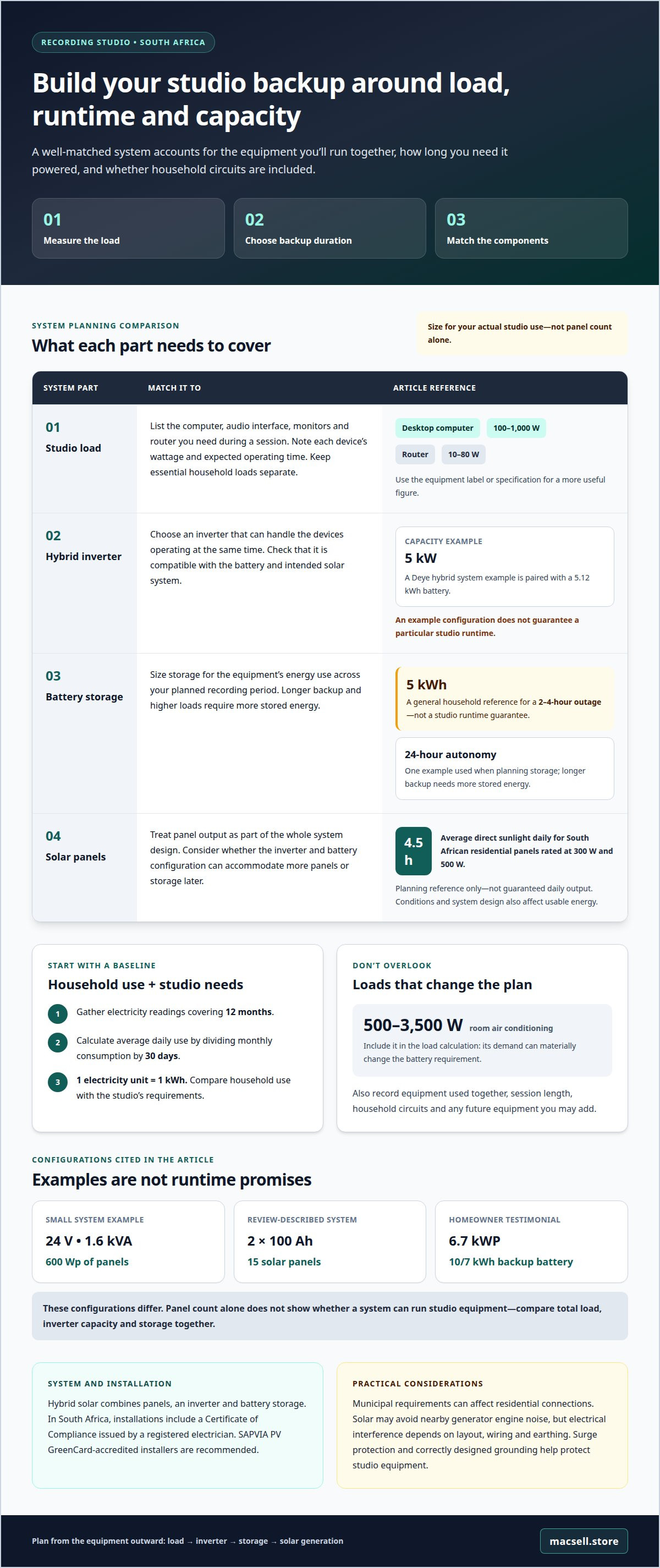
More solar panels aren’t automatically the answer to keeping a recording session running. Solar power for a home recording studio in South Africa needs to account for the equipment’s electricity use and how long you want battery backup to last. For most South African households, a 5 kWh battery is a suggested option for a 2-4-hour outage, but a studio’s requirements depend on its own load and session duration.
Hybrid solar combines panels, an inverter and battery storage to supply power and provide backup when the grid is unavailable. The right balance depends on which studio equipment you need to run, its combined demand and whether you also want to power household loads.
This guide explains how to estimate a studio’s power needs, plan an expandable home system and assess hybrid solar with lithium-ion batteries for backup. You’ll also see which hardware choices can support different system requirements, and where to start when matching components to your setup.
Key Takeaways
- Start by identifying the studio equipment you need to run and how long you want it powered during an outage.
- Plan an expandable system around household electricity use, with room to add capacity as your needs change.
- Match hybrid inverter and lithium-ion battery capacity to your backup priorities, not just the solar panel array.
- Explore compatible panels, hybrid inverters and battery options, including a Sunsynk and Hubble combo kit.
Expandable residential systems
A residential solar PV system can support a recording studio alongside household circuits. Expansion works best when the first design accounts for future equipment and added demand. Begin with electricity readings covering 12 months, then calculate average daily use by dividing monthly consumption by 30 days. One electricity unit equals 1 kilowatt hour (kWh). This gives a practical baseline for comparing household use with studio requirements.
List the equipment that must stay powered during a session, such as a computer, audio interface, monitors and router. Record each device’s wattage and expected operating time. A desktop computer’s general range is 100-1000 watts, whilst a router’s is 10-80 watts. The actual equipment label or specification gives a more useful figure for your calculation. Add essential household loads separately, so the studio’s backup needs remain clear.
South African residential panels rated at 300W and 500W average about 4.5 hours of direct sunlight daily. Treat this as a planning reference, not a guaranteed daily output. Panel output and the system’s usable energy also depend on conditions and design. For expansion, consider whether the inverter and battery configuration can accommodate additional panels or storage later.
Small system examples show why component capacity matters. A listed 24V, 1.6kVA home system has 600Wp of panels. A residential system described in a review included two 100Ah batteries and 15 solar panels. These examples have different configurations; panel count alone doesn’t show whether a system can run studio equipment. Compare total load, inverter capacity and storage together.
South African residential customers use solar PV installers for system design and installation. Payment may be upfront or through a finance arrangement, depending on the provider and purchase terms. Keep hardware selection separate from installation and financing decisions. A staged plan can start with essential studio loads, then add compatible capacity as household consumption or recording requirements change.
A reviewer-described residential system included 2x100Ah batteries; keep that stated configuration distinct from planned additions when assessing storage needs for a future studio setup.
Hybrid solar and battery backup
A hybrid system combines solar panels, an inverter and battery storage. During an outage, the battery can keep selected circuits running. For sensitive studio equipment, choose an inverter that can handle the devices you run at the same time, alongside a compatible lithium battery sized for the session. No single inverter and battery combination suits every studio.
Studio electricity use depends on each device’s wattage and operating time. List the computer, monitors, audio interface and router, then estimate how long each runs during a typical session. Battery capacity should cover their energy use for your planned recording period, while inverter capacity must accommodate the devices operating simultaneously.
A 5 kWh battery is a general household reference for a 2-4-hour outage, not a studio runtime guarantee. Size backup around the studio’s actual load. A 24-hour autonomy period is one example used when planning system storage, but longer backup requires more stored energy.
The cost of solar and battery hardware depends on panel capacity, inverter rating and storage. Compare what each package includes and account separately for installation scope. Grid power relies on utility supply; a generator uses fuel and requires servicing. Their practical reliability depends on supply continuity, fuel access and maintenance.
South African installations include a Certificate of Compliance issued by a registered electrician. Using an installer holding SAPVIA PV GreenCard accreditation is also recommended. Municipal requirements can affect residential solar connections, so the applicable process depends on the property’s municipality.
Solar can reduce reliance on a generator during recording, avoiding engine noise nearby. Electrical interference still depends on system layout, wiring and earthing. Surge protection and correctly designed grounding help protect studio equipment. If the battery fails, backup is unavailable until storage is restored.
For a system matched to studio loads, consider hybrid inverters and lithium batteries alongside solar panels. Component choice should follow the equipment’s simultaneous demand and the recording session’s required backup duration.
For comparison, the page gives a Deye 5kW hybrid solar system paired with a 5.12kWh battery as an entry-point example for medium households. A South African homeowner testimonial describes a 6.7 kWP solar system installed with a 10/7 kWh backup battery, and describes the battery paired with that system as 10/7 kWh. These examples do not guarantee a particular studio runtime.
Lithium-ion battery storage
Lithium-ion storage supplies studio equipment when solar generation falls or grid power fails. Battery capacity, measured in kilowatt hours, indicates how much energy it can store. The useful capacity for recording depends on the equipment running together and the session length. A high-load computer setup and extended session need more stored energy than a short backup for essential equipment.
LiFePO₄, or lithium iron phosphate, is a lithium-ion battery chemistry used in energy storage. Chemistry is only one selection factor: capacity, inverter compatibility and charging limits also matter. Match the battery to the inverter and intended solar system so the components can work together as designed.
For studio computers, monitors, microphones and air conditioning, list each device’s rated power and expected operating time. Add the energy demand for equipment used simultaneously, then size storage for the desired backup period. Include air conditioning in the load calculation: room units have a general wattage range of 500-3500 watts. Its actual demand can materially change the battery requirement.
Solar panels and battery storage work together: panels supply energy when sunlight is available, and the battery stores energy for later use. During a recording session, stored energy can support selected circuits when grid power is unavailable. The panel array must also replenish the energy used, and generation depends on sunlight and system design.
High-quality solar batteries can be expected to serve for approximately 10 years. That makes usable capacity and system compatibility relevant beyond the initial purchase. Battery performance depends on operating conditions and how the complete system is managed. Include studio-critical devices first, then account for household loads sharing the same backup.
For example, a session may require a computer, audio interface and monitors, while air conditioning may be optional. Separating essential from non-essential loads helps prioritise battery capacity. It also clarifies which equipment should remain powered during an outage, rather than sizing storage around every device in the room.
Hybrid solar systems for homes
A hybrid system connects solar panels, an inverter and battery storage to serve home circuits and store energy for later. For a recording studio, its key advantage is combining household generation with backup for selected equipment. Size the system around daily energy use and the loads that must stay powered. Adding a studio to a home changes both calculations, particularly when other appliances run during recording.
Typical South African system ranges vary with household consumption. A small home using 15-20 kWh daily may suit 3-5 kW of solar capacity and 5-10 kWh of battery storage. A medium household consuming 25-40 kWh daily may need 5-8 kW and 10-15 kWh of storage. Homes using more than 40 kWh daily generally require at least 10 kW of solar capacity.
Use household consumption figures as context, not as a studio specification. Planning solar power for a home recording studio in South Africa starts with adding studio use to the home’s daily demand, then identifying which equipment needs backup. A computer, monitors and audio interface may be essential; air conditioning and other household circuits can be prioritised separately. This helps match inverter capacity to simultaneous demand and battery storage to the required backup period.
One listed hybrid home-system configuration combines an 8 kVA inverter, 4880 Wp of solar panels and 10.8 kWh of battery capacity. It illustrates how inverter rating, panel capacity and storage describe different parts of a system. The inverter supports loads, panels generate electricity, and the battery stores it. Compare each figure against household use and studio requirements rather than treating one rating as a complete sizing answer.
For solar power for a home recording studio in South Africa, establish total daily consumption, mark essential circuits, then define the backup duration. Match solar generation to energy use and battery storage to the loads needed after sunset or during outages. A home hybrid solar system can then be assessed as one integrated setup, with studio and household requirements considered together.
MacSell Solar Outlet
MacSell Solar Outlet supplies solar hardware for residential systems that include recording studios, including hybrid inverters, lithium batteries and solar panels. Its pre-configured kits can help when comparing components for studio and household loads.
Available options include solar panels, hybrid inverters and lithium batteries, as well as the Sunsynk 8KVA & 2X Hubble AM2 5.5 KWh Combo Kit. These components address different parts of a system: panels generate power, hybrid inverters manage energy flow, and batteries store electricity for backup. Choose components around your equipment demand, required backup and plans for system expansion.
Before comparing hardware, note which equipment must run together, its power requirements and how long you want backup to last. These details help narrow down relevant options without treating a single component as a complete system.
Explore solar hardware options for your home recording studio at MacSell Solar Outlet.
Plan the next recording session around your power needs
Before choosing equipment, decide which parts of your studio must stay operational during an outage. A session built around a computer and audio interface has different priorities from one that also relies on climate control or additional household circuits. Use your planned recording routine to define those priorities, then match system components to the way you work.
This approach makes solar power for a home recording studio in South Africa a practical design decision, rather than a question of panel count alone. It gives you a clear basis for selecting compatible hardware and accounting for future changes to your studio setup. Keep essential loads and backup priorities in view as you compare options.
MacSell Solar Outlet offers solar hardware options for building a home system around your requirements. Contact MacSell Solar Outlet to explore suitable components for your setup, and take the next step towards a recording space with a considered power plan.
Frequently Asked Questions
Can a home recording studio run fully off-grid or should it use grid-tied solar with backup?
A grid-connected hybrid system with battery backup is a practical option for studios that need outage protection while retaining grid power. A fully off-grid setup can work when its panels and battery storage meet the studio’s energy needs, including periods without sufficient solar generation. The choice depends on how much independence you need and whether you can plan recording sessions around stored energy.