

Sunsynk 8KVA Hubble AM2 Combo: Technical Procurement and Hardware Guide
Relying on a standard 5kVA system is no longer enough for South African households running boreholes, geysers, and modern kitchens during stage 6 load shedding. You need a robust solution that handles high surge loads without constant tripping. The Sunsynk 8KVA Hubble AM2 combo has emerged as the definitive hardware choice for those demanding total energy independence. It's a pairing that solves the frequent headache of brand incompatibility whilst delivering the high discharge rates required for heavy appliances. This technical pairing represents a reliable market standard for high-capacity residential power.
We understand that configuring advanced power electronics can be a minefield of confusing BMS settings and technical hurdles. This guide simplifies the procurement process by focusing on the exact hardware specifications you need for a successful, long-term setup. You'll master the integration requirements and technical parameters of the Sunsynk 8KVA and Hubble AM2 pairing. We cover everything from maximum DC input and 1C discharge rates to the critical SSEG registration deadlines that every South African system owner must meet by 30 September 2026 to ensure full legal compliance.
Key Takeaways
- Evaluate the 8000W continuous power metrics of the Sunsynk inverter to ensure your system handles high-draw appliances like geysers and borehole pumps.
- Understand the technical configuration of CAN-bus communication between the Battery Management System and the inverter for automated hardware protection.
- Calculate the optimal solar array size required to recharge the Hubble AM2 battery bank whilst simultaneously powering essential household loads.
- Streamline your procurement process by identifying the critical hardware components found in a pre-configured Sunsynk 8KVA Hubble AM2 combo kit.
- Align your hardware selections with South African SSEG regulations to meet the 30 September 2026 fee-waiver deadline for grid-tied systems.
Understanding the Sunsynk 8KVA and Hubble AM2 Synergy
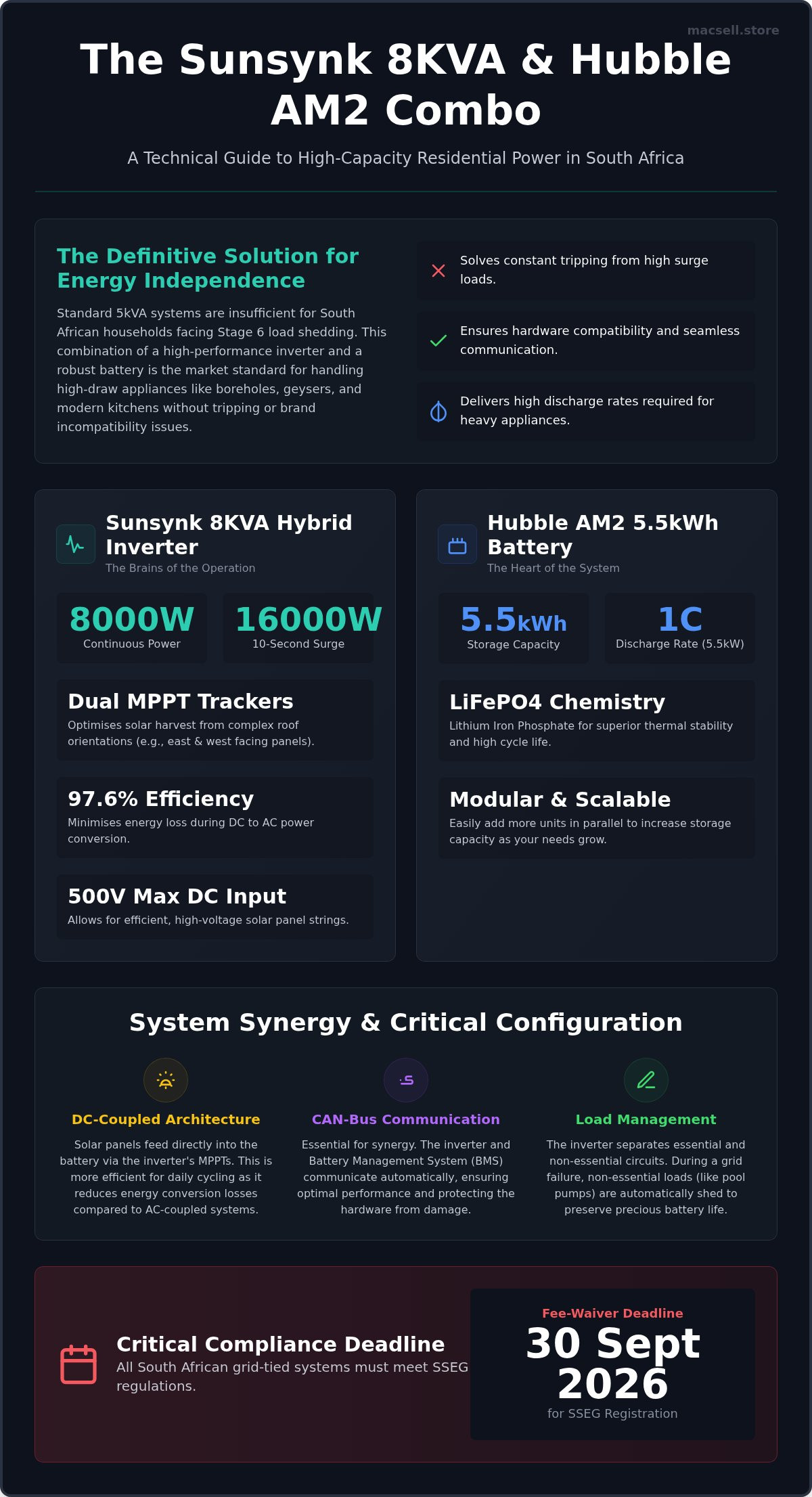
The Sunsynk 8KVA Hubble AM2 combo pairs a high-performance hybrid inverter with a 5.5kWh lithium iron phosphate battery. This specific hardware combination is a benchmark for South African residential energy systems because it balances high power output with long-term hardware reliability. The architecture typically relies on DC-coupled solar storage. In this setup, solar panels feed directly into the battery through the inverter's MPPT controllers. It's more efficient than AC-coupled systems for daily cycling because it reduces energy conversion losses.
Selecting hardware that manages high-surge loads whilst maintaining battery health is critical. The Sunsynk unit handles the heavy lifting, whilst the Hubble AM2 provides the necessary discharge current to support large appliances without triggering protection shutdowns. This synergy ensures the system remains stable during the sudden transitions common with load shedding.
The Role of the Sunsynk 8KVA Hybrid Inverter
The SYNK-8K-SG05LP1-SM2 model provides a continuous power output of 8000W. It's designed to manage heavy household appliances like borehole pumps and geysers that require significant start-up current. The unit utilises advanced solar inverter technology to manage energy flow between the grid, solar panels, and battery bank.
Dual MPPT trackers allow for complex roof orientations. You can mount panels on both east and west-facing roof sections to maximise solar harvest throughout the day. The inverter functions in grid-tied, off-grid, or UPS modes. It adapts to your energy environment, ensuring power continuity even when the national grid fails.
Hubble AM2 5.5kWh: More Than Just Storage
The Hubble AM2 uses LiFePO4 (Lithium Iron Phosphate) chemistry. This chemistry is preferred for its thermal stability and high cycle life. A standout feature is the 1C discharge rate. A single 5.5kWh battery can provide 5.5kW of continuous power. This allows the system to support peak usage periods that would overwhelm batteries with lower discharge ratings.
Growth is built into the design. The AM2 is modular, allowing you to add more units in parallel as your energy needs increase. This scalability is essential amongst South African users who often start with a basic Sunsynk Hubble combo kit and expand their storage capacity later. The hardware ensures that as you add more batteries, the BMS communication remains synchronised for optimal performance.
Technical Specifications and Performance Metrics
The Sunsynk 8KVA Hubble AM2 combo delivers a 8000W continuous power rating. This capacity provides enough headroom to run a standard four-bedroom household, including high-draw items like geysers and kitchen appliances. Inverter efficiency is rated at 97.6%, ensuring minimal energy loss during the DC to AC conversion process. Voltage matching between these components is precise. The Sunsynk 48V architecture aligns with the Hubble AM2 nominal voltage of 51.2V, which facilitates stable charging cycles and efficient energy discharge. Thermal management remains a priority for hardware longevity. The inverter uses active cooling with variable-speed fans to maintain optimal temperatures, even when ambient heat exceeds 40 degrees Celsius in the South African interior.
The Hubble AM2 capacity of 5.5kWh is often considered the sweet spot for residential backup. It provides enough stored energy to cover the base loads of a home—such as refrigeration, lighting, and security—through a standard load shedding window whilst leaving a safety margin. For households with higher consumption, the modular nature of the hardware allows for easy parallel connection. You can scale the storage capacity without needing to replace the core inverter unit. If you are planning a high-performance system, you can order your hardware components to ensure immediate availability for your project.
Inverter Load Management Capabilities
The Sunsynk 8KVA allows for the strict separation of essential and non-essential loads. Essential circuits stay powered during a grid failure, whilst non-essential loads like pool pumps are automatically shed to preserve battery life. The 16000W surge capacity is a critical metric. It provides a 10-second window to manage the high start-up currents required by borehole pumps or air conditioning compressors. The maximum DC input voltage for the Sunsynk 8KVA model is 500V, which allows for efficient, high-voltage panel strings. Adhering to SAPVIA installation standards ensures these electrical limits are correctly configured for safety and compliance.
Battery Cycle Life and Depth of Discharge
The 6000-cycle rating of the Hubble AM2 is a key driver for long-term return on investment. This rating implies over 15 years of daily cycling before the battery reaches its end-of-life capacity. To optimise the lifespan of your lithium ion solar battery, we recommend a Depth of Discharge (DoD) of 80%. Whilst the cells can handle deeper discharges, keeping a 20% reserve significantly reduces chemical stress. The integrated Hubble Cloudlink system provides granular monitoring. It tracks individual cell health and temperatures, preventing premature failure through proactive management of the internal Battery Management System.
Mastering BMS Communication and System Settings
The Battery Management System (BMS) serves as the primary safety layer for your energy storage hardware. It provides automated protection against over-charge, deep discharge, and thermal instability. For a Sunsynk 8KVA Hubble AM2 combo, establishing a digital handshake between the inverter and battery is non-negotiable. This is achieved through CAN-bus communication. By using a standard RJ45 cable, the battery sends real-time data regarding state of charge (SoC), voltage, and temperature directly to the inverter's control logic.
Selecting "Battery Type: Lithium" on the Sunsynk interface is vastly superior to manual "Use Batt" or voltage-based modes. Lithium mode allows the Hubble BMS to dynamically adjust charge parameters. If a cell becomes unbalanced or reaches a temperature limit, the BMS instructs the inverter to reduce current immediately. Manual settings lack this responsiveness, which often leads to reduced cycle life or hardware trips during heavy usage. Troubleshooting communication errors in multi-battery stacks usually begins with dip switch positioning. Each battery in a parallel bank must have a unique address to prevent data collisions on the CAN-bus network.
The Hubble Cloudlink Integration
Operating as a sophisticated gateway, the Cloudlink device facilitates remote hardware management. It connects to the Sunsynk RS485 port and provides a portal for firmware updates, which are essential for maintaining compatibility with the latest 2026 hardware revisions. This integration ensures that your system performance is logged in real-time. This data is often a prerequisite for warranty validation. It allows technical teams to diagnose issues remotely without an on-site visit. The setup requires a dedicated internet connection to maintain the link between the local hardware and the Hubble monitoring cloud.
Optimal Inverter Settings for Hubble Batteries
Configuring charge and discharge limits is vital for protecting the chemical integrity of the AM2 cells. A single Hubble AM2 supports a 100A continuous discharge rate. When using a dual-battery setup, you can increase this limit to 200A to fully utilise the 8kW capacity of the Sunsynk inverter. Setting the low-battery cut-off to 20% provides a necessary buffer during extended load shedding periods, preventing the cells from reaching a critically low voltage state.
Integrated functions on the Sunsynk 8KVA include "Signal Island" and "Zero Export." Signal Island allows the inverter to create a stable microgrid when the main grid is down, whilst Zero Export ensures no power is fed back into the municipal network. This is particularly important for users who haven't yet completed their SSEG registration. Correctly configuring these parameters ensures your system remains compliant with local grid requirements whilst providing seamless backup power.
Sizing Your System: Panels and Battery Parallelism
The Sunsynk 8KVA inverter supports a maximum DC input power of 10400W. To effectively recharge a Hubble AM2 bank whilst simultaneously powering active household loads, the solar array must be sized to exceed peak daytime consumption. A standard configuration for the Sunsynk 8KVA Hubble AM2 combo typically involves between 10 and 16 high-wattage panels. Over-provisioning the solar array is a strategic choice for South African users. It ensures that during overcast weather or shorter winter days, the system still generates enough current to maintain battery health and cover essential circuits without relying on the grid.
Matching high-wattage panels, such as those exceeding 550W, with the Sunsynk MPPT controllers requires careful attention to voltage limits. The inverter's dual MPPT trackers allow for flexible stringing, but each string must remain within the optimal operating window. You can browse our solar panel inventory to find the correct wattage for your specific string configuration.
Solar Array Configurations for the 8KVA Inverter
Efficiency depends heavily on string voltage. The Sunsynk 8KVA MPPT range is 125V to 425V. When using 550W+ panels, stringing 6 to 8 panels in series per MPPT tracker usually keeps the voltage within the sweet spot for maximum conversion. If you are planning a large installation, consult our bulk solar panels South Africa guide for detailed procurement strategies. Shading on even one panel can significantly drop the output of an entire string. The dual-tracker design allows you to isolate different roof orientations, such as North and West, to mitigate the impact of moving shadows or varied roof pitches.
Expanding the Hubble AM2 Battery Bank
Increasing storage capacity requires paralleling multiple AM2 units. Each additional battery requires dedicated 35mm or 50mm DC cables and a set of busbars to ensure equal current distribution. Correct DIP switch settings on the battery front panel are mandatory. These settings allow the BMS to recognise the master and slave units within the communication chain. Balancing the charge is critical. Before connecting a new battery to an existing bank, you must ensure all units are at the same voltage level to prevent massive current surges between batteries.
Determining when to move from a standard backup power kit South Africa to a full off-grid configuration usually depends on your discharge requirements. Whilst one AM2 can handle essential loads, supporting the full 8kW discharge potential of the Sunsynk inverter requires at least two units in parallel. This configuration provides 11kWh of storage and allows for a 200A continuous discharge rate, which is sufficient for running heavy appliances throughout the night.
Hardware Procurement: Buying Your Combo Kit in South Africa
Procuring a complete Sunsynk Hubble combo kit requires a detailed inventory check to ensure all technical components are compatible and present. When ordering your Sunsynk 8KVA Hubble AM2 combo, verify that the package includes the specific RJ45 communication cables required for the CAN-bus digital handshake. Missing DC battery lugs or incorrect mounting brackets can stall a project. A specialised hardware outlet provides the expertise needed to verify these technical nuances before dispatch, ensuring that internal fuses and battery-to-inverter cables match the 8kW power requirements.
Logistics for these systems involve significant weight and safety considerations. The Sunsynk 8KVA inverter weighs approximately 32kg, whilst each Hubble AM2 battery unit is roughly 42kg. National delivery services must use specialised handling for lithium-ion products to prevent internal cell damage during transit. Always inspect the packaging for impact marks before signing for the delivery. Preparing a clear, accessible space for offloading these heavy components is essential for a smooth hardware handover.
The Benefits of Hardware-Only Procurement
Sourcing hardware directly offers substantial cost savings by removing the markups typically applied by full-service firms. You gain full control over the specific hardware revisions used in your system, ensuring you receive the latest 2026 firmware versions. Before purchasing, check the hybrid inverter price South Africa benchmarks to confirm you are receiving competitive market rates. This procurement model allows you to own the hardware outright whilst you organise an independent accredited installer to perform the commissioning.
Warranty and Technical Documentation
Hardware guarantees depend on accurate record-keeping. You must register the serial numbers for both the Sunsynk and Hubble units on their respective national portals immediately after delivery. This step is critical for accessing long-term technical support. A Certificate of Compliance (CoC) from your installer is the most vital document in your technical file. It serves as proof that the hardware was installed according to South African electrical standards. Manufacturers often require a copy of the CoC to validate warranty claims. Ensure all technical manuals and warranty cards are safely stored after the hardware is signed off.
Securing Your High-Performance Energy Future
Integrating the Sunsynk 8KVA Hubble AM2 combo provides a technically superior framework for achieving total South African energy independence. By mastering CAN-bus communication and adhering to 1C discharge parameters, you ensure your hardware operates within its designed performance window. Success in the field depends on precise component matching, ranging from high-wattage panel strings to the correct modular battery parallelism. It's a system built for durability, provided you maintain technical compliance and meet the critical 30 September 2026 SSEG fee-waiver deadline for grid-tied systems.
MacSell Solar Outlet acts as an official Sunsynk and Hubble retail partner, maintaining a specialised solar hardware inventory for immediate procurement. We provide national South African delivery for all our pre-configured kits, ensuring your equipment arrives safely and ready for commissioning by your chosen accredited installer. Browse our Sunsynk 8KVA and Hubble AM2 Combo Kits to secure your system components today. You're now equipped with the technical knowledge to build a reliable, high-capacity power solution that handles the toughest load shedding schedules with ease.
Frequently Asked Questions
Can I use a single Hubble AM2 battery with a Sunsynk 8KVA inverter?
Yes, you can use a single battery, but it restricts the inverter's potential. A single Hubble AM2 has a continuous discharge limit of 100A, which equates to approximately 5kW of power. Since the Sunsynk 8KVA can deliver 8kW, a single battery will trip if you exceed its BMS limit. We recommend a minimum of two batteries for this setup to ensure the hardware handles high-surge appliances without interruptions.
How do I set up the communication between the Sunsynk 8KVA and Hubble AM2?
Setup involves connecting a standard RJ45 cable between the battery CAN port and the inverter CAN port. On the Sunsynk interface, navigate to the battery setup menu and select "Lithium" as the battery type. You must then set the communication protocol to the correct Hubble setting. Ensure the master battery DIP switches are configured correctly so the inverter recognises the BMS data for automated voltage management and hardware protection.
What is the maximum number of Hubble AM2 batteries I can connect in parallel?
You can connect up to 15 Hubble AM2 batteries in parallel using the integrated RS485 communication ports. This allows for a total storage capacity of 82.5kWh. When expanding your Sunsynk 8KVA Hubble AM2 combo, you must use identical battery models and firmware versions. Correct busbar sizing and equal cable lengths are mandatory to ensure even current distribution and prevent premature wear on individual battery cells within the parallel bank.
Does the Sunsynk 8KVA Hubble combo support remote monitoring?
Yes, the system supports comprehensive remote monitoring through several hardware options. The Sunsynk inverter includes a Wi-Fi logger that connects to the Sunsynk platform for basic performance tracking. For deeper technical insights, the Hubble Cloudlink provides cell-level data and remote firmware updates. This feature is standard on the Sunsynk 8KVA Hubble AM2 combo, allowing you to monitor state of charge and solar generation via mobile applications for peak efficiency.
Is the Hubble AM2 compatible with the Sunsynk Cloudlink?
The Hubble AM2 is designed to work with the Hubble Cloudlink, which is the manufacturer's official monitoring gateway. Whilst the question refers to a Sunsynk Cloudlink, it's important to clarify that Cloudlink is a Hubble-specific product. It provides deeper integration than standard Wi-Fi dongles, allowing for remote firmware updates and cell-level health checks. This device ensures your hardware remains compatible with the latest system optimisations whilst maintaining your long-term warranty status.
What solar panel wattage is best suited for the Sunsynk 8KVA MPPT?
High-wattage solar panels between 550W and 620W are best suited for the Sunsynk 8KVA MPPT controllers. These panels allow you to reach the 10400W maximum DC input limit with fewer physical units. Each MPPT tracker handles a specific voltage range, so stringing panels to stay within 125V and 425V is essential. This configuration ensures the inverter reaches its peak efficiency whilst providing sufficient current to recharge the battery bank during daylight hours.
What happens to the Sunsynk 8KVA Hubble combo during a prolonged power outage?
The system continues to provide power by cycling between solar generation and battery storage. If the outage exceeds the battery capacity and solar is unavailable, the inverter will shut down once the low-battery cut-off is reached. The hardware is designed to automatically restart once solar energy becomes available the next morning. This ensures that essential circuits remain functional during long-term grid failures common in the South African energy landscape without manual intervention.
Do I need a special cable for the BMS connection between Sunsynk and Hubble?
A standard straight-through CAT5e or CAT6 RJ45 cable is generally sufficient for the CAN-bus link. You don't usually need a specialised proprietary cable, but you must verify the pinout configuration in the hardware manual. The communication pins on the Sunsynk 8KVA and Hubble AM2 must align for the BMS data to flow correctly. Using a high-quality shielded cable helps prevent electromagnetic interference from the high-voltage DC lines located near the inverter.