

Sunsynk 8kW Inverter Technical Guide: South Africa (2026)
The most expensive mistake in South African solar procurement isn't buying the wrong brand; it's miscalculating the technical tolerances of the hardware you've already chosen. You've likely encountered conflicting datasheets or felt the frustration of trying to pin down exact NRS 097-2-1 compliance details amidst a sea of global marketing fluff. It's a common hurdle when trying to match high-performance lithium batteries with specific inverter outputs. This guide eliminates that uncertainty by providing a definitive breakdown of the Sunsynk 8kW inverter specifications South Africa requires for a stable, compliant, and efficient 2026 energy system.
You'll master the technical parameters and performance capabilities needed to optimise your hardware procurement without the guesswork. We'll examine maximum PV input limits, clarify continuous versus peak discharge rates, and confirm battery compatibility to ensure your hardware investment delivers exactly what the technical manual promises. This is a precision-led look at the core of your residential power strategy. We focus on the data that matters for long-term system reliability and hardware efficiency.
Key Takeaways
- Identify how the Sunsynk 8kW inverter specifications South Africa data applies to your specific inductive loads and continuous power requirements.
- Learn how to leverage the 10400W DC input and the 125V-425V MPPT range to maximise solar harvest through array overclocking.
- Identify critical battery integration standards, including the 190A charge/discharge capacity, for high-performance lithium storage systems.
- Confirm mandatory NRS 097-2-1 grid compliance and integrated safety protocols necessary for legal South African solar installations.
- Evaluate the technical advantages of pre-configured Sunsynk 8KVA and Hubble AM2 combo kits for streamlined hardware procurement and system sizing.
Core Power Specifications: Understanding the 8kW Rating
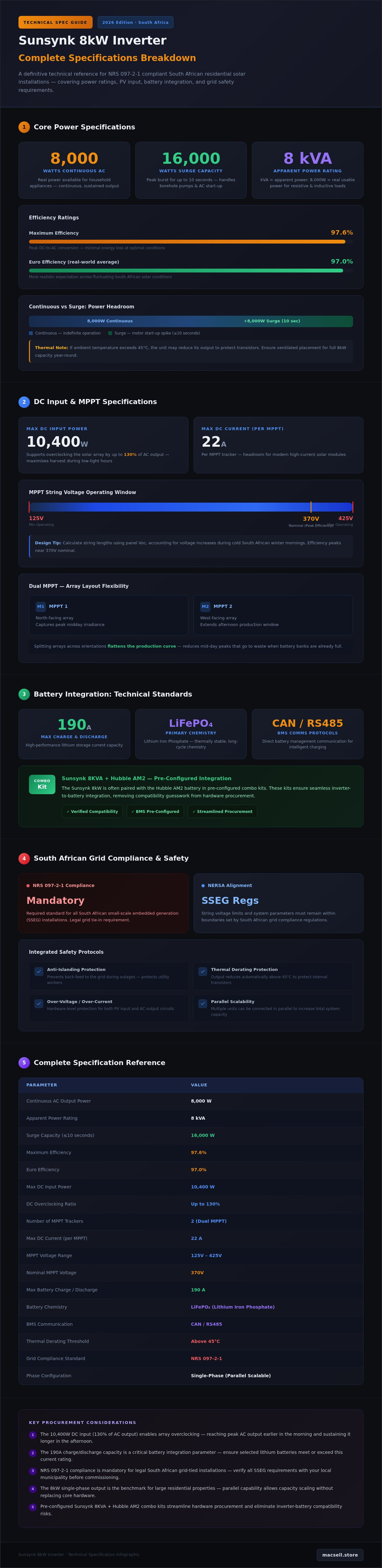
The foundation of any robust solar installation lies in its output capacity. For the Sunsynk 8kW inverter specifications South Africa users must review, the 8000W continuous AC power rating is the primary metric. This value represents the actual work the inverter can perform over an extended duration. There's a technical distinction between the 8kVA rating and the usable wattage. While kVA measures apparent power, the 8000W figure accounts for the real power available to drive household appliances. Inductive loads, such as fridge compressors or power tools, rely on this wattage for stable operation. Understanding these Sunsynk 8kW inverter specifications South Africa requirements ensures your system isn't underpowered for daily demands.
Efficiency is a non-negotiable factor for hardware procurement. This unit features a 97.6% maximum efficiency rating. Its 97.0% Euro efficiency provides a more realistic expectation of performance across fluctuating South African solar conditions. These figures indicate minimal energy loss during the conversion process from DC to AC. High efficiency directly translates to more usable power from your PV array and less heat generation within the unit. This performance is a hallmark of advanced solar inverter technology designed for high-demand environments.
Continuous vs Peak Load Handling
Starting heavy motors requires a temporary burst of energy. The Sunsynk 8kW provides a 16000W surge capacity for up to 10 seconds. This headroom is essential for borehole pumps and large air conditioning units that draw massive current upon startup. Without this surge capability, the system would trip under the pressure of inductive spikes. In a real-world scenario, you can run climate control systems whilst maintaining battery health and powering essential lighting. Heat management is critical for maintaining these ratings. Ambient temperature significantly impacts continuous power output. In South Africa's harsher climates, the inverter's internal cooling system works to prevent thermal derating. If the environment exceeds 45 degrees Celsius, the unit may reduce its output to protect its transistors. Proper placement in a ventilated area ensures you get the full 8kW capacity regardless of the season.
Single-Phase Versatility for South African Homes
The 8kW model is the preferred standard for large residential properties across the country. It offers enough capacity to handle a standard four-bedroom home's peak demand without requiring a three-phase upgrade. For those with higher requirements, the unit's parallel capability allows for scaling. You can connect multiple units to increase total system capacity as your energy needs grow. The 8kW output is the definitive benchmark for residential energy independence in 2026. This hardware is often paired with high-performance storage in a Sunsynk Hubble combo kit to ensure seamless integration between the inverter and the battery bank.
DC Input and MPPT Specifications: Solar Array Planning
The Sunsynk 8kW inverter specifications South Africa requires for 2026 prioritises high DC-to-AC ratios for consistent energy production. With a maximum DC input power of 10400W, this hardware supports "overclocking" the solar array by up to 130%. This allows the system to reach its 8kW AC output peak earlier in the morning and maintain it longer during the afternoon. The dual Maximum Power Point Tracker (MPPT) design is essential for managing complex roof layouts. By splitting the array across North and West orientations, you can flatten the production curve and reduce the mid-day peak that often goes to waste if battery banks are already full. Each MPPT handles a maximum DC input current of 22A, providing the headroom needed for modern, high-current modules.
System designers must ensure that the total string voltage remains within the 125V to 425V operating window. Whilst the inverter can technically function at lower voltages, efficiency peaks when the string voltage sits near the 370V nominal mark. It's vital to calculate string lengths based on the open-circuit voltage (Voc) of your panels, accounting for voltage increases during cold South African winter mornings. Adhering to these parameters ensures your installation remains within the limits set by South African grid compliance regulations for small-scale embedded generation.
Optimising String Voltage for Efficiency
Peak conversion efficiency relies on staying close to the 370V nominal voltage. If your string voltage is too low, the inverter's internal boost converter works harder, which generates heat and reduces overall yield. The start-up voltage is 150V. This means your solar array won't begin delivering power until the combined voltage of the panels hits this threshold. For smaller arrays, this could delay early morning energy harvest. You should aim for a string configuration that stays well above this minimum even under high-temperature conditions when panel voltage naturally drops. If you're looking to scale your system, you can browse our inventory for compatible high-voltage components.
Hardware Compatibility with High-Wattage Panels
The 22A current limit on each MPPT makes the 8kW Sunsynk ideal for pairing with bulk solar panels South Africa retailers currently distribute. High-wattage bifacial modules (550W+) often produce currents that exceed the 13A or 15A limits of older inverter generations. This unit's 22A capacity prevents current clipping, ensuring you capture the full output of bifacial panels even during periods of high albedo. When planning your hardware procurement, always include a 20% safety margin for DC isolators and surge protection devices to handle unexpected atmospheric spikes. Correct hardware selection prevents thermal stress on the MPPT trackers and extends the lifespan of the internal power electronics.
Battery Integration: Technical Standards for Energy Storage
The Sunsynk 8kW inverter specifications South Africa hardware utilizes a low-voltage 48V architecture, operating within a 40V to 60V range. This standard voltage window ensures compatibility with a broad spectrum of lithium-ion and LiFePO4 storage solutions. A standout feature of this model is the 190A maximum charge and discharge current capacity. This high current limit allows for rapid energy transfer, which is essential when recharging large battery banks during short windows of grid availability. Precise communication between the inverter and the Battery Management System (BMS) is handled via dedicated CANBus and RS485 ports. This digital handshake ensures the inverter receives real-time data regarding cell temperature, voltage, and health.
Safety during off-grid operation is managed through the "Signal Island" feature. This internal relay handles the neutral-to-earth bonding required when the system disconnects from the utility. It ensures that your home's earth leakage protection remains functional during power outages, adhering to the safety principles found in the National Energy Regulator of South Africa (NERSA) grid compliance standards. Without this specific grounding protocol, an off-grid system could pose a significant electrical risk to the occupants and the hardware itself.
Pairing with Hubble Lithium Batteries
The technical synergy between Sunsynk and Hubble hardware is a primary reason for their popularity in local installations. When you analyze the Hubble AM2 battery price and its performance metrics, the value of native BMS integration becomes clear. The inverter reads the State of Charge (SOC) directly from the Hubble BMS, providing far greater accuracy than voltage-based calculations. You should configure the Depth of Discharge (DoD) to approximately 80% to 90% to maximise the cycle life of the lithium cells. This precise control prevents the inverter from over-stressing the battery during peak demand periods.
Managing Load Shedding Cycles
Grid instability requires a methodical approach to energy management. The 8kW Sunsynk features a programmable "Time of Use" function with six distinct time slots. You can use these to prioritise solar charging during the day and reserve grid charging for the hours immediately preceding scheduled outages. The 190A charge rate is particularly effective for handling back-to-back load shedding stages. It allows a depleted battery bank to reach full capacity in less than two hours, provided the PV array or grid input is sufficient. This rapid recovery capability ensures your energy storage is ready for the next cycle of instability without relying on slow, trickle-charge patterns.
South African Grid Compliance and Safety Specs
Legal installation in South Africa is impossible without strict adherence to local grid standards. The NRS 097-2-1 certification is the primary requirement for any grid-tied inverter. This standard ensures the Sunsynk 8kW inverter specifications South Africa installers rely on include mandatory anti-islanding protection. This safety feature instantly disconnects the inverter from the grid during a power failure, preventing the dangerous back-feeding of electricity that could harm municipal technicians working on the lines. Without this specific certification, your local municipality won't approve the system for a legal grid connection.
The unit includes a comprehensive suite of integrated protection mechanisms. DC polarity protection prevents damage from incorrect solar string wiring, whilst overcurrent and thermal protection systems monitor internal temperatures and load levels. The hardware carries an IP65 rating. This means the enclosure is dust-tight and protected against low-pressure water jets, allowing for installation in garages or sheltered outdoor locations. It's still advisable to avoid direct sunlight to prevent thermal derating during peak summer temperatures. These safety layers are built into the core architecture to protect both the hardware and the home's electrical infrastructure.
Grid-Tie and Export Limiting
Managing energy flow is essential for compliance in municipalities that don't permit feed-in. The Sunsynk 8kW utilises a Current Transformer (CT) clamp to monitor the flow of electricity at the main incoming breaker. If the system detects power moving toward the grid, it immediately throttles back solar production to match the household's actual consumption. You can configure these zero-export settings directly through the touchscreen interface. In the event of a total grid failure, the internal bypass switch manages the transition to battery power, ensuring essential loads remain active without manual intervention. You can view our full range of compliant hardware to find the right components for your municipal requirements.
Hardware Certification and Standards
The Sunsynk 8kW meets international safety benchmarks, including IEC 62109-1/2 and EN 61000 standards. These certifications guarantee the unit's electromagnetic compatibility and structural safety under high-voltage operation. Proper grounding is a non-negotiable part of the installation process. The inverter must be correctly bonded to the residential distribution board's earth bar to ensure fault currents are safely dissipated. Adhering to these standards is about more than just legal operation; the NRS 097-2-1 certification is essential for maintaining the validity of your household insurance policy in the event of an electrical fire or surge damage. Failing to use certified hardware often results in rejected claims after a system failure.
Hardware Procurement: Combo Kits and System Sizing
The Sunsynk Hubble combo kit represents the most efficient procurement route for 2026 residential projects. By bundling the 8kW inverter with matched Hubble AM2 storage, you eliminate the compatibility risks often found when sourcing disparate components. This combination is engineered to handle the high-current demands of modern South African homes whilst staying within the strict Sunsynk 8kW inverter specifications South Africa mandates for peak performance. Choosing a pre-configured kit ensures that the internal communication protocols and discharge rates are already optimised for the hardware's specific thermal limits. It's a transactional decision that prioritises system uptime and hardware longevity.
The Sunsynk 8kW vs 5kW Comparison
A 5kW system often struggles with the simultaneous operation of high-draw appliances. Whilst a 5kW unit handles lights, routers, and basic refrigeration, it lacks the headroom for geysers, ovens, or pool pumps. The 8kW model provides the necessary capacity to integrate these heavy loads into your backup strategy. It's a matter of future-proofing your investment. A larger inverter allows for easy household expansion, such as adding air conditioning or an electric vehicle charger, without requiring a complete hardware overhaul. You should consult the hybrid inverter price South Africa guide to understand how the 8kW unit's value scales compared to smaller entry-level options. The 8kW output remains the standard for medium-to-large residential properties.
Monitoring and Control via Sunsynk Logger
Management of the 8kW system relies on the Wi-Fi or GPRS data logger hardware. This plug-and-play accessory connects via the inverter's RS232 port and provides a real-time data stream to the Sunsynk cloud. Technical specs include support for remote firmware updates, allowing for performance optimisations without on-site technical visits. The user interface on the mobile application gives you granular control over the six-stage time-of-use settings and battery discharge depths. You can monitor PV production, grid usage, and load consumption from any location, ensuring the system operates within its design parameters. This data-driven approach is essential for maintaining the efficiency of the Sunsynk 8kW inverter specifications South Africa requires for 2026.
A complete hardware procurement list for a 2026 installation includes:
- Core Inverter: Sunsynk 8kW Hybrid Inverter with NRS 097-2-1 certification.
- Storage: High-performance lithium battery bank, such as the Hubble AM2 5.5kWh series.
- PV Array: High-wattage panels totalling up to 10400W DC input.
- Communication: Wi-Fi or GPRS data logger for remote monitoring and BMS integration.
- Switchgear: AC/DC protection boxes with integrated surge arrestors and DC isolators.
- Accessories: CT clamp for export limiting and high-quality battery communication cables.
Securing Your 2026 Energy Independence
Navigating the technical landscape of high-performance solar hardware requires a focus on precision rather than just power ratings. You've mastered the essential Sunsynk 8kW inverter specifications South Africa demands for compliant and efficient operation. From managing the 10400W DC input limit to ensuring seamless communication with Hubble lithium batteries, your procurement strategy is now data-driven. Adhering to NRS 097-2-1 standards isn't just a legal necessity; it's the foundation of a safe and insurable residential power system. These technical parameters ensure your hardware delivers long-term reliability against grid instability.
As an official Sunsynk hardware retailer, MacSell Solar Outlet provides the technical certainty needed for successful solar integration. We offer national South African delivery on all components, including our expert-curated solar combo kits designed for immediate deployment. You can view Sunsynk 8kW inverter hardware at MacSell Solar Outlet to secure the core of your energy strategy. Transitioning to a stable, hybrid power solution is a practical step toward total household autonomy. You're now equipped to build a system that performs exactly as the technical manual promises.
Frequently Asked Questions
Is the Sunsynk 8kW inverter NRS 097-2-1 certified for South Africa?
Yes, the 8kW model is fully NRS 097-2-1 certified. This certification is a legal requirement for any grid-tied installation across South Africa. It ensures the inverter includes mandatory anti-islanding protection to protect municipal technicians during grid outages. Without this specific compliance, you cannot legally connect the unit to the utility grid or apply for municipal feed-in approvals. Always verify the certificate version matches current local regulations before finalising your hardware procurement.
Can I run a borehole pump on a Sunsynk 8kW hybrid inverter?
You can run most residential borehole pumps using this inverter. The unit features a 16000W surge capacity for up to 10 seconds, which is specifically designed to handle the high start-up current of inductive motors. Whilst the 8000W continuous output handles the running load, the surge headroom prevents the system from tripping when the pump engages. Ensure your total household demand doesn't exceed these limits during the pump's start-up phase.
What is the maximum number of solar panels I can connect to the 8kW model?
The total capacity is determined by the 10400W maximum DC input power. If you use standard 550W modules, you can connect approximately 18 to 19 panels depending on the string configuration. It's vital to stay within the 125V to 425V MPPT voltage range and ensure the open-circuit voltage doesn't exceed 500V. This "overclocking" allows the system to maintain its 8kW AC output for longer periods during the day.
Does the Sunsynk 8kW inverter work with Hubble AM2 batteries?
Yes, this inverter is fully compatible with Hubble AM2 lithium batteries. The hardware supports direct BMS communication via CANBus or RS485 protocols. This integration allows the inverter to read accurate State of Charge data directly from the battery cells. We often recommend the Sunsynk 8kW inverter specifications South Africa combo kits that include Hubble storage for guaranteed technical synergy. This pairing ensures the 190A charge/discharge capacity is utilised safely and efficiently.
What happens to the Sunsynk 8kW inverter during a grid failure?
The inverter automatically transitions to "Island Mode" within 10 milliseconds of a grid failure. This rapid switchover functions like a high-capacity UPS, ensuring your essential household loads remain powered via the battery bank and solar array. The internal neutral-to-earth bonding relay engages to maintain safety grounding during the outage. Once the grid returns, the system synchronises with the utility frequency before switching back to standard hybrid operation and recharging the batteries.
Can I parallel two Sunsynk 8kW inverters for a 16kW output?
You can parallel up to 16 units to scale your system's capacity. Connecting two 8kW inverters creates a 16kW continuous output system, which is ideal for large estates or light commercial applications. The units communicate via a parallel cable to balance the load and manage the battery bank as a single energy storage system. This modular approach allows you to expand your power capacity as your household demand grows without replacing the original hardware.
What is the standard warranty period for Sunsynk inverters in South Africa?
The standard manufacturer's warranty for these units is 5 years. This coverage typically applies to the internal power electronics and build quality of the inverter. To maintain the warranty, the unit must be installed according to the manufacturer's technical guidelines and operate within its specified voltage and temperature limits. We recommend registering your serial number on the Sunsynk portal immediately after hardware procurement to ensure your 2026 support lifecycle is correctly documented and active.
Does the 8kW Sunsynk inverter include a built-in DC isolator?
Yes, the 8kW model features an integrated DC isolator switch located on the side of the chassis. This allows for the safe disconnection of the solar array during maintenance or emergency scenarios. Whilst this internal switch provides a primary layer of safety, many South African municipal regulations still require an external DC combiner box with additional surge protection and fusing. Always check your specific local compliance requirements to ensure your total system hardware meets all safety standards.